|
And like this helps the situation.....
| quote: | In response to years of constant bullying, Iran test fires Rockets of Peace
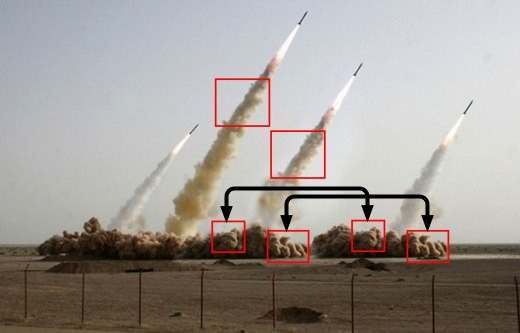
TEHRAN, Iran (CNN) -- Iran has test fired nine missiles in response to what it says are threats from Israel and the United States, according to state-run Iranian media and a U.S. military source.
The Islamic Republic News Agency and Press TV reported that the naval forces of Iran's Islamic Revolutionary Guard Corps Wednesday test-fired a Shahab-3 missile during war games in the Persian Gulf.
The exercise comes a month after Israel conducted a military drill in the eastern Mediterranean involving dozens of warplanes, and the latest Iranian activities prompted concern from Israel and condemnation from the United States.
Iran occasionally tests missiles, but this firing comes amid international tensions over its nuclear aspirations.
"The war game was aimed at improving the combat readiness of Iran's armed forces. The 2,000-kilometers-range Shahab-3 missiles were tested to demonstrate Iran's capability in hitting its enemies accurately at the early stages of their probable attacks against the Islamic Republic. VideoWatch footage of the missiles being fired »
"Domestic and foreign political and military analysts believe that Shahab-3 is able to reach targets in the occupied lands in case of the Zionist regime's probable attacks against Iran's nuclear sites," the Islamic Republic News Agency said.
Iran's Press TV said the military "successfully test-fired new long and mid-range missiles." It mentioned the Shahab 3, "which can hit any target within a range of 2,000km." It said the missile was equipped with a one-ton conventional warhead.
"Nine highly advanced missiles with improved accuracy were simultaneously tested including the Zelzal and Fateh missiles with ranges of 400km and 170km respectively."
Press TV said troops were also involved in the maneuvers in the Persian Gulf and Strait of Hormuz areas.
A U.S. military official with knowledge of the testing counted the firing of seven missiles, one Shahab-3 and six shorter-range ballistic missiles. The testing took place over land, the official said.
The official, who noted that these kinds of tests had occurred before and were not unexpected, said the tests were tracked by U.S. intelligence.
World powers, who suspect Iran is intent on building nuclear weapons, have offered economic and other incentives in exchange for the suspension of its enrichment program.
Iran, which says its nuclear program is strictly to produce energy, defends its right to proceed with enrichment.
There are worldwide worries that Israel, which is concerned by Irans plans, is pondering a unilateral strike.
Israel's recent aerial military exercise was in part an effort to send a message that it has the capability to attack Iran's nuclear program.
The distance involved in the exercise was roughly the same as would be involved in a possible strike on the Iranian nuclear fuel plant at Natanz, a U.S. military official said.
In 1981, Israel attacked a nuclear facility in Iraq. Israel also struck a site in Syria that some say was a nuclear reactor under construction.
One Israeli Cabinet member, Shaul Mofaz, recently said it "will attack" Iran if the nuclear program was not halted.
Last week, the Islamic Revolutionary Guard Corps commander, Gen. Mohammed Ali-Jaafari, said any strike against Iran's nuclear facilities would be regarded a the beginning of war.
At the same time, Iranian leaders are discounting the possibility of war. President Mahmoud Ahmadinejad, in Malaysia this week for a conference, told reporters Iran was trying to prevent a confrontation.
"We are making all-out efforts to expand peace and security in the world. You should not be concerned about a new war," he said on Tuesday.
Mark Regev, spokesman for Israeli Prime Minister Ehud Olmert, said it did not want conflict with Iran.
"But the Iranian nuclear program and the Iranian ballistic missile program must be of concern for the entire International community," Regev said.
The White House reacted strongly to the Iranian test-firing.
"Iran's development of ballistic missiles is a violation of United Nations Security Council resolutions and completely inconsistent with Iran's obligations to the world," said National Security Council spokesman Gordon Johndroe.
Johndroe mentioned that the U.S., Britain, France, Russia, China and Germany "are committed to a diplomatic path, and have offered Iran a generous package of incentives if they will suspend their uranium enrichment activities."
"They should also refrain from further missile tests if they truly seek to gain the trust of the world. The Iranians should stop the development of ballistic missiles, which could be used as a delivery vehicle for a potential nuclear weapon, immediately."
U.S. Sen. John McCain, R-Ariz., the Republican presidential candidate, said the tests "demonstrate again the dangers it [Iran] poses to its neighbors and to the wider region, especially Israel."
"Ballistic missile testing coupled with Iran's continued refusal to cease its nuclear activities should unite the international community in efforts to counter Iran's dangerous ambitions."
McCain supports working with Europe and regional allies to deal with Iran, not "unilateral concessions."
Democratic presidential candidate Barack Obama said he would handle the situation with talks and sanctions.
"Iran is a grave threat. We have to make sure that we are working with our allies to apply tightening pressure economically on Iran at the same time as we start engaging in the kind of direct diplomacy that can lead them to standing down on issues like nuclear weapons."
CNN's Barbara Starr and Elaine Quijano contributed to this report. |
http://www.cnn.com/2008/WORLD/meast...les/index.html
|







 They dont mention how many times both the US and Israel have threatened to attack Irans nuclears facilities,and then when Iran reacts to those threats they are views as a bunch of brainless radicals.


