|
Overclocking 101
Chapter 1: Electronics and Time
All electronics denature over time. The reason for this is, elements in the circuitry oxidize, and perfrom other chemical reactions which cause the circuit to change perfromance. For an example, resistors will increase in resistance over time as the coil inside the resistor becomes less conductive due to oxidation. If this resistor is part of an amplifier circuit, the increase in resistance will increase or decrease the amplification depending on the circuit layout. Due to this phenomenon, all electronic devices will stop working eventually.
Chapter 2: Temperature Effects
Like with many things in nature, temperature changes the rate of reaction in a system. Regarding oxidation, the higher the temperature in the system, the faster the oxidation will occur. The reason is that the higher temperature causes higher molecular motion in the lattice and introduces faster moving oxigen molecules into the system. Each element induces a faster rate of reaction.
Chapter 3: Overclocking
Overclocking increases the CPU clock frequency by multiplying the BASE clock frequency by a multiplier. The BASE clock's freqency never changes. Since the generator never changes, additional heat is not introduced from the generator, but from the remaining components of a processor (90% transistors, 10% other pieces). The higher frequency causes more frequent left and right electron motion due to the increased clock and causing heat to be introdued throught the processor. This causes the lifetime of the processor to decrease.
Chapter 4: Business Strategy
Even though default multipliers could be changed to maximum at production level, this would decrease the liftime of the chips and would not meet the standardized requirements. However, if the multiplier is lowered to a low value, the chips would last too long and would not be financialy sound.
can you tell i'm bored at work?
|


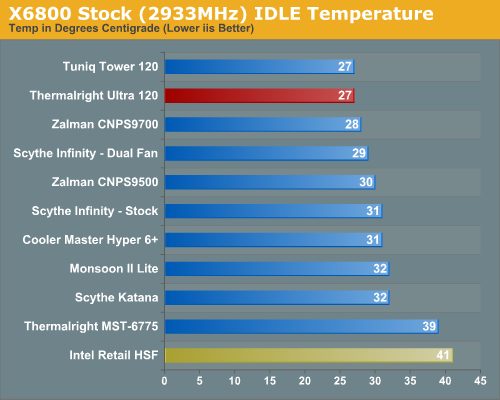
 or the Cooler Master Hyper 212 is a lot better for almost half the price.