 |
|
|
|
 |
Renegade
____________/

Registered: May 2001
Location: Prague, Czech Republic
|
|
|
I think Opus has already covered most of what's needed to be said, but I just wanted to ask a few questions of my own.
| quote: | Originally posted by Krypton
Great demonstration of how assumptions work to prove evolutionary theory. When Pakicetus inachus was first found, all Mr. Gengrich had was a posterior portion of the cranium, two fragments of the lower jaw, and isolated upper- and lower-cheek teeth. Yet, he claimed this creature as the ancestor of the whales, when even with a complete skeleton, there is no link between the creature and whales. Are you going to say that two completely different systems somehow are related, especially when saying a wolf-like animal (relatively small) evolved into a gigantic animal totally suited for life in the open ocean, NOT flaviul riverbed environments. We have hundreds of millions of fossils, and should find no difficulty finding clear relationships between kinds. Pakicetus inachus, even if found in riverbed material does not prove ANYTHING. Evolutionists were declaring this a missing link before a complete skeleton was even found. |
I'm curious as to how you think evolutionary biologists come to the conclusions that they do, Krypton. From what you've been saying here, I get the impression that you think biologists just dig up a load of bones overy now and then, make an appoximate guess as to how old they are, make an approximate guess as to where they fit in the evolutionary tree, give it a name, kick off their shoes, pour themselves a brandy and then spend all evening laughing at the gullibility of the public. I really don't think you appreciate just how much evidence there is (i.e. all the evidence there is), from a variety of scientific fields, to support evolution. Now matter how many idle, misinformed criticisms you raise against it here, there is no other theory that can even come close to explaining the data we find.
For instance, I just typed in "whale evolution" into Google Scholar and got 18,000 results (i.e. 18,000 papers that in some way present evidence related to evolution and whales). From just the first page, I can tell you:
- Mathematical models lend support to the recent speciation of killer whales.
- Observed patterns of paternal care in different species of whales are a reflection of the differing selection pressures facing each of the species during their evolutionary history.
- A new species of "archaeocete" (ancient whale) called "Himalayacetus subathuensis" was recently discovered in India. It dates back 53.5 million years and "has Pakicetus-like molar teeth" (fancy that!) that have "an isotopic composition intermediate between values reported for freshwater and marine archaeocetes, indicating that Himalayacetus probably spent some time in both environments".
- Whales share SINE "genes" with the other species of the "Cetartiodactyla" superorder (whales, pigs, camels, cows etc). "[T]he possibility that the four independent SINE loci diagnosing the hippo-cetacean clade would be inserted at the same site by chance would be on the order of 1 in 10^36" - did you just catch those odds? I'll put it another way: the odds of those species of animal having those genetic sequences without sharing a common ancestor are 1 in 10 trillion trillion trillion.
- The study of nucleotide sequences demonstrates an ancestral link between whales and ungulates (hooved animals) about 60 million years ago and that whales themselves split into 5 unique evolutionary trees about 30-34 million years ago (which, funnily enough, just happens to correspond to what we find in the fossil record).
- The homology (common features due to common ancestry) of 35 individual sections of the whale skull can be demonstrated in the fossil record, going all the way back to our good friend Pakicetus.
This is just one page of evidence (out of 1,800) for the evolutionary origins of just one order of animals. There is no other explanation for this evidence other than common ancestry through natural evolution. If you have an alternative explanation, then I'd like to hear it.
And once you've explained this evidence (I recommend starting with "Cytochrome B Nucleotide Sequences and the Identification of Five Primary Lineages of Extant Cetaceans" and working your way up from there) and before we start on page two of our google scholar results, you can then explain what I see in the first two results I get from typing "whale evolution" into plain old google.
First I get this website, which explains how nine independent fields of scientific enquiry arrive at exactly the same conclusions about the origin of whales:
http://www.talkorigins.org/features/whales/
Could you explain to me why all the available:
- Paleontological evidence,
- Morphological evidence,
- Molecular biological evidence,
- Vestigial evidence,
- Embryological evidence,
- Geochemical evidence,
- Paleoenvironmental evidence,
- Paleobiogeographic evidence and
- Chronological evidence
all point to exactly the same conclusion? Is there any reasonable explanation other than to accept that whales evolved from a common ancestor with pigs, cows and - if we go back far enough - all other life on this planet as well?
Then I get this image, which shows the slow, gradual evolution of whales as preserved in the fossil record:

Could you explain for me:
- Which of these small evolutionary steps, each of which represents the "microevolutionary" progress of a few million years (i.e. about 1,000 times more time than creationists believe it took all 250,000 species of the world's beetles to evolve from just two individual members of beetle "kind"), is simply far too unlikely to have occurred?
- At what point in that tree does whale "kind" become something-else "kind"?
- Why do these species present themselves in exact evolutionary order in the fossil record? Why don't why find any Pakicetus bones in the same layer of sediment that we find Dorudon bones?
- Keeping in mind all the other evidence there is to support whale evolution (genetic etc.) how do you explain the existence of these animals we find here and what is their relationship to modern whales?
Do you see now why questions like:
| quote: | | Can we demonstrate in a laboratory that fully functional land-dwelling animals can evolve into fully functional open-ocean dwelling animals? |
are both irrelevent and extremely stupid?
| quote: | | From my point of view, these so-called transitional fossils are all fully functional animals in their own right whose species is either extinct or living. |
Exactly! The idea of a "transitional" fossil is just a conceit that results from living in the present day. Every species that has ever lived (excepting a few evolutionary dead-ends) is both a fully-functional and transitional species of animal (this includes human beings). We view "Dalanistes", say, as a transitional species between "Pakicetus" and modern whales, but this overlooks the fact the Dalanistes forged out a very successful living for itself in its own right for (possibly) millions of years. By the same token, paleontologists will probably look at our walruses - weird animals that are neither quite perfectly suited to existence on land or on sea - as just another transitional species between bears and whatever new species of aquatic mammal the walrus evolves into by then.
I've already posted this for you about 3 times and I'm going to keep posting it until you acknowledge it and you explain which part of it you're having trouble understanding:
| quote: | Pick one:
1) There is no such thing as a transitional fossil.
2) All fossils are transitional.
As impossible as it may sound, both statements are equally valid, at the same time, dependent only on what you consider a transitional fossil.
It is important to recognize that there is no such thing as a distinct species in nature. Species, races, geni (gena? genii? help me out here guys.) etc. are all concepts defined by humans. Biology presents us with a continuum of ever changing creatures and we just pick certain points on the line of evolution of a "species" and give those different names.
So, there is nothing species about a "transitional fossil". Imagine a color spectrum. There is no real difference between the color red and the color between orange and red. Orange-red is a transitional color that lies between orange and red. But at the same time, orange is a transitional color that lies between orange-red and yellow-orange. The only difference between proper colors and transitional colors is that we defined some to be proper and call the rest transitional.
So, if you are looking for a transitional fossil that's half a fish and half a mammal (to exaggerate), you won't see that. But that is not what evolution predicts. You will see a very long list of fossils starting with fish and after countless generations (well not countless, i just have no idea what the actual number is. Some of the biologists here will be able to tell) you arrive at a mammal. But the step from each generation to the next is very very small, and every generation is a transitional that lies between it's parent and offspring generations. |
| quote: | | I simply cannot ever see how there could not be a Creator. |
And that is why you never will.
EDIT: Oh, just saw this:
| quote: | Originally posted by Krypton
So, how does evolutionary theory suppose how life arose from non-living matter (which has never been documented in a lab)? |
All life is composed entirely of non-living matter - no atom or molecule is "alive". There is no process in our body (including consciousness) that is not entirely the result of chemical interactions taking place in our bodies between "non-living" particles of matter. The line between "life" and "non-life" is not a distinct one: can simple, self-replicating molecules be classified as life? Can viruses? Can bacteria? Where is the line drawn?
There are many theories for the origins of life (none of which can presently be proven, due to the fact that the earliest "living" molecules would have been too small to be preserved in the fossil record), so perhaps you can do some research and tell us which of the natural theories of the origin of life are less likely than the theory that some invisible, incorporeal, omnipresent consciousness from another dimension did just for the hell of it?
___________________
http://eschatonnow.blogspot.com/
Last edited by Renegade on Jul-17-2007 at 17:34
|
|
 Jul-17-2007 16:41 Jul-17-2007 16:41 
|
|
|
|
|
Krypton
83.798 g/6.022x10^23

Registered: Nov 2003
Location: Texas
|
|
|
| quote: | Let's make sure we are speaking the same language before we go any further:
Do you understand the concept of abiogenesis?
Do you understand the concept of biological evolution?
Now, you realize that the former is NOT related to the latter?
I really think this is important for us to get down before we move on. So please respond with your understand of these two when you have a chance.
|
The implications of evolution are abiogenesis no? How could biological evolution ever start? Are you saying that evolution only deals with how animals change over time? Wouldn't the beginning of life fall into biology? So why isn't it relevant?
| quote: | | Are you sure you understand evolution well enough? Do you have any knowledge of what researchers do with methodological naturalism (via the scientific method) that demonstrates the factual basis of a change of allele frequencies in a population over time via the known mechanisms of mutation and natural selection? Because this what appear that you do not. |
You are too smart Let me google allele frequencies. I never denied a diversity in genetics. I denied that diversity in genetics creates new species, i.e., river-dwelling animals turning into 50ft. long whales. Let me google allele frequencies. I never denied a diversity in genetics. I denied that diversity in genetics creates new species, i.e., river-dwelling animals turning into 50ft. long whales.
If the otter was extinct, and we found fossils of it around the globe, do you think evolutionists would toute the creature as a relative of the whale? Simply because it is adapted to life in the water?
| quote: | Hmmm, I see. You do realize that there is a great amount of information that can be told from a skull, right? Let's take an initial look at the Pakicetus skull:
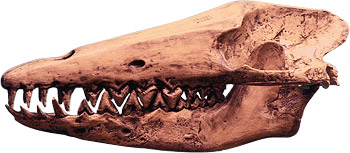
Now compare that to the skull of a modern-day false killer whale:

and now compare to that of a modern german shepherd:
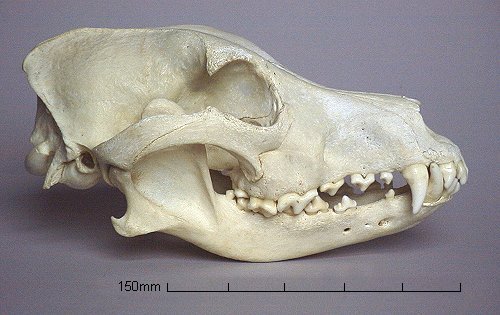
Which one does it look like to you? |
It would be awesome if all three of these skulls were scaled together in size. You would see the whale skull is much larger than both Pakicetus and the dog! A whale calf, specifically orcas are already 180 kg and about 2.4 m long (8 ft). Compare that to the size of dogs and Pakicetus. What a stupid interpretation of a fossil. That a dog-sized creature can turn into a completely different animal that weighs tonnes.
| quote: | | Now if you have peer-reviewed primary literature that supports your claims that Pakicetus is terrestrial only, I'd love to see them. There are most certainly terrestrial features (tympanic membrane, no pressure from pressure changes in the ear, molars similar to mesonychids), but we also have the aquatic features as well (features mentioned previously plus the other teeth similar to later cetaceans like premolars, whale-like sagittal skull crest, narrow braincase, and jaws more elongated) - hence a wonderful transition with a semi-aquatic animal. |
Thank you for even mentioning peer-reviewed literature. I went to my university database and just began reading the peer-reviewed articles on artiodactyls, Pakicetus, whale fossils, etc. I must clarify when I said Pakicetus was a terrestrial creature, I meant it was not an ocean-going animal. I find the consensus is whales somehow came from land, however unclear, I am certainly not qualified to argue against this literature. Something interesting to note, whales seem closer to artiodactyls than mesonychians. What this means?
| quote: | 1. Define "kinds". Be specific in your description
2. What's your point? |
Species which cannot interbreed. We need to document an instance in which a new organism born cannot breed with the same species its parents belong to simply because it is a new species. Where do new species coming from old species begin? Kind of like a, "What came first (chicken or egg?)" arguement.
| quote: | | If we could, that would be a tremendous falsification to evolution. You do understand this concept, right? It's the basic tenet of evolution with the known mechanism of mutation and natural selection. Such mutations combined with the process of natural selection does not simply occur with a "poof!" that delineates in such a drastic manner that you are desperately hoping for to supposedly "prove" evolution. That simply does not occur along such a short timeline. Sorry. |
I would dispute that. Though it may not be a poof, punctuated equilibrium which is commonly excepted would say it takes much less time than millions of years for a new species to arise..
| quote: | In short, punctuated equilibrium is the idea that evolution in many (but not all) lineages has been marked by long periods of stasis, interspersed with relatively brief periods of more rapid change when new species arise. Gould estimated that the period of rapid change when a new species is born accounts for about 1 per cent of its total lifespan. If the average stable lifespan of a species is a few million years, then its period of development--the punctuation--would have lasted a few tens of thousands of years. While that is not long on a geological scale, it is still longer than the history of human civilisation.
Gould and Eldredge proposed punctuated equilibrium as a palaeontologist's view of the history of life: they were describing the palaeontological data available at the time, pointing out that there was no geological evidence to support Charles Darwin's belief that species evolved gradually. Time has shown them to be correct, and their observations are now accepted by most biologists as an accurate account of evolutionary history.
Myers, P.Z. "A short sharp slice of evolutionary history: thirty-five years after they first appeared in print, provoking howls of protest, Stephen Jay Gould's ideas on evolution are as compelling and essential as ever.(Punctuated Equilibrium)(Book review)." New Scientist 194.2603 (May 12, 2007): 54(2). Academic OneFile. Thomson Gale. University of Phoenix. 17 July 2007
<http://find.galegroup.com/ips/infom...nix&version=1.0>. |
| quote: | You do realize that evolutionary researchers are not confined to their laboratories, right?
I'm just curious - how do you personally define "macroevolution"?
And why is the thought of evolution taking so gosh darn long so gosh darn difficult for you to accept? |
Change in offspring whereby they cannot reproduce with their parent species.
| quote: | What was the "assumption" again of evolution that you seemingly keep referring to? I guess I'm a little confused at what you call an "assumption." Are you referring to dating methodology? If so, explain.
Genetics and molecular biology? If so, explain.
Paleontological evidence? If so, explain. |
Assumption 1: changes in morphologies are induced by random mutations on the genome.
Assumption 2: changes in the morphology of plant or animal make the life form either more or less successful in the competition to survive.
Randomness remains as the basic driving force that produces the varied mutations from among which the selection by survival takes place.
I never identified the god I believe in. I identified my belief in a Creator of the universe. Really, it cannot be examined under the normal constraints of science, but rather enters a more philosophical branch like metaphysics. We are constrained to what we can sense and detect. We are limited. I guess what your asking is, "Can we detect a god through scientific instruments?" Detecting god would really mean communication with god, a being said to be outside space-time. We cannot communicate with anything outside of this universe as we're contrained by the laws of physics, but who is to say the god is constrained, which by the very nature of being a god is not constrained. Perhaps the reason religion is so prevalent is this god's attempt to communicate with us. Obviously, we're outside physical science, so using physical science to definately prove an entity exists outside our laws of physics by using the laws of physics is totally not rational. Nothing can be described outside the laws of nature.
| quote: | It doesn't - exactly my point. The concept of abiogenesis (life from non-life) is separate and distinct from evolution (change of allele frequencies in a population over time). Evolution research does not touch abiognesis research, nor should it.
Granted, there might be some similar ideas with abiogenesis (i.e. possible mutation events in amino acids of sorts), but the research albeit very interesting in abiogenesis is both distinctly separate and very incomplete (to the nth degree of incompleteness compared to evolutionary research).
So the comparison of life creation you are creating by lumping these two concepts together and calling them "evolution" versus a theistic involvement of some sort is incorrect on those grounds. |
Isn't evolution trying to document the history of life? So why are we ignoring the very genesis of life itself? You can't escape it. Either life generated itself, or it didn't. What has to be true for evolution to be true?
| quote: | | this is a typical fallacy you find repeated by the theist. it takes the form "life exists, therefore god does". there are innumerable, precise conditions that must have arisen to grant life on planet earth. this does not equal design. who knows how many universes exist/have existed where the parameters were not conducive to life? its the same argument regarding the very particular positioning of earth around the sun, yet theists seem to ignore the billions of galaxies, billions of stars, and presumably, billions of planets. |
Please, read for yourself what the physicists are talking about...
| quote: | | In physics and cosmology, the anthropic principle says that we should take account of the constraints that our existence as observers imposes on the sort of universe that we could observe. Originally proposed as a rule of reasoning, the term has since been extended to cover supposed "superlaws" that in various ways require the universe to support intelligent life, usually assumed to be carbon-based, and occasionally to be specifically human beings. Anthropic reasoning involves assessing these constraints by analysing the properties of universes with different fundamental parameters or laws of physics from ours, and has frequently concluded that essential structures, from atomic nuclei to the whole universe, depend for stability on delicate balances between different fundamental forces; balances which only occur in a small minority of possible universes — so that ours seems to be fine-tuned for life. Anthropic reasoning also attempts to explain and quantify this fine tuning. |
| quote: | | so who created god then? surely a being with as much information as god must therefore have been put together by something else. and who but that being together etc? |
If god was created, the being would not be a god. God, by its very nature is eternal, and has always been described as such.
| quote: | | irrelevant. that's like saying computer don't exist coz they're a recently recent "discovery". |
No idea what you're trying to get at...
| quote: | no, no it doesn't. all it does is make a joke of intellectual debate, by arguing "there appears to be a hole in the theory here, let's place god in that hole". which is un-scientific nonsense. there is no "hole" in creationism simply because there is no proper theory to begin with.
and of course religion doesn't "explain it all". it explains NOTHING. unless you wish to argue that genesis is somehow realistic, there is nothing in any religious text to give us any kind of blueprint for how things were created, and certainly doesn't give us ANY reason to doubt the volumes of scientific evidence that has categorically supported evolutionary theory. |
I am not placing god in transitional holes in the evolutionary timeline... I am stating a notion that complex organisms arise at same time, fully formed into their own phylas. Until you can explain definatively why we are here to observe the universe, philosophy or religion, etc. will continue to be the mode of universal understanding.
| quote: | | When defeated divert attention from the particular topic. If you had read what Opus has posted numerous times, you would've been able to answer your own question. Too bad he's wasting his time on someone who has convinced himself that his point of view is right and there is nothing else to be studied or worth considering. Shame, because Opus is really good at constructing and documenting his arguments; you could've learned something from what he posted. |
We're talking about the history of life. I'm not diverting anything. Opus is probably by far, the most well-informed person on biology here. On specifics like whale evolution, it's hard to argue against him. I even felt compelled to use my university library, where I did find that the consensus was of an evolutionary one. I find it hard to argue against that, in fact I can't. The authors are professors and professionals who have way more knowledge of the subject than I could argue against it. But my fundamental axioms remain the same.
| quote: | | how did god make the world if it has never been documented in a lab???? |
Where talking about it right now aren't we?
Really comes down to the lense we look at science through. The god-lense and the no-god lense. Different visions obviously are going to be seen.
| quote: | Now god is not a "term" krypton would accept. He wants something along the lines of intelligent being. This intelligent being may be mortal too.. he just was sooo fucking smart.. he created the universe out crazy mathematical formulas and experimented and and poof...BIG BANG.
Seriously, why do people need some sense of meaning in their pathetic lives??
U are a living organism! Just fucking live and die. Thats it. U want some sort of afterlife to show that ur insignificant life would be rewarded in a place where there is a load of blow where u can snort all u want and wont die of overdose??? |
Did you decide to come out of the COR? Can't argue against ad hominems and ranting.
___________________

|
|
Jul-17-2007 18:05 
|
|
|
|
|
Lira
Ancient BassAddict

Registered: Nov 2001
Location: Brasilia, Brazil
|
|
|
| quote: | Originally posted by Krypton
The implications of evolution are abiogenesis no? How could biological evolution ever start? Are you saying that evolution only deals with how animals change over time? Wouldn't the beginning of life fall into biology? So why isn't it relevant? |
1) No, evolution has nothing to say about abiogenesis.
2) How could gravity ever start? It doesn't really concern the theory - what science does is analyse observable data and find explanations.
3) Not just animals, but living beings in general. Isaac Newton, for example, knew gravity existed, knew how to predict its impact over things, but couldn't tell exactly where it came from. And it never really bothered him.
4) If we could observe and repeat the origin of life under certain conditions, yeah, it would fall into biology.
5) So far, we haven't been able to see life coming out of anything that wasn't already alive - so far, all we did, was managing to produce organic substances without using any sort of prior "vital force".
___________________
Indiana Clones Upcoming Sets
[ I May Upload Something Someday ]
|
|
Jul-17-2007 18:51 
|
|
|
|
|
MisterOpus1
Grumpy Old Fart

Registered: Dec 2001
Location: Kansas City
|
|
|
Can't talk too much tonight with an exam looming in the morning. I'll cover these points tomorrow afternoon once it's finished. I'll just hit your first quote for now:
| quote: | | The implications of evolution are abiogenesis no? |
Not at all. I hardly talk to any evolutionist that discusses abiogenesis, nor would I expect them to. If you want to go beyond that and discuss primordial soup-type stuff and amino acid formation creating a symbiotic relationship of life (one proposed theory of abiogenesis), you're completely stepping out of evolutionary theory, which again is simply a change of allele frequencies (alleles - gotta have life for that) in a population over time via mutation (i.e. cell mutation) and natural selection.
| quote: | | How could biological evolution ever start? |
I don't know, and I'm completely comfortable saying that simply because we don't have sufficient evidence to say we do know. The further and further you go back, the more difficult the evidence is to obtain for obvious reasons. Since it doesn't touch biological evolution, though, I really can't say.
That's not to say that there are those evolutionary theorists that don't have an opinion on the matter. Quite the contrary - I'm sure you might find some that do. But what they admit (at least what they should admit) is that they simply don't know. The phrase "I don't know" really works well for researchers when there is insufficient evidence to support any hypothetical reasoning.
How often do you hear a creationist say the words, "I don't know"? Personally, I rarely hear it, because more often than not they have a propensity to fill in those unknown gaps with "Godidit." They're welcome to do as they choose, of course, but those fill-ins are not immune to scientific scrutiny.
| quote: | | Are you saying that evolution only deals with how animals change ove time? |
Precisely.
| quote: | | Wouldn't the beginning of life fall into biology? |
The moment it starts and has a chance to mutate and adapt, absolutely.
But not a second sooner.
| quote: | | So why isn't it relevant? |
To summarize:
Life from non-life: evolution cares not a wit
Life surviving in its environment: evolution kicks in.
I'll address the other comments tomorrow.
As for everyone else here who support a particular argument against Krypton, I would ask that you keep a respectful tone from now on (not everyone, just a poster or two). He has demonstrated respect in return, plus from what I've seen he is also willing to take time and research the evidence himself. In the past decade that I have engaged in debates with creationists, seeing someone go out and study the evidence against their own arguments (i.e. read the research from evolutionary researchers) is a rarity. I think that's something worth considering from here on out.
Plus, full disclaimer time - for those that have not known me for all these years, I was once an ardent, hard-core creationist myself prior to enrolling in college (and eventually majoring in cellular biology and a grad degree in physiology). I admit I often times go immediately into attack mode when I see a creationist argument out there, but I'm willing to take a step back and give room to anyone who's willing to examine the data in more detail when questioned (which happened to me when I was confronted with my same arguments way back when).
___________________
Whence September dusk grows crisper still,
with leaves all crimson conquered,
I yearn to shout,
and dance about,
and stick pickles in my honker...
|
|
Jul-17-2007 23:54 
|
|
|
|
|
MisterOpus1
Grumpy Old Fart
Registered: Dec 2001
Location: Kansas City
|
|
|
| quote: | Originally posted by Krypton
You are too smart Let me google allele frequencies. I never denied a diversity in genetics. I denied that diversity in genetics creates new species, i.e., river-dwelling animals turning into 50ft. long whales. |
Why? If the evidence points to that in genetics (which it does), combined with the paleontological/geological, morphological, molecular, embryological, vestigial evidence, on what basis other than your unsupported incredulity?
| quote: | | If the otter was extinct, and we found fossils of it around the globe, do you think evolutionists would toute the creature as a relative of the whale? Simply because it is adapted to life in the water? |
Do you think evolutionary researchers categorize life in the taxonomy based on such silly simplicity as that?
| quote: | | It would be awesome if all three of these skulls were scaled together in size. You would see the whale skull is much larger than both Pakicetus and the dog! A whale calf, specifically orcas are already 180 kg and about 2.4 m long (8 ft). Compare that to the size of dogs and Pakicetus. What a stupid interpretation of a fossil. That a dog-sized creature can turn into a completely different animal that weighs tonnes. |
The point I was making was in regards to the morphological features of the Pakicetus skull versus the whale (killer) and the dog skull. You pointed out below that you are modifying your original premise about Pakicetus being terrestrial. This was why I brought out the features of the skulls to demonstrate the differences between the aquatic mammal versus the terrestrial mammal and which one Pakicetus more closely represents.
As for the size of the critters changing over time, I'm curious as to why this is difficult for you to accept. We are talking about the Eocene era here, where we begin to see the modern-day mammals arise. I'm not sure why you have difficulty accepting that they initially started off rather small (as all life-forms have), but have grown for various reasons to fit their given niche. Again if the evidence from all the combined fields of research point in that direction, why continue with the unfounded skepticism? If a given population of critters has more of an advantage to grow for survival, then they will either do so or they'll go extinct.
And the direction of growth is not one way (i.e. getting bigger), BTW. They can most certainly "shrink", per se. I'm sure a few critters come to mind.
| quote: | | Thank you for even mentioning peer-reviewed literature. I went to my university database and just began reading the peer-reviewed articles on artiodactyls, Pakicetus, whale fossils, etc. I must clarify when I said Pakicetus was a terrestrial creature, I meant it was not an ocean-going animal. I find the consensus is whales somehow came from land, however unclear, I am certainly not qualified to argue against this literature. Something interesting to note, whales seem closer to artiodactyls than mesonychians. What this means? |
Well it's pretty cool, actually, considering that the molecular and DNA evidence was pointing in that direction of the artiodactyls for over a decade prior to the Gingerich findings in 2001 (or at least when their paper was published in 2001). If the evidence points in that direction of them being more related to the modern day hippo versus a wolf, then so be it. When you have genetic and molecular evidence demonstrating it should be in a different lineage and then have the paleontological evidence catch up and confirm that lineage, that's a pretty ideal situation.
| quote: | Species which cannot interbreed.
We need to document an instance in which a new organism born cannot breed with the same species its parents belong to simply because it is a new species. Where do new species coming from old species begin? Kind of like a, "What came first (chicken or egg?)" arguement |
IOW, you want documentation of observed instances of speciation, i.e. new species being formed? Again I ask that you read such documentation here:
http://www.talkorigins.org/faqs/faq-speciation.html
http://www.talkorigins.org/faqs/speciation.html
And these merely scratch the surface.
| quote: | | I would dispute that. Though it may not be a poof, punctuated equilibrium which is commonly excepted would say it takes much less time than millions of years for a new species to arise.. |
Oh heck, I got a good one too:
| quote: | In 1964 five or six individuals of the polychaete
worm, Nereis acuminata, were collected in Long Beach
Harbor, California. These were allowed to grow into a
population of thousands of individuals. Four pairs
from this population were transferred to the Woods
Hole Oceanographic Institute. For over 20 years these
worms were used as test organisms in environmental
toxicology. From 1986 to 1991 the Long Beach area was
searched for populations of the worm. Two populations,
P1 and P2, were found. Weinberg, et al. (1992)
performed tests on these two populations and the Woods
Hole population (WH) for both postmating and premating
isolation. To test for postmating isolation, they
looked at whether broods from crosses were
successfully reared. The results below give the
percentage of successful rearings for each group of
crosses.
WH X WH - 75%
P1 X P1 - 95%
P2 X P2 - 80%
P1 X P2 - 77%
WH X P1 - 0%
WH X P2 - 0%
They also found statistically significant premating
isolation between the WH population and the field
populations. Finally, the Woods Hole population showed
slightly different karyotypes from the field
populations.
Source: J. R. Weinberg et al. 1992. Evidence for rapid
speciation following a founder event in the
laboratory. Science 46(4):1214-1220. |
40 years. And there's bacterial species that can go much, much quicker than that.
Punctuated equilibria, however, also has as one of its primary premises (actually probably THE primary premise) are long periods of stasis. What I'm trying to decifer is your argument of time exactly. Of course there are moments of quicker change within a population that allows the process of mutation and natural selection to take hold. Other points in time there are no opportunistic moments for this. The consequences are the same regardless - a given species population is either doing well in its given environment and continues forward, or it doesn't do well and it either goes extinct or successfully adapts. So is the time still a factor that you are having difficulty accepting or not in these instances? I guess I'm a bit confused on your position.
| quote: | | Change in offspring whereby they cannot reproduce with their parent species. |
That's a very, very, very broad brush to categorize the entire animal phyla. Is this the only means of separation past the species level that you have, or is there more within the kinds, like kinds within the kinds?
Furthermore, how inclusive is your definition of "kinds"?
And how does one aptly describe the noticeable and obvious chronological distribution in our fossil record of plants and animals?
Given the genetic similarities and relationships between different species, how does one explain such similarities and differences with the word "kinds" between species genetically?
These are very difficult questions to answer based on the simplistic category of "kinds", which is why researchers have never used such a term.
| quote: | Assumption 1: changes in morphologies are induced by random mutations on the genome.
Assumption 2: changes in the morphology of plant or animal make the life form either more or less successful in the competition to survive. |
Before we go any further, I want to make sure that based upon your own outside research you still want to stick to these "assumptions".
Again I would like to point to you the links of instances of speciation above. There is no assumption being made in these instances. Here's another example that I like:
| quote: | A single gene gives rise to the mirror-image form of a snail's body plan, which could become established as a different species if mating is prevented between snails of different chirality by genital mismatch1, 2, 3. Here we use molecular phylogeny to demonstrate the parallel evolution of reversal between left and right lineages of the Japanese land snail Euhadra. We find that the different mirror-image forms have evolved in favour of the genetically dominant handedness as a result of single-gene speciation.
Evolution: single-gene speciation by left-right reversal.
Ueshima R, Asami T. Nature. 2003 Oct 16;425(6959):679. |
These guys took a single gene mutation and changed the shell pattern of this snail species. Consequently, the new shell created prevented the snails to mate with their prior species (genitals couldn't reach). It was an event of reproductive isolation taking place.
Another interesting situation is the infamous Nylon Bug:
http://www.nmsr.org/nylon.htm
Another one I like is the first tetraploid rat:
http://www.intl-pag.org/pag/8/abstracts/pag8374.html
http://www.cricyt.edu.ar/institutos...ecia%202000.htm
How are these instances combined with the previous two sites on observed instances of speciation run on an "assumption"? If it is NOT mutation and natural selection taking place, what is your plausible explanation? Divine intervention? If so, how would you know divine intervention when you saw it on the molecular level?
| quote: | | Randomness remains as the basic driving force that produces the varied mutations from among which the selection by survival takes place. |
Patently false. Randomness (aka mutation) by itself has very little value for evolution. Only combined with natural selection does the process of change of allele frequencies in a population over time does the process of mutation (i.e. randomness) pertain. The "driving force" as you describe are both processes occurring, and not one superceding the other.
| quote: | | I never identified the god I believe in. I identified my belief in a Creator of the universe. Really, it cannot be examined under the normal constraints of science, but rather enters a more philosophical branch like metaphysics. We are constrained to what we can sense and detect. We are limited. I guess what your asking is, "Can we detect a god through scientific instruments?"............. |
Not at present. We're seeing eye to eye on the matter, which is what is so terribly frustrating with creationists/IDers in their attempts to insert a supernatural being in the realm of the observed and measurable natural world. Keeping the two wholly separate must occur, which is exactly what evolution or any other science does.
Why doesn't creationism do this?
| quote: | | Isn't evolution trying to document the history of life? So why are we ignoring the very genesis of life itself? You can't escape it. Either life generated itself, or it didn't. What has to be true for evolution to be true? |
Again I hope I made myself more clear on the position of evolutionary researchers in a previous post. If for some reason this is not more clear, continue to discuss it as you like. However you must understand that you are continually asking questions that are outside the field of evolution. It's somewhat akin to asking a neurologist to discuss dark matter in the cosmos.
| quote: | | Please, read for yourself what the physicists are talking about... |
I know this was addressed to someone else, but I would like to correct the idea of the anthropic principle and how it is somewhat misapplied here. I'll just rip the entire quote since I can't do it justice paraphrasing again:
| quote: | 1. The claim assumes life in its present form is a given; it applies not to life but to life only as we know it. The same outcome results if life is fine-tuned to the cosmos.
We do not know what fundamental conditions would rule out any possibility of any life. For all we know, there might be intelligent beings in another universe arguing that if fundamental constants were only slightly different, then the absence of free quarks and the extreme weakness of gravity would make life impossible.
Indeed, many examples of fine-tuning are evidence that life is fine-tuned to the cosmos, not vice versa. This is exactly what evolution proposes.
2. If the universe is fine-tuned for life, why is life such an extremely rare part of it?
3. Many fine-tuning claims are based on numbers being the "same order of magnitude," but this phrase gets stretched beyond its original meaning to buttress design arguments; sometimes numbers more than one-thousandfold different are called the same order of magnitude (Klee 2002).
How fine is "fine" anyway? That question can only be answered by a human judgment call, which reduces or removes objective value from the anthropic principle argument.
4. The fine-tuning claim is weakened by the fact that some physical constants are dependent on others, so the anthropic principle may rest on only a very few initial conditions that are really fundamental (Kane et al. 2000). It is further weakened by the fact that different initial conditions sometimes lead to essentially the same outcomes, as with the initial mass of stars and their formation of heavy metals (Nakamura et al. 1997), or that the tuning may not be very fine, as with the resonance window for helium fusion within the sun (Livio et al. 1989). For all we know, a universe substantially different from ours may be improbable or even impossible.
5. If part of the universe were not suitable for life, we would not be here to think about it. There is nothing to rule out the possibility of multiple universes, most of which would be unsuitable for life. We happen to find ourselves in one where life is conveniently possible because we cannot very well be anywhere else.
6. Intelligent design is not a logical conclusion of fine tuning. Fine tuning says nothing about motives or methods, which is how design is defined. (The scarcity of life and multi-billion-year delay in it appearing argue against life being a motive.) Fine-tuning, if it exists, may result from other causes, as yet unknown, or for no reason at all (Drange 2000).
7. In fact, the anthropic principle is an argument against an omnipotent creator. If God can do anything, he could create life in a universe whose conditions do not allow for it.
http://www.talkorigins.org/indexcc/CI/CI301.html |
That source also gives a coupla good other sources for more reading on this misnomer:
http://www.infidels.org/library/mod...-revisited.html
http://www.stephenjaygould.org/ctrl/stenger_intel.html
(hey, that darn Gould guy again!)
http://www.physlink.com/Education/essay_weinberg.cfm
| quote: | | I am not placing god in transitional holes in the evolutionary timeline... I am stating a notion that complex organisms arise at same time, fully formed into their own phylas. Until you can explain definatively why we are here to observe the universe, philosophy or religion, etc. will continue to be the mode of universal understanding. |
Philosophically speaking, you're more than welcome to utilize philosophy and religion for such questions of "why" all you like. But I do hope you're not asking evolutionary science or any science for that matter to do that. Science merely describes "what" or "how", and leaves the "why" to someone else.
___________________
Whence September dusk grows crisper still,
with leaves all crimson conquered,
I yearn to shout,
and dance about,
and stick pickles in my honker...
Last edited by MisterOpus1 on Jul-19-2007 at 04:36
|
|
|
Jul-19-2007 04:26
|
|
|
|
|
| |
All times are GMT. The time now is 17:14.
Forum Rules:
You may not post new threads
You may not post replies
You may not edit your posts
|
HTML code is ON
vB code is ON
[IMG] code is ON
|
|
|
|
|
|
Contact Us - return to tranceaddict
Powered by: Trance Music & vBulletin Forums
Copyright ©2000-2026, Jelsoft Enterprises Ltd.
Privacy Statement / DMCA

|


