 |
|
|
|
 |
Alccode
teksetter!
Registered: Apr 2002
Location: toronto
|
|
|
| quote: | Originally posted by Q5echo
right, but we're not debating the remotely tangible or the intangible here. a man landed on the moon or he didn't. |
The same considerations seem to apply. I agree that the factual possibilities are either a man landed or not, but our belief that it did occur, as outsiders to the actual event, is socially created through news reports, interviews, etc. "Outsiders" in the sense of space -- we weren't there when it occured, and time -- it was 40 years ago. Basically, you are implicitly trusting the whole patchwork of information sources that have come to you regarding the moon landings and concluding that they did really occur, but in actual fact you yourself have no way of knowing for sure. Even if you were around at the time and watched it live on TV, you still wouldn't know for sure. Unless you were the actual astronauts themselves, or the folks in mission control, or the engineers who built it all, or the direct friends and family of all those people, etc., in decreasing order of certainty of knowledge.
Well now we also have that Japanese probe that photographed the landing sites too, but again this is all being filtered through the societal lens. I think it would be less filtered for the operators controlling the probe, but even for them, what they're seeing is contingent on assuming that the engineers made an "accurate" camera, which then boils down to a scientific theory of optics which may or may not hold water 50 years from now. How much more uncertain for us, who learn about it third-hand (or even further removed). And then when something about the news reports or the info we're given doesn't make sense or is inconsistent, I would claim we see there the effects of the distortions of the societal lens. (Unfortunately, this is where people who are prone to think in terms of conspiracy theories find the fodder for their beliefs, when more often than not it all boils down to the messiness of the transmission of knowledge.)
In the case of the moon landings the sheer variety and volume of information about it indicates pretty positively that they did in fact occur. It's akin to the status of a scientific theory like evolution through natural selection. It, too, is uncertain and prone to change (it probably won't look entirely the same in the future), but the basic concept is pretty much indisputable given the sheer volume of evidence.
On the other hand, a scientific theory that has much less evidence going for it, like string theory, would be much more doubtful in its facticity, and this is even reflected in popular culture:
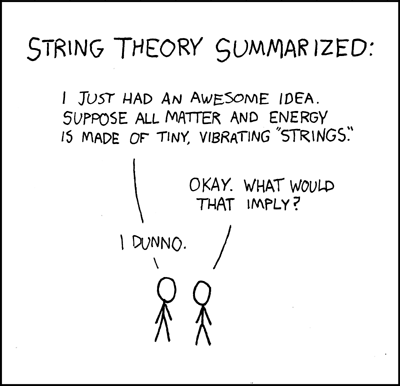
(source: http://xkcd.com/171/)
So, going back to the moon landings, the analogous situation is if ALL we knew about the moon landings was ONE single news report with one photo and a muffled recording of the radio communications, naysayers would be more justified in doubting that the landing occured. I think the fact that we (and yourself, I hope) would agree with this shows that we implicitly understand "societal truth" versus "scientfic" or "actual" truth. If we didn't, we would have taken that one news report on face value and believed. (We would also believe tabloids.)
OK, at this point I think the effort gone into explaining this totally outweighs the importance of the issue. It's a very simple but subtle point. Here's a one sentence summary. Yes, I agree a man landed on the moon, but not because I know the truth of it but because, weighing the evidence, I feel it is reasonable to say that the social truth of the matter corresponds with the actual fact, though I can't know for sure.
The same can be said about scientific theories. I think it's important, and healthy, to have this kind of viewpoint. If we don't, then we are liable to become like Thomas Kuhn's "old guard", the influential people in science who are so attached to an outdated or overthrown theory, that real progress is hindered due to their rigidity, and can only proceed when they (literally) die off.
The analogous situation in society is the "you're either with us or against us" mentality. Not recognizing the "softness" and uncertainty of what we think we know, even if we're pretty sure some things are true, jeopardizes our welfare in the future when we are unable to change our beliefs to fit the changing reality. Sometimes, even something that we know "for sure" turns out to be false, and we have to be ready to let go of the old belief.
Last edited by Alccode on Jul-29-2009 at 17:05
|
|
 Jul-29-2009 16:35 Jul-29-2009 16:35 
|
|
|
|
|
Alccode
teksetter!
Registered: Apr 2002
Location: toronto
|
|
|
| quote: | Originally posted by pkcRAISTLIN
who the fuck are you? that was an awesome post, and if ******** would express himself that coherently i suspect the ad hominems would be much, much rarer. |
Thanks. But are the ad hominems really necessary in the first place, just because someone doesn't seem to fit in? My whole intention in the first place was to point out that some people are demonizing ******** without actually making an effort to understand what he's trying to say (with exceptions of course). Not that I fully agree with everything ******** says.
All this stuff about philosophy of science is incidental... but now that it has somewhat changed the course of the discussion, I guess its purpose has been served. Hehe. 
I also don't think anyone here is inherently cruel -- I chalk it all up to the de-personalization of the internet. Like how people can easily get road rage and scream bloody murder at another person in a car, not realizing that it's a person. Chances are that if they stepped outside and actually talked to the person from the other car, face to face, they would not nearly be so angry.
I bet if everyone in PDD met in real life, it would be either an awkward situation at worst, or a fairly cheery one at best, despite the sheer harshness of some of the threads like this one. 
|
|
|
Jul-29-2009 16:50
|
|
|
|
|
Alccode
teksetter!
Registered: Apr 2002
Location: toronto
|
|
|
| quote: | Originally posted by Krypton
How mystical! How do we know we'r not in some video game being ruthlessly manipulated by THE PROGRAMMER!? |
Haha, ironically that's not far from the truth: "you" are living in a virtual world that is created by your brain. And not only that, but there's yet another layer of abstraction imposed by the society you live in (which also happens to be created by the mind/brain).
It just happens to be the case that the virtual world corresponds -- but doesn't exactly match -- the underlying, real world most of the time, which is indeed fortunate for us. But not in all cases.
In the end, however, we can't ever see, hear, touch, taste, or smell reality directly. It's all mediated by the experiences our brain creates to represent sensory stimuli. This is why "your" reality can be so easily manipulated. And not just when you take drugs -- even when sad or depressed, the whole world seems to take a downturn in your mind. That's because you're living in a dream world! Mwahahaha! 
(But there is no "programmer"...)
|
|
|
Jul-29-2009 16:58
|
|
|
|
|
pkcRAISTLIN
arbiter's chief minion

Registered: Jul 2002
Location:
|
|
|
| quote: | Originally posted by Alccode
The same considerations seem to apply. I agree that the factual possibilities are either a man landed or not, but our belief that it did occur, as outsiders to the actual event, is socially created through news reports, interviews, etc.
"Outsiders" in the sense of space -- we weren't there when it occured, and time -- it was 40 years ago. Basically, you are implicitly trusting the whole patchwork of information sources that have come to you regarding the moon landings and concluding that they did really occur, but in actual fact you yourself have no way of knowing for sure. Even if you were around at the time and watched it live on TV, you still wouldn't know for sure. Unless you were the actual astronauts themselves, or the folks in mission control, or the engineers who built it all, or the direct friends and family of all those people, etc., in decreasing order of certainty of knowledge.
Well now we also have that Japanese probe that photographed the landing sites too, but again this is all being filtered through the societal lens. I think it would be less filtered for the operators controlling the probe, but even for them, what they're seeing is contingent on assuming that the engineers made an "accurate" camera, which then boils down to a scientific theory of optics which may or may not hold water 50 years from now. How much more uncertain for us, who learn about it third-hand (or even further removed). And then when something about the news reports or the info we're given doesn't make sense or is inconsistent, I would claim we see there the effects of the distortions of the societal lens. (Unfortunately, this is where people who are prone to think in terms of conspiracy theories find the fodder for their beliefs, when more often than not it all boils down to the messiness of the transmission of knowledge.)
In the case of the moon landings the sheer variety and volume of information about it indicates pretty positively that they did in fact occur. It's akin to the status of a scientific theory like evolution through natural selection. It, too, is uncertain and prone to change (it probably won't look entirely the same in the future), but the basic concept is pretty much indisputable given the sheer volume of evidence.
On the other hand, a scientific theory that has much less evidence going for it, like string theory, would be much more doubtful in its facticity, and this is even reflected in popular culture:
(source: http://xkcd.com/171/)
So, going back to the moon landings, the analogous situation is if ALL we knew about the moon landings was ONE single news report with one photo and a muffled recording of the radio communications, naysayers would be more justified in doubting that the landing occured. I think the fact that we (and yourself, I hope) would agree with this shows that we implicitly understand "societal truth" versus "scientfic" or "actual" truth. If we didn't, we would have taken that one news report on face value and believed. (We would also believe tabloids.)
OK, at this point I think the effort gone into explaining this totally outweighs the importance of the issue. It's a very simple but subtle point. Here's a one sentence summary. Yes, I agree a man landed on the moon, but not because I know the truth of it but because, weighing the evidence, I feel it is reasonable to say that the social truth of the matter corresponds with the actual fact, though I can't know for sure.
The same can be said about scientific theories. I think it's important, and healthy, to have this kind of viewpoint. If we don't, then we are liable to become like Thomas Kuhn's "old guard", the influential people in science who are so attached to an outdated or overthrown theory, that real progress is hindered due to their rigidity, and can only proceed when they (literally) die off.
The analogous situation in society is the "you're either with us or against us" mentality. Not recognizing the "softness" and uncertainty of what we think we know, even if we're pretty sure some things are true, jeopardizes our welfare in the future when we are unable to change our beliefs to fit the changing reality. Sometimes, even something that we know "for sure" turns out to be false, and we have to be ready to let go of the old belief. |
Now, this is all well and good, and for the most part (imo) accurate and sensible. However, your arguments simply do not correlate with the level of discussion any of us in the PDD have seen regarding “alternative” viewpoints of accepted factual data/history.
There is an astronomically huge difference between healthy scepticism and enquiry, and the anti-intellectual, anti-science, anti-logic mantra of the conspiracy mindset. The simple fact of the matter is that none of these BS positions have anywhere near the levels of evidence or insight necessary to create doubt concerning “socially constructed” norms. So while I agree that some things should never be taken for granted, I think its extraordinarily disingenuous to equate that position with the crazies that proffer exactly the kind of “group-think” you’re criticising here.
Indeed, in the current example re the moon, it isn’t a debate about the validity of science at all. It’s an argument wholly created around conspiracy without any evidence. Im not sure how often you poke your nose in here but some of us are just fatigued from the pure, unadulterated bullshit being spewed by the usual suspects, and ad hominems seem to be the natural response to such a disregard for logic, deduction and established scientific knowledge. I don’t think it is unreasonable to arbitrarily dismiss such absurdities in favour of discussing topics that actually matter.
___________________

|
|
Jul-30-2009 01:30 
|
|
|
|
|
|
|
|
thedoggyworld
tranceaddict
Registered: Jun 2007
Location: lovin it
|
|
|
I couldn't tell it if was or wasn't. If you believe they put a man -- on the moon? Doubt it. If anything the public lexicon could never be the same.
___________________
The Democratic Party
|
|
Jul-30-2009 23:06 
|
|
|
|
|
Alccode
teksetter!
Registered: Apr 2002
Location: toronto
|
|
|
| quote: | Originally posted by Q5echo
actually my post was going to be, where do you stand on climate issues?
seeing as how this thread was over in about 3 pages i was curious to know how you feel about the current "scientific consensus" on anthropogenic global warming theory |
Heh, nice one. This whole issue dovetails very well with all the sociological considerations mentioned before.
The simple question of human activity affecting the climate is, I think, probably beyond dispute (with the answer being in the affirmative). But I dunno, maybe you or someone else (since I don't know your position on this either, thus not knowing if this is a "trick question" or not) will post an article showing how some credible study found no correlation between CO2 emissions and rising global temperatures. These things can happen. I'm sorry to say that I haven't been too involved in reading about the whole climate change debate. It used to be the case that smoking cigarettes wasn't widely believed to be so deleterious to our health, and I'm sure that at least some of the studies that came out in support of the tobacco industry showed that smoking is not dangerous. In the heyday of that debate, I'm sure that people who were not in the "know" could honestly be confused as to what to believe.
The same is occurring today in several areas, including the question of climate change. My personal belief is that, yes, the growing scientific consensus is converging on the conclusion that human activity is causing significant and, perhaps, irreversible climate change. And that there are really wealthy and powerful interests -- the entire oil industry -- who probably honestly don't really care about the truth of the matter but want to keep making a lot of money, or (and more psychologically interesting) honestly believe a priori that carbon emissions don't cause global warming, because then it's consistent with their internal belief structure and resolves the cognitive dissonance. They want to believe they are making an honest living, after all. (It's interesting to note that this latter belief is more socially acceptable since it agrees with the scientific consensus, but if it wasn't the case, then that "oil industry" statement could probably be labelled as a conspiracy theory.)
So the oil industry is probably akin to the tobacco industry during the whole smoking debate: just as the question of the danger of smoking is pretty much now indisputable, likewise the question of human-caused global warming is probably going to turn out to be indisputable as well.
BUT, but, but. It is absolutely important, for the purposes of scientific methodology, that an "open mind" be maintained throughout. There are undoubtedly anomalies in the scientific picture of climate change. It's always the case in science that not all of the data fits the theory. Actually, in many cases a lot of interesting data doesn't fit the theory at all. Almost all of the revolutions in scientific theories in the past have been ultimately caused by the dominant scientific paradigm not being able to fully address some really burning anomalies in the data that didn't fit the theory. Thomas Kuhn, the famous physicist-turned-philosopher/sociologist (who was responsible for the notion of "paradigm shifts" entering the mainstream vocabulary), classified anomalies into two types. Most anomalies are of such little consequence to the dominant paradigm that they are simply ignored or, in some cases, are eventually shown to fit the theory after all. But there are significant anomalies that can cause a crisis to occur, where eventually the paradigm is shown to be unsatisfactory and thrown out. This is the standard pattern of scientific work. Wikipedia has a great introductory exposition of this process in their article on Paradigm shifts.
Anyway, the relevance of that for our discussion is that, seeing as how if you want to do good science you must not ignore the anomalies, thus if some scientists show dissenting evidence for the dominant consensus on anthropogenic climate change, they must not be brushed aside simply because they don't fit the theory. There might be some kernel of truth in a piece of dissenting evidence that, upon further investigation, turns out to bring the whooooole house of cards down.
A prototypical historical case of this was in physics at the turn of the last century, when Newtonian/classical mechanics was the dominant scientific paradigm for explaining how objects move in space -- basic physics. This was at a time in history when the scientific consensus was that humans were, for the first time, pretty much in possession of nearly complete scientific knowledge of how the universe works. Only the minor details had to be worked out. Now, difficulties in classical mechanics started to pop up here and there, and perhaps the most (in)famous of all was the Michelson-Morley experiment, which had some strong evidence against the notion of the "luminiferous aether", a critical component of classical mechanics. It was this, among other equally "disagreeable" anomalies, that eventually resulted in the complete rejection of classical mechanics, and the introduction of relativity theory, as pioneered by Einstein, to supplant it. In fact, it was Einstein's famous first paper on special relativity that not only established a totally new understanding of space and time, but that also conclusively demolished the notion of the aether, thus putting the final nail in the coffin of classical mechanics.
And so, the "naysayers" in the whole global warming question shouldn't be rejected out of hand, at our own peril. Of course, just because there might be a lot of dissenting voices, some being religiously or culturally prominent, obviously doesn't give them much credibility. I'm talking about "that one" scientific theory that gets rejected from a journal because it's "too controversial" and the author loses his or her tenureship, but that actually turns out to be the initiator for yet another revolution in our understanding of climate and the human role. I'm not saying such a paper or study exists, just that we shouldn't label naysayers as "crazies".
Bah, again that was way too long of a post. Sorry about that. All I'm really saying is that, yes, I tentatively believe that humans are the main factor in the cause of climate change, but as to a whole bunch of other issues -- whether the planet would have started warming up on its own, e.g., due to the sun, apart from human factors and thus we're not sure just how much of a difference human activity is making, etc. etc. -- I just don't know. I'm not a climatologist. But the point is that neither are most people who are "debating" the issue!! Thus any strong positions, like "science has indisputably proven that humans are causing climate change, and you're a crazed conspiracy theorist if you don't believe that with equal fervor" (or the opposite, being equally fervent that humans aren't causing climate warming), are unjustified both historically and scientifically. In my opinion.
Last edited by Alccode on Aug-01-2009 at 20:03
|
|
|
Aug-01-2009 19:40
|
|
|
|
|
Alccode
teksetter!
Registered: Apr 2002
Location: toronto
|
|
|
| quote: | Originally posted by pkcRAISTLIN
There is an astronomically huge difference between healthy scepticism and enquiry, and the anti-intellectual, anti-science, anti-logic mantra of the conspiracy mindset. The simple fact of the matter is that none of these BS positions have anywhere near the levels of evidence or insight necessary to create doubt concerning “socially constructed” norms. So while I agree that some things should never be taken for granted, I think its extraordinarily disingenuous to equate that position with the crazies that proffer exactly the kind of “group-think” you’re criticising here. |
The point about "group-think" was that we are all subject to it, even the non-conspiracy theorists! Have you been to the moon yourself, or were you in mission control on July 20th, 1969? No, you are just taking it on a kind of faith. It just so happens that the social belief that people did land on the moon is pretty darn well backed up by a whole boatload of evidence, so it's pretty safe to say that it's true -- and that thus your faith is not blind. In this sense I agree with you.
What I disagree with is the divisive spin that's placed on this. Just because the lunar landings were most definitely not faked, it doesn't mean that those people who are just plain sure that humans landed on the moon are, because of the obviousness of the evidence or due to their conviction, somehow not subject to social pressures but are above them, in some heavenly Rational Realm. Such things don't exist -- we are social creatures and acquire our knowledge and beliefs about our reality through social means. The whole point of the sociological study of science, I think, is to show that even science is a social means of gathering the truth. (Though it happens to be veridical most of the time.)
| quote: |
Indeed, in the current example re the moon, it isn’t a debate about the validity of science at all. It’s an argument wholly created around conspiracy without any evidence. Im not sure how often you poke your nose in here but some of us are just fatigued from the pure, unadulterated bullshit being spewed by the usual suspects, and ad hominems seem to be the natural response to such a disregard for logic, deduction and established scientific knowledge. I don’t think it is unreasonable to arbitrarily dismiss such absurdities in favour of discussing topics that actually matter. |
I agree with you entirely. I just don't like calling people crazies and thus heaping abuse on them. I believe it's preferrable to simply kindly yet firmly argue with people you disagree with, even if you believe that they are simply wrong and are " crazy conspiracy theorists". (They probably think you are simply wrong too!) 
EDIT: ok, so because I haven't been active as much as you or others have, I probably haven't lost my patience as much for this, but again, even if I lost patience I wouldn't go as far as some people have here, which is at times a bit cruel, IMO.
Last edited by Alccode on Aug-01-2009 at 19:59
|
|
|
Aug-01-2009 19:52
|
|
|
|
|
| |
All times are GMT. The time now is 23:42.
Forum Rules:
You may not post new threads
You may not post replies
You may not edit your posts
|
HTML code is ON
vB code is ON
[IMG] code is ON
|
|
|
|
|
|
Contact Us - return to tranceaddict
Powered by: Trance Music & vBulletin Forums
Copyright ©2000-2026, Jelsoft Enterprises Ltd.
Privacy Statement / DMCA

|


