|
| quote: | Originally posted by {b.s.e.}
Uh, OK, Rumsfeld. Answer a question with a question.
I don't think you understand what you're saying. The Official Story does not comply with the Conservation of Motion. Matter and gravity and their relation are absolute.
See Exhibit A of your misunderstanding of Physics

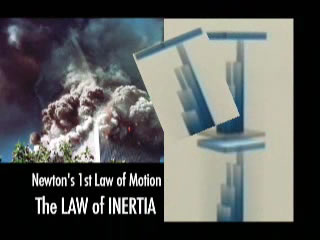
According to conservation-of-momentum laws, the block of approximately 34 floors on top of the South Tower should have continued to topple and fall through the path of least resistance: the air. It should have continued to topple and fall to the ground far outside the building’s footprint and NOT through the path of most resistance: the building itself. That same block which can be seen twisting at the start of the collapse should have kept twisting and obeyed the law of conservation of angular momentum but the rotation suddenly stopped. The stopping of both its rotation and its “toppling” can only be explained by the breakup of most of the block, which would have destroyed its moment of inertia. But there is no good explanation for the upper block to break up at the start of the collapse; unless of course, it was being broken up in a purposeful way as in a controlled demolition. This violation of physical laws alone virtually proves that the Official Story is a lie. |
im the one that misunderstands physics yet youre the one that keeps saying "motion" instead of "momentum". in any case, physics is a less-important area of science than civil engineering re 911.
that said, i am very unschooled in both, so i must defer to my expert mr mackey
| quote: |
Dr. Griffin next turns to WTC 2, and claims that (1) the upper block should have fallen outside the building footprint, and (2) the block’s rotation should have continued as it fell, both according to conservation of momentum.
This, perhaps more than any other passage, confirms Dr. Griffin’s poor grasp of elementary physics. Suppose we are treating the upper block, after all connections to the lower block have failed. If we treat it as a rigid object, it will be subject to two major forces: Gravity, acting through the center-of-mass and always pulling downward; and reactive forces from impacts with the lower structure, pushing predominantly upward, but acting at the point of contact and not necessarily through the center-of-mass. In our simplified model, apart from these two forces, the upper block retains its initial momentum, which is downward with some rotational momentum as well.
Before breaking completely free, the upper block will tilt around a loosely-defined hinge point, as discussed previously. The hinge creates a “force couple” – gravity pulling through the center balanced by an opposing force, at the hinge, pushing upwards and off-center. This is what leads to rotation. However, at no time is there a horizontal force, unless the upper block rotates so far that a hinge is a poor model of the interaction. This is not predicted. The “hinge” is likely to be a surviving series of columns bending but still supporting their load. These columns are predicted to buckle, snapping off at or near the hinge point, after only a few degrees of rotation – NIST estimates that the upper block rotated 7 to 8 degrees in one axis, and 3 to 4 degrees in another, prior to breaking the hinge [160]. The steel columns simply cannot provide support after being bent ten or twenty degrees. Also, if the “hinge” is closer to the middle and thus the center of mass, horizontal forces will be even smaller. This is true in this case – the hinge is predicted to pass through the core at an offset and an angle, as shown in NCSTAR1-6D in Figure 4-89 on page 256. As a result of the central location and small rotational tolerance of the hinge, the horizontal forces applied to the upper block are small, and thus there will be little or no horizontal movement.
The upper block would need a large amount of horizontal force in order to side-step the lower structure. Recall that the Towers were 208 feet, about 63 meters, across. This means that the upper block would have to be translated at least 104 feet before it would tumble over the side, and it would have to do so in only a few seconds – let’s assume five seconds. To translate 104 feet in five seconds would require a steady lateral acceleration of 8.3 feet per second2, and if we loosely estimate the upper block at around 25,000 metric tons, this means we require a continuous horizontal force of 14 million pounds (65,000,000 N), or approximately two times the thrust of the Space Shuttle at liftoff.
It is not even clear if the upper block could survive such a force intact, let alone where it would come from. If this force was the natural result of gravity causing it to “slide off,” since this force is over 25% of the force of gravity, it implies that the reactive force must somehow work at an angle as if the upper block was sliding down a steep ramp. There is no reason whatsoever to expect such unusual behavior – the contact forces will be almost totally vertical. There is also not enough reactive force to provide this thrust, not even if it could somehow be applied at 90 degrees. We can estimate the maximum average resisting force from the speed of collapse. Because the lower structure is crushed within 11 or 13 seconds, according to Bazant et al., the average reactive force supplied by the lower structure is a small fraction of the static gravity load, and thus the total impulse is insufficient to supply the needed thrust, even if we could somehow explain why it is horizontal instead of vertical.
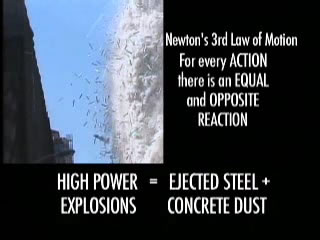
Furthermore, if the upper block experienced such a lateral force, Newton’s Third Law requires an equal and opposite reactive force. While the lower structure would flex rather than translate (assuming this side force did not fracture the structure), there is simply no sign of this force in the lower structure, though admittedly the falling debris and dust makes it difficult to be certain. But the dust and debris provides further evidence of no such horizontal force. In one scenario, the debris accumulating below the lower block would be mainly cast the opposite way, accounting for the “thrust;” but as these pieces were smaller and less cohesive, some of them would have been thrown enormous differences. In another, the debris is carried along with the falling block, meaning the horizontal force required is much larger still. This simply did not happen. Instead, the smaller debris falls, snaps, and rebounds away with moderate but essentially random velocities in all directions, rather than being biased to any side as the toppling case would dictate. There is no support for toppling whatsoever.
The argument from conservation of angular momentum is similarly flawed. Dr. Griffin and Mr. Hoffman both assume that conservation of angular momentum guarantees that the upper block would continue spinning at the same rate. But this is only true if the upper block does not come in contact with the lower structure – angular momentum is only conserved so long as there are no external forces affecting the mass off-center. Since the upper block tilts, it first comes in contact with the lower structure at the down-tilted corner. Impact here, off-center, provides opposite angular momentum. Similarly, as it falls a bit further, contact at the up-tilted corner will add angular momentum. This will tend to rock the upper block back and forth as it settles through each floor. However, if the block continues to rotate, the down-tilted corner will fall farther than the up-tilted corner, and experience more and larger impacts, which work against rotation. Because of this geometry, the rotation is a self-regulating process to some extent.
What we expect, therefore, is that the upper block will slow in its rotational rate, but probably not all the way to zero. The impacts of floors below adding to and subtracting from this rate are going to be somewhat random and partially average out. This is, in fact, what is seen in the video – the upper block does rotate a bit further before it disappears from view.
Because Dr. Griffin and Mr. Hoffman misapply the laws of conservation of momentum, either assuming horizontal momentum where there is none or neglecting other contributions to angular momentum, their expectations about the trajectory of the upper block are also wrong. The behavior of the upper block is as expected. |
http://wtc7lies.googlepages.com/Mac..._review_2_1.doc
___________________

|