|
|
|
|
 |
pkcRAISTLIN
arbiter's chief minion

Registered: Jul 2002
Location:
|
|
|
| quote: | Originally posted by culorut
Point is it was found and it can cut through metal beams very easily, the stuff gets up to 4500F in seconds. |
no, it wasn't found. no evidence of thermite. and no, thermite doesn't "cut" through anything very easily. it certainly isn't capable of cutting through steel in a nice uniform way to bring about collapse of a building. it just doesn't work that way.
| quote: | Originally posted by culorut
The fires in the WTC towers where up much higher and did not last too long, they where practically out. Charges containing Thermate where planted much further below on the support beams and electronically detonated. |
practically out? why was there smoke still billowing into the air when they started to collapse? where exactly were these thermite charges placed? its impossible to collapse a building the way you believe it occured. certainly impossible to coordinate thermite to the degree you believe. its an incindiary, not a demolition explosive.
| quote: |
Thermite in general makes an ugly hole with molten metal drips/blobs. It doesn't make clean cuts. It's a powder that undergoes a violent chemical reaction as seen in the video below.
http://www.guzer.com/videos/thermite_car.php
Note how much thermite is used. The pot is about a liter, but how much thermite is that?
Stoichiometric thermite requires 2 moles of Al per 1 mole of Fe2O3
2Al + Fe2O3 = Al2O3 + 2Fe
2 moles of Al weigh 54 g
1 mole of Fe2O3 weighs 160 g
density of Al=2.64 g/cc
density of Fe2O3=5.24 g/cc
54 grams of Al is equivalent to 20.5 cc of Al.
160g of Fe2O3 is equivalent to 30.5 cc of Fe2O3
Therefore, 51 cc of fully dense powder of 20.5 cc Al and 30.5 cc Fe2O3 weighs (54+160) g = 214 g.
A volume of 1000 cc would weigh (1000/51)*214 = 4.2 kg
For a powder packing density of 50%, the powder would weigh:
0.5*4.2 kg = 2.1 kg = 4.8 lb
That much just to burn a small hole in a small car engine. I bet it's even an aluminum block but lets say it isn't. How much do you think it would take to burn a massive core column? Then add enough to burn for 6 weeks! You see where we're going. You'd need tons. |
link
| quote: | Originally posted by culorut
How else would they have been able to bring down the engineering marvels which the World Trade Towers where? |
the particular structural design of the WTCs is what brought down these "engineering marvels". the WTCs had a very specific design, completely unlike most modern buildings, and this had a very large part to play in their collapse.
___________________

|
|
 May-01-2007 00:08 May-01-2007 00:08 
|
|
|
|
|
culorut
Supreme tranceaddict

Registered: Jan 2007
Location: right here
|
|
|
May-01-2007 02:11 
|
|
|
|
|
pkcRAISTLIN
arbiter's chief minion
Registered: Jul 2002
Location:
|
|
|
| quote: | Originally posted by culorut
Wrong again, Thermate not thermite. Thermate is military grade thermite which gets up to 4500F and cuts through metal beams like butter. |
sorry, but thermate is practically thermite.
from wiki
| quote: |
Thermate, or Thermate-TH3, is an incendiary compound primarily used for military applications. Because of the similarity in names, thermate is sometimes confused with one of its components, thermite.
Thermate is a mixture of thermite and pyrotechnic additives which have been found to be superior to standard thermite for incendiary purposes. Its composition by weight is generally thermite 68.7%, barium nitrate 29.0%, sulphur 2.0% and binder 0.3%. Addition of barium nitrate to thermite increases its thermal effect, creates flame in burning and significantly reduces the ignition temperature.
Thermate is used in incendiary hand grenades. |
it acts almost identically. so we're splitting hairs here in this context. it is an INCENDIARY. not a demolition explosive. meaning it IS NOT designed or capable of bringing down buildings. yes, it CAN eat through steel like butter, but not in a fashion that could be relied upon to bring down a building.
look at any demolition video. charges are set up and down a building to bring it down. you cant just plant some thermite at the bottom of a building and bring it down. it doesn't work like that. thermate is used to destroy equipment, there isnt a SINGLE example of it being used in the way you believe.
and you still haven't explained how the tonnes (yes TONNES) of thermate was hidden. thermate simply isnt practical.
| quote: |
It cannot be used to melt vertical structures, because the molten iron simply flows past the target |
link
and, thermate residue WAS NOT found at ground zero. sulfur was. BIG difference.
| quote: | Originally posted by culorut
Smoke means the fires are going out and therefore not hot, not hot enough to weaken or come even close to melting steel that is. Thermate used in conjunction with other explosives can and did bring down the WTC towers. |
oh, so when the planes first hit and there was smoke coming out of the building, that was an indication of it going out? come now. those fires weren't going anywhere.
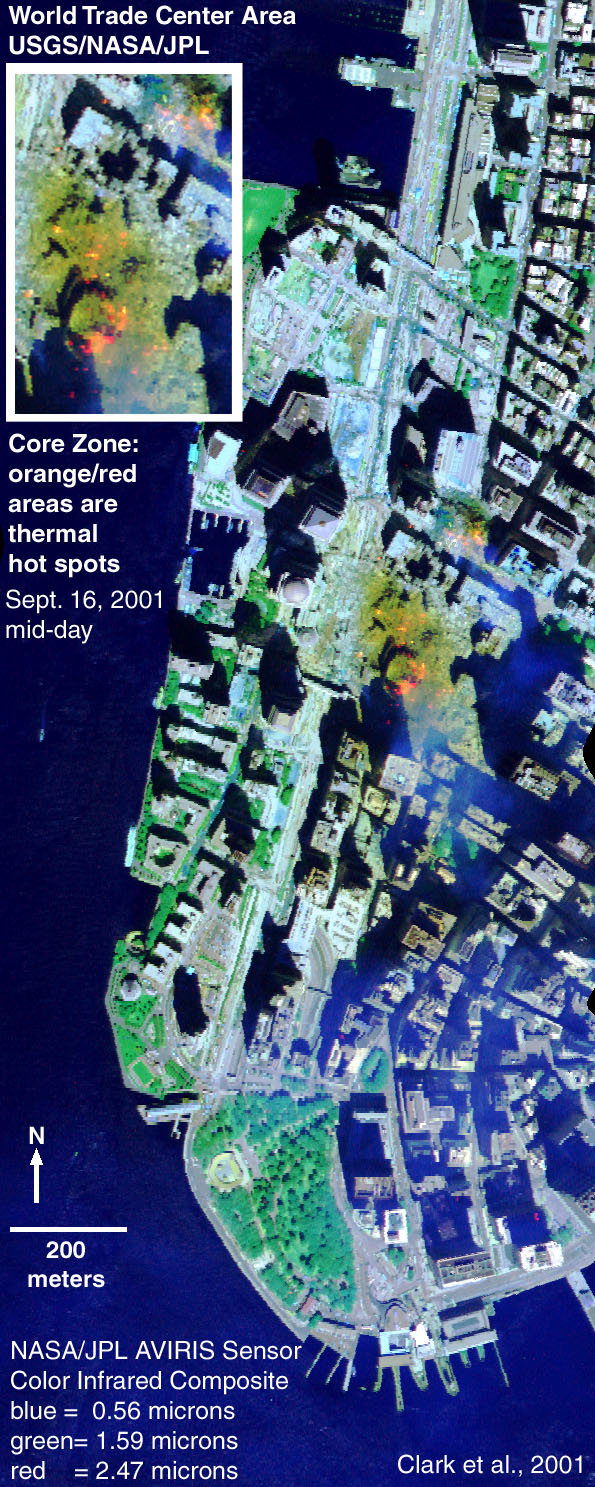
there have been plenty of tests showing that average office spaces can reach temperatures necessary to weaken steel.
"other explosives" ?????? what now? now you're just getting silly. where were these other charges set? what type of explosive was used? why on earth is the government fooling around with thermite (useless in demolition) when they have these other explosives?
| quote: | Originally posted by culorut
The particular design of the WTC towers where unique correct but they did not fail because of the airplanes crashing into them. They where built to withstand multiple airline impacts including their fuel. |
no, ive already shown you this assumption is flawed. plus, theres no guarantee that anything "built to withstand" can infact withstand anything. that's a non sequitur. as already stated- it is impossible to accurately state that a building can withstand a plane of this size hitting it- you just cant predict it. there are too many un-testable properties of a crash like this.
even if the fuel & fire were taken into account (they werent) there is absolutely no way to test a building for this eventuality, short of crashing a plane into it. theres no argument here mate.
| quote: | Originally posted by culorut
The Empire State Building was hit by a B-25 bomber near the end of WW2, it destroyed 19 floors and guess what? It's still standing to this very day. |
come on, at least have the academic commitment to comparing like cases.
first off- the empire state building isnt a "tube within a tube" structural design. so any comparison is ludicrous. its like comparing my mitsubishi lancer to an F1 racing car. just silly.
secondly- have a look at the difference between the sizes of the planes will you?

| quote: |
The size of a B-25 bomber is much smaller than a Boeing 767, with smaller wingspan and smaller fuel capacity. A B-25 bomber has a wingspan of 67 feet, compared with 156 feet for a Boeing 767. The fuel capacity of the B-25 bomber was 1,000 gallons, as compared with 24,000 gallons for a Boeing 767. As well, the speed at which a B-25 bomber travelled was far less than the ~500 mph than the speed that the two Boeing 767's were travelling when they hit the World Trade Center.
The World Trade Center was designed to withstand the force from the impact of a Boeing 707, lost in the fog and travelling at a relatively slow speed of 180 miles per hour.
The Boeing 767 aircraft that hit the World Trade Center were significantly heavier, with fuel for transcontinental flights. American Airlines Flight 11 was travelling at 470 miles per hour when it crashed into the North Tower at 8:46 a.m. United Airlines Flight 175 was travelling at 590 miles per hour when it crashed into the South Tower.
The energy contained in an airplane or other moving object is proportional to the velocity. |
there is a nice table that doesn't translate well into TA,
but heres my crude paraphrase
767 north tower energy crash: 3,954,417,824
767 south tower energy crash: 6,229,464,421
707 likely low-speed energy crash: 528,658,660
thats a massive difference. simply put- the towers were not designed to take the full brunt of a massive plane full of fuel and used as a weapon. to state otherwise is simply to ignore common sense.
| quote: | Originally posted by culorut
No plane hit WTC7 but it fell symmetrically, how did the fires slice through the support columns at the same time to cause it to collapse the way it did at almost free fall speed? |
actually, WTC7 didnt fall at free fall speeds
| quote: |
Seismograph trace of the collapse of WTC 7 indicates that parts of the building were hitting the ground for 18 seconds. This means the collapse took at least 18 seconds, of which only the last approximately 15 seconds are visible in videos: 8 seconds for the penthouses and 7 seconds for the north wall to come down. |
link
you dont need to "slice" through anything. WTC7 was heavily damaged and burned for over 5 hours.
what do the firefighters (experts regarding fire wouldnt you say?)
| quote: |
Firehouse: Was there heavy fire in there right away?
Hayden: No, not right away, and that’s probably why it stood for so long because it took a while for that fire to develop. It was a heavy body of fire in there and then we didn’t make any attempt to fight it. That was just one of those wars we were just going to lose. We were concerned about the collapse of a 47-story building there. We were worried about additional collapse there of what was remaining standing of the towers and the Marriott, so we started pulling the people back after a couple of hours of surface removal and searches along the surface of the debris. We started to pull guys back because we were concerned for their safety.
Firehouse: Chief Nigro said they made a collapse zone and wanted everybody away from number 7— did you have to get all of those people out?
Hayden: Yeah, we had to pull everybody back. It was very difficult. We had to be very forceful in getting the guys out. They didn’t want to come out. There were guys going into areas that I wasn’t even really comfortable with, because of the possibility of secondary collapses. We didn’t know how stable any of this area was. We pulled everybody back probably by 3 or 3:30 in the afternoon. We said, this building is going to come down, get back. It came down about 5 o’clock or so, but we had everybody backed away by then. At that point in time, it seemed like a somewhat smaller event, but under any normal circumstances, that’s a major event, a 47-story building collapsing. It seemed like a firecracker after the other ones came down, but I mean that’s a big building, and when it came down, it was quite an event. But having gone through the other two, it didn’t seem so bad. But that’s what we were concerned about. We had said to the guys, we lost as many as 300 guys. We didn’t want to lose any more people that day. And when those numbers start to set in among everybody… My feeling early on was we weren’t going to find any survivors. You either made it out or you didn’t make it out. It was a cataclysmic event. The idea of somebody living in that thing to me would have been only short of a miracle. This thing became geographically sectored because of the collapse. I was at West and Liberty. I couldn’t go further north on West Street. And I couldn’t go further east on Liberty because of the collapse of the south tower, so physically we were boxed in. |
link
sorry, but youre simply parroting non sequiturs and halftruths propogated by the "truthers".
___________________
|
|
|
May-01-2007 02:30
|
|
|
|
|
pkcRAISTLIN
arbiter's chief minion
Registered: Jul 2002
Location:
|
|
|
| quote: | Originally posted by culorut
Thermate is useless? It can cut through steel like butter and it's useless? You forgot to explain how the fires cut the columns of WTC7 at the same time which caused it to fall so perfectly in it's own footprint. Nice dodge from that one.
Forget drawing links, the molten metal was there what ever caused it.
Your common sense makes no sense. |
honestly, are you going to engage the topic and refute the evidence ive sited? if you believe so fully that your faulty analysis is correct, please refute each point i have made in a clear and consise manner. at least admit that your comparison re the B-25 is complete nonsense
yes, thermate is useless. it cant cut steel in such a way as to bring about the catastrophic collapse of a building. it is useless because its impossible to house THAT much thermite in contact with the steel support columns. its logistically impracticle, if not impossible.
why do the columns of WTC7 need to be "cut"? again, it DIDNT fall in its own footprint- it fell in a direction completely consistent with where the damage and fire was.
| quote: |
"But the building doesn't look like it fell over, it fell "in its own foot print" you might say. That's because it is impossible for a 47 story steel building to fall over like that. It's not a small steel reinforced concrete building like the ones shown as *Examples* of buildings which fell over. Building 7 is more like the towers, made up of many pieces put together. It's not so much a solid block as those steel reinforced concrete buildings.
To put it simply, the building DID fall over backward and to the south-east. Just not like a steel reinforced concrete building would. Another telling photo is this one taken closer to the event date.

Note just past building 7 is a small amount of debris on the white building behind it. (Building 7 is pile in the upper center-left of the photo. The white building is at the top center-left of the photo.) That building is to the north east corner of building 7. Note about 1/3rd of the east side of the building falling to the north in the photo below.
Here is another photo from over Building 7. The white building is on the left. Note the debris from building 7 which crossed the street and landed on top of the white building.

This suggests the building was split by the penthouse collapses most of the way down. One section went to the south-east while a smaller section went to the north. It wasn't that symmetrical. |
a building that has its load distribution changed dramatically has a chance of collapse, especially given the intensity of the resulting fires for such a long period of time. remember the steel supports of WTC7 (and 1&2) were on the outside, they werent a "grid" pattern as seen in most steel structure buildings. so a significant structural integrity problem, such as the 20+ floors that were damaged/missing/engulfed in fire had to rely on the rest of the building to take the load. which it did for a time.
simple fact is all the emergency crew at ground zero knew the building was going to collapse hours before it did. are you really going to argue you know better than the experts there on that fateful day?
___________________
|
|
|
May-01-2007 02:58
|
|
|
|
All times are GMT. The time now is 00:38.
Forum Rules:
You may not post new threads
You may not post replies
You may not edit your posts
|
HTML code is ON
vB code is ON
[IMG] code is ON
|
|
|
|
|
|
Contact Us - return to tranceaddict
Powered by: Trance Music & vBulletin Forums
Copyright ©2000-2026, Jelsoft Enterprises Ltd.
Privacy Statement / DMCA

|