|
Esperanto: is it as ironic as it sounds?
I love to study languages, and Esperanto has always puzzled me because of its origins and goals. I've studied a bit of the language and the reason why I'm posting this thread here is because I believe that I must have misunderstood something wrong and I am looking for different ideas for a constructive discussion 
| quote: | taken from Omniglot.com
Zamenhof was born in the Polish city of Bialystok which at that time was home to a polyglot, multiethnic mixture of Poles, Russians, Jews, Lithuanians and Germans. He believed that much of the distrust and misunderstanding between the different ethnic groups was a result of language differences, so he resolved to create an international language which could be used as an neutral lingua franca and could help break down the language barriers. |
A lingua franca is sure needed, but why couldn't it be one of the languages already used in the region, like Polish? (that's how all civilizations have been doing since the beginning - in fact, I'm doing it right now). Some may say it's a pride thing (why learn another language instead of having other people learning your "superior" language?), but if people aren't willing to learn someone else's language, that's because they're not willing to know more about this other people anyway: it's something that should be changed socially, not linguistically.
| quote: | taken from Omniglot.com
The majority of Esperanto roots are based on Latin, though some vocabulary is taken from modern Romance languages, and from English, German, Polish and Russian. Roots can be combined with affixes to form new words, for example: lerni = to learn, lernejo = a school, lernanto = a pupil/student, lernejestro = a headmaster. The affixes can also stand alone: ejo = place, estro = leader/head, etc. |
So let's suppose you don't agree with what I said in my previous paragraph and you do think that a neutral language is a better idea. How can Esperanto be a neutral language if it's essentially European? Thai people would see Esperanto the same way they see English, with just one difference: When learning English, they would get to know more about the English culture, history and society; the same doesn't happen to Esperanto.
| quote: | taken from Omniglot.com
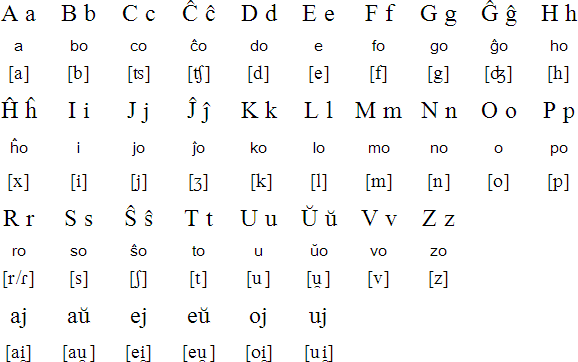 |
This is a chart with the phonetic values (if you don't know what these symbols areclick here for the IPA guide - quite handy if you like linguistics). Sincerely, because of my accent (Brazilian Portuguese is my mother language), "h" and "h^" would sound exactly the same. Not much, right? But let's now focus on all my Spanish speaking neighbours from Latin America. "b" and "v" would be the same; "s" and "z" would be the same; "g^" and "j^"... and this list could go on and on. Maybe there wouldn't much misunderstanding, because sometimes you can understand the meaning from the context, but shouldn't an international language have a simple phonetic structure? And, wouldn't the Esperanto spoken here become different from the Esperanto spoken there and eventually become two different languages after some years?
What do you guys think? (does anyone like linguistics here?  ) )
___________________
Indiana Clones Upcoming Sets
[ I May Upload Something Someday ]
|


