|
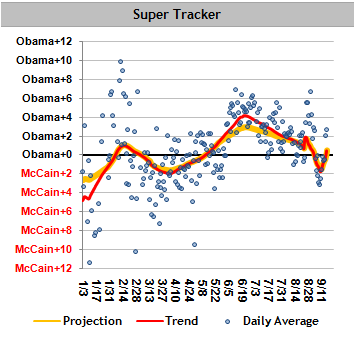
Obama taking back lead in polls
| quote: | Poll Finds McCain, in Tight Race, Is Still Tied to Bush
By ROBIN TONER and ADAM NAGOURNEY
WASHINGTON — Despite an intense effort to distance himself from the way his party has done business in Washington, Senator John McCain is seen by voters as far less likely to bring change to Washington than Senator Barack Obama. Mr. McCain is widely viewed as a “typical Republican” who would continue or expand President Bush’s policies, according to the latest New York Times/CBS News Poll.
Polls taken after the Republican convention suggested that Mr. McCain had enjoyed a surge of support — particularly among white women after his selection of Gov. Sarah Palin of Alaska as his running mate — but the latest poll indicates “the Palin effect” was, at least so far, a limited burst of interest.
The contest appears to be roughly where it was before the two conventions and before the vice presidential selections: Mr. Obama has the support of 48 percent of registered voters, compared with 43 percent for Mr. McCain, a difference within the poll’s margin of sampling error, and statistically unchanged from the tally in the last New York Times/CBS News Poll in mid-August.
The poll showed Mr. McCain had some enduring strengths, including a substantial advantage over Mr. Obama as a potential commander in chief. And it found that for the first time, 50 percent of those surveyed in the Times/CBS News Poll said they considered the troop buildup in Iraq — a policy that Mr. McCain championed from the start — has made things better there.
The poll also underlined the extent to which Mr. McCain’s convention — and his selection of Ms. Palin — had excited Republican base voters about his candidacy, a development that is no small thing in a contest that continues to be so tight: 47 percent of Mr. McCain’s supporters described themselves as enthused about the Republican party’s presidential ticket, almost twice what it was before the conventions. As often happens at this time of year, partisans are coalescing around their party’s nominees and independents are increasingly the battleground.
But the Times/CBS News poll suggested that Ms. Palin’s selection has, to date, helped Mr. McCain only among Republican base voters; there was no evidence of significantly increased support for him among female voters in general. White women are evenly divided between Mr. McCain and Mr. Obama; before the conventions, Mr. McCain led Mr. Obama among white women by a margin of 44 percent to 37 percent.
By contrast, at this point in the 2004 campaign, President Bush was leading Senator John Kerry of Massachusetts, the Democratic challenger, by 56 percent to 37 percent among white women.
The latest Times/CBS nationwide telephone poll was taken Friday through Tuesday with 1,133 adults, including 1,004 registered voters. The margin of sampling error is plus or minus 3 percentage points for all respondents and for registered voters. Among other groups, Mr. Obama had a slight edge among independents, and a 16 percentage-point lead among voters aged 18 to 44. Mr. McCain was leading by 17 points among white men and by the same margin among voters 65 and over. Before the convention, voters aged 65 and older were closely divided. In the latest poll, middle-aged voters — 45 to 64 — were almost evenly divided between the two.
The poll was taken during a period of extraordinary turmoil on Wall Street. By overwhelming numbers, Americans said the economy was the top issue affecting their vote decision and they continued to express deep pessimism about the nation’s economic future. They continued to express greater confidence in Mr. Obama’s ability to manage the economy, even as Mr. McCain has aggressively sought to raise doubts about it.
This poll found evidence of concern about Ms. Palin’s qualifications to be president, particularly compared to those of Senator Joseph R. Biden Jr. of Delaware, Mr. Obama’s choice for a running mate. More than 6 in 10 of those surveyed said they would be concerned if Mr. McCain could not finish his term and Ms. Palin had to take over. In contrast, two-thirds of voters surveyed said Mr. Biden would be qualified to take over for Mr. Obama, a figure that cut across party lines.
And 75 percent said they thought Mr. McCain had picked Mrs. Palin more to help him win the election, rather than because he thought that she was well-qualified to be president. By contrast, 31 percent said they thought that Mr. Obama picked Mr. Biden more to help him win the election, while 57 percent said it was because he thought Mr. Biden was well-qualified for the job.
This poll was the taken right after Mrs. Palin sat down for a series of high-profile interviews with Charles Gibson on ABC News.
Over the last two weeks, Mr. McCain has increasingly tried to distance himself from his party and President Bush, running as an outsider against Washington. The poll suggested the urgency of Mr. McCain’s task: The percentage of Americans who disapprove of the way Mr. Bush is conducting his job, 68 percent, is as high as it has been for any sitting president in the history of polling by The New York Times. And 81 percent said the country is heading in the wrong direction.
The poll found that 46 percent of voters thought Mr. McCain would continue Mr. Bush’s policies, while 22 percent said he would be more conservative than Mr. Bush. (About one quarter said a McCain presidency would be less conservative than Mr. Bush’s.) And at a time when Mr. McCain has tried to appeal to independent voters by separating himself from his party, notably with his convention speech, 57 percent of all voters said they viewed him as a typical Republican, compared with 40 percent who said he was a different kind of Republican.
.......................
http://www.nytimes.com/2008/09/18/u...ics/18poll.html |
So much for McCain's bounce, Obama has been gaining ground for a while now.

Gallup has Obama 47%, McCain 45% but I don't trust them anymore since they apparently inflated McCain's initial convention bounce to make headlines.
| quote: | In other words, Gallup is admitting the following:
1. At the time it released the September 8th poll (showing McCain up by 10), it believed institutionally that likely voter results were less accurate than registered voter results.
2. Likely voter results have only occasionally diverged from the registered voter results.
3. Despite these facts, Gallup deliberately chose to release, to the widest fanfare possible, a poll using an admittedly less accurate method (the likely voter method) at the time of McCain's maximum convention bounce, knowing that it would show a large divergence (+10 for McCain vs. only +4 with registered voters) based on the likely voter method, even though such a divergence is not often present.
4. In short, they combined all possible factors in McCain's favor to make his lead seem as big as possible -- and the media went wild with it.
http://www.dailykos.com/storyonly/2...5933/788/599244 |
We'll see what comes of Palin's email account being hacked. See the Armageddon thread for that.
|