|
GEOMETRY GURUS!!! Area of an Oval - SOLVE! (pg. 3)
|
View this Thread in Original format
| DJ Pudl |
I've got an answer, it took a lot of calculation. For now I'll just give you my answer so far: 421.4756 units^2.
I'm working on creating some step by step with the equations.
The basic method I used was to find the equation of the two circles and calculate their derivative. I set the two derivatives equal to each other and found the point where they were equal.
From that I used trig/geometry to calculate all the areas involved.
Give me a bit to write something up, but there is an answer for now...
Jonathan |
|
|
| jdjd |
| you shouldnt need calc for this |
|
|
| DJ Pudl |
the problem is figuring out where one circle starts and the other stops. Since they need to be tangent to each other, how can you do this without calc?
Jonathan |
|
|
| DJ Pudl |
all right, it's all written up, including a formula you can use to calculate the areas of any type of shape with this form, ie different radii and different width of the oval. I'll try to scan it in tomorrow.
The equation isn't pretty, however...
Jonathan |
|
|
| DJ Pudl |
I've posted my solution as a pdf. Take a look at it, and double check my work to make sure you understand what's going on and maybe find any errors.
As a side note, once you find the point of intersection (ie the place where the slopes of the two circles is equal), you can split the top half of the oval into 3 sections and integrate each of the sections in turn. This works because the integral of a function is the area under the curve. You would then multiply your result by 2 to include the bottom half as well.
Solution
Good luck with everything,
Jonathan |
|
|
| cbxzcm |
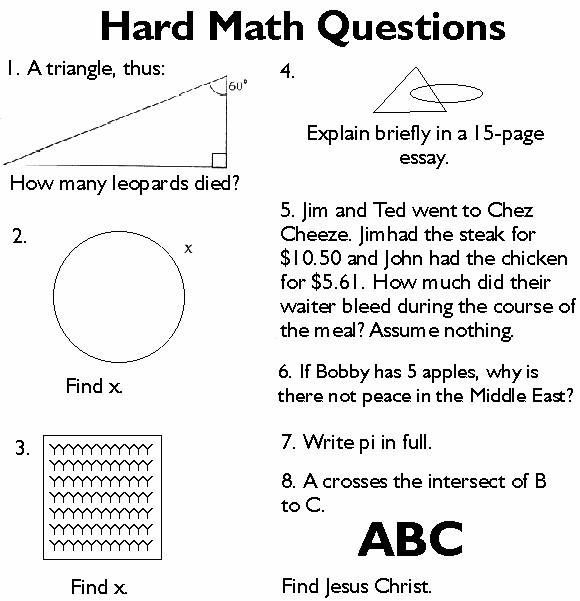
That problem is a piece of cake. Try working out these:
 |
|
|
| mezzir |
| quote: | Originally posted by DJ Pudl
I've posted my solution as a pdf. Take a look at it, and double check my work to make sure you understand what's going on and maybe find any errors.
As a side note, once you find the point of intersection (ie the place where the slopes of the two circles is equal), you can split the top half of the oval into 3 sections and integrate each of the sections in turn. This works because the integral of a function is the area under the curve. You would then multiply your result by 2 to include the bottom half as well.
Solution
Good luck with everything,
Jonathan |
mein!
that was like the original idea i had but it seemed like there must be a way w/o calc so i went with the sketchy basic geometry route
...i like my answer better |
|
|
| DJ Pudl |
| hehe, yeah, it certainly took a lot of work. There is probably a way to do it with geometry only, how did you calculate the area, by the way? |
|
|
| mezzir |
found the area of the two pairs of sectors and added the inside rectangle
the one sketchy part is that i based it all on an assumption that pon further inspection i'm not sure was correct
tho that only should've altered it by like 20 max
huh |
|
|
| Photo_bot_2k1 |
the answer is exactly
708.32425562 |
|
|
| DJ Pudl |
| quote: | Originally posted by Photo_bot_2k1
the answer is exactly
708.32425562 |
any work or explanation to back that up? |
|
|
| ASOT100 |
check the back of the book if it's an odd problem
lol jk |
|
|
|
|

