|
New Planet(oid) Found in Solar System
|
View this Thread in Original format
| occrider |
Scientists Find Another Huge Mini-World in Outer Solar System
By Andrew Bridges
Associated Press
posted: 09:00 am ET
15 March 2004
LOS ANGELES (AP) -- It is a frozen world more than 8 billion miles from Earth and believed to be the farthest known object within our solar system.
NASA planned a Monday press conference to offer more details about Sedna, a planetoid between 800 miles and 1,100 miles in diameter, or about three-quarters the size of Pluto.
Named for the Inuit goddess who created the sea creatures of the Arctic, Sedna lies more than three times farther from the sun than Pluto. It was discovered in November.
"The sun appears so small from that distance that you could completely block it out with the head of a pin," said Mike Brown, an astronomer at the California Institute of Technology who led the NASA-funded team that found Sedna.
That makes Sedna the largest object found orbiting the sun since the discovery of Pluto, the ninth planet, in 1930. It trumps in size another world, called Quaoar, discovered by the same team in 2002.
Brown and his colleagues estimate the temperature on Sedna never rises above 400 degrees below zero Fahrenheit, making it the coldest known body in the solar system.
Sedna follows a highly elliptical path around the sun, a circuit that it takes 10,500 years to complete. Its orbit loops out as far as 84 billion miles from the sun, or 900 times the distance between the Earth and our star.
Brown and Chad Trujillo, of the Gemini Observatory in Hawaii, and David Rabinowitz, of Yale University, discovered Sedna on Nov. 14, 2003, using a 48-inch telescope at Caltech's Palomar Observatory east of San Diego.
Within days, other astronomers around the world trained their telescopes, including the recently launched Spitzer Space Telescope, on the object.
The team also have indirect evidence a tiny moon may trail Sedna, which is redder than all other known solar system bodies except Mars.
http://www.space.com/scienceastrono...ect_040315.html |
|
|
| occrider |


Everybody repeat after me if you want to live:
Bah weep grah na weep ninibong |
|
|
| Sand Leaper |
| What's the difference between a planet and a planetoid? |
|
|
| DrUg_Tit0 |
| Heh, this really makes Pluto's status as a planet shakey. |
|
|
| occrider |
| quote: | Originally posted by Sand Leaper
What's the difference between a planet and a planetoid? |
Not much really. Something to do with the planet's orbit, size, etc. Defining a planetoid as a planet is somewhat arbitrary as Pluto's status is often questioned. |
|
|
| Shakka |
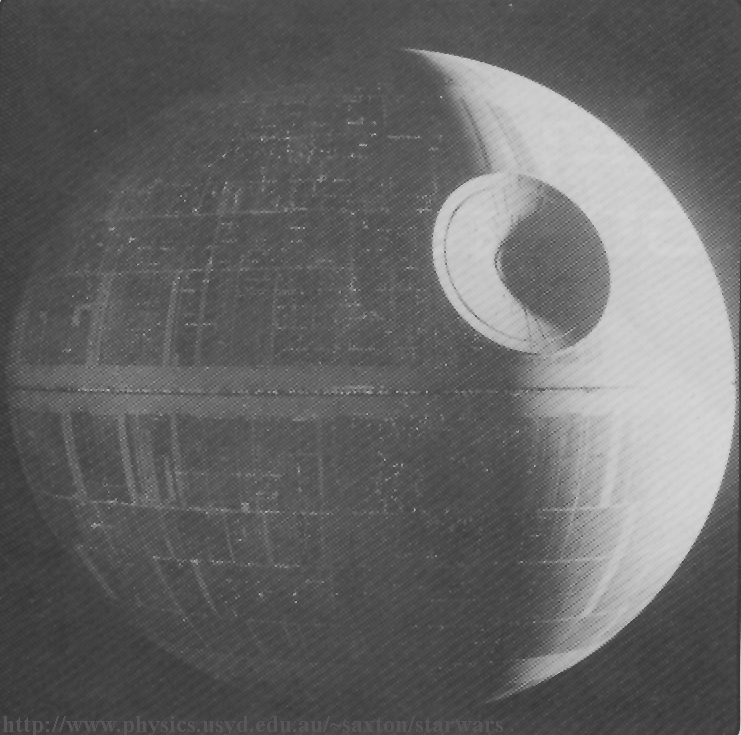
Damn, Occ. I was hoping for the Death Star.
 |
|
|
| St_Andrew |
| quote: | Originally posted by Yoepus
pics or STFU |

space sience is so exiting :D |
|
|
| nrjizer |
| IMHO if it's large enough to have gravity which binds it together, and it's orbiting the Sun, then just call it a planet. If it's too small for gravity, then its an asteroid (which is 1 big chunk of rock as opposed to many smaller ones held together by gravity). If it circles a planet instead of the Sun (or any star), call it a moon. |
|
|
| DrUg_Tit0 |
| quote: | Originally posted by nrjizer
IMHO if it's large enough to have gravity which binds it together, and it's orbiting the Sun, then just call it a planet. If it's too small for gravity, then its an asteroid (which is 1 big chunk of rock as opposed to many smaller ones held together by gravity). If it circles a planet instead of the Sun (or any star), call it a moon. |
Well, I hate to burst your theory but every existing object exhibits that funny property of gravitationally attracting other objects and holding itself together because of gravity, so you'll have to come up with a better solution than this one ;) |
|
|
| MisterOpus1 |
Yeah, I guess Haley should be a planet by that definition. And all those "asteroids" in the Kuiper Belt are just a bunch of "mini-planets"?
Hmmm. Interesting. |
|
|
| PHALPAX |
| quote: | Originally posted by MisterOpus1
Yeah, I guess Haley should be a planet by that definition. And all those "asteroids" in the Kuiper Belt are just a bunch of "mini-planets"?
Hmmm. Interesting. |
hhhmmm.....the ISS is about the size of a big astroid, thus making it the first synthetic planet ever made! Rock on humanity! |
|
|
|
|

