|
The most depressing photo you've seen (pg. 2)
|
View this Thread in Original format
| lücid |
and one more that's surely the most depressing...
 |
|
|
| No one |
:(
Cannot believe a little boy that young is smoking. Like a man. :eek:
That little one next to the vulture..man. :(
Yup, I'm depressed now. |
|
|
| occrider |
I thought this was rather depressing.
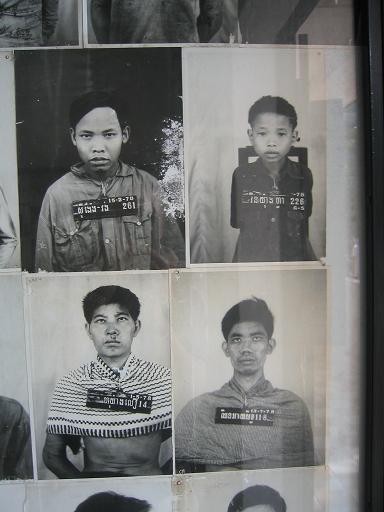
Detainees of Khmer Rouge torture center S-21. I believe that out of the tens of thousands that passed through its doors only 6 survived.
Now to lighten the mood slightly (as if that's possible in a war):

Poor pillow :( |
|
|
| enferno |
| quote: | Originally posted by Laux de par
whats that infamous picture with (it looks to be a german?) man with a gun to (looks to be Asian?) teens head. You can kind of see bullet penetrating the head... :conf: sorry for the lack of info. the shooter is on the left side of pic, victim on right. |
are you talking about the viet-kom execution? |
|
|
| getfoul |
this one makes me shed a single tear.
|
|
|
| Laux de par |
| quote: | Originally posted by enferno
are you talking about the viet-kom execution? |
you have a pic?
I think I've seen the same man shooting the kid in the head as someones avatar here :nervous:
it's by far the most hideous i've EVER seen.
is that pic of the child smoking real ? :conf: |
|
|
| occrider |
| quote: | Originally posted by Laux de par
you have a pic?
I think I've seen the same man shooting the kid in the head as someones avatar here :nervous:
it's by far the most hideous i've EVER seen.
|
This photo?
 |
|
|
| Laux de par |
| quote: | Originally posted by occrider
This photo?
|
yes !!! how disturbing.... who took it?
Will you give me a brief synopsis on the history of this photo ? |
|
|
| occrider |
| quote: | Originally posted by Laux de par
yes !!! how disturbing.... who took it?
Will you give me a brief synopsis on the history of this photo ? |
Photojournalist Eddie Adams took careful portraits of U.S. presidents and world figures. But his best known work is one that was sudden and unglamorous: the 1968 killing of a Viet Cong captive in Vietnam.
Adams' picture of South Vietnam's police chief, Lt. Col. Nguyen Ngoc Loan, shooting the prisoner in the head on Feb. 1, 1968, would became one of the Vietnam War's most indelible images and one that shocked the American public.
Adams died Sunday at his Manhattan home from complications of amyotrophic lateral sclerosis, or Lou Gehrig's disease, said his assistant, Jessica Stuart. He was 71.
"Eddie Adams was an enormous talent and an inspiration to generations of AP photographers and staffers. His courage and creativity left a mark that will live forever," said AP President and CEO Tom Curley.
In addition to his photographs of 13 wars, Adams' images of politics, fashion and show business appeared on countless magazine covers and in newspapers around the world. His portraits of presidents ranged from Richard Nixon to President Bush, and those of world figures included Pope John Paul II, Deng Xiaoping, Anwar Sadat, Fidel Castro and Mikhail Gorbachev.
But fame instant, enduring and discomforting resulted from that single execution photograph taken on the embattled streets of Cholon Saigon's Chinese quarter during the communists' Tet Offensive.
Drawn by gunfire, Adams and an NBC film crew watched South Vietnamese soldiers bring a handcuffed Viet Cong captive to a street corner, where they assumed he would be interrogated. Instead, Loan, strode up, wordlessly drew a pistol and shot the man in the head.
In later years, Adams found himself so defined and haunted by the picture that he would not display it at his studio. He also felt it unfairly maligned Loan, who lived in Virginia after the war and died in 1998.
"The guy was a hero," Adams said, recalling Loan's explanation that the man he executed was a Viet Cong captain, responsible for murdering the family of Loan's closest aide a few hours earlier.
"Sometimes a picture can be misleading because it does not tell the whole story," Adams said in an interview for a 1972 AP photo book. "I don't say what he did was right, but he was fighting a war and he was up against some pretty bad people."
Adams won a 1969 Pulitzer Prize for the Saigon execution picture, among the more than 500 honors he received in his career, including a 1978 Robert Capa Award and three George Polk Memorial Awards for war coverage.
Adams served as a Marine Corps combat photographer in the Korean War and became one of the nation's top photojournalists with newspapers, the AP from 1962-72 and again from 1976-80, and with Time-Life, Parade magazine and other publications.
Adams had no social or political agenda, but was at heart "a hard-news photographer, always sharply focused on the picture that tells the story," said Hal Buell, AP's former executive photo editor.
"He was also a perfectionist who would go to the mat over anything he saw in the editing that he felt detracted from the story but he was most critical of himself, for opportunities missed or not up to the high standards he set," Buell said. |
|
|
| Laux de par |
| quote: | Originally posted by occrider
Shedding Some Light On Another Picture That Became An Antiwar Icon
Excerpt from the book Vietnam Insights: Logic of Involvement and Unconventional Perspectives by James M. Griffiths
An incident that occurred during the Tet Offensive of 1968 probably created the longest lasting image of the horror and brutality of the Vietnam War. Vietnamese National Police chief Gen. Nguyen Loc Loan executed Vietcong prisoner Bay Lop in the streets of Saigon by placing a .38 to his head and pulling the trigger. This was done in the full view of the cameras. The still photograph taken by photographer Eddie Adams was flashed worldwide and won Adams a Pulitzer Prize. The film of the incident was broadcast to 20 million Americans on The Huntley-Brinkley Report on February 2, 1968.
This incident had a great impact on U.S. public opinion. A U.S. high school textbook of 1995 describes it this way, accompanied by the famous picture:
Particularly alarming was the savage flavor that the war had taken on. In the midst of the fighting , television cameras recorded the sight of a captured Vietcong guerrilla being led up to a South Vietnamese police officer on a downtown Saigon street. The officer pulled out his pistol and shot the young soldier through the head, leaving him lying dead with his blood gushing onto the street. No single image did more to create feeling among Americans that Vietnam was an immoral conflict.21
This incident does show the horror and brutality of war, but it is examined in this book for another reason. As horrible as the incident was, its brutality then and for the most part up to the present day has been portrayed as unprovoked . What the textbook of today does is repeat the errors of omission that occurred during the reporting of the event at the time.
Photographer Adams later said that he talked to Loan and Loan said "They killed many of my men and many of your people."22 Adams continued referring to the executed Vietcong: "They found out that he was the same guy who killed one of his ---uh---Loan’s officers and wiped out his whole family.23 Adams also expressed regret for what the photograph had done to Loan’s life. |
Wow.. that gave me chills. Thanks Occrider. Very helpful :)
Never would I have guessed that there were two sides to this "story." Because first seeing this pic, it was powerful enough to create a story. But who really knows if there were two sides? Loan could have said that to deter anger amongst all or to better his conscious. I wonder what Loan's life was like after the fact the incident was aired on television and this photo was produced in textbooks. |
|
|
| occrider |
| quote: | Originally posted by Laux de par
Wow.. that gave me chills. Thanks Occrider. Very helpful :)
Never would I have guessed that there were two sides to this "story." Because first seeing this pic, it was powerful enough to create a story. But who really knows if there were two sides? Loan could have said that to deter anger amongst all or to better his conscious. I wonder what Loan's life was like after the fact the incident was aired on television and this photo was produced in textbooks. |
Heh sorry, changed my post to a more well-written article I found that seems to paraphrase less. |
|
|
| Laux de par |
| quote: | Originally posted by occrider
Heh sorry, changed my post to a more well-written article I found that seems to paraphrase less. |
heh thanks again ! got extra info on Adams now. I'll definately have to check out some other of his work.
If i remember correctly, after once seeing this picture on a large scale, you can see the bullet as it had penetrated into the left side of the face. You can see the actual break of the flesh... eh, break is too minute of a word. Am i just seeing things? |
|
|
|
|

