|
The '10th planet' discovered; nah, it's just a Kuiper belt object like Pluto (pg. 2)
|
View this Thread in Original format
| pkcRAISTLIN |
| yeah, and some ancient civilisation (forget who) worked out the circumference of the world just by looking at the motion of the sun\'s shadow. im not discounting their relative brilliance. i just find it hard to believe they could have any notion of things that we still cannot find. if anyone can provide me with proof, ill be all too happy to recant :) |
|
|
| DJ Kenosis |
This is not the same object as Sedna. Sedna already has an extensive research literature about it (including a Nature paper written by my thesis advisor); this object is new. Sedna is, though, one of the many Kuiper belt objects found that are comparable in size to Pluto. The one Dr. Brown has found recently is the first one that is definitely larger. |
|
|
| DJ Kenosis |
| quote: | Originally posted by pkcRAISTLIN
yeah, and some ancient civilisation (forget who) worked out the circumference of the world just by looking at the motion of the sun's shadow. im not discounting their relative brilliance. i just find it hard to believe they could have any notion of things that we still cannot find. if anyone can provide me with proof, ill be all too happy to recant :) |
Those were the Greeks (Eristothenes) who discovered that but with geometry, not vodoo and religious dogma. |
|
|
| Trancer-X |
| quote: | Originally posted by DJ Kenosis
This is not the same object as Sedna. Sedna already has an extensive research literature about it (including a Nature paper written by my thesis advisor); this object is new. Sedna is, though, one of the many Kuiper belt objects found that are comparable in size to Pluto. The one Dr. Brown has found recently is the first one that is definitely larger. |
I guess that I stand corrected. Thank you! :)
| quote: | Washington Post
Mystery Heavenly Body Discovered
31-Dec-1983
A heavenly body possibly as large as the giant planet Jupiter and
possibly so close to Earth that it would be part of this solar system
has been found in the direction of the constellation Orion by an
orbiting telescope aboard the U.S. infrared astronomical satellite.
So mysterious is the object that astronomers do not know if it is a
planet, a giant comet, a nearby "protostar" that never got hot
enough to become a star, a distant galaxy so young that it is still
in the process of forming its first stars or a galaxy so shrouded in
dust that none of the light cast by its stars ever gets through. "All
I can tell you is that we don't know what it is," Dr. Gerry
Neugebauer, IRAS chief scientist for California's Jet Propulsion
Laboratory and director of the Palomar Observatory for the
California Institute of Technology said in an interview.
The most fascinating explanation of this mystery body, which is so
cold it casts no light and has never been seen by optical telescopes
on Earth or in space, is that it is a giant gaseous planet, as large
as Jupiter and as close to Earth as 50 billion miles. While that may
seem like a great distance in earthbound terms, it is a stone's
throw in cosmological terms, so close in fact that it would be the
nearest heavenly body to Earth beyond the outermost planet
Pluto. "If it is really that close, it would be a part of our solar
system," said Dr. James Houck of Cornell University's Center for
Radio Physics and Space Research and a member of the IRAS
science team. "If it is that close, I don't know how the world's
planetary scientists would even begin to classify it."
The mystery body was seen twice by the infrared satellite as it
scanned the northern sky from last January to November, when
the satellite ran out of the supercold helium that allowed its
telescope to see the coldest bodies in the heavens. The second
observation took place six months after the first and suggested the
mystery body had not moved from its spot in the sky near the
western edge of the constellation Orion in that time. "This
suggests it's not a comet because a comet would not be as large as
the one we've observed and a comet would probably have moved,"
Houck said. "A planet may have moved if it were as close as 50
billion miles but it could still be a more distant planet and not have
moved in six months time.
Whatever it is, Houck said, the mystery body is so cold its
temperature is no more than 40 degrees above "absolute" zero,
which is 459 degrees Fahrenheit below zero. The telescope aboard
IRAS is cooled so low and is so sensitive it can "see" objects in the
heavens that are only 20 degrees above absolute zero. When IRAS
scientists first saw the mystery body and calculated that it could
be as close as 50 billion miles, there was some speculation that it
might be moving toward Earth. "It's not incoming mail," Cal Tech's
Neugebauer said. "I want to douse that idea with as much cold
water as I can." |
|
|
|
| Trancer-X |
| quote: | Originally posted by pkcRAISTLIN
if anyone can provide me with proof, ill be all too happy to recant :) |
Well, at least you're not waiting for the proof that atom's exist. |
|
|
| Trancer-X |
| quote: | Originally posted by pkcRAISTLIN
hehe, yeah, but its gonna take more than conjecture to convince me any ancient civilisation knew about anything that we, to this day, still cannot see ;) |
Yes, because we're so smart and we know everything. Right? I wonder why we haven't been able to figure out how or why the Egyptians, Mayans and Aztecs were able to build their pyramids with such amazing precision and celestial alignment? At Baalbek, in Southern Lebanon - I'd like to know how they managed to lift an 800 TON monolith into place? This is the same monolith the Army Corps of Engineers said would be virtually impossible to move, even using advanced machinery of todays standards!



I wonder how that guy Plato could come up with ideas such as that of an ancient civilization like Atlantis, and it's lost race of inhabitants who may have governed our world prior to their destruction.
It's amazing to think that in the billions of years our planet has been evolving, we are only just now making real medical and scientific progress along the lines of such things as genetics or even astronomy. And our still relatively primitive society wholeheartedly accepts the fact that we still kill one another on a daily basis, over largely unimportant (often ideological) misunderstandings and/or disagreements that are most often perpetuated by money and greed.
If WE ARE the only intelligent life-forms in existence, then this must be one hell of a cognitively challenged Universe that we're living in. |
|
|
| pkcRAISTLIN |
| quote: | Originally posted by Trancer-X
[color=#33ccff]Yes, because we're so smart and we know everything. Right? I wonder why we haven't been able to figure out how or why the Egyptians, Mayans and Aztecs were able to build their pyramids with such amazing precision and celestial alignment? At Baalbek, in Southern Lebanon - I'd like to know how they managed to lift an 800 TON monolith into place? This is the same monolith the Army Corps of Engineers said would be virtually impossible to move, even using advanced machinery of todays standards! |
to quote lister from red dwarf- they had massive whips rimmer. massive massive whips :p
| quote: | Originally posted by Trancer-X
I wonder how that guy Plato could come up with ideas such as that of an ancient civilization like Atlantis, and it's lost race of inhabitants who may have governed our world prior to their destruction. |
and where is the evidence that atlantis was anything but a flight of fantasy?? was plato the world's first fantasy author? :D
what i want you to explain to me, is how a technologically ancient people could possibly account for a space body that we are still unable to find with the best telescopes available. im not discounting that they did, but id like to know HOW. coz if they really could, why isnt the rest of the galaxy that they couldnt see mapped out for us as well?? |
|
|
| Trancer-X |
| quote: | Originally posted by pkcRAISTLIN
what i want you to explain to me, is how a technologically ancient people could possibly account for a space body that we are still unable to find with the best telescopes available. im not discounting that they did, but id like to know HOW. coz if they really could, why isnt the rest of the galaxy that they couldnt see mapped out for us as well?? |
I definitely can't and won't claim to know everything.
BTW, the Mayan calendar was off by 0.0002 days. However, us geniuses couldn't get our calendar right until the Gregorian was developed in the late 1500's, and even then - we didn't adopt it here in America until 1752.
some Peruvian handiwork:


http://www.world-mysteries.com/gw_rnincas.htm |
|
|
| DrUg_Tit0 |
| quote: | Originally posted by Trancer-X
I'd like to point to the fact that with all of our so called "modern technology," we are just now finding this planet - while the ancient Sumerian's (and other such Mesopotamians) knew about it over 12,000+ years ago.
http://www.xfacts.com/MUFON_LA/search2.ram
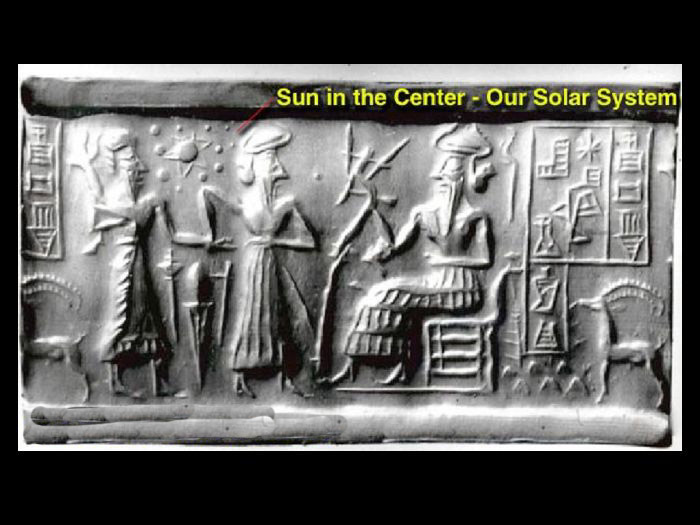 |
I suppose those two additional planets in the picture might be due to Moon being considered a planet, and perhaps the fact that Venus has been considered to be 2 planets for a long time (the morning one and the night one). The fact that the picture represents exactly 11 planets is a strong hint towards that line of reasoning, because it is very likely that there are dozens of planet-size objects in the Kuiper belt. Ultimately, we must decide on whether we will have 8, 9, or a hundred of planets, depending on whether we include Kuiper belt objects into the planet family or whether we exclude them all except for Pluto. Either way, the Sumeran picture is a not accurate. |
|
|
| rainbow_marble |
| zzz this is old news. what is interesting however, is the fact that there could possibly be life within one of jupiter's moons "europa" from the surface, scientists are able to tell that there is a warm ocean underneath the surface of the planet... i believe a satellite was sent several years ago to investigate? i'll look into this further but its pretty interesting that we could have possibly discovered a planet that contains water |
|
|
| metalgearsolid |
| quote: | Originally posted by Trancer-X
At Baalbek, in Southern Lebanon - I'd like to know how they managed to lift an 800 TON monolith into place? This is the same monolith the Army Corps of Engineers said would be virtually impossible to move, even using advanced machinery of todays standards!
|
how do you know that they even moved it? Don't you think the world could've been different and that they didn't move it, instead they just shaped the rock or whatever?
Maybe a UFO moved it for them:nervous: |
|
|
|
|

