|
Studio Buildout Discussion (pg. 3)
|
View this Thread in Original format
| Diginerd |
1. Purely for personal fun and amusement. I've worked in a for profit studio before, except it's hard to make the profit part come out right. That said, by the time I've finished building this out I can play tax games with the space, as well as have demonstratble costs when putting out records (ie more money for me).
2. That's the other reason I'm doing this. I have a ton of gear, and I never seam to have it all setup or be able to use it as I wish. Too many moving parts and all that. I want to be able to go in there and be making music inside 5 minutes.
For that I need to do a lot of up-front systems design, by which I mean setup the midi control just so, all the audio hooked up to the patchbay in just the right way so I can use everything without patching. ie I only need to use the patchbay if I want to do something special with a particular source.
All of this translates to a significant period of time of not doing any actual music, but ultimately it should pay of with massively increased productivity when I'm in there, and once things are all "Shaken down" no more annoying "WTF? Why is it only coming through on the right channel" kind of moments.
I want to be able to quickly chose to do something and have it happen, not spend 20 minutes struggling and killing my creativity in the process. That's one of the major benefits of going through this process.
Of course if I was purely software based it would be akin to setting up my "PC just so", unfortunately the physical world is a little tougher to deal with in this manner!
As to your point of being more creative with less gear, I'm a big fan of working under limitations (as you may have seen from my water software discussions a while back), but on the otherhand if I can have all my tools available to me inside 10 seconds then why the hell not..
Finally it was a matter of space in the house. This is the only location where I could put my gear, so having it nice to work in strikes me as a good move. |
|
|
| Diginerd |
Oh as an aside. If you're doing construction for your hobby, and your hobby isn't construction then you may well have gone off the deep end!
I have no idea if I'm ever going to be releasing tracks commerically again. I'd love to, but if not I want a room I can grow old, fat and happy in. :-) |
|
|
| DJFreaq |
| quote: | Originally posted by Diginerd
I'd love to, but if not I want a room I can grow old, fat and happy in. :-) |
Beautifully said. |
|
|
| halo |
| quote: | Originally posted by jahnlay
Polystyrene is porous, just the air gaps are very small, do some research and you'll see. |
Absorbing Sound is not just a matter of porosity. In fact is's true that polysyrene has a low structure factor, which means that there is a lot of air enclosed in a defined volume of material. But porositiy is not to be confused with a low structure factor. For a material to be porous it also has to have a low air flow resistance (? german: Strömungsresistanz)... you should be able to blow rigth through the material... well... kinda :) |
|
|
| simonbostock |
Hey Diginerd,
This is really interesting stuff.. I know people dream of things like this but when I get a place of my own, I'm going to convert a loft into a studio so I'll be keeping an eye on this thread.
Best of luck! |
|
|
| Diginerd |
Thanks for the support..
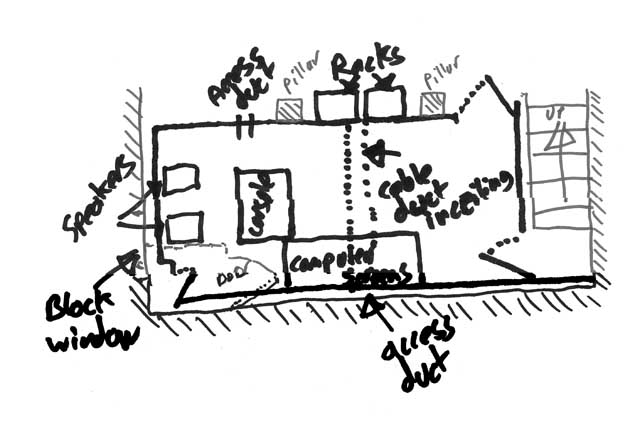
Ok here's some chicken scratch drawings.
1st up Floorplan:-
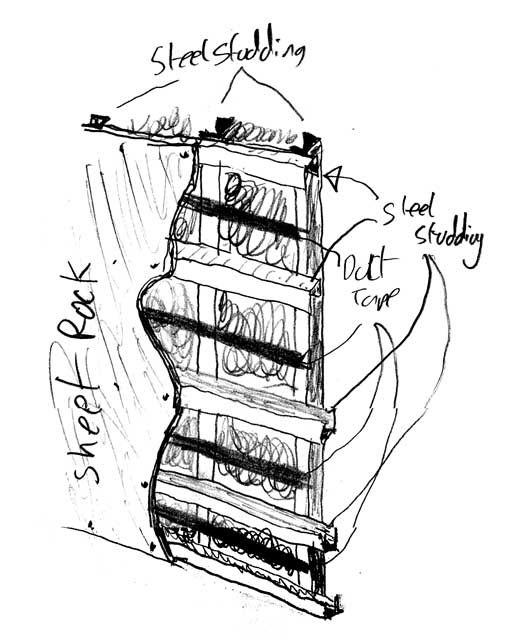
And here's how I plan to build the walls, once I rip off the panneling. The scribble is rockwool.
 |
|
|
| Diginerd |
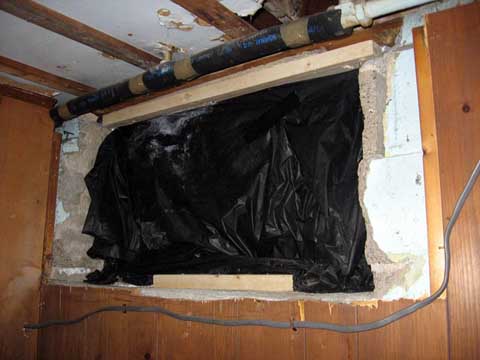
Say goodbye to the window....
1st of all put up black plastic so from the outside nothing looks too untoward...
Next put up a piece of 1" ply and fix and fill (Great stuff) around the edges.
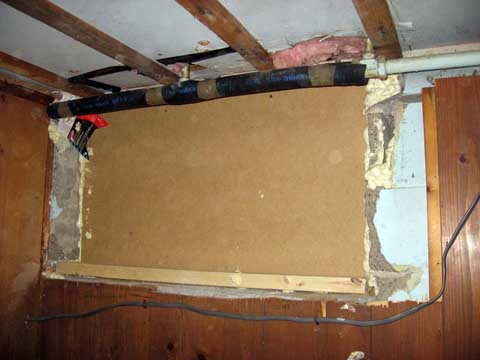
Finally rip off the chintzy wooden panneling, put up a second piece of Ply (packign the gap between the two panels with rock wool, seal that in too and coat the whole lot in Dry Lok. Add some hydraulic cement to seal up all the cracks around the windows whilst we're at it.
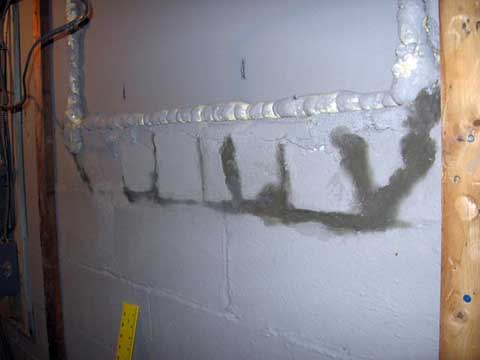
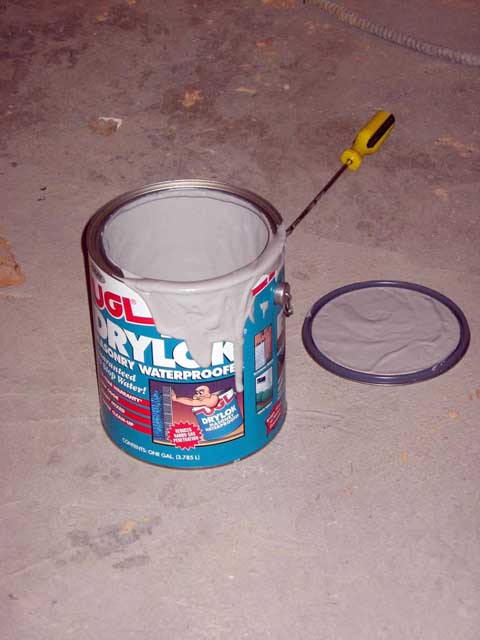
Next up, destruction of the Power panel closet and the first lot of studding is going to go up.. |
|
|
| -_1_--Ben--_1_- |
Are you going to make hardcore ?
You`ve wrecked that place before you began.
Lol
______
never the less, you can make a nice place of it. |
|
|
| Diginerd |
You should see the mess I made when I trashed the closet and ripped all the panneling off the walls..
So, this weekend was productive.
Finished ripping out all the panneling on the walls, ripped down the closet containing the breaker board, painted the window wall with sealant, got the studing up on the window wall (And moved a power cable), & packed the gaps between studs with rockwool
I also finished packing out the ceiling with rock wool, and sealed up all the holes. I also decided to fill the gaps between the wooden slats with an additional layer of sheetrock (For mass).
Unfortunately all that condenses to two pics!
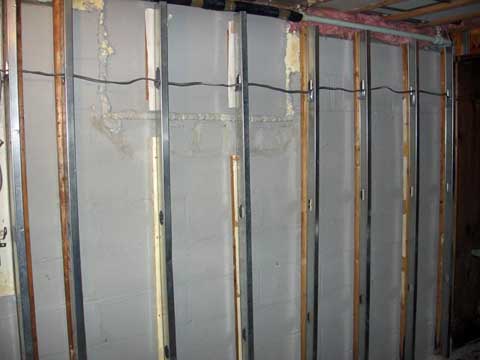
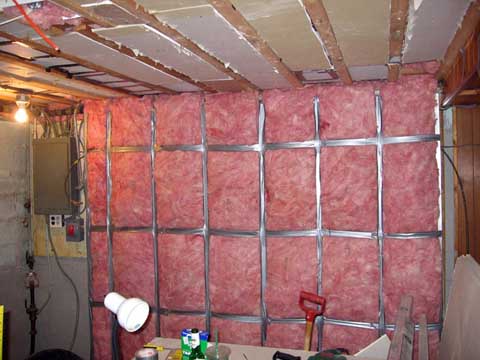
I do promis I'll get around to posting some pics and graphs of my models explaining the method behind my madness.
Also at some poitn I suppose I need to consider patchbay design too. |
|
|
| halo |
Nice work.
Just two things:
Why not close the window with concrete ore bricks? Those would give you way better sound insulation.
Why cover the whole wall with another layer that basically does nothing more than take away some space? Wasn't your room below the ground up to the lower edge of the window? |
|
|
| Diginerd |
1. I have to leave the option of at some point restoring the window. Replacing the window would have been permit hell), so my sealing although looking pretty brutal is considered "Temporarary"!
Also the way I've sealed it is pretty effective, neither one of the 1" boards is connected to the same timber frame mounted to the wall, and there is an air gap half packed with rockwool.
2.
A) I needed to reduce the dimensions of the room.
B) Once there is an airgap infront of the rock wool and 2 layers of sheetrock infront of that the whole wall acts as a LF Absorber (As will the others).
At the end of that I should be in the fortunate position of only having to damp mids and highs in the rooms using foam (ie the infamous eggcrate foam that everyone considers as treatment). LF which is the usual problem in this kind of space is being taken care of by room construction. No need to in-room bass traps. |
|
|
| halo |
| quote: | Originally posted by Diginerd
A) I needed to reduce the dimensions of the room.
|
Why is that?
Reduced dimensions will raise the lower cutoff of the room response.
| quote: | Originally posted by Diginerd
B) Once there is an airgap infront of the rock wool and 2 layers of sheetrock infront of that the whole wall acts as a LF Absorber (As will the others).
|
Right, but membrane or panel absorbers are effective only in a very small range. Building them without proper planning will likely cause more low frequency problems than cure.
| quote: | Originally posted by Diginerd
(ie the infamous eggcrate foam that everyone considers as treatment) |
Using plain acoustic foam is more effective than the eggcrate types. But that's an old argument :rolleyes: |
|
|
|
|

