|
Conceptual Physics Question (pg. 4)
|
View this Thread in Original format
| Omega_M |
| quote: | Originally posted by Caela
My Guesses :
1. A
(laser is smaller, light is more concentrated, less light particles = faster speed?)
2. C
(terminal velocity has a universal speed for every object...can't remember the exact number though)
3. B
(less air pressure at the bottom of the ball, since the top is leading the rest of it through the air, resulting with more velocity under the ball, since it is driving the ball in the direction it's moving). |
Fail.
1)Speed of light is a fundamental constant (3 x 10^8 m/s)
2) Read the question again.
3) Vague.
Edit: Never mind, I didn't read Astroboy's post. |
|
|
| Nrg2Nfinit |
| quote: | Originally posted by Caela
hehe...this is why I am not a physics major. Those were just guesses anyhoo :) |
It also helps explain your hair color :p |
|
|
| astroboy |
| quote: | Originally posted by Lunar Phase 7
Did you even read my post?
Please check that wikipage, cause I can't be arsed typing anymore. |
Yes I did. Including the one that said "excluding the limited effect of air resistance)." That's a heck of a thing to exclude when you're answering a question about terminal velocity, a concept that depends on air resistance.
You first suggested that weight was immaterial to terminal velocity (ie air resistance met by a falling object). Then you implicitly conceded that it was relevant as demonstrated by my feather and elephant example (I chose an extreme example to demonstrate that in principle weight must be relevant as common sense would so dictate).
Crosswinds or "horizontal forces" are irrelevant in this case. Its a basic question of upward air resistance as opposed to downward force.
From basic principles look at it this way:
The upward force air resistance has on an object is proportional to A) the surface area of the object and B) the velocity of the object. A can be discounted because in our case the two objects are of the same shape.
Now terminal velocity is reached when the downward force of an object is equal to the upward force.
For simplicity's sake lets assume that the two objects are a polystyrene ball with a mass of 98 grams (downward force of 1 Newton) and a heavy metal ball of the same diameter with a mass of 10.2kg (downward force of 100 Newtons). Now assuming both begin to accelerate (gain velocity) at the same rate, and the upward air resistance begins to climb at the same rate - will it take the air resistance longer to climb to 1 Newton of upward force for object A or 100 Newtons of upward force for object B?
edit: looks like D-res has already explained all this in his post.
Looks like you're getting confused with Gallileos proof that objects accelerate at a constant speed of 9.8m/s/s if you exclude air resistance (ie in a vacuum.. it's precisely why in the wiki or wherever people talk about Gallileo they exclude air resistance). And the idea of terminal velocity to which weight is very relevant. |
|
|
| Lunar Phase 7 |
| quote: | Originally posted by astroboy
Yes I did. Including the one that said "excluding the limited effect of air resistance)." That's a heck of a thing to exclude when you're answering a question about terminal velocity, a concept that depends on air resistance.
You first suggested that weight was immaterial to terminal velocity (ie air resistance met by a falling object). Then you implicitly conceded that it was relevant as demonstrated by my feather and elephant example (I chose an extreme example to demonstrate that in principle weight must be relevant as common sense would so dictate).
Crosswinds or "horizontal forces" are irrelevant in this case. Its a basic question of upward air resistance as opposed to downward force.
From basic principles look at it this way:
The upward force air resistance has on an object is proportional to A) the surface area of the object and B) the velocity of the object. A can be discounted because in our case the two objects are the same.
Now terminal velocity is reached when the downward force of an object is equal to the upward force.
For simplicity's sake lets assume that the two objects are a polystyrene ball with a mass of 98 grams (downward force of 1 Newton) and a heavy metal ball of the same diameter with a mass of 10.2kg (downward force of 100 Newtons). Now assuming both begin to accelerate (gain velocity) at the same rate, and the upward air resistance begins to climb at the same rate - will it take the air resistance longer to climb to 1 Newton of upward force for object A or 100 Newtons of upward force for object B? |
Oksy, you've got your view, I got mine. Let's see the results when the guy takes the test. |
|
|
| Caela |
| quote: | Originally posted by Nrg2Nfinit
It also helps explain your hair color :p |
:rolleyes: Who said this is my natural hair color? ;) |
|
|
| astroboy |
| quote: | Originally posted by Lunar Phase 7
Oksy, you've got your view, I got mine. Let's see the results when the guy takes the test. |
It's not my view, it's basic physics.
| quote: |
At low speeds the drag is much less than the gravitational force and so the object accelerates. As it speeds up the drag increases, until eventually it equals the weight.
...
Mathematically, terminal velocity is described by the equation
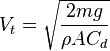
where
Vt is the terminal velocity,
m is the mass of the falling object,
g is gravitational acceleration,
Cd is the drag coefficient,
ρ is the density of the fluid the object is falling through, and
A is the object's cross-sectional area. |
Source:http://en.wikipedia.org/wiki/Terminal_velocity
| quote: | | With all else (gravitational acceleration, density, cross-sectional area, drag constant, etc.) being equal, heavier objects fall faster. |
Source:http://en.wikipedia.org/wiki/Drag_(physics)#Velocity_of_falling_object |
|
|
| astroboy |
| quote: | Originally posted by Caela
hehe...this is why I am not a physics major. Those were just guesses anyhoo :) |
Yeah I'd probably suck at answering questions on what you're studying. But you shouldn't write yourself off. At least you attempted to answer the questions rationally, which is the main thing with maths/physics. If you wanted to you probably could major in physics. |
|
|
| Nrg2Nfinit |
| quote: | Originally posted by Caela
:rolleyes: Who said this is my natural hair color? ;) |
could have easily fooled me :stongue: |
|
|
| Caela |
| quote: | Originally posted by Nrg2Nfinit
could have easily fooled me :stongue: |
At least I attempted to answer the questions...Where were your answers? |
|
|
| Omega_M |
| quote: | Originally posted by D-res
Wording your sentence like this can be potentially misleading for those unfamiliar. While you're correct in saying heavier objects will exert more downward force than lighter objects, one must keep in mind that the downward acceleration of gravity (-9.8m/s^2) is the same for all objects, regardless of weight. |
I don't quite understand how my statement is misleading. All I am doing is stating Newton's second law.
Infact, your statement that acceleration due to gravity is constant, is misleading for objects falling in air.
As the object starts falling down the force of gravity is dominant and initially, there is no drag.
As the object speeds up, drag acts upwards and starts to nullify the effect of gravity.
It implies that acceleration starts with a finite positive value and ends up being zero at the instant the body reaches terminal velocity.
After that, the object continues to fall with a constant velocity and zero acceleration.
If acceleration due to gravity is constant, it implies that the object always has a constant net downward force acting on it,
and that it always speed up. But that is just not the case in air or any medium except for vacuum. |
|
|
| Nrg2Nfinit |
| quote: | Originally posted by Caela
At least I attempted to answer the questions...Where were your answers? |
i have the second last calculus to worry about here! jesus. See my calculus thread add your contributions there :p |
|
|
| Lunar Phase 7 |
| quote: | Originally posted by astroboy
It's not my view, it's basic physics.
Source:http://en.wikipedia.org/wiki/Terminal_velocity
Source:http://en.wikipedia.org/wiki/Drag_(physics)#Velocity_of_falling_object |
I dont't wanna fall out about this, I respect the fact you have took time to think this through, and you do seem to know your stuff, but I still say you are wrong. Or at least, the least right.
http://www.physlink.com/Education/AskExperts/ae6.cfm
Might be interesting to read. |
|
|
|
|

