|
9/11 planner confesses to many plots
|
View this Thread in Original format
| star-traveller |
| quote: | 9/11 planner confesses to many plots
He compares Al Qaeda operatives to American revolutionaries in his tribunal testimony.
By Peter Spiegel, Times Staff Writer
March 15, 2007
WASHINGTON — Khalid Shaikh Mohammed, the Kuwaiti national who is thought to be the highest-ranking Al Qaeda operative in U.S. custody, told a military tribunal in Guantanamo Bay, Cuba, last weekend that he was responsible for the Sept. 11 terrorist attacks, according to a transcript of the hearing.
In a written statement read to a three-officer panel, Mohammed claimed he was Al Qaeda leader Osama bin Laden's "operational leader" for the "9/11 operation," responsible for the "organizing, planning, follow-up and execution" of the plot.
"I was responsible for the 9/11 operation, from A to Z," Mohammed said, according to the transcript, which was released by the Pentagon on Wednesday night.
Mohammed was present at the hourlong, closed-door hearing Saturday, and he interjected frequently in slightly broken English. His admission was read to the tribunal by an Air Force lieutenant colonel who was serving as Mohammed's representative.
Mohammed also gave a lengthy, apparently spontaneous speech in which he likened Al Qaeda operatives to American revolutionaries, described a war against a dominating U.S. presence and even expressed a measure of remorse.
"I'm not happy that 3,000 been killed in America," he said, according to the transcript. "I feel sorry, even. I don't like to kill children and the kids. Never Islam are give me green light to kill people. Killing, as in the Christianity, Jews and Islam, are prohibited."
In his 31-point statement, Mohammed claimed responsibility for a wide range of terrorist plots, including the 1993 attack on the World Trade Center; the 2002 bombings of nightclubs in Bali, Indonesia; and the so-called shoe-bomber plot to down U.S. airliners traveling across the Atlantic. He said he took part in plans to kill former Presidents Carter and Clinton, as well as the late Pope John Paul II.
Mohammed has made similar claims in the past about his involvement in terrorist attacks. The Sept. 11 commission report, published three years ago, cited several interrogation reports compiled by U.S. intelligence agencies in which Mohammed described his role in the attacks in detail.
In addition, the trial of alleged Al Qaeda conspirator Zacarias Moussaoui last year included statements by Mohammed that were read to jurors, in which he described his role in several terrorist plots.
But Saturday's hearing was the first time Mohammed had faced a U.S. legal proceeding since he was captured in Pakistan in March 2003. And it was the first time he was allowed to freely discuss U.S. allegations without interrogators present. He used the opportunity to present charges that he had been tortured by his U.S. captors, and he attempted to portray himself as a soldier fighting a war of independence.
"What I wrote here is not I'm making myself hero when I said I was responsible for this or that," Mohammed said, addressing the U.S. Navy captain who presided over the tribunal. "You are military man. You know very well there are language for any war."
None of the military officers who participated were named, a common practice in the tribunals that is intended to prevent possible retribution.
Mohammed was held by the CIA in a secret U.S. detention facility for more than three years. He was moved into military custody at Guantanamo Bay in September after the Supreme Court ruled that all Al Qaeda detainees were covered by the Geneva Convention, which prohibits inhumane treatment.
Saturday's hearing, formally called a combatant status review tribunal, was intended to determine whether Mohammed will officially be classified as an "enemy combatant" and held at Guantanamo Bay.
Although Mohammed's tribunal is largely a formality, under military detention rules adopted after a series of Supreme Court rulings, all Guantanamo Bay detainees must be accorded such a hearing. A ruling is likely to take several weeks.
The government's case against him is based at least in part on a computer hard drive that the Pentagon said was seized when Mohammed was captured and that contained code names, flight numbers and photos of the Sept. 11 hijackers. But the case also may include classified evidence that was not made public or provided to Mohammed.
In addition to his claims of being involved in dozens of successful and foiled terrorist plots — including the so-called second wave of planned attacks on U.S. buildings, the Library Tower in Los Angeles among them — Mohammed asked that other detainees at Guantanamo Bay be treated humanely, arguing that many of them were not Al Qaeda or Taliban operatives.
Mohammed appears to have exaggerated his role in some of the plots. The 1993 World Trade Center bombing, for instance, was masterminded by Ramzi Ahmed Yousef, who was convicted of coordinating the attack by a U.S. court in 1996.
But Bruce Hoffman, a terrorism expert at Georgetown University, said most of the nearly three dozen attacks listed — many of which were foiled — appeared to have been masterminded or guided by Mohammed.
"It's almost every single Al Qaeda plot up until he was apprehended," Hoffman said. "This just shows that Bin Laden and [Al Qaeda No. 2 Ayman] Zawahiri can make threats, but Khalid Shaikh Mohammed was the go-to guy."
....
|
9/11 planner confesses to many plots
| quote: | CIA's Harsh Interrogation Techniques Described
Sources Say Agency's Tactics Lead to Questionable Confessions, Sometimes to Death
By BRIAN ROSS and RICHARD ESPOSITO
Nov. 18, 2005 — Harsh interrogation techniques authorized by top officials of the CIA have led to questionable confessions and the death of a detainee since the techniques were first authorized in mid-March 2002, ABC News has been told by former and current intelligence officers and supervisors.
They say they are revealing specific details of the techniques, and their impact on confessions, because the public needs to know the direction their agency has chosen. All gave their accounts on the condition that their names and identities not be revealed. Portions of their accounts are corrobrated by public statements of former CIA officers and by reports recently published that cite a classified CIA Inspector General's report.
Other portions of their accounts echo the accounts of escaped prisoners from one CIA prison in Afghanistan.
"They would not let you rest, day or night. Stand up, sit down, stand up, sit down. Don't sleep. Don't lie on the floor," one prisoner said through a translator. The detainees were also forced to listen to rap artist Eminem's "Slim Shady" album. The music was so foreign to them it made them frantic, sources said.
Contacted after the completion of the ABC News investigation, CIA officials would neither confirm nor deny the accounts. They simply declined to comment.
The CIA sources described a list of six "Enhanced Interrogation Techniques" instituted in mid-March 2002 and used, they said, on a dozen top al Qaeda targets incarcerated in isolation at secret locations on military bases in regions from Asia to Eastern Europe. According to the sources, only a handful of CIA interrogators are trained and authorized to use the techniques:
1. The Attention Grab: The interrogator forcefully grabs the shirt front of the prisoner and shakes him.
2. Attention Slap: An open-handed slap aimed at causing pain and triggering fear.
3. The Belly Slap: A hard open-handed slap to the stomach. The aim is to cause pain, but not internal injury. Doctors consulted advised against using a punch, which could cause lasting internal damage.
4. Long Time Standing: This technique is described as among the most effective. Prisoners are forced to stand, handcuffed and with their feet shackled to an eye bolt in the floor for more than 40 hours. Exhaustion and sleep deprivation are effective in yielding confessions.
5. The Cold Cell: The prisoner is left to stand naked in a cell kept near 50 degrees. Throughout the time in the cell the prisoner is doused with cold water.
6. Water Boarding: The prisoner is bound to an inclined board, feet raised and head slightly below the feet. Cellophane is wrapped over the prisoner's face and water is poured over him. Unavoidably, the gag reflex kicks in and a terrifying fear of drowning leads to almost instant pleas to bring the treatment to a halt.
According to the sources, CIA officers who subjected themselves to the water boarding technique lasted an average of 14 seconds before caving in. They said al Qaeda's toughest prisoner, Khalid Sheik Mohammed, won the admiration of interrogators when he was able to last between two and two-and-a-half minutes before begging to confess.
"The person believes they are being killed, and as such, it really amounts to a mock execution, which is illegal under international law," said John Sifton of Human Rights Watch.
The techniques are controversial among experienced intelligence agency and military interrogators. Many feel that a confession obtained this way is an unreliable tool. Two experienced officers have told ABC that there is little to be gained by these techniques that could not be more effectively gained by a methodical, careful, psychologically based interrogation. According to a classified report prepared by the CIA Inspector General John Helgerwon and issued in 2004, the techniques "appeared to constitute cruel, and degrading treatment under the (Geneva) convention," the New York Times reported on Nov. 9, 2005.
It is "bad interrogation. I mean you can get anyone to confess to anything if the torture's bad enough," said former CIA officer Bob Baer.
Larry Johnson, a former CIA officer and a deputy director of the State Department's office of counterterrorism, recently wrote in the Los Angeles Times, "What real CIA field officers know firsthand is that it is better to build a relationship of trust … than to extract quick confessions through tactics such as those used by the Nazis and the Soviets."
One argument in favor of their use: time. In the early days of al Qaeda captures, it was hoped that speeding confessions would result in the development of important operational knowledge in a timely fashion.
However, ABC News was told that at least three CIA officers declined to be trained in the techniques before a cadre of 14 were selected to use them on a dozen top al Qaeda suspects in order to obtain critical information. In at least one instance, ABC News was told that the techniques led to questionable information aimed at pleasing the interrogators and that this information had a significant impact on U.S. actions in Iraq.
According to CIA sources, Ibn al Shaykh al Libbi, after two weeks of enhanced interrogation, made statements that were designed to tell the interrogators what they wanted to hear. Sources say Al Libbi had been subjected to each of the progressively harsher techniques in turn and finally broke after being water boarded and then left to stand naked in his cold cell overnight where he was doused with cold water at regular intervals.
His statements became part of the basis for the Bush administration claims that Iraq trained al Qaeda members to use biochemical weapons. Sources tell ABC that it was later established that al Libbi had no knowledge of such training or weapons and fabricated the statements because he was terrified of further harsh treatment.
"This is the problem with using the waterboard. They get so desperate that they begin telling you what they think you want to hear," one source said.
However, sources said, al Libbi does not appear to have sought to intentionally misinform investigators, as at least one account has stated. The distinction in this murky world is nonetheless an important one. Al Libbi sought to please his investigators, not lead them down a false path, two sources with firsthand knowledge of the statements said.
When properly used, the techniques appear to be closely monitored and are signed off on in writing on a case-by-case, technique-by-technique basis, according to highly placed current and former intelligence officers involved in the program. In this way, they say, enhanced interrogations have been authorized for about a dozen high value al Qaeda targets — Khalid Sheik Mohammed among them. According to the sources, all of these have confessed, none of them has died, and all of them remain incarcerated.
While some media accounts have described the locations where these detainees are located as a string of secret CIA prisons — a gulag, as it were — in fact, sources say, there are a very limited number of these locations in use at any time, and most often they consist of a secure building on an existing or former military base. In addition, they say, the prisoners usually are not scattered but travel together to these locations, so that information can be extracted from one and compared with others. Currently, it is believed that one or more former Soviet bloc air bases and military installations are the Eastern European location of the top suspects. Khalid Sheik Mohammed is among the suspects detained there, sources said.
The sources told ABC that the techniques, while progressively aggressive, are not deemed torture, and the debate among intelligence officers as to whether they are effective should not be underestimated. There are many who feel these techniques, properly supervised, are both valid and necessary, the sources said. While harsh, they say, they are not torture and are reserved only for the most important and most difficult prisoners.
According to the sources, when an interrogator wishes to use a particular technique on a prisoner, the policy at the CIA is that each step of the interrogation process must be signed off at the highest level — by the deputy director for operations for the CIA. A cable must be sent and a reply received each time a progressively harsher technique is used. The described oversight appears tough but critics say it could be tougher. In reality, sources said, there are few known instances when an approval has not been granted. Still, even the toughest critics of the techniques say they are relatively well monitored and limited in use.
Two sources also told ABC that the techniques — authorized for use by only a handful of trained CIA officers — have been misapplied in at least one instance.
The sources said that in that case a young, untrained junior officer caused the death of one detainee at a mud fort dubbed the "salt pit" that is used as a prison. They say the death occurred when the prisoner was left to stand naked throughout the harsh Afghanistan night after being doused with cold water. He died, they say, of hypothermia.
According to the sources, a second CIA detainee died in Iraq and a third detainee died following harsh interrogation by Department of Defense personnel and contractors in Iraq. CIA sources said that in the DOD case, the interrogation was harsh, but did not involve the CIA.
The Kabul fort has also been the subject of confusion. Several intelligence sources involved in both the enhanced interrogation program and the program to ship detainees back to their own country for interrogation — a process described as rendition, say that the number of detainees in each program has been added together to suggest as many as 100 detainees are moved around the world from one secret CIA facility to another. In the rendition program, foreign nationals captured in the conflict zones are shipped back to their own countries on occasion for interrogation and prosecution.
There have been several dozen instances of rendition. There have been a little over a dozen authorized enhanced interrogations. As a result, the enhanced interrogation program has been described as one encompassing 100 or more prisoners. Multiple CIA sources told ABC that it is not. The renditions have also been described as illegal. They are not, our sources said, although they acknowledge the procedures are in an ethical gray area and are at times used for the convenience of extracting information under harsher conditions that the U.S. would allow.
ABC was told that several dozen renditions of this kind have occurred. Jordan is one country recently cited as an "emerging" center for renditions, according to published reports. The ABC sources said that rendition of this sort are legal and should not be confused with illegal "snatches" of targets off the streets of a home country by officers of yet another country. The United States is currently charged with such an illegal rendition in Italy. Israel and at least one European nation have also been accused of such renditions. |
CIA's Harsh Interrogation Techniques Describeda
I'm posting this article for you just to think for a minute, what if Khalid Shaikh Mohammed is acutally innocent?
My points:
1. Bush administration failed to capture Ben Laden.
2. All achievements in capturing terrorists who were behind 9/11 look very and very shallow before.
3. Bush was urgently needed one man who is willing to take all responsibility on himself just because he wants to close this case ASAP and proudly present it to the fellow Americans that he's finally captured the Evil No.1
4. I admire this guy, he was tortured by CIA and my guess is that he was forced to accept that. As you might understand even if he didn't do it he would never saw the light again. |
|
|
| Lilith |
| quote: | Originally posted by star-traveller
1. Bush administration failed to capture Ben Laden.
|
They gave up ages ago.
| quote: | | "He sees himself as a warrior and this is a very carefully worded statement and I am sure that for the most part, it is true," said Michael Scheuer, a former senior CIA agent who headed the unit that hunted Osama bin Laden before it was disbanded two years ago. |
SMG
Rest is speculation unless you've got some sort of proof. |
|
|
| Fir3start3r |
| quote: | Originally posted by star-traveller
4. I admire this guy, he was tortured by CIA and my guess is that he was forced to accept that. As you might understand even if he didn't do it he would never saw the light again. |
You admire this guy?
I think you seriously need to reevaluate your morals you obviously left behind you.
Regardless if he, 'fought the power' like some angst-ridden underdog teenager fighting 'the man', this is no time for misplaced sympathy.
This man was wanted for the killing of THOUSANDS of innocent people around the world.
Seriously wtf :wtf:
...I'm guessing you own a Che shirt somewhere in your closet too... |
|
|
| Dopey |
| quote: | Originally posted by Fir3start3r
...I'm guessing you own a Che shirt somewhere in your closet too... |
lol more like Stalimovich |
|
|
| Omega_M |
| quote: | Originally posted by star-traveller
2. All achievements in capturing terrorists who were behind 9/11 look very and very shallow before. |
Just because they weren't caught does not mean that the efforts are shallow. |
|
|
| Sunsnail |
| 9/11 planners and american rebels in the 1770's are not alike. |
|
|
| MrSquirrel |
I don't think anyone truly believes this guy was responsible for everything he claims, it is just too convenient.
But I also don't think any sane person (or even mildly insane such as myself) believe that this guy wasn't involved in the planning and execution of terrorist attacks on their "enemies".
The timing of the whole thing bothers me more than anything. Seems like another smoke and mirrors "hey look we are doing good stuff guys!" news release by the administration.
MrS
EDIT: mis worded sentence 2....fixed it. |
|
|
| star-traveller |
This guy confessed under tortures. The fact he was found guilt doesn't cost a dime. You all should understand that any of us will confess in anything just to stop it.
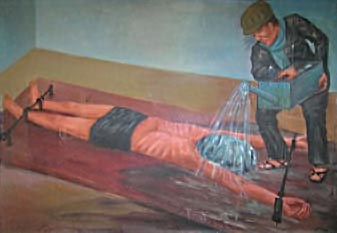
Waterboarding
I don't understand how in the civilized country, the country that has a lot of Human Rights committees, authorities can allow the interrogation to be a primary form of finding the guilt:
| quote: | ...
When higher-level al-Qaeda operatives were captured, CIA interrogators sought authority to use more coercive methods.
These were cleared not only at the White House but also by the Justice Department and briefed to senior congressional officials, according to a statement released last month by the Office of the Director of National Intelligence. Waterboarding was one of the approved techniques. |
Waterboarding Historically Controversial
I remember how many Human Rights organizations were condemning Russia because of the human rights abuses in Chechnya. It was the US administration policy to push Russia to prevent such cases. Now they do exactly the same and nobody gives a on it. They just jailed a guy who was interrogated to his confession. OMG, what's that country coming to? |
|
|
| Dopey |
| quote: | Originally posted by star-traveller
This guy confessed under tortures. The fact he was found guilt doesn't cost a dime. You all should understand that any of us will confess in anything just to stop it.
Waterboarding
I don't understand how in the civilized country, the country that has a lot of Human Rights committees, authorities can allow the interrogation to be a primary form of finding the guilt:
Waterboarding Historically Controversial
I remember how many Human Rights organizations were condemning Russia because of the human rights abuses in Chechnya. It was the US administration policy to push Russia to prevent such cases. Now they do exactly the same and nobody gives a on it. They just jailed a guy who was interrogated to his confession. OMG, what's that country coming to? |
So you have evidence that Khalid Shaikh Mohammed was waterboarded? Oh, you don't? You're speculating? Oh, okay. |
|
|
| star-traveller |
| quote: | Originally posted by Dopey
So you have evidence that Khalid Shaikh Mohammed was waterboarded? Oh, you don't? You're speculating? Oh, okay. |
WTF ?!?!?!?!?! Have you tried to read what I posted ????
| quote: | ...
According to the sources, CIA officers who subjected themselves to the water boarding technique lasted an average of 14 seconds before caving in. They said al Qaeda's toughest prisoner, Khalid Sheik Mohammed, won the admiration of interrogators when he was able to last between two and two-and-a-half minutes before begging to confess.
...
|
Look boy, do me a favor, don't post some crap just because you don't like me. |
|
|
| Dopey |
| quote: | Originally posted by star-traveller
WTF ?!?!?!?!?! Have you tried to read what I posted ????
Look boy, do me a favor, don't post some crap just because you don't like me. |
You really must be quite daft if you think an unnamed source whispering sweet nothings into a reporter's ear in a dark alley constitutes evidence. |
|
|
| star-traveller |
| quote: | Originally posted by Dopey
You really must be quite daft if you think an unnamed source whispering sweet nothings into a reporter's ear in a dark alley constitutes evidence. |
Look I thought I asked you, don't post brainless crap.
| quote: | ...
According to CIA sources, Ibn al Shaykh al Libbi, after two weeks of enhanced interrogation, made statements that were designed to tell the interrogators what they wanted to hear.
...
|
|
|
|
|
|

