|
Geroge Bush is a ****ing retard (pg. 2)
|
View this Thread in Original format
| Fir3start3r |
| quote: | Originally posted by Lilith
Hunt around the rivals and see if they can transfer the loan over into a fixed rate one for you, or just weather the storm because I'd say after enough of a beating, most everyone isn't going to want anything to do with loans unless they can help it and it'll come down again as consumers go into bunker down and saving mode.
Which would happen under normal circumstances.
In an environment where the government basically rewards folly in the finance sector, well we both know where that ship sails don't we... start bailing! :eek:
Plan B for you might also involve getting an evaluation on the house, sell it for a profit, find another place to live and punch out but that's usually going to take awhile to move on a market so it's not exactly a short term solution either. At least if the government goes in for this it might cause another housing boom you could be able to make a bit of money off of it instead of bleeding out from the interest rates. |
I guess if you guys are bunkering down, down there, why not do some home renovations? :D
I kinda agree with Shakka on this one.
The market normally corrects itself, even if is going to hurt. |
|
|
| Lilith |
Nuh-uh, I've had enough of furniture and floor polishing today and my arms feel like they're about to drop off, I've also come to the conclusion cordless drills are absolutely poo for doing anything which takes more than 15 minutes :mad:
The market always straightens itself out, just a case of 'when' and how, personally I'm more in favour of the finance sector working itself out and copping a few well deserved lumps to the head for educational purposes, then the government can do what it does best. Sit around and waste tax payers money making policy to regulate it so it doesn't happen again in 4-5years time when the shock of what's been done wears off and has another bunch of banditos ride in to the do the same thing all over again. |
|
|
| Krypton |
Excerpts from The Price of Loyalty:
This book recounts the tenure of Paul O'Neill as Treasury Secretary under Bush for the first 3 years of the administration...
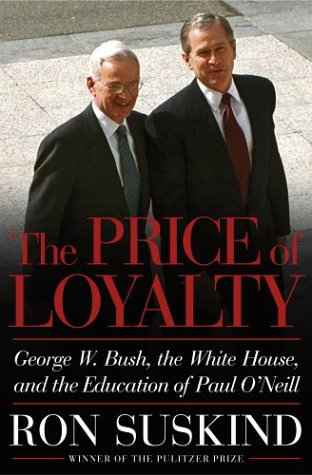
Excerpt:
It was the afternoon of Wednesday, January 24, the third day of the Bush administration...
O'Neill, as Treasury Secretary, institutionally designated to be the President's leading voice on the economy, offered a fifteen-minute overview on what he considered the informed opinion (that is, his and Greenspan's) and said that they were in the early stages of either an apparently mild recession or a pronounced inventory correction. The key was to remain sober. To watch the numbers. If we look concerned and talk up recession too much, he said, it will depress spending and encourage a downturn. O'Neill explained that the major problem was not the "encumbrances on capital" -- there was plenty of low-cost capital out there, unable to find a profitable home. The problem was on the consumption side. The real numbers, he assured the President, did not support the bleakness of some "economic theorists".
(It was these theorists such as Larry Lindsay who helped push the Bush tax cuts of $1.6 trillion. Remember, we had a $5 trillion dollar SURPLUS left over after the Clinton administration, so in 2000, Bush's people were trying to figure out what to do with it all.)
O'Neill referred to items of his memo. Marginal rate cuts, if they were affordable, should be the priority. He said the tax cut plan, under almost any permutation thus far proposed, wouldn't provide measurable stimulus in the short-term; what would create positive economic effects is "a sense that fiscal discipline has been preserved"--something that should boost equities markets (during the tech bubble crash) and keep long-term bond rates in check. All that left the economy well suited to respond to a rate cut from the Fed.
There were a dozen questions that O'Neill had expected Bush to ask. He was ready with the answers. How large did O'Neill consider the surplus, and how real? How might the tax cut be structured? What about reforming Social Security and Medicare, the budget busters? How will we know if the economy has turned?
Bush didn't ask anything. He looked at O'Neill, not changing his expression, not letting on that he had any reactions--either positive or negative.
O'Neill decided therefore to move from the economy to a related matter. Steel tariffs. If was a simmering issue--the US steel industry was hurting and pushing for protections...
The President said nothing. No change in expression. Next subject.
Certainly, each president's style is different. But O'Neill has a basis for comparisn. Nixon, Ford, Bush 41, and Clinton, with whom he had visited four or five times during the nineties for long sessions on policy matters. In each case, he's arrived prepared to mix it up, ready for engagement. You'de has it out. that was what he was known for. It was the reason you got called to the office. You met with the President to answer questions.
"I wondered, from the first, if the President didn't know the questions to ask," O'Neill recalled, "or did he know and just not want to know the answers? Or did his strategy somehow involve never showing what he thought? But you can ask questions, gather information, and not necessarily show your hand. It was strange."
/Excerpt |
|
|
| Krypton |
Excerpt 2:
The package of tax proposals, led by the 50 percent cut in the individual tax on dividends, had been all but buried before the midterm elections; it came up infrequently and always in the past tense--what George W. Bush wanted to do bu couldn't afford.
But after the Republicans won the midterms, O'Neill could sense a change in the White House, a smugness, a sureness. Now Cheney brought up the tax proposals again, how they would provide stimulus...
O'Neill jumped in, arguing sharply how the government was "moving toward a fiscal crisis" and "what rising deficits would mean to our economic soundness."
Cheney cut him off.
"Reagan proved deficits don't matter," Cheney said.
O'Neill shook his head, hardly believing that Cheney--whom he and Greenspan has known since Dick was a kid--could say such a thing.
He was speechless. Cheney moved to fill the void. "We won the midterms," he said. "This is our due." |
|
|
| Krypton |
| There's Bush administration monetary policy for ya;). |
|
|
| occrider |
| quote: | Originally posted by Shakka
In reality, he has proposed somehow helping 80,000 homeowners who must have good credit but simply cannot make their new adjustable rate payments (i.e. not a very large portion of the low-end credit spectrum when consensus seems to think that 2-3 million subprime borrowers could be in jeopardy). At the end of the day it's probably more politics than anything, but IMHO, any sort of bailout from something that anyone with 2 eyes and the ability to read should've seen coming for years is just bad policy and delves deeply into moral hazard.
|
Exactly. And so why do these 80,000 folks even deserve a bailout over teh 2-3 million other borrowers? Oh gee just because a person has a good credit history we should bail them out from being so stupid to get in a bad mortgage unlike the other similarly stupid people with poor credit histories :rolleyes:. Maybe these people with good credit histories should have thought twice before they got into voodoo loans or whatever to maximize their property holdings. Now we have this bilateral system in place where the Bush administration is bailing out home buyers while the Fed is bailing out lenders. The Fed shoud ONLY be concerned about avoiding a liquidity crunch. the credit crunch even if it leads to a recession, the primary focus are interest rates and avoiding depression. A recession would actually eliminate or purge non-competitive firms from the market and actually free up capital for more productive enterprises. Something I think the US is due for as evidenced by the latest going on. |
|
|
| Lilith |
| quote: | Originally posted by Krypton
There's Bush administration monetary policy for ya;). |
Well, that the inbred US aristocracy for ya :toothless
Just as a somebody who's dabbled from time to time in foreign investment it's not exactly a shock, in so much as something I always suspected happening behind the doors. To be blunt, he isn't (quite obviously every time he opens his mouth) very smart and it's not something which has encouraged me to reinvest again until he's gone, just so I can sleep a little better each night not fretting about something going *clunk* and waking up broke. Always figured he's one of those people who just simply cannot multitask, a lot like a few of the people I've worked with in the past that focuses on one thing only and just sort of stare at you blankly until the conversation comes around to what, either they want or what's currently their task.
Which is alright if you're one of the bean counters or cubicle smurfs, down in the mail room or doing data entry where your single-task focused as part of your career.
As a politician
No
It's just not a trait which rewards in any way, no one expects someone in charge to be an expert on everything, however they should have a rudimentary understanding from the ground up of what goes on. All good CEO's and upper managers have it along with the ability to not always be down there with the troops getting a hands on feel for it, but you do need to have those in the advisory role and middle management giving you no BS, straight up answers so you know where to steer them and the company. Or in this case, the country and it's economy.
To further illustrate this, is the now infamous expression for a time in Bush's speeches which was-
"Stay the Course"
Which I haven't heard for awhile.
Maybe that is a good thing, maybe the speech writers got sick of it losing it's impact but the very nature of the role as director, is to be forceful when you have too, but you do need a certain degree of pragmatic ability to adapt to changing events as you should have a feel for the pulse of things running. Bloody mindedness only really serves to alienate the lower echelons of your admin group and leaves you wide open to getting sideswiped by simply refusing to evolve with situations. You aren't listening to them, they've got no real option but to just keep rattling off whatever they where saying previously and knowing they will be ignored.
Second thing in association with this is sometimes ignored a little too much is the repeated sackings of those in advisory roles, be they field commanders or legal advisors, who are essentially getting dumped out of the advisory roles because they aren't saying what the bloody minded director wants to hear. To some degree, they are also tasked with the unenviable jobs which are impossible to do and when they fail, they simply get cut off with the announcement that they failed their job, leaving the director looking like he's doing something, however at the same time ignoring the warning signs of 'gee, not all's well in that area!'
And continue to load another body into the breech to do the exact same, impossible role.
It is very little wonder this is brewing up to be the worst US administration in history, should I be right just analysing it from a managers perspective without even touching on the events, after all, he certainly doesn't!
Which just leaves us with the Dems...
(Yes, didn't think I'd be so nice as to leave you guys out of the basting did you? :D You know me, I'll burn anything, anyone, regardless of political swing if they do a hokey job of it :p)
They're screwed :stongue:
I honestly don't know how they're going to fix the damage, really if someone landed me the job of running a debacle like that, I'd flat out walk away from it and go find another job quick as possible.
But they're going to win, it's not really up for debate I don't think.
So, we may as well look at the contenders there and the prime one seems to be the cheerleader, Hillary, who I've not really got one ounce of respect or confidence in. She hails from the same kind of quasi-aristocracy that they all come from, the old money, old school of US families that are more or less from the same neighbourhood. They grow up as kids, marry the girl next door and bumble into politics in their early 20's, bumble around for another 40-50 years and wander off leaving another gormless bunch of brats in charge to take over the next generation.
Out of touch, no idea really what goes on outside their cloistered lives and aside from the fact you've not staged a revolution yet to purge them from the face of the earth, I guess you're happy with it being that way.
Hillary has no guts, fairly mediocre record of not tipping the boat or steering anything anywhere either and manages to be exceptionally noisy and forceful whilst doing so, but unlikely to change anything. Which might turn out to be a good thing in some ways as a few of the last lots errors are going to need to bleed a bit before they ever heal, but she's not the stroke of blinding genius out of nowhere to save anything overnight.
Obama, I don't think will win. He doesn't seem to be too bad, but I'm not sure of his history, credentials and seems to have fallen out of nowhere. Which is a pity really as he'd probably go a long way, if allowed, to patching up (some really appalling) international relations and I'd sort of hope that the Dems keep him around for specifically that purpose and maybe launch him into office should the man present a nose for the job.
hmm, that's a bit long...
Short, personal micro management version- You're boned either way regardless of who gets in next term, save money, watch your interest rates on big investments and tough it out for the next few years until things settle down to a dull roar.
Because right now for the next year it's going to be all over the shop and you'd really not want to be taking big chances. |
|
|
| Shakka |
| quote: | Originally posted by occrider
Exactly. And so why do these 80,000 folks even deserve a bailout over teh 2-3 million other borrowers? Oh gee just because a person has a good credit history we should bail them out from being so stupid to get in a bad mortgage unlike the other similarly stupid people with poor credit histories :rolleyes:. Maybe these people with good credit histories should have thought twice before they got into voodoo loans or whatever to maximize their property holdings. |
One of my favorites is called "NINJA" loans. "No Income, No Job, No Assets." Yeah, sounds like a winner to me! Give him a jumbo!
| quote: | | Now we have this bilateral system in place where the Bush administration is bailing out home buyers while the Fed is bailing out lenders. The Fed shoud ONLY be concerned about avoiding a liquidity crunch. the credit crunch even if it leads to a recession, the primary focus are interest rates and avoiding depression. A recession would actually eliminate or purge non-competitive firms from the market and actually free up capital for more productive enterprises. Something I think the US is due for as evidenced by the latest going on. |
Agree. I'm of the belief that not only could there be a recession, frankly after all of this euphoric, nonsensical, maniacal credit binging, there should be a recession, regardless of what the Fed does. I kinda believe they might be powerless to stop it {despite the adage of not fighting the Fed).
This was interesting
| quote: |
Does America need a recession?
Aug 23rd 2007
From The Economist print edition
An intriguing, if unpopular, thought
THE late Rudi Dornbusch, an economist at the Massachusetts Institute of Technology, once remarked: “None of the post-war expansions died of old age. They were all murdered by the Fed.” Every recession since 1945, with the exception of the one in 2001, was preceded by a sharp rise in inflation that forced the central bank to raise interest rates. But today's Federal Reserve is no serial killer. It seems keener on blood transfusions than on bloodletting.
When the Fed cut its discount rate on August 17th, it admitted for the first time that the credit crunch could hurt the economy. The markets are betting it will soon cut its main federal funds rate. Economists are arguing vigorously about how much damage falling house prices and the subprime mortgage crisis will do. But there is one question that is rarely asked: even if a downturn is in the offing, should the Fed try to prevent it?
Most people think the question smacks of madness. According to received wisdom, the Fed should not cut interest rates to bail out lenders and investors, because this creates moral hazard and encourages greater risk-taking; but if financial troubles harm spending and jobs the Fed should immediately ease policy so long as inflation remains modest. Central bankers should be guided by the “Taylor rule”—and set interest rates in response to deviations in both output and inflation from desired levels.
A necessary evil
But should a central bank always try to avoid recessions? Some economists argue that this could create a much wider form of moral hazard. If long periods of uninterrupted expansions lead people to believe that the Fed can prevent any future recession, consumers, firms, investors and borrowers will be encouraged to take bigger risks, borrowing more and saving less. During the past quarter century the American economy has been in recession for only 5% of the time, compared with 22% of the previous 25 years. Partly this is due to welcome structural changes that have made the economy more stable. But what if it is due to repeated injections of adrenaline every time the economy slows?
Many of America's current financial troubles can be blamed on the mildness of the 2001 recession after the dotcom bubble burst. After its longest unbroken expansion in history, GDP did not even fall for two consecutive quarters, the traditional definition of a recession. It is popularly argued that the tameness of the downturn was the benign result of the American economy's increased flexibility, better inventory control and the Fed's firmer grip on inflation. But the economy also received the biggest monetary and fiscal boost in its history. By slashing interest rates (by more than the Taylor rule prescribed), the Fed encouraged a house-price boom which offset equity losses and allowed households to take out bigger mortgages to prop up their spending. And by sheer luck, tax cuts, planned when the economy was still strong, inflated demand at exactly the right time.
Many hope that the Fed will now repeat the trick. Slashing interest rates would help to prop up house prices and encourage households to keep borrowing and spending. But after such a long binge, might the economy not benefit from a cold shower? Contrary to popular wisdom, it is not a central bank's job to prevent recession at any cost. Its task is to keep inflation down (helping smooth out the economic cycle), to protect the financial system, and to prevent a recession turning into a deep slump.
The economic and social costs of recession are painful: unemployment, lower wages and profits, and bankruptcy. These cannot be dismissed lightly. But there are also some purported benefits. Some economists believe that recessions are a necessary feature of economic growth. Joseph Schumpeter argued that recessions are a process of creative destruction in which inefficient firms are weeded out. Only by allowing the “winds of creative destruction” to blow freely could capital be released from dying firms to new industries. Some evidence from cross-country studies suggests that economies with higher output volatility tend to have slightly faster productivity growth. Japan's zero interest rates allowed “zombie” companies to survive in the 1990s. This depressed Japan's productivity growth, and the excess capacity undercut the profits of other firms.
Another “benefit” of a recession is that it purges the excesses of the previous boom, leaving the economy in a healthier state. The Fed's massive easing after the dotcom bubble burst delayed this cleansing process and simply replaced one bubble with another, leaving America's imbalances (inadequate saving, excessive debt and a huge current-account deficit) in place. A recession now would reduce America's trade gap as consumers would at last be forced to trim their spending. Delaying the correction of past excesses by pumping in more money and encouraging more borrowing is likely to make the eventual correction more painful. The policy dilemma facing the Fed may not be a choice of recession or no recession. It may be a choice between a mild recession now and a nastier one later.
This does not mean that the Fed should follow the advice of Andrew Mellon, the treasury secretary, after the 1929 crash: “liquidate labour, liquidate stocks, liquidate the farmers, and liquidate real estate...It will purge the rottenness out of the system.” America's output fell by 30% as the Fed sat on its hands. As a scholar of the Great Depression, Ben Bernanke, the Fed's chairman, will not make that mistake. Central banks must stop recessions from turning into deep depressions. But it may be wrong to prevent them altogether.
Of course, even if a recession were in America's long-term economic interest, it would be political suicide. A central banker who mentioned the idea might soon be out of a job. But that should not stop undiplomatic economists asking whether a recession once in a while might actually be a good thing. |
|
|
|
| MisterOpus1 |
Just ran across this in another blog. Nevada is apparently up creek right now. Nearly 1 filing of foreclosure out of almost 200 houses. And your neck of the woods in Georgia, Shakka, seems to be hit pretty hard as well:
| quote: | Research out this morning shows foreclosure filings rose 9 percent from June to July and surged 93 percent over the same period last year, with Nevada, Georgia and Michigan accounting for the highest foreclosure rates nationwide.
The filings include default notices, auction sale notices and bank repossessions. The figures are the latest measure of the ailing housing market, which has seen defaults and foreclosures soar as financially strapped borrowers have failed to make payments or find buyers.
In all, 179,599 foreclosure filings were reported during July, up from 92,845 in the year-ago month, according to Irvine-based RealtyTrac Inc.
A total of 164,644 foreclosure filings were reported in June.
The national foreclosure rate in July was one filing for every 693 households, the firm said.
"While 43 states experienced year-over-year increases in foreclosure activity, just five states - California, Florida, Michigan, Ohio and Georgia - accounted for more than half of the nation's total foreclosure filings," said RealtyTrac Chief Executive James J. Saccacio.
Nevada posted the highest foreclosure rate: one filing for every 199 households, or more than three times the national average. It reported 5,116 filings during the month, an increase of 8 percent from June.
Georgia's foreclosure rate was more than twice the national average, with one filing for every 299 households. The state reported 12,602 foreclosure filings, up 75 percent from June.
Michigan reported 13,979 filings in July, a 39 percent spike from June.
http://www.wxyz.com/content/news/fi...8c-ae88096f24ba |
So is this what Bush's "Ownership Society" looks like? |
|
|
| Shakka |
| quote: | Originally posted by MisterOpus1
Just ran across this in another blog. Nevada is apparently up creek right now. Nearly 1 filing of foreclosure out of almost 200 houses. And your neck of the woods in Georgia, Shakka, seems to be hit pretty hard as well:
So is this what Bush's "Ownership Society" looks like? |
ha. Ultimately I place a lot of blame on Greenspan, but Dubya has certainly touted the increase in home ownership rates throughout his presidency. It's amazing how blind some people can be to wreckless manias. And yeah, good ole GA is right up there in foreclosures. Maybe I can get a million dollar McMansion for pennies on the dollar! The sad thing is they continue to build! There are like 25 highrise condo buildings planned to go up in Buckhead alone over the next 7 years. It's insane. About the only positive thing I can say is that our house is in-town where homes tend to hold their value a bit better than in the burbs. But even then, I lose sleep at night. |
|
|
| Fir3start3r |
This is one instance where I'm glad our Canadian financial and housing sector is somewhat insulated from the States.
CIBC (Canadian Imperial Bank of Commerce) did loose approx. $250Million I believe due do the sub-prime fall-out though. |
|
|
| MisterOpus1 |
| quote: | Originally posted by Shakka
ha. Ultimately I place a lot of blame on Greenspan, but Dubya has certainly touted the increase in home ownership rates throughout his presidency. It's amazing how blind some people can be to wreckless manias. And yeah, good ole GA is right up there in foreclosures. Maybe I can get a million dollar McMansion for pennies on the dollar! The sad thing is they continue to build! There are like 25 highrise condo buildings planned to go up in Buckhead alone over the next 7 years. It's insane. About the only positive thing I can say is that our house is in-town where homes tend to hold their value a bit better than in the burbs. But even then, I lose sleep at night. |
Just curious, but do you think this mess was possibly one reason why Greenspan retired (before the started hitting the fan)? |
|
|
|
|

