|
OK physicists...splain this to me in layman's terms (pg. 4)
|
View this Thread in Original format
| Dervish |
| quote: | Originally posted by Moongoose
If i understand that correctly (i probably dont but this is my interpretation of it). First you get the electron to as near as possible to the speed of light in vacuum nd only after it reaches that speed you have it hit water. For the fraction of the second that it needs to slow down it travels faster than the local speed of light. In the case of water i think that cw is only 2/3 of c0. |
Ok this is a ramble and goes on a bit sorry...(it started as a one paragraph..)
That's what I thought too. I agree with that interpretation and can understand the logic.
But ok as light moves from one medium to another for it's speed to be constant (in the new medium) it needs to instantly change to lights constant speed for that medium. That is that it would have infinite acceleration/deceleration. If it had a period of acceleration or deceleration in the new medium... it's speed would not be constant.
Which would infer that it is massless. Which given. E = (mC)^2 when mass is 0 E must be 0 ((0*C)*(0*C) = 0) is quite confusing as does it exist is it has 0 mass and 0 energy?
Conclusion. Einstein was a lying . :p
Or..... as gravity is the curvature of time and space (spacetime really). The slow down between mediums the period of deceleration is movement up the gravity potential (like a hill). And then constant speed but in a slower time frame at that gravity.
But what confuses me then is that to think of it in that way would further infer that as mass infers gravity which further infers a time slow down "well". Wouldn't all mass clump together as low mass high speed matter gets drawn to larger matter by gravity and held there for longer (due to the slowdown of time).
Obviously the interactions of matter get involved explosions etc. but still all this points towards an ultimate collection or ball of mass in which time stands still.
But... at the very center of said ball would I be wrong in saying there would be zero gravity? (think of an apple at the center of the earth where is going to fall to?) If zero gravity... then surely time is moving more quickly in the center. Extrapolate that down then in all mass time moves more quickly in the center?
Hmmmmmm interesting thoughts. Sorry for the ramble and lack of answers. |
|
|
| Dervish |
(possibly ignore this I'm just typing it so I don't forget it lol)
Further thought. Take this uniform ball of mass. At a given temp (nothing is absolute zero) all of the matter in the ball will be vibrating (not a absolute zero).
Since in the center there is no gravity. Meaning no curve in spacetime. Further meaning that the center would experiencing time more quickly than the outer rim. Would the same kinetic energy expressed as heat lead to a quicker vibration in the center? (relatively)
Also in this ball would the pressure of the outer being drawn in would compress the mass. At uniform temp there would be a uneven distribution of energy in the mass.
It would get greater towards the center? From our start point would the center heat up quicker (quicker time, more mass, more energy).
EDIT: *noticed stupid typo. |
|
|
| occrider |
| quote: | Originally posted by Dervish
(possibly ignore this I'm just typing it so I don't forget it lol)
Further thought. Take this uniform ball of mass. At a given temp (nothing is absolute zero) all of the matter in the ball will be vibrating (not a absolute zero).
Since in the center there is no gravity. Meaning no curve in spacetime. Further meaning that the center would experiencing time more quickly than the outer rim. Would the same kinetic energy expressed as heat lead to a quicker vibration in the center? (relatively)
Also in this ball would the pressure of the outer being drawn in would compress the mass. At uniform temp there would be a uneven distribution of energy in the mass.
It would get greater towards the center? From out start point would the center heat up quicker (quicker time, more mass, more energy). |
Why would a ball of mass not have any gravity in the center? |
|
|
| Dervish |
| quote: | Originally posted by occrider
Why would a ball of mass not have any gravity in the center? |
If it's in the center where would the gravity pull be towards? Even the gravity pull of the mass around it would even out. Would it be pulled apart or crushed or what?
It's confusing
EDIT: I mean For everything that gets pulled towards the earth there is an equal and opposite pull of the earth towards the object. It's just that the earth is that big that it doesn't move much lol.
For me it's getting towards mind territory. But I'm guessing it's a conflicting mash of forces at the center and not all pull in the way. And at some point they reach equilibrium which tends to trap the matter in somehow.
(By the way 99% of the stuff I've said is just me rambling when I was on night shift at work with nothing better to do. It wasn't researched in any great way. But actually is kinda interesting I think.) |
|
|
| Dervish |
Ok look at below.
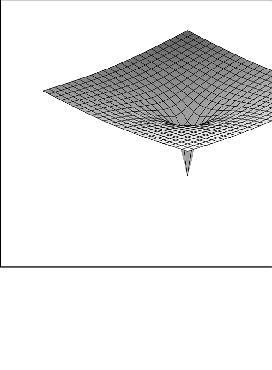
If you are at the very bottom of the spike (the center of the object). That is the very pin prick of the middle. Would it be as flat as the plane at the sides? |
|
|
| jerZ07002 |
| quote: | Originally posted by Dervish
EDIT: I mean For everything that gets pulled towards the earth there is an equal and opposite pull of the earth towards the object. It's just that the earth is that big that it doesn't move much lol. |
it's been a while since i had physics (about 5 to be exact), but i'm not sure that is correct. An object's gravitational pull depends on its mass. The only way there can be an equal and opposite pull on earth from an object is if the object has the same mass as the earth. |
|
|
| Dervish |
| quote: | | According to Newton's 3rd Law, the Earth itself experiences an equal and opposite force to that acting on the falling object, meaning that the Earth also accelerates towards the object. However, because the mass of the Earth is huge, the acceleration of the Earth by this same force is negligible, when measured relative to the system's center of mass. |
EDIT: The earth will pull itself towards the object just as it pulled the object to it no? (and the object will slightly pull the earth too) |
|
|
| occrider |
| quote: | Originally posted by Dervish
If it's in the center where would the gravity pull be towards? Even the gravity pull of the mass around it would even out. Would it be pulled apart or crushed or what?
It's confusing
EDIT: I mean For everything that gets pulled towards the earth there is an equal and opposite pull of the earth towards the object. It's just that the earth is that big that it doesn't move much lol.
For me it's getting towards mind territory. But I'm guessing it's a conflicting mash of forces at the center and not all pull in the way. And at some point they reach equilibrium which tends to trap the matter in somehow.
(By the way 99% of the stuff I've said is just me rambling when I was on night shift at work with nothing better to do. It wasn't researched in any great way. But actually is kinda interesting I think.) |
I'm no physicist, but I think you're not taking into account density. At any point of a ball of mass, the closer you get to the center the more dense it is and thus the more gravity there is per square inch. In addition gravity is a force where you have to look at holistic systems and groups as opposed to singular points in space. So the center of a ball of matter doesn't have to pull anything in a direction, it simply pulls matter towards itself as a rule of a composition of matter. |
|
|
| Dervish |
Well I'm thinking at some some instantanous point the gravity gradient needs to switch from pulling one direction tothe other. An in two axis this would mean one point where there is no gravity.
Falling Towards Center
------------
Center (Instansous Point Falling No Where)
------------
Falling Towards Center
I mean if you could put something in the very center it would never fall out would it?
EDIT: Perhaps I'm meaning gravity gradient rather than gravity... but still if gravity is a force at the center they must even out. |
|
|
| Renegade |
| quote: | Originally posted by Dervish
Well I'm thinking at some some instantanous point the gravity gradient needs to switch from pulling one direction tothe other. An in two axis this would mean one point where there is no gravity.
Falling Towards Center
------------
Center (Instansous Point Falling No Where)
------------
Falling Towards Center
I mean if you could put something in the very center it would never fall out would it?
EDIT: Perhaps I'm meaning gravity gradient rather than gravity... but still if gravity is a force at the center they must even out. |
Gravity doesn't so much pull anything towards "the center" of of an object, so much as it attracts matter to wherever the highest density of matter is (which just happens to converge on the center!).
Maybe an MS Paint will help. Imagine the big circle here is the Earth or some other large body and the yellow circle is just some random clump of matter within it:

The blue area and the red area are just clumps of matter as well. Given the relative size of the red and blue clumps, which one do you think the yellow clump will be attracted to?

Because the blue clump is larger than the red clump, it will be attracted in that direction (although it can't actually move because it so closely compacted with other clumps of matter that are trying to do the same thing). The opposite is true for a yellow clump on the other side:

Making sense? Wherever that clump of matter is, it will always be attracted to the matter on the other side of the sphere because there will necessarily be more matter on that side for it to be attracted to. As a result, every clump of matter is essentially converging on the center, where the attractive force from the matter in the rest of the sphere becomes even in every direction.
Difficult to explain, but I think that's the gist of it. :-/ |
|
|
| Dervish |
| Yeah I understand that but at the center all the forces even out. Is what I'm meaning. |
|
|
| Renegade |
| quote: | Originally posted by Dervish
Yeah I understand that but at the center all the forces even out. Is what I'm meaning. |
Think in terms of atoms. The atom at the exact center of a planet will soon be displaced by atoms rushing past to the other side. It would be posssible - in theory - for an atom to experience an equitable gravitational pull from every side, but in reality - at those sort of pressures - there is never an "exact" centre of a planet and the whole system remains in a kind of self-correcting flux (hence the vaguely spherical shapes of stars and planets etc.).
If you're talking about black holes, then those represent the entire mass of an object colapsing into a "singularity", which is basically impossible to represent mathematically, let alone graphically. We're talking infinities, so imagine a point in space curved a billion times more than you can imagine, a mass that weighs a billion times more than you can imagine and a scale of space that is a billionth the size that you can imagine. You're not even a billionth of the way there.
Also, I'm pretty drunk. Hope that helps. |
|
|
|
|

