|
The Oldskool Series: history of EDM (1964-2004) (pg. 4)
|
View this Thread in Original format
| 2rip |
Episode #8: Deep Bass [1991-1993 Jungle & Darkcore]

DOWNLOAD: http://2rip.podomatic.com/enclosure...38_37-07_00.mp3
Early jungle evolved from acid house productions that sampled breakbeats. Key acid house tunes during the evolution period from 1989-1992 were 808 State's "Cubik" and Stakker's "Humanoid." Also during the same time Frankie Bones released "Bones Breaks" which was one of the first "breakbeat" productions.
In the early 90's hardcore music was perceived to have become too commercial. Producers like DJ Hype, Mickey Finn, Grooverider & Fabio began stripping down the elements of hardcore, removing the happy elements and replacing them with half-time basslines and multiple break structures. Many productions in this era were also taking samples from horror movies with screaming, yelling and crying sounds. The genre really began to break around the time of 1992. It was still considered hardcore at the time - in fact the term "darkcore" was designated to this style.
Examples of Darkcore are Goldie's "Terminator" (1992) and Top Buzz's "Living In The Darkness" (1992). These tracks took some of their cue from from the darker sounds of Belgium techno - tracks like 4 Hero's "Mr. Kirk's Nightmare" (1990) and The Psychopath's "Nightmare" (1991).
The dark sound appealed to many people in dancehall & reggae communities. The Jamaican "sound system" culture influenced the emerging sound with remixing techniques from dub & reggae. Darkcore & dancehall were being mixed together at parties until soon dancehall reggae was incorporated into the sound of darkcore. As the yet-unnamed genre evolved, the use of sampled breakbeats became more complex. The most notable sample is the Amen Break which was taken from a funk song by The Winston Brothers called "Amen, Brother."
In 1993 the confusion surrounding this style finally broke. Jungle had finally gained it's own identity with dedicated UK club venues such as Roast, Roller Express, and Telepathy. Andy C produced the classic jungle hit "Valley of the Shadows" while Ed Rush formed the darkcore party "Bloodclot Attack."
The origin of the term "jungle" is absolutely debatable. However the emergence of the term can very roughly be traced to Jamaican/Caribbean MC's where they often made references to "the jungle" or "junglists." A junglist was a reference to anyone living in Kingston, Trenchtown - the area that was known as "The Concrete Jungle."
Across the Atlantic, Toronto's hardcore scene began to split as well, creating the largest jungle scene in North America. In London, jungle was a very Black, non-rave sound. The only difference in Toronto was that there was very little Black interest in jungle and the majority stayed away from it. In the United States, Black interest was still primarily focused on the house music scenes of New York & Chicago.
The winter period linking 1992 to 1993 was considered a very "dark" time, especialy for the Toronto rave scene. The overall quality of ecstacy that was being sold was deteriorating, the use of speed was on the rise, and crack was becoming increasingly popular. Overdose cases were becoming far too common in the rave scene while criminality & scamming had also rooted itself in the hardcore arena.
Running parallel to what was happening in the winter of 1992 was Darkcore. In response to darkness that was coming from the UK, other producers of hardcore began moving in the opposite direction. The "happy" elements of hardcore were soon being embellished, creating what has ever since been the arch-nemesis for the jungle community - happy hardcore.
This podcast features some of my early jungle collection with tracks from 1991-1993. For me early jungle was defined by Roni Size & LTJ Bukem. Both of which remained a huge inspiration for me throughout the 1990's which you will see as we near the millenium.
Tracklist:
Rufige Kru - Fabio's Ghost
Q Bass feat. Skeng Gee - Gun Connection
Dubplate Remixes - Simply Rolling
Brainkillers & Lewi Cifer - Hurt Me
Roni Size - Fresh
Ravers Choice - Side B
Roni Size - The Refresher
LTJ Bukem - Bookworm
LTJ Bukem - Logical Progression
David Bryce - Logical Reprise
Bodysnatch - Euphony
Brainkillers & Lewi Cifer - On A Different Mission
Xenophobia - The Phoenix |
|
|
| 2rip |
Episode #9: The New Sound of Hardcore

DOWNLOAD: http://2rip.podomatic.com/enclosure...57_02-07_00.mp3
In the context of Jamaican pop culture, a sound system was basically a group of DJs and MCs. The crews would load trucks with generators, turntables and huge speakers to set up street parties. Many of these dj's were very set on playing "exclusive" music which would only be shared amongst their own sound system. These exclusive records were pressed onto an acetate disc called dubplates. In the record industry these discs were used as test pressings to help master a recording before the track was pressed to vinyl and mass produced.
After the break of 1994, the entire United States was beginning to more widely embrace jungle. Dieselboy, who at the time was living in Pittsburgh, was hosting a show on Carnegie Mellon's radio station WRTC. In 1994, Dieselboy released "The Future Sound of Hardcore" which was his first major mix. The demo sold over 100 copies online through the first electronic mailing list application known as LISTSERVs. Selling this mixtape was a slow process but it eventually snowballed into a variety of gigs up and down the East Coast.
Since the term "jungle" had become so closely related to the reggae-influenced sound, dj's and producers who did not incorporate reggae sounds began to adopt the term "drum & bass." Incidentally this term was used several years prior by a London KISS FM disc jockey named Trevor Nelson to describe rougher funk melodies & "raregroove" that he was playing on the pirate radio station.
The release of General Levy's "Incredible" in 1994 was another major turning point for jungle. This record featured a quote by General Levy himself which turned a lot of heads for other major drum & bass producers. Many of these producers began to feel that the genre was taking on too many violent elements mixed with crowds that were tinged with gangster type of appeal. This was the birth of "intelligent drum & bass."
Intelligent drum & bass focused on warm, jazzy elements. It also featured samples that were atmospheric with deep basslines. Alongside the evolution of intelligent drum & bass, ragga became more stripped-down, featuring more aggressive snare drums. This style was soon titled as being "hardstep."
This podcast is to musically chart the progression from acid house to darkcore, not quite leading into hardstep or intelligent. The previous episode did not demonstrate any tracks that featured the Caribbean dancehall/ragga style that had become and integral part of the jungle culture. That sound is found on DJ Spice's "New Stylee" and DJ Sparks "Hang Dem High."
4 Hero - Mr. Kirk's Nightmare (1990)
2 Bad Mice - Bombscare (1989)
Stakker - Humanoid (1989)
Rufige Cru - Darkrider (1992)
Holy Noise - I Am A Nightmare Walking (1992)
Aphrodite - Raw Motion (1992)
Subject 13 - Armageddon Countdown (1992)
DJ Spice - The New Stylee (1992)
DJ Sparks - Hang Dem High (1992)
2 Bad Mice - Underworld (DJ Hype Remix)(1993)
LTJ Bukem - Demon's Theme (1991) |
|
|
| 2rip |
Episode #10: Freedom 2 Dance [1991-1994]
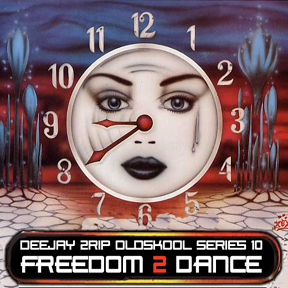
DOWNLOAD: http://2rip.podomatic.com/enclosure...15_24-07_00.mp3
Inspired by productions such as "Can You Feel It?" by Larry Heard aka Mr. Fingers, deep house emerged from Chicago around the year of 1988. Producers such as Masters At Work and DJ Pierre helped define the genre leading up the 90's. Deep house tracks had a slightly dissonant feel as the jazz elements in many of it's tracks were brought out by using more complex chord structures than previous house music songs.
At the start of the 90's there was much more happening all around the country, particularly in the New England & Mid-Atlantic region spanning from Boston to New York to Washington, DC and also Pittsburgh. The sounds of hardcore had ripped through all of suburban America. In New York Frankie Bones was pushing Storm Raves which had their final party in 1992. In Pittsburgh in 1991, a shop called Turbo Zen was opened by Joel Bevacqua aka Deadly Buda. Turbo Zen kicked the Pittsburgh rave scene into high gear with the production of Power Rave in 1992 which featured Richie Hawtin, John Acquaviva & Adam X.
Across the Mississippi a man named Kurt Eckes was pioneering the hardcore sound into massive rave productions. Hardcore was a perfect taste for Milwaukee as the town had an insatiable taste for heavy metal, from thrash to death. The promotion headed by Eckes was known as the Drop Bass Network. In Milwaukee it was not rare to see ravers dancing under giant goat heads and pentagrams. People in this area found rave music's most popular drug ecstacy to be "too soft." The drug of choice in Milwaukee was LSD.
With the passing of the Summer of Love, the rise of hardcore and the spawn of the American rave scene there were plenty of people trying to find the style that suited them. Many of the house and techno heads continued to stick to those genres because it was what they knew electronic dance music to be. Groups of New York, San Francisco, and Chicago house music producers continued to either beef up or tone down their productions. During this time artists like Mark Farina continued to provide warmer, more ambient and jazzy sounding melodies as the deep house music scene flourished.
This podcast introduces several deep house tunes from 1991 through 1994. We will embellish on house music and it's role in the rave scene in the coming episodes.
Mystic Phases - Don't You Feel It
Angel Moraes - I Like It feat. Octavia Lamber
Suburban Soul - Do My Thing
Balance - The Dance (Off Da Beat Dub)
Funky Green Dogs - Reach For Me (De Dum Dub)
Mark Walker & Joe Issa - Better Place
Enrico Mantini - Kill & Go
Enrico Mantini - Everday & Night
Bass is Base - The Spirit feat. Syndicate
Last Americas - Look Listen Love (Robotman Mix)
Nick Jones & Acei Carter - Shake It
K.E.L.S.E.Y. - This Way (Deep Mix)
Joey Negro - Feel It |
|
|
| 2rip |
Episode #11: RAVE WORLD

DOWNLOAD: http://2rip.podomatic.com/enclosure...53_27-07_00.mp3
The Cleveland rave culture was inspired by a college radio dj from station WRUW named Stevie T. In 1992, he along with DJs Lars Fischer, Mike Filly, and Rob Bertrand attempted their first rave together. Unfortunately it was busted by the police before it even started. Soon after this, Mike Filly teamed up with DJ Rob Sherwood to form Tone Deaf and Color Blind Productions. In June of 1992 the crew hosted TIDAL RAVE featuring a live performance by 2 Unlimited. Their second event, KOOLAID in July of 1992 featured F.U.S.E. as well as Joey Beltram & Richie Hawtin. KOOLAID took place in a warehouse near East 4th St & Prospect. In June of 1992 a promoter named Jimmie Allen hosted A MIDSUMMER'S NIGHT with headliner Sleepy C in Akron, OH.
In 1993 Joe Lesesne began the PB-CLE (Pittsburgh-Cleveland) mailing list. This list grew exponentially and moved to what is now hyperreal.org in the fall of 1995.
Rewind a few years back and you have what may very well be the start of the Washington, DC rave scene. Giovanni Baez can be accredited to being one of the first East Coast rave promoters, throwing parties known as Catastrophic. In 1990 Scott Henry, Tony Japzon & Charles Fields produced a party called Orbit. The first Fever event was hosted at the Paradox in 1992.
Far away from the East Coast, in Salt Lake City UT, a man named Pete Ashdown along with partner John Webster had begun importing acid house to Utah. The first party was set to go off when the venue owner cancelled the arrangement. Several months and several venue issues & cancellations later Ashdown & Webster hosted "Rave 1 - Utah's First Rave." The party pulled roughly 120 people and was a mix of ravers and non-ravers. Ashdown dj'ed the whole night while his partner ran the door. He and Webster hosted two more follow-up parties in Salt Lake City while the next wave of events were hosted by a DJ named Chris Sick along with support from his girlfriend Jodi Nielsen. In 2006 Pete Ashdown ran for the Utah Senate election against incumbent Orrin Hatch.
In 1992, Speedy J a Dutch techno producer broke through with a release on Richie Hawtin's & John Acquaviva's Plus 8 record label known as Pullover. Kenny Larkin who also released an influential track on Plus 8 has been described as "massively influential" on producers all over the globe.
This podcast encompasses various shades of techno from both the United States in Detroit to European techno and widely know and resampled tracks such as Moby's "Go."
Speedy J - Flashback
Psyance - Motion
FUSE - Technotropic
Moby - Go
Kenny Larkin - We Shall Overcome
Fellows - Last Laugh
Moby - Drug Fits The Face
Biosphere - Fairy Tale
Hardfloor - AM Trip
Sven Vath - Barbarella
Da Sampla - With A Piece of Ice
Acid Jesus - Move My Body
Underground Resistance - Nocturbulous
Robert Armani - Circus Bells |
|
|
| 2rip |
| Is there anyone on here that grew up in the Arizona rave scene? |
|
|
| Echo of Silence |
I'm falling behind again, aren't I?
I forgot to ask you earlier (before you changed the numbers on page 1) why the first set is numbered 7. Were there 6 sets before that one?
:D |
|
|
| 2rip |
| quote: | Originally posted by Echo of Silence
I'm falling behind again, aren't I?
I forgot to ask you earlier (before you changed the numbers on page 1) why the first set is numbered 7. Were there 6 sets before that one?
:D |
No, I actually re-ordered some of the series. The actual first podcast I had put out for this was Everything Begins with E! but that was dated 1988. So for timeline sake I decided to renumber with Precursor being the first since it is all music and history from the early 80's. |
|
|
| 2rip |
Episode #12: Perception

DOWNLOAD: http://2rip.podomatic.com/enclosure...02_35-07_00.mp3
As stated in Wikipedia the term "electronica" encompasses a wide range of contemporary electronic music. The music is designed for a wide range of uses which can include foreground listening, some forms of dancing, and also background music.
Electronica soon became a catch-all phrase for ambient, chill-out, downtempo, downbeat, and any abstract forms of electronic music. The focus on songs, a fusion of styles, and combination of traditional along with electronic instruments often sets electronica apart from straight ahead styles like house, techno and trance.
In 1991 Autechre released their first single titled "Cavity Job" but did not release a full album until 1993. In 1989 Moby signed a contract with Instinct Records and releaed "Go" which reached the UK Top 10 in 1991. In 1992 Aphex Twin released his first album "Selected Ambient Works 85-92" which came out on R&S Records, the same label that released Beltram's Energy Flash.
In the rave scene the earliest mentioned chillout room was at Konspiracy in Manchester, UK. In chill rooms people would often find couches accompanied with dim lighting and projectors with trippy images displayed. This culture carried over into the United States as well as raves and nightclubs around the world. Every chill room had it's own personality, some better than others. The Higher Intelligence Agency helped lift chillout music from the side stage to the main stage with their Oscillate parties in Birmingham.
In 1994 Sonic Soul Productions hosted their first chill-out event in Baltimore, MD. This event led to the series of "Cloudwatch" parties. In 1997 a compilation was released under the Sonic Soul label featuring artists such as Steve Roach, DJ Spooky, and DJ Who.
Eric Idle & Richard Wilson - One Foot In The Grave (Wireless Mix)
Mark Van Hoen - Battery Ending
Control X - Ambient 4
LFO - El Ef Oh
Aphex Twin - Shiny Metal Rods
Moby - Bad Days
Beaumont Hannant - Utuba
Autechre - Chatter
F.U.S.E. - Slac
Control X - Babylon
Plastikman - Plastique |
|
|
| nefardec |
this is really shaping up!
I'd love to hear a mix of some early 90s euro house stuff like mighty quinn |
|
|
| elFreak |
| agree, this latest one looks the most win of them all yet. |
|
|
| 2rip |
| quote: | Originally posted by elFreak
agree, this latest one looks the most win of them all yet. |
this might be a little bit out of line to say but listen to that one on acid in a dark room with a bunch of candles and close your eyes. trust me on that. |
|
|
| 2rip |
Episode #13: Arcadia [1993]

DOWNLOAD: http://2rip.podomatic.com/enclosure...52_43-07_00.mp3
In 1991 Chris & James Griffin started a small dance party in Cheltenham UK. This night eventually became known as Trance. Chris & James soon decided to part ways to hold their own individual parties. Chris formed Perception while James went on to organize Fantazia. New Years of 1992/1993 was the 6th Fantazia event and possibly their largest, with an attendance of 16,000.
In 1992 Jaydee aka DJ Robin Albers released the classic hit called 'Plastic Dreams' on R&S Records. The track hit #1 on the US Billboard's Hot Dance Music/Club Play chart.
With an idea originally conceived by Eddie Gordon, DJ Pete Tong began hosting the Essential Mix. The first broadcast hit the air on October 30, 1993. While The Essential Mix was usually pre-recorded and played via studio there were also live versions of the show that branched from venues in the UK to other areas such as Ibiza, North America, Germany, and South Africa.
While it was always accepted that Age of Love was the first trance tune ever pressed, Dance 2 Trance was considered to have released the second trance pressing ever titled "We Came In Peace." Progressive trance became a popular sub-genre which contains elements of house, techno and ambient music while trance focused more on anthemic qualities and melodies, moving away from arpeggiated analog synth patterns. Compared to the classic definition of trance, the progressive subgenre was deeper and more abstract, however continued to maintain the three typical structure elements of build-up, climax & breakdown. Meanwhile uplifting and epic trance took their buildups and breakdowns to an exagerrated point.
The genre immediately began to rise in popularity, finding it's niche in being 'edgier' than house, more soothing than drum & bass, and more melodic than techno.
This podcast demonstrates again the rise of trance in a compilation of very popular songs from 1993. Next week we will look again at "progressive" dance music as we begin to move into 1994, prior to returning to the house and techno sounds of the mid 1990s.
Jaydee - Plastic Dreams
With It Guys - Let The Music Take Control
Strategy - High Energy
Sourmash - Pilgrimage To Paradise (Barrel Beat Mix)
Nico - Darkstar
Jagga - Finito
Golden Girls - Kinetic (Frank De Wulf Remix)
Humate - Love Stimulation |
|
|
|
|

