|
Bush asks Congress for $700 billion bailout (pg. 2)
|
View this Thread in Original format
| Clovis |
| If I hear one more person call Obama socialist I will get violent. |
|
|
| Krypton |
| quote: | Originally posted by Shakka
This is hardly a political matter. One could just as easily argue that the Community Reinvestment Act passed under the Clinton administration helped pave the way for the subprime fiasco that set off the credit domino rally we've been seeing. Get your head out of your ass and try to be a part of the solution, not a part of the problem and the constant finger-pointing and blaming that is going on.
Or perhaps you can explain to me how George Bush personally went about extending reckless amounts of credit to people who were not worthy of it and were too irresponsible to handle it? No, we couldn't possibly assign just the smallest bit of blame to people who took advantage of the system. We couldn't possibly spread a little blame around to everyone involved. We must always place all of the blame squarely at the feet of George Bush. To do otherwise would actually require a broader understanding of what has actually happened here. |
Nowhere did I mention the name of George Bush. I said the government. This mean the executive AND Congress. The deregulators. My head is certainly not in my ass... |
|
|
| Capitalizt |
| quote: | Originally posted by jerZ07002
i'm going to keep reposting this until you guys get it; we have no idea if we we foot the bill, we could actually profit from the deal |
jer you seem to be stuck on the "old news" of the AIG/Fannie/Freddie bailouts. We are bailing out AIG with $80 billion. This is PEANUTS compared to the $700-800billion+ we are spending to buy BAD ASSETS from every bank in the country. This is the real bailout. Taxpayers are purchasing all of the utter crap that banks couldn't even sell for 10 cents on the dollar on the open market. The government is bailing out every bank now..EVERY BANK..not just an insurer and a few mortgage companies. There is no way to profit from this horrible exchange. The paper being bought is worth next to nothing. |
|
|
| jerZ07002 |
| quote: | Originally posted by Capitalizt
jer you seem to be stuck on the "old news" of the AIG/Fannie/Freddie bailouts. We are bailing out AIG with $80 billion. This is PEANUTS compared to the $700-800billion+ we are spending to buy BAD ASSETS from every bank in the country. This is the real bailout. Taxpayers are purchasing all of the utter crap that banks couldn't even sell for 10 cents on the dollar on the open market. The government is bailing out every bank now..EVERY BANK..not just an insurer and a few mortgage companies. There is no way to profit from this horrible exchange. The paper being bought is worth next to nothing. |
i understand what's going on with the government purchasing debt with depressed values. However, the fact still remains that historically the government doesn't lose in these bailouts. the point is the debts have little value because noone is willing to buy because people are extremely risk averse at the moment. not necessarily because the assets have no value. the only way to know whether debt has truly lost its value is to wait until there is a default. Since that hasn't happened with most of these debt obligations its far too soon to say they are worthless. With yields as high as these obligations are fetching, when investors fears subside, people will come to their senses and the obligations will be much more marketable. they are only "worthless" because in the current market noone is willing to take a risk. |
|
|
| Q5echo |
| quote: | Originally posted by Krypton
Nowhere did I mention the name of George Bush. I said the government. This mean the executive AND Congress. The deregulators. My head is certainly not in my ass... |
what "deregulation" are you talking about specifically? |
|
|
| Krypton |
| quote: | Originally posted by Q5echo
what "deregulation" are you talking about specifically? |
Well, from the top of my head, Phil Gramm's systematic deregulation of the financial sector. Another one, Alan Greenspan's Fed rate reduction to 1% in 2003. There are certainly other instances. |
|
|
| Shakka |
| quote: | Originally posted by Krypton
Nowhere did I mention the name of George Bush. I said the government. This mean the executive AND Congress. The deregulators. My head is certainly not in my ass... |
You did say:
| quote: | | The current leadership has run this country into the ground. |
Is it wrong of me to conclude you were making a veiled reference to Dubya? At least you admit congress now, but I think your more recent post laying a lot of blame on Easy Alan Greenspan's overly loose monetary policy is a greater step in realizing the root cause of much of the current credit crisis.
That said, if I made an obvious mis-read of your statement, then I owe you an apology. |
|
|
| culorut |
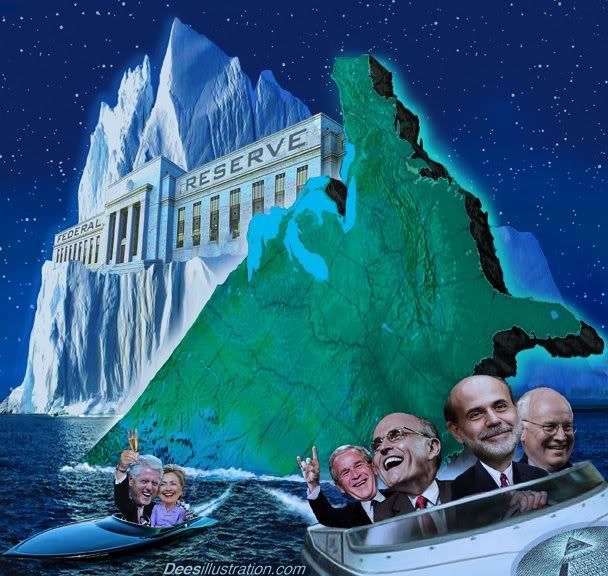 |
|
|
| Krypton |
| quote: | Originally posted by Shakka
You did say:
Is it wrong of me to conclude you were making a veiled reference to Dubya? At least you admit congress now, but I think your more recent post laying a lot of blame on Easy Alan Greenspan's overly loose monetary policy is a greater step in realizing the root cause of much of the current credit crisis.
That said, if I made an obvious mis-read of your statement, then I owe you an apology. |
Of course ole' George is part of the blame. But by "current leadership", I mean the government as a whole, most notably, the one-party Republican control of the government from 2000-2006... |
|
|
| MisterOpus1 |
| quote: | Originally posted by Krypton
Well, from the top of my head, Phil Gramm's systematic deregulation of the financial sector. |
To which President Clinton signed into law, correct?
I know, Clinton had to work the best way he could with the Republican majority at the time, and this just one in a healthy handful of dumb moves on his part in working with the Republican-led Congress.
But it was his pen that ultimately signed it into law, and the blame can and should also be put upon Bubba's shoulders as well. |
|
|
| Q5echo |
| quote: | Originally posted by Krypton
Of course ole' George is part of the blame. |
ole' George & Co. saw the hazard in 2003 and tried to impose Federal oversight of Fannie Mae & Freddie Mac but was shot down by insiders in Congress. |
|
|
| Q5echo |
| quote: | Originally posted by Krypton
The current leadership has run this country into the ground. Our current government is a corrupt piece of ... |
A Mortgage Fable
Once upon a time, in the land that FDR built, there was the rule of "regulation" and all was right on Wall and Main Streets. Wise 27-year-old bank examiners looked down upon the banks and saw that they were sound. America's Hobbits lived happily in homes financed by 30-year-mortgages that never left their local banker's balance sheet, and nary a crisis did we have.
Then, lo, came the evil Reagan marching from Mordor with his horde of Orcs, short for "market fundamentalists." Reagan's apprentice, Gramm of Texas and later of McCain, unleashed the scourge of "deregulation," and thus were "greed," short-selling, securitization, McMansions, liar loans and other horrors loosed upon the world of men.
Now, however, comes Obama of Illinois, Schumer of New York and others in the fellowship of the Beltway to slay the Orcs and restore the rule of the regulator. So once more will the Hobbits be able to sleep peacefully in the shire.
With apologies to Tolkien, or at least Peter Jackson, something like this tale is now being sold to the American people to explain the financial panic of the past year. It is truly a fable from start to finish. Yet we are likely to hear some version of it often in the coming months as the barons of Congress try to absolve themselves of any responsibility for the housing and mortgage meltdowns.
Yes, greed is ever with us, at least until Washington transforms human nature. The wizards of Wall Street and London became ever more inventive in finding ways to sell mortgages and finance housing. Some of those peddling subprime loans were crooks, as were some of the borrowers who lied about their incomes. This is what happens in a credit bubble that becomes a societal mania.
But Washington is as deeply implicated in this meltdown as anyone on Wall Street or at Countrywide Financial. Going back decades, but especially in the past 15 or so years, our politicians have promoted housing and easy credit with a variety of subsidies and policies that helped to create and feed the mania. Let us take the roll of political cause and financial effect:
- The Federal Reserve. The original sin of this crisis was easy money. For too long this decade, especially from 2003 to 2005, the Fed held interest rates below the level of expected inflation, thus creating a vast subsidy for debt that both households and financial firms exploited. The housing bubble was a result, along with its financial counterparts, the subprime loan and the mortgage SIV.
Fed Chairmen Alan Greenspan and Ben Bernanke prefer to blame "a global savings glut" that began when the Cold War ended. But Communism was dead for more than a decade before the housing mania took off. The savings glut was in large part a creation of the Fed, which flooded the world with too many dollars that often found their way back into housing markets in the U.S., the U.K. and elsewhere.
- Fannie Mae and Freddie Mac. Created by government, and able to borrow at rates lower than fully private corporations because of the implied backing from taxpayers, these firms turbocharged the credit mania. They channeled far more liquidity into the market than would have been the case otherwise, especially from the Chinese, who thought (rightly) that they were investing in mortgage securities that were as safe as Treasurys but with a higher yield.
These are the firms that bought the increasingly questionable mortgages originated by Angelo Mozilo's Countrywide and others. Even as the bubble was popping, they dived into pools of subprime and Alt-A ("liar") loans to meet Congressional demand to finance "affordable" housing. And they were both the cause and beneficiary of the great interest-group army that lobbied for ever more housing subsidies.
Fan and Fred's patrons on Capitol Hill didn't care about the risks inherent in their combined trillion-dollar-plus mortgage portfolios, so long as they helped meet political goals on housing. Even after taxpayers have had to pick up a bailout tab that may grow as large as $200 billion, House Financial Services Chairman Barney Frank still won't back a reduction in their mortgage portfolios.
- A credit-rating oligopoly. Thanks to federal and state regulation, a small handful of credit rating agencies pass judgment on the risk for all debt securities in our markets. Many of these judgments turned out to be wrong, and this goes to the root of the credit crisis: Assets officially deemed rock-solid by the government's favored risk experts have lately been recognized as nothing of the kind.
When debt instruments are downgraded, banks must then recognize a paper loss on these assets. In a bitter irony, the losses cause the same credit raters whose judgments allowed the banks to hold these dodgy assets to then lower their ratings on the banks, requiring the banks to raise more money, and pay more to raise it. The major government-anointed credit raters -- S&P, Moody's and Fitch -- were as asleep on mortgages as they were on Enron. Senator Richard Shelby (R., Ala.) tried to weaken this government-created oligopoly, but his reforms didn't begin to take effect until 2007, too late to stop the mania.
- Banking regulators. In the Beltway fable, bank supervision all but vanished in recent years. But the great irony is that the banks that made some of the worst mortgage investments are the most highly regulated. The Fed's regulators blessed, or overlooked, Citigroup's off-balance-sheet SIVs, while the SEC tolerated leverage of 30 or 40 to 1 by Lehman and Bear Stearns.
The New York Sun reports that an SEC rule change that allowed more leverage was made in 2004 under then Chairman William Donaldson, one of the most aggressive regulators in SEC history. Of course the SEC's task was only to protect the investor assets at the broker-dealers, not the holding companies themselves, which everyone thought were not too big to fail. Now we know differently (see Bear Stearns below).
Meanwhile, the least regulated firms -- hedge funds and private-equity companies -- have had the fewest problems, or have folded up their mistakes with the least amount of trauma. All of this reaffirms the historical truth that regulators almost always discover financial excesses only after the fact.
- The Bear Stearns rescue. In retrospect, the Fed-Treasury intervention only delayed a necessary day of reckoning for Wall Street. While Bear was punished for its sins, the Fed opened its discount window to the other big investment banks and thus sent a signal that they would provide a creditor safety net for bad debt.
Morgan Stanley, Lehman and Goldman Sachs all concluded that they could ride out the panic without changing their business models or reducing their leverage. John Thain at Merrill Lynch was the only CEO willing to sell his bad mortgage paper -- at 22 cents on the dollar. Treasury and the Fed should have followed the Bear trauma with more than additional liquidity. Once they were on the taxpayer dime, the banks needed a thorough scrubbing that might have avoided last week's stampede.
- The Community Reinvestment Act. This 1977 law compels banks to make loans to poor borrowers who often cannot repay them. Banks that failed to make enough of these loans were often held hostage by activists when they next sought some regulatory approval.
Robert Litan, an economist at the Brookings Institution, told the Washington Post this year that banks "had to show they were making a conscious effort to make loans to subprime borrowers." The much-maligned Phil Gramm fought to limit these CRA requirements in the 1990s, albeit to little effect and much political jeering.
We could cite other Washington policies, including the political agitation for "mark-to-market" accounting that has forced firms to record losses after ratings downgrades even if the assets haven't been sold. But these are some of the main lowlights.
Our point here isn't to absolve Wall Street or pretend there weren't private excesses. But the investment mistakes would surely have been less extreme, and ultimately their damage more containable, if not for the enormous political support and subsidy for mortgage credit. Beware politicians who peddle fables that cast themselves as the heroes. >LINK<
i don't know that much about financial markets to make a sound judgement to it's accuracy but i thought it was fun and informative |
|
|
|
|

