|
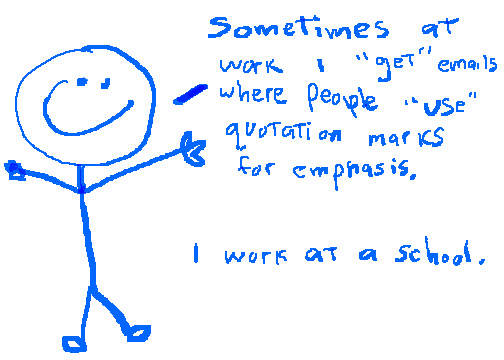
"The" blog "of" unnecessary "quotation" marks. (pg. 3)
|
View this Thread in Original format
| TranceGiant |

/Laser |
|
|
| Cpt.Cocaine |
| quote: | Originally posted by Renzo

It's kinda missing, but not really. |
It's just what they told the kids.
"he ran away" |
|
|
| Lira |
Relevant to this thread:
| quote: | Quotation marks (typically the single ones ‘ ’) that are used to mark the use of a word as not necessarily one that the present writer would endorse (The so-called ‘universal grammar ’ that linguists talk about) are standardly known as scare quotes. Those used (illiterately, it is often thought) simply to emphasize or call attention to a word (‘FRESH’ TOMATOES!) are sometimes, less standardly, called greengrocer's quotes. I think we need a third and separate name for the increasingly common journalistic use seen in this national science news story taken from a British newspaper today (I quote it in full, so nothing is being suppressed):
Hormone ‘makes women unfaithful’
WOMEN with high levels of one sex hormone are more likely to have affairs — and are considered more attractive by themselves and others. Those with the most oestradiol, a form of oestrogen, are less satisfied with their lovers and more likely to have a roving eye, a study suggests today. ‘Attractive women may not only have more alternatives but also high standards that are difficult to satisfy,’ said US psychologist Dr Katrina Durante, whose study is published by the Royal Society. ‘They may have fewer reasons to be committed to any partner if higher-quality potential mates are available.’
I am not commenting on the fact that the report says not a single word about the hormone causing infidelity. This is Language Log, not Endocrinology Log. What I'm pointing to is that the quoted words are not a quote: they never appear in the article at all.
The inaccuracy of the headline is indeed glaring. The story actually presents two strikingly and somewhat bafflingly different lines of content. First, the newspaper reports that oestradiol levels correlate with (a) higher infidelity, (b) stronger self-perception of being pretty, (c) greater other-perceived attractiveness, and (d) lower satisfaction with partners. Second, Dr Durante is quoted as making certain (seemingly unrelated) claims about women who are pretty: that they have (a) more options, (b) high standards, and (c) less reason to stick with a dweeb when hunks are accessible. The things Dr Durante is quoted as saying are plausible enough, but none of them relate to hormones at all. And nothing in the whole story mentions hormonal causation of any behavior.
But independently of this, what is this practice of making up an expression and putting it in single quotation marks in the headline? (I'm not saying it is new, by the way. I have been seeing it for decades.) We are surely not talking about greengrocer's quotes. And these aren't scare quotes either. Scare quotes are used for the opposite kind of case: where the expression has been bandied about already, and the writer wants to indicate detachment from its implications or skepticism about its being the appropriate wording to use (scare quotes because the writer is scared to commit to this way of phrasing things). Here, the headline writer is fully committed to the appropriacy of the expression in the quotation marks: the headline writer made them up! (The fact that the pseudo-quote is wildly inaccurate too just makes it worse in this case.)
My suggestion for what to call this use of quotation marks is in my title: let's call them mendacity quotes. |
http://languagelog.ldc.upenn.edu/nll/?p=1017 |
|
|
| dj_alfi |
oh and
 :tongue2 :tongue2
 :stongue: :stongue:
 :haha: :haha: |
|
|
| bas |

Why do they both say "bags"? |
|
|
| stren |
| I don't know Bas, I just don't know |
|
|
| couch-potato |
| quote: | Originally posted by stren
"L"OL |
AHAHAHAHA!!!!!!
I lol'd. "Seriously" |
|
|
| Fpcookie |
| quote: | Originally posted by dj_alfi
:haha: |
:stongue: :stongue: :stongue: |
|
|
| Frenchie |
 |
|
|
|
|

