|
Obama Takes It To Them In Opinion Piece For Washington Post
|
View this Thread in Original format
| josh4 |
| quote: | The Action Americans Need
By Barack Obama
Thursday, February 5, 2009; A17
By now, it's clear to everyone that we have inherited an economic crisis as deep and dire as any since the days of the Great Depression. Millions of jobs that Americans relied on just a year ago are gone; millions more of the nest eggs families worked so hard to build have vanished. People everywhere are worried about what tomorrow will bring.
What Americans expect from Washington is action that matches the urgency they feel in their daily lives -- action that's swift, bold and wise enough for us to climb out of this crisis.
Because each day we wait to begin the work of turning our economy around, more people lose their jobs, their savings and their homes. And if nothing is done, this recession might linger for years. Our economy will lose 5 million more jobs. Unemployment will approach double digits. Our nation will sink deeper into a crisis that, at some point, we may not be able to reverse.
That's why I feel such a sense of urgency about the recovery plan before Congress. With it, we will create or save more than 3 million jobs over the next two years, provide immediate tax relief to 95 percent of American workers, ignite spending by businesses and consumers alike, and take steps to strengthen our country for years to come.
This plan is more than a prescription for short-term spending -- it's a strategy for America's long-term growth and opportunity in areas such as renewable energy, health care and education. And it's a strategy that will be implemented with unprecedented transparency and accountability, so Americans know where their tax dollars are going and how they are being spent.
In recent days, there have been misguided criticisms of this plan that echo the failed theories that helped lead us into this crisis -- the notion that tax cuts alone will solve all our problems; that we can meet our enormous tests with half-steps and piecemeal measures; that we can ignore fundamental challenges such as energy independence and the high cost of health care and still expect our economy and our country to thrive.
I reject these theories, and so did the American people when they went to the polls in November and voted resoundingly for change. They know that we have tried it those ways for too long. And because we have, our health-care costs still rise faster than inflation. Our dependence on foreign oil still threatens our economy and our security. Our children still study in schools that put them at a disadvantage. We've seen the tragic consequences when our bridges crumble and our levees fail.
Every day, our economy gets sicker -- and the time for a remedy that puts Americans back to work, jump-starts our economy and invests in lasting growth is now.
Now is the time to protect health insurance for the more than 8 million Americans at risk of losing their coverage and to computerize the health-care records of every American within five years, saving billions of dollars and countless lives in the process.
Now is the time to save billions by making 2 million homes and 75 percent of federal buildings more energy-efficient, and to double our capacity to generate alternative sources of energy within three years.
Now is the time to give our children every advantage they need to compete by upgrading 10,000 schools with state-of-the-art classrooms, libraries and labs; by training our teachers in math and science; and by bringing the dream of a college education within reach for millions of Americans.
And now is the time to create the jobs that remake America for the 21st century by rebuilding aging roads, bridges and levees; designing a smart electrical grid; and connecting every corner of the country to the information superhighway.
These are the actions Americans expect us to take without delay. They're patient enough to know that our economic recovery will be measured in years, not months. But they have no patience for the same old partisan gridlock that stands in the way of action while our economy continues to slide.
So we have a choice to make. We can once again let Washington's bad habits stand in the way of progress. Or we can pull together and say that in America, our destiny isn't written for us but by us. We can place good ideas ahead of old ideological battles, and a sense of purpose above the same narrow partisanship. We can act boldly to turn crisis into opportunity and, together, write the next great chapter in our history and meet the test of our time.
The writer is president of the United States.
http://www.washingtonpost.com/wp-dy...id=opinionsbox1 |
So much for compromise? WTF? Chicago roots take hold. |
|
|
| Lebezniatnikov |
About time.
And lol @ the byline. |
|
|
| The17sss |
I'm sick of hearing this: | quote: | | "By now, it's clear to everyone that we have inherited an economic crisis as deep and dire as any since the days of the Great Depression." |
For chrissake, things are NOT worse now than when Jimmy Carter was president and we had 70% tax rates, 13% unemployment, crazy inflation, and 21% interest rates.
As for the rest of that piece, has Obama realized he won the presidency? All I see is in this editorial is empty sloganeering and cheap fear-mongering instead of substantive cases for the vast array of spending projects in his stimulus bill.
| quote: | | We've seen the tragic consequences when our bridges crumble and our levees fail. |
*sigh*.... Again, both were public projects when built, and both had serious flaws from the beginning. The bridge collapsed not because a lack of maintenance, but because its original design seriously underestimated the thickness of support plates in the structure and a decision by designers (and approved by Minnesota) not to build redundant support. The levees weren't built to their original specifications, a problem at which the government kept throwing money for decades to no great effect. The "tragic consequences" resulted from government incompetence not from a lack of investment, and Obama's use of these two events displays a staggering ignorance of the facts... AGAIN.
The rest is well said by E. Morrisey:
| quote: | Obama gives no support for the argument that all of the spending in his bill should get passed under emergency conditions, or that any of it will specifically create even one job this year. Obama chants "Now is the time" in five successive paragraphs as if he's making a campaign speech rather than a cool, calm case for his legislation. He blathers on about how people "voted for change", but that's just a slogan, not a policy, and it certainly isn't an argument. La change, c'est vous, mon President , but that doesn't make 'change' evidence .
In fact, in most of this column, Obama makes the opposite case. He argues that he's building infrastructure for a generation of growth. Fine, but that's hardly the reason for an emergency spending bill. That kind of long-term planning belongs in a process that can take a close look at the proposals and measure them carefully, especially given the amounts of money involved. If Obama wants to have that debate, then split all of the long-term spending into separate bills and push them through the normal legislative process, and leave only the immediate stimulus spending in HR1. |
|
|
|
| Groundhog Boy |
| quote: | Originally posted by The17sss
I'm sick of hearing this:
For chrissake, things are NOT worse now than when Jimmy Carter was president and we had 70% tax rates, 13% unemployment, crazy inflation, and 21% interest rates. |
Equity destruction? I don't remember housing values (a component of net worth) declining so much in the 70s. In fact, they inflated with everything else. |
|
|
| Clovis |
| quote: | Originally posted by The17sss
*sigh*.... Again, both were public projects when built, and both had serious flaws from the beginning. The bridge collapsed not because a lack of maintenance, but because its original design seriously underestimated the thickness of support plates in the structure and a decision by designers (and approved by Minnesota) not to build redundant support. The levees weren't built to their original specifications, a problem at which the government kept throwing money for decades to no great effect. The "tragic consequences" resulted from government incompetence not from a lack of investment, and Obama's use of these two events displays a staggering ignorance of the facts... AGAIN.
|
It doesn't make a difference, the point is our infrastructure is ed and we need to seriously invest in it. If he needs to use weak examples that most everyone remembers that's fine by me. |
|
|
| Q5echo |
| quote: | Originally posted by Clovis
It doesn't make a difference, the point is our infrastructure is ed and we need to seriously invest in it. If he needs to use weak examples that most everyone remembers that's fine by me. |
it's unbelievable what this guy does to people. fascinating |
|
|
| XaNaX |
I'm already sick of Obama and the Democrats beating the same drum every day saying "pass our pork stimulus bill because people voted for change and because we are in a crisis". Do they seriously think that because they were voted into office the American people also gave them carte blanche to do/spend whatever they want without providing justification. Just because we are in a crisis doesn't mean its time to pass a trillion dollar bloated spending bill that our children's children will be paying for just because Obama says so.
If Obama wants the stimulus bill passed how about justifying some of that spending in terms of the economic stimulus it will provide instead of printing the equivilent of a campaign speech in the newspaper. Someone needs to tell him that once you have won the time for rhetoric is over, you have to get down to business and act. The Democrats should be ashamed of themselves for filling that stimulus bill full of pork. If they really wanted that bill passed quickly they would have left that |
|
|
| pkcRAISTLIN |
| id like to know where all these 'fiscal conservatives' in the republican party have been the last 8 years. |
|
|
| Lebezniatnikov |
| quote: | Originally posted by XaNaX
If Obama wants the stimulus bill passed how about justifying some of that spending in terms of the economic stimulus it will provide |
It's very surprising to me that people still believe the economic stimulus might not be needed. Also, the "pork" in the bill is often contentious (creating jobs is creating jobs, after all), and represents a very small proportion of the Senate version.
| quote: | Robert Reich
February 5, 2009, 11:54AM
Tomorrow's job report is likely to be awful. January's job losses could easily top half a million. We're deep into the most vicious of economic cycles: Consumers are slashing their spending because they're perilously in debt and worried about keeping their jobs. But as a result, businesses are facing shrinking sales of goods and services, so they're slashing payrolls, which of course makes consumers even more anxious and further reduces their spending power. Meanwhile, businesses are cutting way back on new investments in equipment, which hurts upstream suppliers, who are now slashing their payrolls. And so it goes, downward. The gap between what the economy could produce if it were running near full capacity and what it's now producing continues to widen. The shortfall is projected to be over a trillion dollars this year.
How do we get out of this downward plunge?
Regardless of your ideological stripe, you've got to see that when consumers and businesses stop spending and investing, there's only entity left to step into the breach. It's government. Major increases in government spending are necessary, and the spending must be on a very large scale. In the last several weeks the President has put forward the outlines of a stimulus plan, and has left it to the House and Senate to fill in the details. A tiny portion of the details that made it into the House version should be stripped away because they seem like old-fashioned pork. But most spending in the bill is absolutely appropriate. My worry is there's not nearly enough of spending to fill the shortfall in overall demand.
Yet at this very moment, Senate Republicans are seeking to strip the President's stimulus package of many of its spending provisions and substitute tax cuts. Part of this is pure pander: They know tax cuts are more popular with the public than government spending, even though spending is a far more effective way to stimulate the economy (more on this in a moment). Another part is pure partisan politics: Republicans are emboldened by Obama's willingness to court Republicans (taking three Republicans into his cabinet, bringing Republican leaders into the White House for consultations, putting all those business tax cuts into the stimulus bill in order to gain Republican favor) without getting anything at all back from the GOP. House Republicans snubbed the bill entirely. So, Senate Republicans say to themselves, what's to lose?
Plenty. Millions more jobs and a full-fledged Depression, for example.
Can we get real for a moment? Take a look at this chart, which comes from calculations by Mark Zandy and his colleagues at economy.com. You see that each dollar of spending has much more impact than each dollar of tax cut.
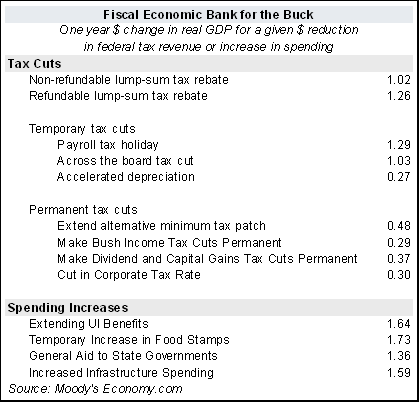
There are three reasons for this. First, most people who receive a tax cut don't spend all of it. They use part of it to pay down their debts or they save it. Most of us did one or the other last spring with that tax rebate. From the standpoint of any particular individual, paying down debts or saving may be smart behavior -- even commendable. But what's intelligent for an individual does not necessarily translate into what's good for the economy as a whole. The only way to get businesses to create or preserve jobs is through additional spending. And unlike tax cuts used to pay down personal debt or add to savings, every dollar of government spending flows directly into the economy and adds to overall demand.
Second, even that portion of a tax cut we might actually spend doesn't necessarily go into the American economy. It goes all over the world. I have nothing against creating or preserving the jobs of Asians who assemble those flat-panel TVs you see at the mall, for example, but right now we're trying to create or preserve jobs here in America. Sure, the retail workers at the mall who sell the flat-panel TV's might benefit, but remember we're talking about how to get the biggest bang for every dollar. When government spends to repair a highway or build a school or help pay for medical services, the money and the jobs stay here in America.
Finally, those who say cutting taxes on businesses is the best way to create or preserve jobs forget about the demand side. Even with a tax cut, businesses won't hire workers unless there are customers to buy what those workers produce. A government stimulus that creates jobs is a necessary precondition.
This isn't a matter of more or less government, however much Republicans and conservatives would like to wedge it in that old ideological box. The issue is how to revive the economy. When consumers and businesses can't or won't spend enough to keep the economy going, government has to be the spender of last resort. Period. |
http://tpmcafe.talkingpointsmemo.co...and-the-sti.php |
|
|
| josh4 |
| quote: | | Originally posted by The17sss |
So apparently you only seem to recognize and point out fear-mongering when its coming from the other side. |
|
|
| Shakka |
| quote: | Originally posted by pkcRAISTLIN
id like to know where all these 'fiscal conservatives' in the republican party have been the last 8 years. |
If you keep your eyes on the rear-view mirror you might just drive off a cliff. There were plenty of them that winced every time Dubya didn't veto a project. Unfortunately they weren't in congress. |
|
|
| josh4 |
| quote: | Obama Names Economic Panel
By JEFF ZELENY
Published: February 6, 2009
WASHINGTON — Saying that he wanted to leave no stone unturned in finding ways to put people back to work, President Obama on Friday appointed a team of outside economic advisers to offer advice to help the White House craft a response to the nation’s growing recession.
The White House Economic Recovery Advisory Board, led by a former Federal Reserve chairman, Paul Volcker and modeled after the foreign intelligence board created by President Dwight D. Eisenhower, includes advisers from business, labor and academia.
The president is naming the board as the administration prepares for another wave of stinging economic news with the January unemployment report. The president said in a speech late Thursday that Democrats could not allow Republican critics to delay the economic stimulus bill.
“We are not going to get relief by turning back to the very same policies that for the last eight years doubled the national debt and threw our economy into a tailspin,” Mr. Obama said.
While the president already has a large stable of economic advisers at his disposal, the new board is intended to provide advice from outside Washington. When Mr. Obama first discussed the board after his election last year, he said he wanted to find a way to bypass the “echo chamber” of the capital.
“The board will bring a diverse set of perspectives and voices from different parts of the country and different sectors of the economy to bear in the formulation and evaluation of economic policy,” the White House said in a statement on Friday morning. The board, which will be announced in a White House ceremony, is also set to establish Mr. Volcker as a key member of the president’s economic team. He has long been an adviser, but his role in the opening weeks of the administration has been undefined.
The group includes Jeffrey Immelt, chairman of General Electric, and Jim Owens, the chairman of Caterpillar Inc., which announced last week the layoff of 20,000 jobs. William Donaldson, a former Securities and Exchange Commission chairman, will also serve on the board, along with Roger Ferguson, the president of T.I.A.A.-CREF, and Martin Feldstein, a Harvard University professor, who was the chief economic adviser to President Ronald Reagan.
The group also includes two leading labor officials: Richard Trumka of the A.F.L.-C.I.O. and Anna Burger of the Service Employees International Union. The board, which will meet for two years, will be guided by Austan Goolsbee, an economic adviser to the president.
In his announcement on Friday morning, aides said, Mr. Obama will also urge Congress once again to pass his economic recovery package. He has spent much of the week hearing concerns from lawmakers, but said Thursday evening that the $800 billion range represented “the scale that we need to deliver for the American people.”
“I think it is important to make sure that the recovery package is of sufficient size to do what’s needed to create jobs,” Mr. Obama told reporters as he flew aboard Air Force One to speak to House Democrats meeting in Williamsburg, Va. “We lost half a million jobs each month for two consecutive months and things could continue to decline.”
He added, “Every economist, even those who may quibble with the details in the makeup of the package will agree that if you’ve got a trillion dollars in lost demand this year and a trillion dollars in lost demand next year then you’ve got to have a big enough recovery package to actually make up for all those lost jobs and lost demand.”
|
I really like how Obama is committed to keeping himself informed from a large swath of people outside the Washington bubble. Starkly different from a previous President that kept himself sheltered and surrounded by Yes-wo/men and group think. I continue to be encouraged on how Obama operates and I really think we'll start to see serious progress from his methods.
| quote: | Originally posted by Shakka
If you keep your eyes on the rear-view mirror you might just drive off a cliff. There were plenty of them that winced every time Dubya didn't veto a project. Unfortunately they weren't in congress. |
LOL what a crock of . Is this really how you people rationalize their mistakes?
The same idiots that made those mistakes are still there and they're trying to make them again. God forbid they actually learn from them and adapt accordingly.
Don't come up in here trying to pass blame to Bush after-the-fact. Especially not after all the apologizing and defending you yourself were doing those 8 years. |
|
|
|
|

