|
Capitalism is evil? (pg. 6)
|
View this Thread in Original format
| DigiNut |
| quote: | Originally posted by MarkT
believe it or not (even in a capitalist system), people choose to pursue jobs that result in things other than wealth accumulation...like social status/privilege, personal satisfaction, or simply because they feel it's 'good work' and perhaps even that they 'ought' to do it if they have an aptitude for it. if that can be done *within* the context of a capitalist society, it's not a stretch to think that those motivations would become more prominent in a socialist one. |
Trouble is that these secondary motivations are random and often fleeting. Many people start a career because they enjoy it or feel a responsibility but don't continue for very long. Others leave, or don't go into the field in the first place, because it doesn't pay well enough to give them the quality of life they want.
You also make the mistake of looking entirely at wage-based work, which is relatively unimportant to society's function. The people that matter are the people who start businesses. As Jay pointed out earlier, there's little to no risk in having a "job", so people are often willing to make the tradeoffs you describe. It's different as an entrepreneur; you're taking a much bigger risk and nobody will do this unless they can reap the corresponding rewards upon success.
Is cold hard cash the ONLY thing that motivates people? Hell no. But it's measurable, and it's still the most reliable. You have to think about the jobs that people don't want to do, which, honestly, is most of them; or the ones that are intensely stressful or require years and years of training and up-front investment. You aren't going to get the best people for those jobs unless you pay them well.
The only way to stop society at large from going exclusively into the easy/fun fields is to offer them a concrete incentive to do something else. In order for society to function, a lot of people have to do things that they don't really enjoy that much, and paying them to do it is more reliable than forcing them to do it. |
|
|
| Jayx1 |
| quote: | Originally posted by MarkT
it's the 'same ' from the perspective of much of the general population. the end result is that wealth is controlled be a privileged few and not enjoyed by all of the people. it makes no difference to the average person if that wealth is controlled by the state or a handful of citizens (or foreigners, as the case is quickly becoming in the U.S.) |
So most people in capitalist countries are not wealthy? Am i missing something? I guess wealth is subjective because from what i can see, most of us here are beyond wealthy. Even those of us who think we are poor are wealthy. Capitalism creates a wealthy society where there are some who are extremely wealthy.
| quote: | | socialism doesn't fail to recognize motivation. it fails to assign personal wealth as the primary motivation. believe it or not (even in a capitalist system), people choose to pursue jobs that result in things other than wealth accumulation...like social status/privilege, personal satisfaction, or simply because they feel it's 'good work' and perhaps even that they 'ought' to do it if they have an aptitude for it. if that can be done *within* the context of a capitalist society, it's not a stretch to think that those motivations would become more prominent in a socialist one. is that utopian, idealistic...yes. so take what you can and apply it to reality instead of just dismissing it. there ARE beneficial elements that can be extracted. |
See your summations here are lovely on paper. If only the human mind could think like that. People are less compelled to do things for others and more compelled to look out for themselves. Even the most altruistic person is greedy. The reason they give is because it makes them feel good. But there is ALWAYS a motivation.
Even in cuba where i find that people are extremely friendly and neighbourly, there is still no motivation to do any more than you need to to survive. Becuase doing MORE work results in the same outcome.
I spent 3 weeks in a cuban village. I can tell you that most of the people there are bored less and sit around all day doing nothing. Why? because they tell me that there is no work and when there is it doesnt pay much more than what they get from the government to sit around all day anyways. So they spend their time hanging out with neighbours and helping them out. They are somewhat happy but wish they had something to work for. They all pretty much have the same which is not much at all. The government controls their money, their housing, their work (if there is any) and even how much and what type of food they can eat. Most start illegal black market business when they can by stealing from the government and reselling by either bartering or selling. If you are cuban and are caught selling ANYTHING its jail time.
How many cubans broke down to me and admitted that they dreamed of one day being able to have the ability to advance themselves in order to help themselves and their family? If the wrong people even heard these conversations they would disappear and id be jailed and hopefully deported. Why do you think these folks risk their lives to go to a place where they can earn money for their starving families?
The cuban diet is pork (special occasions) rice, corn and water. maybe the odd chicken and THATS it.
Cuba is the closest to pure socialism we have on the planet at the moment and look how well thats working out.
BTW i hear Micheal Moore is a big fan of Cuba. :rolleyes: |
|
|
| DigiNut |
| quote: | Originally posted by MarkT
similar to unemployment figures. I imagine that it's difficult to pinpoint the # of people who choose to be unemployed, have temporarily exited the employment sector, work outside fo the legal one, etc. |
It's possible that I've exaggerated slightly, but as for the age distribution, the numbers are available:
http://www.census.gov/hhes/www/hlth...oric/index.html
I took the 2007 data and made a chart for the tl;dr types:
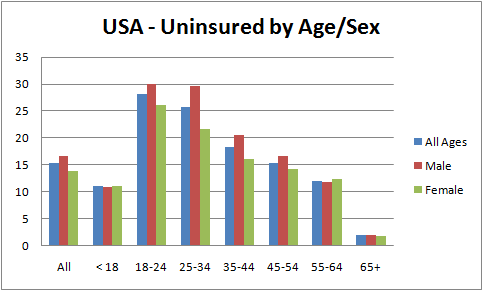
I think what's going on here is incredibly obvious. Parents get insurance for their kids, and as soon as those kids turn 18 and are no longer eligible as dependents, the insurance drops off the map until about age 35. It's even more dramatic with the men than the women.
Look at the data for yourself; I think it's almost safe to say that virtually ALL uninsured in any age group in excess of about 10% are uninsured by choice, and this cuts the number down by a huge amount, to well under 10 million by my estimate. And even then it's hard to say how many really can't get insurance, when you look at how high a percentage are insured at 65+.
And out of 10 million, do your own little back-of-the-envelope estimate of how many you think will become gravely ill, and of that number, how many are genuinely poor and don't have anything saved up for a rainy day (i.e. "self-insured"). That number has got to be less than 1 million; even ignoring the financial aspect, less than 1 in 10 people are going to get that sick.
So really, just how big a problem are we talking about here? And how does it really stack up against other countries? I'm willing to bet that the U.S. actually has better statistics than most because those people can still get the care they need, unlike in a European two-tiered system where they may not be able to go to a private hospital at all, and may become even more sick on some public waiting list.
Any questions? |
|
|
| Jayx1 |
I have one... wheres Mccarthy when you need him?
LOL jokes.... |
|
|
| miketg23 |
| quote: | Originally posted by DigiNut
It's possible that I've exaggerated slightly, but as for the age distribution, the numbers are available:
http://www.census.gov/hhes/www/hlth...oric/index.html
I took the 2007 data and made a chart for the tl;dr types:
Any questions? |
Is it not at all disturbing that 10% of children do not have any medical coverage? |
|
|
| DigiNut |
| quote: | Originally posted by miketg23
Is it not at all disturbing that 10% of children do not have any medical coverage? |
I hope this isn't another "think of the children!" appeal. That 10% seems to be the part that's relatively constant across the board (except 65+). A contextless number really shouldn't disturb or alarm anybody; you need to interpret that number.
Whatever the specific proportions are, that number will comprise people who:
- "Self-insure", i.e. have net assets or social connections that makes 3rd-party insurance unnecessary;
- Make a conscious choice not to insure because they perceive it as low-risk (includes the parents of some children);
- Make a conscious choice not to insure because of financial ineptitude (i.e. they can afford it but can't budget / think it's too expensive);
- Make an unconscious choice not to insure (disorganized, absent-minded);
- Cannot obtain insurance because of medical history or high-risk activities;
- Are only temporarily uninsured, i.e. they were insured through their employer and recently lost or quit their job;
- Are living below the poverty line and cannot afford any kind of insurance.
Now I won't pretend to know the exact proportions of all of those possibilities, but it is safe to say that low income is just one reason among many why an individual or family might not be insured, and without more information, we really can't simply assume that any one reason is the dominant one.
So my short answer is no, I am not "disturbed" by that statistic. I would say that the number warrants concern, and perhaps further investigation, but it is not a reason to panic and demand nationalization of the health care system. |
|
|
| Kellyboop |
I love how Michael Moore bashes capitalism yet offers no solution to the issues he brings up.
Excellent job douche! |
|
|
| Flec |
Politics Explained
FEUDALISM: You have two cows. Your lord takes some of the milk.
PURE SOCIALISM: You have two cows. The government takes them and puts them in a barn with everyone else's cows. You have to take care of all of the cows. The government gives you as much milk as you need.
BUREAUCRATIC SOCIALISM: You have two cows. The government takes them and put them in a barn with everyone else's cows. They are cared for by ex-chicken farmers. You have to take care of the chickens the government took from the chicken farmers. The government gives you as much milk and eggs as the regulations say you need.
FASCISM: You have two cows. The government takes both, hires you to take care of them and sells you the milk.
PURE COMMUNISM: You have two cows. Your neighbors help you take care of them, and you all share the milk.
RUSSIAN COMMUNISM: You have two cows. You have to take care of them, but the government takes all the milk.
CAMBODIAN COMMUNISM: You have two cows. The government takes both of them and shoots you.
DICTATORSHIP: You have two cows. The government takes both and drafts you.
PURE DEMOCRACY: You have two cows. Your neighbors decide who gets the milk.
REPRESENTATIVE DEMOCRACY: You have two cows. Your neighbors pick someone to tell you who gets the milk.
BUREAUCRACY: You have two cows. At first the government regulates what you can feed them and when you can milk them. Then it pays you not to milk them. Then it takes both, shoots one, milks the other and pours the milk down the drain. Then it requires you to fill out forms accounting for the missing cows.
PURE ANARCHY: You have two cows. Either you sell the milk at a fair price or your neighbors try to take the cows and kill you.
LIBERTARIAN/ANARCHO-CAPITALISM: You have two cows. You sell one and buy a bull.
SURREALISM: You have two giraffes. The government requires you to take harmonica lessons.
(Original source unknown . . . this version expanded and Illuminated by SJ.) |
|
|
| MarkT |
| quote: | Rather than relying on capitalism to save them during the recession, Moore said, major U.S. corporations actually turned to socialism in the form of taxpayer-funded bailouts.
"The true believers of socialism in the United States of America are Wall Street and corporate America. They want the safety net there for themselves and they have very willingly taken...trillions (of dollars) of our money," Moore said. |
http://www.thestar.com/entertainmen.../article/695446
hahaha...he's got a point there :D |
|
|
| DigiNut |
| quote: | Originally posted by MarkT
hahaha...he's got a point there :D |
Hardly. His point actually demonstrates the biggest problem with corporate welfare, namely that as soon as you start offering handouts, everyone will want one. How can Citigroup compete with Bank of America if BAC has $20 billion in free money and C doesn't?
We have the same thing in Canada on a smaller scale with programs like SRED. You'd be amazed at who applies for - and gets - those grants. If you're a small business working in the tech sector and you're not drinking from that well, then you're putting yourself at a disadvantage.
It's not as if company execs walked up to their congressmen and asked for billions of dollars in bailouts (except for GM, but forget about their useless asses). The government offered it to practically anyone who was big enough and wanted some. What did you think that the CEO of JP Morgan was going to say? "No, thank you, we're doing just fine, you go ahead and send that $25 billion to Goldman Sachs instead, we really don't need it." Right.
What a goddamn idiot Moore is, doesn't even bother to do a shred of research. And the long-term effects of these bailouts have yet to be seen. With markets trending up, these companies are now making money hand over fist, but the moral hazard that's been created could cause them to lose even more if the economic climate changes. |
|
|
| Jayx1 |
| Capitalism isnt perfect... But its a hell of a lot better than the alternative which i have seen and experienced first hand. |
|
|
|
|


