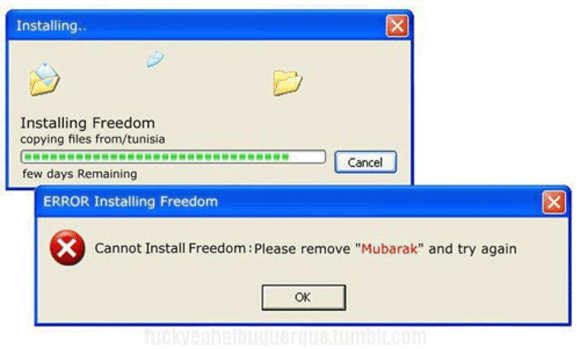
Originally posted by Lebezniatnikov
With secession happening in South Sudan, and protests already starting to crop up in Khartoum, keep an eye on Sudan.
At least 13 people, including two children, have been killed in clashes between soldiers in the volatile south Sudan town of Malakal, doctors say.
Battles broke out on Thursday between rival northern troops, some of whom want to stay in the south. Malakal has previously seen north-south clashes.
The fighting comes as Southern Sudan is waiting for confirmation of the result of its independence referendum.
Provisional results say 99% of voters opted to secede from the north.
A local official said many more people may have been killed.
Zharen
I find it rather astonishing that after one successful revolt in Tunisia, it has spread to so many other countries in the Middle East, including Iran and Libya. And yet no one seems to be making such a big deal about it in the US, although when you really think about it, it is sort of amazing.
Witnesses: Saudi forces fire on protesters, injure 3
Three people were taken to the hospital Thursday after Saudi security forces fired on scores of protesters in the city of Qatif, according to two witnesses and an activist.
The protests took place one day ahead of a planned "Day of Rage" in the Middle Eastern country.
Defying a Saudi government ban on all kinds of public demonstrations, more than 100 people in the predominantly Shiite city in eastern Saudi Arabia urged authorities to release Shiite prisoners, the witnesses and activist said.
At some point, the witnesses said Saudi security forces shot to disperse the crowd. It was unknown if the forces fired rubber bullets or live ammunition. Those injured were taken to Qatif Central Hospital for treatment, the activist and witnesses said.
The witnesses and activist asked not to be named because they feared reprisals.
Ali Ahmed, the director of the Washington-based human rights advocacy group Institute for Gulf Affairs, who said he's been in touch with protesters, said a 16-year-old demonstrator was hurt in the hand, while an 18-year-old was injured in the foot. He claimed that a third unidentified person was more seriously hurt with injuries to the abdomen.
Ahmed said he had contacted the U.S. State Department with his concerns about the Saudi security forces' actions.
The previous day, a similar number of protesters took to the streets at Qatif. Human Rights First Society President Ibrahim Al-Mugaiteeb said that police kept a watchful eye, but did not intervene.
A Saudi interior ministry spokesman did not respond to repeated calls to discuss the incident, and other Saudi officials likewise had no comment on the matter.
Flanked by U.S. National Security Advisor Tom Donilon, Deputy National Security Advisor for Strategic Communications Ben Rhodes acknowledged that U.S. authorities were aware of reports that Saudi Arabian police had fired on protesters.
"What we have said to the Saudis and to all the people of the region is that we're going to support a set of universal values in any country in the region," Rhodes said, adding that the message has been "articulated in public and in private" to the Saudi government. "And that includes the right to peaceful assembly, to peaceful protest, to peaceful speech."
The incident Thursday came as a precursor to Friday's planned "day of rage" in Saudi Arabia, though longtime observers of the kingdom remained skeptical that it would make a major impact.
"I don't think any protests that happen tomorrow will be destabilizing to the country," said Christopher Boucek, a Saudi expert with the Carnegie Endowment for International Peace.
Prominent blogger Ahmed Al-Omran said the Saudi government remains unresponsive to people in the streets.
"I don't think they're really in touch with the people," he said.
Several of the recent protests -- including those in Qatif on Thursday -- have been driven by Shiite Muslims, who are a minority in the Sunni-dominated Arab kingdom.
The unrest brewing in parts of the Middle East and North Africa has appeared to get Saudi leaders' attention, with King Abdullah announcing a series of sweeping measures late last month aimed at relieving economic hardship.
That said, Saudi authorities have done little to change their tack against demonstrators, even authorizing security forces to "take all measures against anyone who tries to break the law and cause disorder."
Last week, about 24 protesters were detained in Qatif, as they denounced "the prolonged detention" of nine Shiite prisoners held without trial for more than 14 years, Amnesty International said.
Police kicked and beat three protesters with batons in what was an apparent peaceful demonstration, Amnesty said in a statement.
"The Saudi Arabian authorities have a duty to ensure freedom of assembly and are obliged under international law to allow peaceful protests to take place," said Philip Luther, deputy director of the human rights group's Middle East and North Africa program.
"They must act immediately to end this outrageous restriction on the right to legitimate protest."
There was no immediate reaction from the Saudi government to the Amnesty statement.
The protests in the majority Sunni kingdom have followed similar demands across the Arab world for more freedom and democracy.
Rights activists have been advocating the right to protest for months in the kingdom, but they have been denied permission to assemble.
Lately, grass-roots ferment mirroring the unrest across the Middle East and North Africa has emerged, with a Facebook group calling for days of rage and Shiites taking to the streets. Activists have been calling for reform and the release of people jailed without charge or trial.
Amnesty said the recent detentions came a week after a prominent Shiite cleric, Sheikh Tawfiq Jaber Ibrahim al-'Amr, was arrested after a sermon calling for reforms in Saudi Arabia. He was released without charge Sunday.
Most of the protesters are believed to be held in a police station in Dhahran, an eastern city. Among them are activists who have protested arrests and discrimination against the minority Shiites.
"The Saudi authorities must investigate reports of beatings of protesters by security forces. They should also ensure that those detained are either charged with recognizable offenses and tried fairly or released," Luther said.
"While in detention they must be protected from torture and other ill-treatment and given regular access to their family, lawyers and medical staff."
The Shiite activists in "prolonged detention" have been held in connection with the deadly 1996 bombing of a U.S. military complex in Khobar, in which 20 people were killed and hundreds injured.
"According to reports, they were interrogated, tortured and denied access to lawyers together with the opportunity to challenge the legality of their detention," Amnesty said.
I can not believe the Saudis in their right mind would think it is wise to fire upon protesters. Have they not learned anything from their neighboring countries? If it escalates there we could have ourselves another big oil crisis here.
Zharen
Saudis pull a US and sends an occupational force into Bahrain
(Reuters) - Saudi Arabia sent troops into Bahrain on Monday to help put down weeks of protests by the Shi'ite Muslim majority, a move opponents of the Sunni ruling family on the island called a declaration of war.
Analysts saw the troop movement into Bahrain, home to the U.S. Navy's Fifth Fleet, as a mark of concern in Saudi Arabia that concessions by the country's monarchy could inspire the conservative Sunni kingdom's own Shi'ite minority.
About 1,000 Saudi soldiers entered Bahrain to protect government facilities, a Saudi official source said, a day after mainly Shi'ite protesters overran police and blocked roads.
"They are part of the Gulf Cooperation Council (GCC) force that would guard the government installations," the source said, referring to the six-member bloc that coordinates military and economic policy in the world's top oil-exporting region.
Bahrain said on Monday it had asked the Gulf troops for support in line with a GCC defense pact. The United Arab Emirates has said it would also respond to the call.
Witnesses saw some 150 armored troop carriers, ambulances, water tankers and jeeps cross into Bahrain via the 25-km (16-mile) causeway and head toward Riffa, a Sunni area that is home to the royal family and military hospital.
Bahrain TV later showed footage it said was of advance units of the joint regional Peninsula Shield forces that had arrived in Bahrain "due to the unfortunate events that are shaking the security of the kingdom and terrorizing citizens and residents."
Analysts and diplomats say the largest contingent in any GCC force would come from Saudi Arabia, which is worried about any spillover to restive Shi'ites in its own Eastern Province, the center of its oil industry.
Bahraini opposition groups including the largest Shi'ite party Wefaq said the move was an attack on defenseless citizens.
"We consider the entry of any soldier or military machinery into the Kingdom of Bahrain's air, sea or land territories a blatant occupation," they said in a statement.
"This real threat about the entry of Saudi and other Gulf forces into Bahrain to confront the defenseless Bahraini people puts the Bahraini people in real danger and threatens them with an undeclared war by armed troops."
The move came after Bahraini police clashed on Sunday with mostly Shi'ite demonstrators in one of the most violent confrontations since troops killed seven protesters last month.
After trying to push back demonstrators for several hours, police backed off and youths built barricades across the highway to the main financial district of the Gulf banking hub.
Those barricades were still up on Monday, with protesters checking cars at the entrance to the Pearl roundabout, the focal point of weeks of protests. On the other side of the same highway, police set up a roadblock preventing any cars moving from the airport toward the financial area.
In areas across Bahrain, vigilantes, some armed with sticks or wearing masks, guarded the entrances to their neighborhoods.
In areas across Bahrain, vigilantes, some armed with sticks or wearing masks, guarded the entrances to their villages. Sectarian clashes broke out in Madinat Issa, witnesses said.
"We will never leave. This is our country," said Abdullah, a protester, when asked if Saudi troops would stop them. "Why should we be afraid? We are not afraid in our country."
SECTARIAN CONFLICT
Bahrain has been gripped by its worst unrest since the 1990s after protesters took to the streets last month, inspired by uprisings that toppled the leaders of Egypt and Tunisia.
Thousands are still camped out at the Pearl roundabout, having returned since the army cleared out the area last month.
Washington has urged Bahrain to use restraint and repeated the call to other Gulf nations on Monday.
"We urge our GCC partners to show restraint and respect the rights of the people of Bahrain, and to act in a way that supports dialogue," White House spokesman Tommy Vietor said.
The cost of insuring Bahraini sovereign debt against default rose on Monday, nearing 20-month highs after Saudi intervention.
Any intervention by Gulf Arab troops in Bahrain is highly sensitive on the island, where the Shi'ite Muslim majority complains of discrimination by the Sunni Muslim royal family.
Most Gulf Arab ruling families are Sunni and intervention might encourage a response from non-Arab Iran, the main Shi'ite power in the region. Accusations already abound of Iranian backing for Shi'ite activists in Bahrain -- charges they deny.
"The Bahraini unrest could potentially turn into regional sectarian violence that goes beyond the borders of the particular states concerned," said Ghanem Nuseibeh, partner at consultancy Cornerstone Global.
Iran urged Bahrain not to allow foreign interference and urged the government not to use force against protesters.
"Using other countries' military forces to oppress these demands is not the solution," Foreign Ministry official Hossein Amir Abdollahian told the semi-official Fars news agency.
In a sign that the opposition and the royals may find an 11th-hour solution, the opposition groups said they had met the crown prince to discuss the mechanism for national dialogue.
Crown Prince Sheikh Salman al-Khalifa offered assurances on Sunday that talks would address key opposition demands including parliamentary, electoral and government reforms.
Even if talks are successful however, the opposition is increasingly split and hardline groups may keep up protests.
Wefaq is calling for a new government and a constitutional monarchy that vests the judicial, executive and legislative authority with the people. A coalition of much smaller Shi'ite parties are calling for the overthrow of the monarchy -- demands that scare Sunnis who fear this would benefit Iran.
So they think just because they beat their own protesters that they will nullify Bahrain's? We shall see...
Zharen
OMG :(
Different Bahraini protester
jad
!!
Igneous01
that video was extremely disturbing - i must have watched it like 5 times to make sure that was real.
quite horrible whats going on.
and the entire protest is spreading all over africa and middle east. Algeria has been protesting along side Tunisia now, its like a viral spread of protest has erupted over the continent.
I just hope they can resolve it with a new government, and hopefully without any more deaths like those.
President Barack Obama, Defense Secretary Bob Gates, CIA Director Leon Panetta, Secretary of State Hillary Clinton, and other high ranking officials and government agencies were caught by surprise over the uprisings, accused of presiding over a massive intelligence failure and being caught "flat footed."[66][67][68] Panetta, Deputy Secretary of State Jim Steinberg,[69] Director of Intelligence James Clapper,[70] and FBI Director Robert Mueller appeared before the 112th Congress's first House Permanent Select Committee of Intelligence hearing to testify about Egypt and related failures.
Why am I not surprised? One of the most significant events to happen in this decade, possibly this whole century even, and not even a speech about it by our dear leader. Oh well, guess he's too busy enjoying the NCAA championships.
Zharen
We're gonnna tear down that monument now. That'll show those damn protesters!
Bahrain on Friday tore down the 300-foot (90-meter) monument at the heart of a square purged of Shiite protesters this week, erasing a symbol of an uprising that's inflaming sectarian tensions across the region.
The monument – six white curved beams topped with a huge cement pearl – was built in Pearl Square as a tribute to the Sunni-ruled kingdom's history as a pearl-diving center. It became the backdrop to the Shiite majority's uprising after protesters set up a month-long camp at Pearl Square in the capital, Manama.
Security forces overran the camp on Wednesday, setting off clashes that killed at least five people, including two policemen. At least 12 people have been killed in the month-long revolt.
Bahrain's foreign minister, Khalid bin Ahmed Al Khalifa, told reporters in Manama that the army brought down the monument because "it was a bad memory."
"We are not waging war, we are restoring law and order," Khalid said at a press conference in Manama.
Shiite anger rose sharply around the Mideast on Friday as large crowds in Iran and Iraq cursed Bahrain's Sunni monarchy and its Saudi backers over the violent crackdown on protesters demanding more rights.
Amateur video footage of security forces shooting and beating protesters has spread across the internet and fueled fury in predominantly Shiite Iraq and in Iran, where a senior cleric on Friday urged Bahraini protesters to keep going until victory or death.
Thousands of Bahrainis gathered for the funeral of Ahmed Farhan, a 29-year-old demonstrator slain Tuesday in the town of Sitra hours after the king declared martial law in response to a month of escalating protests. Sitra, the hub of Bahrain's oil industry, has been the site of the worst confrontations.
A funeral for Abdul-Jaffer Mohammed Abdul-Ali, 40, took place in the village of Karranah, west of the capital. His brother Abdul-Ali Mohammed told The Associated Press that Abdel-Jaffer was killed on Wednesday morning on his way to Pearl Square to reinforce the protesters' lines during the military assault on the encampment.
Story continues below
Advertisement
"My brother was not a political man, but he participated in the protest every day to have a better future for his four children," Abdul-Ali said.
"When he heard the Pearl Square was under attack, he went there," he added. "Our country is under siege and he wanted to help liberate it."
Shiites account for 70 percent of the tiny island's half-million people but they are widely excluded from high-level posts and positions in the police and military of the country, whic is home to the U.S. Navy's 5th Fleet.
"Brothers and sisters" in Bahrain should "resist against the enemy until you die or win," Iranian Ayatollah Ahmad Jannati told worshippers at Friday prayers at Tehran University, a nationally televised forum seen as expressing the views of Iran's ruling Shiite clergy.
Worshippers chanted angry slogans against Saudi Arabia's royal family, which has sent troops to back Bahrain's king.
"There is no God but Allah, Al Saud is God's enemy," some chanted in Arabic. One Persian banner read, "Death to Al Saud."
Across Iraq, thousands rallied in mostly Shiite cities in the country's largest demonstrations since a wave of dissent spread across the Middle East in the wake of Tunisia's overthrow of its autocratic president.
Grand Ayatollah Ali Sistani – Iraqi-based Shiism's highest ranking cleric in the Mideast – suspended teachings at religious schools across Iraq on Friday in a show of solidarity with the protesters.
A representative of al-Sistani warned during his Friday sermon in the holy city of Karbala that the brutal images of what is happening in Bahrain will inflame passions and lead to sectarian problems in the region.
Bahrain's rulers invited armies from other Sunni-ruled Gulf countries this week to help root out dissent as the month of protests spiraled into widespread calls for an end to the Sunni monarchy. In declaring emergency rule, the king gave the military wide powers to battle the uprising.
There are no apparent links between Iran and Bahrain's Shiite opposition but the U.S. and Sunni leaders in the Persian Gulf leaders have expressed concern that Iran could use the unrest in Bahrain to expand its influence in the region. Iran has recalled its ambassador from Bahrain to protest the crackdown.
The United States bases the 5th Fleet in Bahrain partly to counter Iran's military reach around the region.
ISLAMABAD -- Pakistan pulled out of talks this month with the United States on the future of Afghanistan in protest of an especially deadly American missile attack, the government said Friday, in a sign of rising tensions between the two uneasy allies.
Pakistan's powerful army chief has already criticized Thursday's missile attack on a house close to the Afghan border in a rare personal statement. Intelligence officials say around 36 people – most of them civilians – were killed. A U.S. official familiar with details denied that innocent people were targeted and suggested all the dead were militants or sympathizers.
The relationship was already fraught over the case of an American CIA contractor who shot and killed two Pakistanis but was freed on Wednesday, putting the weak government on the defensive against critics who accused it of selling out to the Americans.
The missile attack added to the heat on the government, which summoned U.S. Ambassador Cameron Munter to protest.
"It is evident that the fundamentals of our relations need to be revisited," the Foreign Ministry said in a statement that did not mention how many civilians were killed. "Pakistan should not be taken for granted nor treated as a client state."
The statement said Pakistan would not attend talks proposed by the United States in Brussels on March 26.
Pakistan had been scheduled to send its deputy foreign minister to the meeting, which was also to include a delegation from Afghanistan, it said.
The U.S. Embassy declined to comment because it was not aware any meeting had been proposed.
An earlier round of the trilateral talks was canceled by the United States in February, apparently in protest of the detention of Raymond Allen Davis, the contractor.
America routinely fires missiles against al-Qaida and Taliban targets close to the Afghan border, and U.S. officials say privately Pakistan assists in some of the strikes. But the program is publicly opposed by Pakistan's government and army because it believes admitting collaborating with America in attacks on its own people would be highly damaging politically.
Davis shot and killed two Pakistanis on Jan. 27 in the eastern city of Lahore and was arrested at the scene.
Washington claimed Davis acted in self-defense and had diplomatic immunity, but Pakistan's government did not accept this. He was released from prison as part of a court deal in which the victims' relatives received $2.3 million in compensation.
Both countries agreed on the "blood money" deal because it meant they could plausibly deny any responsibility for his release. Washington was never likely to allow a CIA contractor to stand trial in Pakistan, while Pakistan's economy is kept afloat with money from America and the International Monetary Fund, meaning Islamabad could not afford to sever its ties with Washington over the affair despite domestic pressure to put him on trial.
There were small demonstrations Friday against the release of Davis in several towns and cities across Pakistan.
The national government in Islamabad and the opposition-led local administration in Lahore have been blasted in the media over the deal. Pakistan's powerful army and the intelligence agencies, which are rarely publicly criticized, have also been attacked. Few believe that releasing Davis would have been possible without their permission and involvement.
Responding to the criticism, Prime Minister Yousuf Raza Gilani said the country had agreed that the Davis case would be decided in the courts. "It is therefore inappropriate to hold any single institution responsible for the final outcome of the case," he said.
Ammar.Hasan
And now the American and Canadian government are attacking libya to help overthrow gadaffi now?