|
dare i say it ... im looking for a picture... (pg. 3)
|
View this Thread in Original format
| Meat187 |
| quote: | Originally posted by Tasty Onions
The sun's radius is 0.04649 AU (1 AU is the average distance between earth and sun). VY Canis Majoris ("Bigg Dawg") has a radius about 2,000 times that of the sun. In AU, then, CM's radius is:
2000 * 0.004649 AU = 9.298 AU
That's just about Saturn's distance from the sun.
So if VY Canis Majoris were where our sun is, it would have swallowed up the first five or six planets of our solar system.
 |
Awesome, isn't it? That thing is so ing huge it literally eats solar systems for breakfast. :wtf: :eyespop: :eek: |
|
|
| srussell0018 |
| quote: | Originally posted by Acton
It's more dependant on the rate at which a star uses its fuel. |
I thought in order for a star to go supernova it had to be at least 6x the mass of the sun or something like that? |
|
|
| Lira |
| quote: | Originally posted by Tasty Onions
The sun's radius is 0.04649 AU (1 AU is the average distance between earth and sun). VY Canis Majoris ("Bigg Dawg") has a radius about 2,000 times that of the sun. In AU, then, CM's radius is:
2000 * 0.004649 AU = 9.298 AU
That's just about Saturn's distance from the sun.
So if VY Canis Majoris were where our sun is, it would have swallowed up the first five or six planets of our solar system.
|
And that's just the largest star we know of. Sure, there are limits as to how big a star can be but we can always be surprised by new findings.
Still, that's mind-boggling. The distance from the Sun up to Jupiter with nothing but hot hotness hotting all the way. I personally can't grasp how big that is and I'm not ashamed to say I believe I won't ever be able to understand how big that is in my lifetime. |
|
|
| srussell0018 |
| quote: | Originally posted by Lira
And that's just the largest star we know of. Sure, there are limits as to how big a star can be but we can always be surprised by new findings.
Still, that's mind-boggling. The distance from the Sun up to Jupiter with nothing but hot hotness hotting all the way. I personally can't grasp how big that is and I'm not ashamed to say I believe I won't ever be able to understand how big that is in my lifetime. |
It helps to use a scale model comparison. Like comparing a grain of sand to a beach ball or something. :p |
|
|
| Tasty Onions |
| quote: | Originally posted by srussell0018
Won't our sun eventually do that anyways once it becomes a red giant, since it's too small to go supernova? |
The sun will swallow earth and maybe Mars. But note that Saturn is more than 6 times the distance from the sun that Mars is, so even at our sun's biggest, it will still be much smaller than VY Canis Majoris. |
|
|
| srussell0018 |
| quote: | Originally posted by Tasty Onions
The sun will swallow earth and maybe Mars. But note that Saturn is more than 6 times the distance from the sun that Mars is, so even at our sun's biggest, it will still be much smaller than VY Canis Majoris. |
Does swallowing planets lead a star to grow larger than it normally would, or is the relative mass insignificant? |
|
|
| srussell0018 |
That's really cool. So the sun would eat up Mercury, Venus, Earth, and maybe Mars, but after becoming a red giant would eventually form a nebula that might create even more planets?
Also lol @ brown dwarf. I bet all the other stars make fun of them. Fags. |
|
|
| Meat187 |
| quote: | Originally posted by Lira
I personally can't grasp how big that is and I'm not ashamed to say I believe I won't ever be able to understand how big that is in my lifetime. |
Here's an explanation you might understand: let's assume the sun were the size of a nice pair of boobs. Then the boobs that correspond to Canis Majoris would be the size of a football stadium. ;) |
|
|
| Tasty Onions |
| quote: | Originally posted by srussell0018
That's really cool. So the sun would eat up Mercury, Venus, Earth, and maybe Mars, but after becoming a red giant would eventually form a nebula that might create even more planets? |
I've hardly read anything about planetary nebulas. Wiki says they last for a few tens of thousands of years, which is tiny on stellar evolution timescale, so I don't know if a lot would happen before it shrank down to its final state as a white dwarf. It might look pretty ing great in the meantime, though:
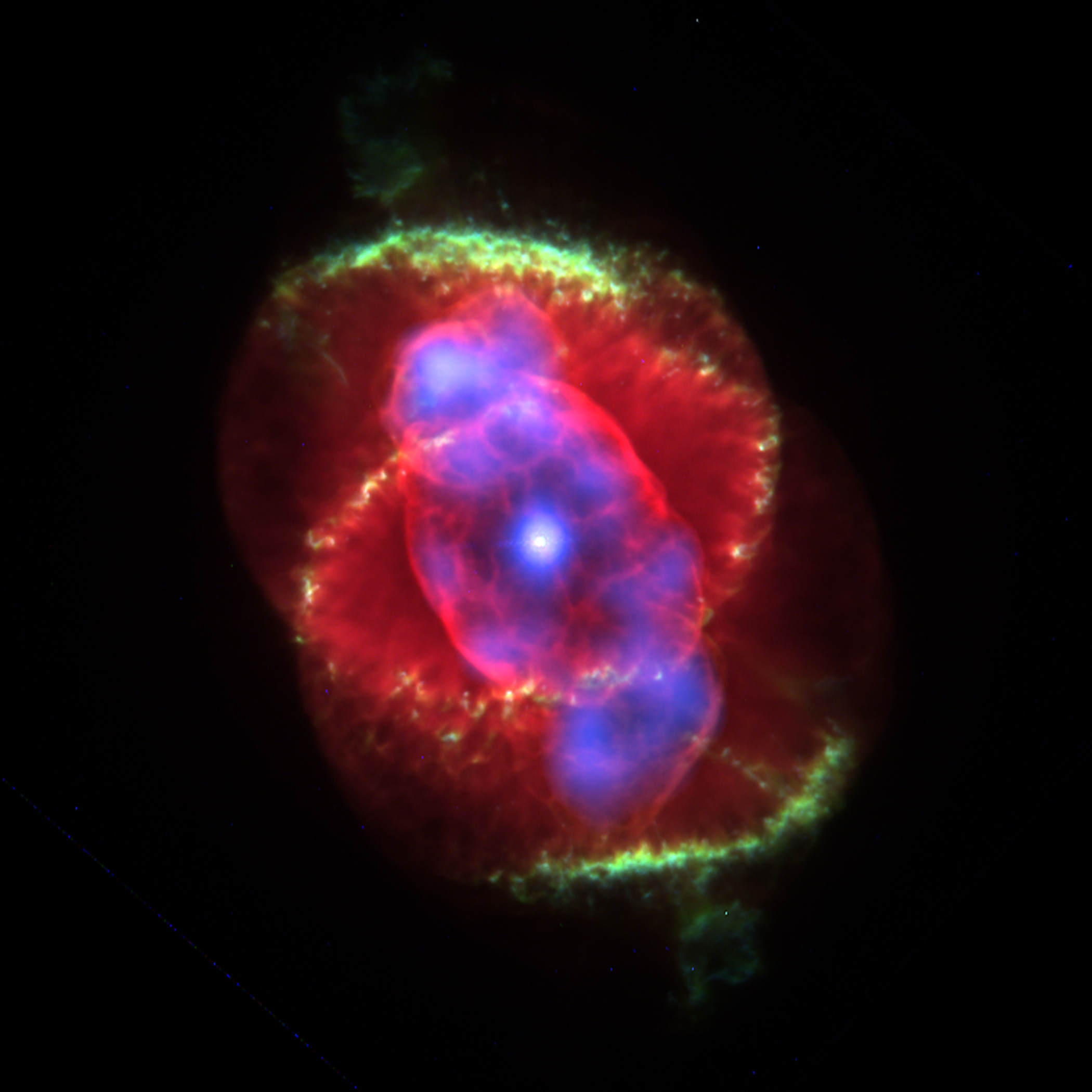
[ Cat's Eye Nebula. ]
| quote: | | Also lol @ brown dwarf. I bet all the other stars make fun of them. Fags. |
LOL. Doomed by a low mass to a boring fate.  |
|
|
| Lira |
| quote: | Originally posted by Meat187
Here's an explanation you might understand: let's assume the sun were the size of a nice pair of boobs. Then the boobs that correspond to Canis Majoris would be the size of a football stadium. ;) |
Precisely, and I just can't visualise such... opulence!
| quote: | Originally posted by Tasty Onions
Guessing it would be insignificant; even Jupiter's mass is a tiny fraction (0.09546%) of the sun's:
http://en.wikipedia.org/wiki/Jupiter_mass
Found a neat stellar evolution chart, btw:
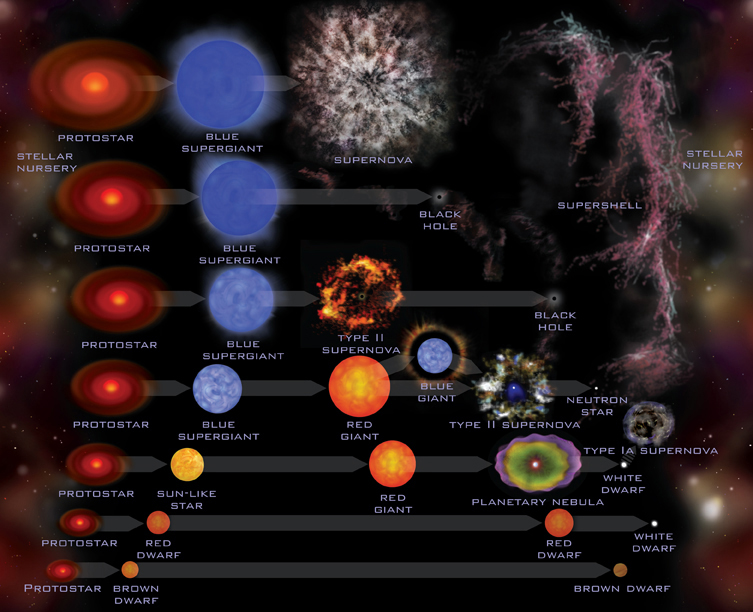 |
That's awesome :) |
|
|
|
|

