|
.
|
View this Thread in Original format
| MrCanada |
| This thread was ruined by ing annoying loser trolls, moids please delete, & warn/suspend/ban these ing loser trolls who spam threads, & do not add to them. No one said these ing losers name, & they still troll, & talk in their own loser internet language. |
|
|
| GGM |
This thread really couldn't exist without some work from without a doubt Toronto's #1 authority on DJs, the scene, EDM, and black guys that make techno from Michigan.
| quote: | Get to know a DJ: Denise Benson

Denise Benson is one of Toronto's most experienced DJs. In the past 20 years, she's performed at an array of Toronto's clubs — some of which still exist, some of which don't — though you can currently find her at Andy Poolhall where she helps to run one of the city's most successful club nights, Cherry Bomb. She's also launched a new party called Loose Hips, the seventh instalment of which runs tonight.
Beyond her work as a DJ, Benson is an accomplished writer who has taken to documenting the history of club culture in Toronto for the The Grid. In this interview, she talked to me about how she got started as a DJ, her writing, and the some of the changes she's noted in the Toronto scene over the years.
How did you get started in Dejaying
In a sense, I've always deejayed. But I started to professionally deejay around the time I moved to Toronto in 1986 to study Radio and Television Arts at Ryerson. By then, I had my set clubs that I went to on a weekly basis, which at the time were Klub Domino and Nuts and Bolts. At the same time, I was coming out as queer, but whenever I went to one of the women's bars I found that I found that I didn't like most of the music they were playing.
It was at that point that I decided to start deejaying again, and one of the first places I got to play at was a place called Showbiz, which was owned by the same owner as Nuts and Bolts. I had been going there all the time because it was not only a queer club, but it also played really cool alternative music.
The scene was quite different then and, in a lot of ways, more open with a variety of crowds mixing. It was also a really amazing time to be going out because the scene was much more of a melting pot of music than it is now. You could, for instance, be into "alternative music," and that could mean that you were into New Wave, Punk Rock, Detroit Techno, or Chicago and New York House. And you would hear it all in the alternative clubs. When I started spinning, I could play anything from Siouxsie and the Banshees to Techno, and that's to me what deejaying is all about. To me, the most interesting aspect of being of being a DJ is trying to find the meeting points between people on the dance floor.
In going through this process of documenting the growth of Toronto's scene, I'm sure there's some really interesting trends you've taken note of. Can you share one or two that have really stood out for you?
Obviously there are both positive and negative changes, though the negative ones come at you first. Of course, I'm generalizing here, but right now, perhaps even more than at any other time I can remember, club crowds are separated. It seems like they're often separated by race, whether they're from the suburbs or downtown, by their sexual orientation and so on just as much as they are by musical tastes. Diverse crowds used to come together through music and I just don't see that happening to the same degree now, weirdly enough.
I would say that one of the things that has disappointed me the most me is that as music has evolved, people have become less and less interested in each other and, sadly, less interested in new sounds. This is a conversation I have with other DJs all the time: we live in a time where people can literally access music from anywhere in the world and they can listen to almost anything, but what do people request in droves? Top forty. As a working DJ it blows my mind that at almost any venue I play at people will ask me for Britney or Rihanna.
How about we end on a positive note — what's a positive trend you've noticed in that same timeframe?
We're coming off a banner year in which people like Austra, Art Department, and Bonjay have released really well received material. Toronto's musical talent — whether its dance music or a band like ed Up — are creating really compelling music. Also, excitingly, there's a lot of overlap between music scenes or communities that people may think of as separate. I'm thinking of bands like Bishop Morocco or the fact that a lot of the guys in Broken Social Scene are into electronic music. Brendan Canning is a great deejay for example, and plays a lot of interesting house, techno and dub.
Toronto's at a point where there's an incredible amount of promise. I've been saying this for years, and I can keep saying it because the quality just keeps going up. I just wish that a broader range of Toronto's club patrons and music lovers would open their ears a bit more broadly to hear what we have going on here and take pride in this city's talent.
RAPID FIRE QUESTIONS
Favourite Brunch Spot: Cafe Neon.
East or West Side? West Side.
Starbucks or Darkhorse: Dark Horse? Cafe Neon. |
| quote: |
DJ Series: Denise Benson, Mark Oliver
Okay, so… instead of going on with my usual “I’ve been busy rant” about why I haven’t been posting at all I’m gonna keep it short.
I’ve been super busy.
… but I’m back.
——————————————————————————————————————
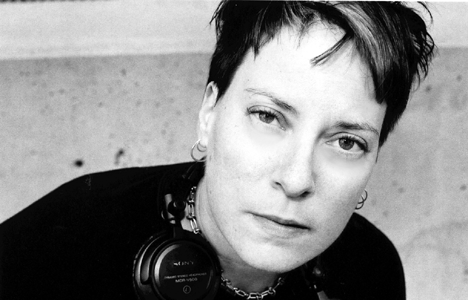
This is Denise Benson.
I’ve still been working on my DJ Series. I’ve actually lost count of how many i’ve photographed but I’m still trekking on. I’ve got big ideas for when i’m done the series but I’ll wait to talk about that…
Anyways…
Denise Benson
A few weeks ago I photographed local DJ and writer, Denise Benson. Denise is a big face in the Toronto electronic scene – not only is she a very busy DJ but she’s also a writer for TheGrid writing about the history of club culture in Toronto. Pretty cool! She’s been a DJ for years and it’s really cool to hear about what the culture used to be like years before I ever got involved.
Here’s the article with more photos of Denise and an interview with my writer, Igor Bonifacic. Check it out on BlogTO here:
http://www.blogto.com/music/2012/01..._denise_benson/
Mark Oliver
So, I’ve seen some people refer to Mark Oliver as a sort of legend in Toronto. He’s a resident DJ at Toronto’s (and probably Canadas’) most famous club, The Guvernment, and has been said to have “fathered the rave movement in Toronto back in the late 1980s” (my writer, Igor, actually said that exact line in the interview). So yeah, he’s pretty rad.
To be honest I wasn’t feeling in my A-Game that day but i’m happy to have come out with a few photos I like. We happened to shoot in a location that Mark lived in years ago and he had some pretty neat stories including one of partiers flooding the first floor of his apartment building which had tens of thousands of his records on it – but luckily on the second floor.
Here’s the article with an interview with my writer, Igor Bonifacic. Check it out on BlogTO here:
http://www.blogto.com/music/2012/02...dj_mark_oliver/
—————————————————————————-
Since I stopped posting I’ve actually shot a tonne of photos. With more DJ’s, a few live shows, and random stuff in between I’ve built up a lot of material to post. I’m hoping to post a few a week so expect the next post in a few days. I’ll end this with a random photo from ‘in between’ |
| quote: | Denise Benson on Toronto's Club Culture

On November 7th, the amazing Denise Benson stopped by the Bloor/Gladstone branch to talk about her GridTO series "Then and Now", chronicling the history of Toronto's nightclub scene. Those in the packed audience were treated to an overview of Toronto dance and live music venues from the 70s to present, detailing the significance of clubs like The Edge, Nuts & Bolts and Komrads both to musicians as well as the LGBTQ and many other communities as supports and gathering places.
For those of you weren't able to make it to the event, check out Denise's interview with CBC Metro Morning's Matt Galloway, delivered earlier in the day (skip to about 2/3rds of the through if you want to miss the earlier story about the American elections).
If you're interested in electronic music and Toronto's club scene, make sure to check out tomorrow's event:
The Revenge of Rave
Wednesday, November 21, 7pm
Bloor/Gladstone Library, 1101 Bloor St. W.
NOW music editor, DJ and musician Benjamin Boles discusses how electronic music has influenced both popular music and popular culture.
Register to guarantee a spot by calling 416-393-7674. |
| quote: |
Denise Benson
(interviewed June 15, 1999)
by Andrew Duke
Denise Benson has, simply put, one damn impressive resume. But despite the fact that she has had experiences many of us would envy, she remains particularly modest about her accomplishments. While others are busy talking, Toronto's Benson is do-ing. Radio DJ, Club DJ, booker, programmer, promoter, publicist, writer, musician-these are just some of the jobs she's been juggling since the mid 1980s.
She grew up in Grafton, Ontario, a small town (population 1000) halfway between Kingston and the big city of Toronto. "From the time I remember being a conscious being, I've always been deeply into music and deeply into words," Benson recalls over the phone from her home in Toronto. "I was a voracious reader as a kid-and continue to be-read like crazy and always had books on the go." Though not from a musical family, she was given a record player at the age of four. "They gave me a turntable (as an incentive) to stop sucking my thumb. I was always really into music, made tapes of music off the radio, and that continued all the way through high school. We had a little high school radio station, plus I volunteered at a commercial AM station for awhile in my early teenage years."
After high school in neighboring Coburg, she went on to take a Bachelor of Applied Arts (with honors) in Radio and Television at Ryerson Polytechnical Institute. "When it came time to think about what I wanted to do with my life, I either wanted to do something that seemed related to writing or music something…I was gonna do creative writing at York; I applied to both and decided on Radio and Television (because) it seemed to combine the elements of words and music to do radio." Benson remembers her family telling her, "'Well, when you get older, you'll forget about this (music).'" She laughs. "I can tease them about that now."
Benson began DJing in Grade Seven at high school dances, and things grew from there. By 1986 she was DJing parties and clubs around the Toronto area, and a year later she started hosting the "Mental Chatter" radio show on CKLN, a weekly gig she has continued to hold down for the last twelve years. NOW magazine began recognizing her abilities as a DJ in 1996, and she's been voted Best Club DJ in Eye Weekly's "Toronto's Best" Readers Poll for the last two years. Now 32, Benson is busier than ever on the wheels of steel. Including her regular DJ gigs (see sidebar), she has six appearances planned for the week we speak.
She was heavily involved in the programming, promotion, and organization of the JVC International Acid Groove Festival of 1997 and their Urban Rhythm Festival the following year, and has held a variety of positions at CKLN Radio throughout her time there. Growing up in a small town, Benson didn't have many music options. "I was so grateful when I discovered Brave New Waves, I'd be up all night every night." In yet another example of her ability to translate goals into action, Benson went on to work at CBC Radio Canada on the revered Brave New Waves program as a freelance writer, programmer, and replacement host.
Benson began writing about music in 1992 and has been published in magazines such as Rites, XTRA!, FUSE, and Word. Since 1996, she's been writing regularly for Exclaim-from numerous reviews and features on a wide variety of artists to last year's essay examining women producers.
March of this year saw her leave her National Beat Promotions day job at Iron Music (where she had been doing promotions and publicity for the label's dance roster) in order to concentrate more on her own words. "In terms of living, breathing, paying bills and stuff, it's gigs and bits of writing (now). I'm at a point where I'm like 'hmm, should I try to get a day job or a couple of days a week kind of job, part time, whatever?' On one hand it would make sanity a bit more possible in that you know that there's a pay check coming, but on the other hand I'm also trying to focus more and more on writing."
Started in January 1997, Benson's favorite regular club gig is her weekly "Glide" party held at Gypsy Co-op. "Because my history previous to (Glide) has been doing much more dancefloor stuff--a lot of things in the women's community, a lot of things in the lesbian and gay scene, obviously the fetish parties, all that kind of stuff, and then a lot of other sort of big parties here and there--with Glide I decided I wanted to stop playing women's nights specifically--because I wanted to focus on the music and whoever came out was coming out because they were into the music-and find a venue where I could start playing all the stuff that I was really deeply into and that I was playing on my radio show. Often your radio show is much more fluid than what you can do in a club because of requests and people's expectations, so Glide is the point in my life where I sat back and went 'OK, I want to do something that is about the music that I'm adoring right now.' I approached Gypsy, they were totally into it, it's much more of a lounge/restaurant kind of vibe and it's just been a really good match. A lot of people who listen to the radio show come out, and for a Wednesday it's been incredible; people are really supportive and I've had a lot of special guests that have come through, special parties that I've done." Some of Glide's many guests have included Goldie, Roni Size, Purple Penguin, Jaz Klash, and Andrea Parker. "(Glide) has been kind of my main baby, and that's really been integral for my whole shift in thinking and my whole approach. So now I'm doing smaller venues, getting paid less, but happier playing the music… It's nice because the crowd has continued to be mixed and you feel like the women in the women's community and the dyke scene who are into good music come out and it's a mixed crowd and that's where I'm happiest anyway."
With all of this activity, you've gotta wonder how Benson finds time to eat and sleep. "It's a bit much sometimes. Trying to balance the night time (DJing) and the daytime writing thing, that's the trickiest element."
Not content to rest, Soleil is a new Friday night Benson has started with fellow CKLN DJ Sassa'le. "It's so much fun, playing whatever we want. The music that I play at both (nights) is very similar, mostly downtempo, d n b (drum n bass), expect a bit more on the jazzy tip with Soleil and a bit darker with Glide. Both nights we play dub, he plays a lot of breaks, and beats, and funky stuff. He's originally from Bristol so he's got a lot of sweet stuff from way back."
Benson stresses that if you're that busy, you have to be enjoying it. "You have to sit back and say 'What do I want to do creatively? How can I pay the bills? How can I not give in to the system of a 9 to 5 job I hate?'" Her passion for the music is a driving force. "You get the nights when you're really tired and you don't want to leave the house and it's like 'why do I do this?' But then you get there, you have a coffee, people start talking to you about the tracks, and away you go. It's so invigorating," she says. "When I stop getting excited about music is when I'll stop doing these kinds of things. And there's no sign of that happening."
In addition to DJing and freelancing, doing more of her own music appears to be an option. A track done with two friends under the name D.O.Y. (Disciples Of Yahoo) originally appeared on Cup Of Tea's "Team Cannabis" compilation of last summer; this has just been licensed to appear on Gerald Belanger's second Metro Breaks compilation.
With so many years in the music scene, Benson knows that women are shown no favors. "I don't want to be ghettoized, I want to be respected for what I do, straight up, as does anybody else, but it is harder being a woman in this industry," she stresses. "For anybody starting out, it's harder particularly when you're beginning for people to take you seriously. But it is that much more difficult when you're a woman." Benson states that women's achievements in the music industry should be recognized because they truly are achievements. "You can count sometimes on a single hand the number of women who are in jobs other than publicity. You can easily count on a single hand how many women are on air on commercial radio stations and not doing traffic or news."
What needs to be done to change this situation? What changes need to be made? The key, Benson says, is persistence. "Women just have to be extra tight in what we are doing. You've got to be focused, you've got to know what you're trying to get and why. You've got to figure out the people to talk to, and you also have to figure out the people to talk to who are human beings who respect your ideas. You're always going to run into jerks in this industry, as in any other, and you've got to find a process of bypassing or weeding those people out--the people who will hold you back because you are a woman. You can see in people's eyes sometimes when they're just not taking your seriously, and sometimes you don't know if that's because of your gender or not." While Benson admits there has been frustration along the way, there's also been much progress. "When I first started DJing in Toronto, there were only two other women DJs in the city that I knew of. Now I can't count us all and that's exciting."
Her philosophy for success is simple. Ask yourself "'This is what I'm interested in doing, what do I need to get there?'" Benson says. "As long as I've got goals, I find that I can achieve them. There's lots of tangents along the way, but setting goals for yourself is crucial and I think that's a big part of why I've been able to do what I do." |
| quote: | Then & Now: Mod Club
In this edition of her nightlife-history series, Denise Benson tells the story of how a ‘60s-retro dance night spawned a world-class concert and DJ venue, transforming College Street in the process.
BY: DENISE BENSON
Club: Mod Club Theatre, 722 College
Years in operation: 2002-present
History: To share the history of how The Mod Club Theatre came to be, one must first trace College Street’s evolution as a nightlife destination. The stretch of College running west of Bathurst to Dovercourt has, of course, long been a hub for Italian, Portuguese and Latino communities. Restaurants and cafés have dotted the strip for decades—with Café Diplomatico at College and Clinton serving as a landmark spot for over 40 years—but it wasn’t until the 1990s that people began to open a broader array of venues that would entertain into the wee hours.
El Convento Rico—originally a haven for Latin gays, lesbians and transgendered people—opened in 1992, bringing dancing and drag shows to College and Crawford. The early-to-mid ’90s also saw the opening of spots including Souz Dal, College Street Bar, Ted’s Collision, and Alex Lifeson’s live music venue The Orbit Room. Intimate café 52 Inc. fed, entertained and politicized on the other side of Bathurst from 1995-2000, while Bar Italia opened on College in 1996 and Ted Footman launched Ted’s Wrecking Yard and Barcode—two floors of live music in one building—in 1997.
Musician Dan Kurtz—formerly of The New Deal and currently of Dragonette—knows the area well.
“When I moved to Canada as a little kid, I lived at College and Bathurst, and spent most of my childhood in the neighborhood,” he says. “As an adult, I bought a house on Beatrice and renovated it, just a year or two before things really began to heat up on the strip. I did that a couple more times with houses in the neighborhood before I moved out and, during that time, College Street became the hottest place to hang out. It was a great mix of a really authentic, old-school and virtually unchanged Italian and Portuguese neighbourhood by day, and an increasingly broad mix of great and cheesy bars and restaurants at night.
“My friends, my band, and most of my family lived in the neighborhood at that time, and it was probably one of the best times of my life,” he adds. In the late ’90s, Kurtz performed at venues like Ted’s, Bar Italia, and Orbit Room while a member of bands including Que Vida.
“At the time, almost every show I played was memorable, since my bands were just coming up,” says Kurtz. “Getting a good gig on College was some measure of legitimacy.”
Lava Lounge, at 507 College just west of Palmerston, added much to the strip. Opened in September 1997 by former Rivoli staffers Greg Bottrell and Rob Eklove (with support from The Rivoli and Queen Mother Café owners Andre Rosenbaum and David Stearn), Lava Lounge was located in the former home of Portuguese family restaurant Cheers. Bottrell and crew transformed it into a resto-lounge, club, and patio licensed for 270 people, making Lava one of the largest spots on College at that time.
“College seemed like a cool up-and-coming area,” recalls Bottrell. “But when we first opened, there was not that much happening on the street. It hadn’t blossomed yet.”
Their timing was good, as the area soon exploded. Hip new spots dotted the landscape, with venues ranging from the super cool (Ciao Edie) to student-centric (Midtown) to pool halls (Clear Spot, later Andy Poolhall), all featuring DJs.
“The late 1990s to 2005 was College Street’s heyday,” says Bottrell, who also opened Asian fusion restaurant Tempo at College and Clinton in 2000. “It was the hip and happening restaurant, patio, and bar area in those years—along with a few clubs, Lava Lounge being one of them.”
Lava featured both live music and DJs from its start. Resident DJs included the likes of Fish Fry, Mike Tull and Tony Lanz, Shawn MacDonald, and John Kong, while Tuesdays were known for the live soul-jazz of Thomas Reynolds and Shugga, often accompanied by vocalist Divine Earth Essence (now Divine Brown).
Bobbi Guy and Mark Holmes, circa 1999. Photo: Trevor Roberts.
In October of 1999, a new Wednesday weekly dubbed Mod Club launched at Lava Lounge. Helmed by friends and British expats Mark Holmes (also known as the vocalist in Platinum Blonde) and Bobbi Guy, the Mod Club nights were inspired by shared obsessions and, partly, the success of Davy Love’s Blow Up Saturdays, then held at The El Mocambo.
“I went to the U.K. with my friend Bobbi in 1999 and, on our way back to Toronto, we hatched this plan for something totally different than Blow Up,” says Holmes, at the beginning of a lengthy phone interview.
“So many bands, like Blur and Oasis, were talking about the influence of all these ’60s bands, and I thought that if people were interested in those bands, they might be interested in where the music came from. I was an absolute 1960s fanatic; I had VHS tapes of The Prisoner, The Avengers, The Saint, and I was crazy about the music, the clothing, everything. I just wished so heavily that I could transport myself back into that time.”
They did the next best thing. Guy designed the Mod Club logo, the pair promoted around town, and soon they were projecting 1960s British imagery while spinning deep collections of Motown, soul, R&B and mod bands in the similarly styled Lava Lounge.
Photo: Courtesy of Mark Holmes.
“Basically, you were in a time capsule the moment you walked in,” says Holmes. “I loved every last magical minute of it.
“Everybody came out dressed like the ’60s; all the guys had suits, all the girls had Vidal Sassoon haircuts. And then it just exploded. After a few Wednesdays, the lineup was down the street. I got my wish: every Wednesday, I got to go back into the ’60s.”
“That night was just a great scene,” agrees Bottrell. “People looked the part. They had scooters, Fred Perry, Ben Sherman. It was a good-looking, young, and—because it was mid-week—downtown crowd. The music with Mark and Bobbi was wicked. People danced their asses off.”
The scene inside Mod Club Wednesdays at Lava Lounge. Photo: Courtesy of Mark Holmes.
Mod Club packed Lava every Wednesday until the club was forced to close in spring of 2004. The building it was in would be torn down to make way for the huge Europa condo building of today.
“We’d signed a regular corporation lease, which had a ‘demolition clause’ in it,” Bottrell explains. “Back then, no one would have predicted that such a condo boom was on the horizon. Also, no one would have guessed that people would demolish a more than one-hundred-year-old building that took up most of a city block to build a bigger and brand new condo.”
By fall of 2004, Bottrell opened Supermarket in Kensington Market. Guy and Holmes continued there for many months of soul-soaked Mod Club Wednesdays.
“I remember one night at Supermarket, Ryan Gosling and Rachel McAdams were in and requested some slow music,” begins Guy. “We obliged, and the whole bar looked on as they re-enacted The Notebook on the dancefloor. We played about six slow songs while they just made out, without a care in the world. Another night there, a guy came into the booth with a weird accent and complimented me on my Hammond groove set, then looked through my CDs. I gave him some tickets to go get us drinks, and watched as he lined up for 10 minutes at the bar. He returned, and then introduced himself as Tiesto. Nice bloke.”
But the Mod Club story also takes us back to College Street, and mirrors its growth. In November 2001, while still holding down Wednesdays at Lava, Guy and Holmes also launched a Saturday Mod Club weekly at newly opened Revival Bar.
Opened by Domenic Tedesco and chef-turned-restaurateur Joe Saturnino, Revival is housed in a beautiful building at the corner of College and Shaw that was once a Baptist church, and later a Polish legion hall. Having been a partner in Italian fine-dining restaurant Veni, Vidi, Vici, which also attracted a later night crowd, Saturnino saw the writing on the wall.
“College Street had always been vibrant,” he says. “But Revival opened at a time when a new adult crowd was taking over. It was a young professional crowd looking for new places to go to.”
Revival gave that crowd food, DJs, and live music. Mod Club Saturdays attracted thousands to College Street and packed Revival for three years.
The first Mod Club go-go dancers at Revival. Photo: Trevor Roberts.
Holmes and Guy spent Saturday afternoons putting up banners, sorting décor, and tweaking sound in anticipation of their capacity crowds. There were mod go-go dancers, confetti cannons, and big lighting effects.
“We made it into a massive rock show,” says Holmes, who DJed alongside Guy and a cast of characters including Boozecan Bob, Taylor & Gedge, Benny K, DJ Da Silva, and Jesse F. Keeler.
“Upstairs on Saturdays, there was a more modern sound comprised of Britpop, and the newly emerging electro sounds coming out of the U.K.,” recalls Guy, who maintained strong links with British DJs. “For the diehards, there was ’60s soul and Hammond groove in the basement.”
Guy and Holmes at Revival. Photo: Trevor Roberts.
“I think in Mark and Bobbi’s minds, the basement was going to be the part that was more like the Wednesdays, and I know I certainly broke that rule, but within context,” chuckles Jesse F. Keeler during a phone chat. “I’d start playing ska, dub, and old reggae in the last hour.
“People wanted to be challenged,” adds Keeler, who’d also been a regular attendee at the Mod Club Wednesdays. “I had a lot of people come up and say, ‘I had no idea that that rap song was a sample until you played that song.’ It was a fun sample school to run for people.”
Keeler was a resident until the band he was most heavily involved in at the time—Death From Above 1979—began to tour regularly and he missed a month of Saturdays. “I walked in one night, ready to go, and there were new guys I’d never seen before in the basement.”
By this time, the Mod Club weeklies were a phenomenon that would soon spawn a now internationally recognized club and concert venue.
Guy and Holmes DJ the opening night of the Mod Club Theatre, November 2002. Photo: Trevor Roberts.
The birth of the Mod Club Theatre: In early 2002, Revival was closed for two weeks because of a liquor-licence infraction.
“We took our scheduled shows across the street, to Corner Pocket,” says Revival’s Saturnino of the pool hall that operated out of 722 College at the time. “Dom and I showed Bruno Sinopoli how to transform his place into a club.”
“It had been a club, and before that it had been some kind of theatre, with the stage and everything,” says Holmes of the space. “I walked around upstairs and thought it was amazing, like in that scene from Quadrophenia when the guy jumped off the balcony into the crowd. It was a beautiful place, but just so gross inside at the time.”
The Mod Club nights would go on to pack both venues on Saturdays for years, with DJs and dancers darting back-and-forth across the street from Corner Pocket to Revival.
Early into their run at both venues, Holmes was inspired.
“I got to thinking that the reason people were going to Lava on Wednesdays and Saturdays at Revival was for Mod Club so I said, ‘What would it be like if I had a place that is The Mod Club? What would it take?’
“A little while later, I made a deal with [Corner Pocket owner] Bruno, put all my money in, and designed the whole place on my laptop. I gave that to the builders, and we built The Mod Club Theatre. People were worried that it would be such a gamble, but I felt I had to keep moving forward.”
Bobbi Guy, Lennox Lewis, and Mark Holmes on opening night. Photo: Trevor Roberts.
The Mod Club Theatre officially opened doors in November 2002. Bobbi Guy recalls a fave moment from the first night.
“[British-Canadian world heavyweight boxing champion] Lennox Lewis had been invited, and came with his entourage of large humans. I knew he was a West Ham United fan so we started talking about some old faces we both knew back in London. We ended up singing West Ham songs arm in arm, much to the bemusement of his troops.”
Why it’s important: “I think, mainly, we gave club-goers a different option from what was happening elsewhere in the city,” says Guy, a key Saturday resident DJ until early 2010. “People were weary of going to the club district for a good night out. We were in a lot safer area, but were just as deadly on the dancefloor. College Street was a quiet place till we showed up; now look at it.”
As for the venue itself, Mod Club Theatre brought a professional 700-capacity club and concert space to College Street.
“It raised the bar for sound and lighting,” states Holmes. “I wanted a place where you could see bands in a beautiful surrounding, with fantastic lights and sound, and where you could sit down without getting chewing gum stuck to the seat of your trousers.”
Early on, films such as 2001: A Space Odyssey screened, but Mod Club Saturdays remained the main draw. Fridays were initially launched as glam night Velvet Goldmine, with Joan Jett flown in to guest DJ at the opening. Crystal Castles’ Ethan Kath was a Friday resident DJ, back in the days when he still answered to “Claudio.”
Holmes also worked to establish Mod Club Theatre as a concert spot, reaching out to event producers including Against The Grain (now Collective Concerts). After Muse performed at the club on a Saturday in April 2004, concert bookings poured in. Area restaurants, like neighbours Il Gatto Nero, benefited from the business.
Muse’s Matt Bellamy gets acquainted with the Mod Club’s bar. Photo: Trevor Roberts.
Above all, Mod Club Theatre is highly versatile as a venue.
“Mod Club is fantastic from a technical perspective, with amazing sound, production, and sight lines,” says Adam Gill, founder of event production company Embrace. “It’s an amazing live/concert room, but also works great for DJ/electronic-type events.”
“The first time I went to Mod Club Theatre was on a Saturday,” recalls DJ/producer and A.D/D Events co-founder Mario Jukica. “Mark really blew me away with the level of production he was doing, creating an exciting atmosphere that relied heavily on the use of video technology and pyrotechnics.
“I was impressed as it felt a bit like a concert. The tech team, led by Mark Prinsloo, had the ability to set the stage for a live band and tear down within minutes, then set up a DJ platform centre stage. This gave me a lot of ideas, and made me really want to work with them.”
It’s this very versatility—and group of people—that made Mod Club Theatre one of the global hubs for the merger of rock and electro.
From 2003 to 2007, Holmes a.k.a. DJ MRK, pioneered and played the highly rated Mod Club radio show, broadcast live on 102.1 The Edge, Thursdays from 11 p.m. to 2 a.m.
“I had an idea to bring the indie crowd and the dance crowd into the same place, and I worked on that with quite a few people. That’s how the radio show got started.
“When I think back, we were so early on it that we had to make our own music. We bootlegged indie tracks and mixed them with electronic music. People at The Edge started getting requests for songs they’d never heard of. It was like witnessing the birth of a new scene.”
Toronto’s Crystal Castles and MSTRKRFT both formed during this time period, and both played the live-to-air with Holmes.
MSTRKRFT backstage at the Mod Club Theatre. Photo: Trevor Roberts.
“That’s how I reconnected with Mark,” says Keeler, the Mod Club-at-Revival resident DJ who’d become half of MSTRKRFT. “I found out he was playing and championing music from both MSTRKRFT and Death From Above. At one point, he asked if I wanted to DJ the live-to-air. I pulled no punches that night. It was MSTRKRFT, and we played the same way we would have in England or anywhere else in the world at the time.”
“Mark took a lot of chances with the music he played through such a commercial medium as 102.1,” confirms Jukica. “Hearing artists like LCD Soundsystem and Mylo on the radio was refreshing. It definitely helped expose the music we were championing at our parties.”
By late 2004, Jukica and Eve Fiorillo were producing parties under the banner of A.D/D at Mod Club Theatre. They booked local DJs including Barbi and Rory Them Finest, and presented themed events like Return To New York, with Arthur Baker, and I Love Neon, with guests including Tiga. A.D/D also had tight ties with influential French electronic label Ed Banger, presenting many of their artists, including at the infamous Daft Punk afterparty of August 2007.
“That was, for sure, our highlight at that venue,” says Jukica, who also DJs as Milano. “Seeing them at the party unmasked until the bitter end, when the club was empty, was special. All the Ed Banger related events had an incredible energy level.”
A.D/D would later take their bookings and colourful, post-raver crowd to CiRCA for their Randomland Fridays, but when that concluded in summer 2009, Adam Gill and Embrace stepped in to fill the void by presenting the musically related Arcade Fridays at Mod Club Theatre.
Over Arcade’s two-plus-years, Embrace highlighted locals like Milano, Meech, Poupon, Gingy and Bordello, Andy Ares, St. Mandrew, DJ Medley and Auto Erotique while also presenting weekly international guests. That impressive roster of names includes Simian Mobile Disco, Claude Von Stroke, Zedd, Laidback Luke, Rusko, Toddla T, and Trentemoller, who presented a most incredible live band show in April 2011.
“Arcade had a great run, and there were so many good nights, but Benga was a special one,” recalls Gill. “It was when dubstep was still a very new and fresh sound, and was a very cool night of music. Wolfgang Gartner was insane; the place went absolutely nuts for him. Fake Blood on our one-year anniversary might have been the best night there though. People went crazy.”
Keeler—who has DJed Mod Club multiple times as part of MSTRKRFT—has another favourite from the venue’s Friday night history.
“I really liked when Vitalic played there live—both times, but the first one was really special. The crowd was really receptive for someone like Vitalic, who doesn’t fit in a box real easy. He’s not a pop guy by any means, but it was just rammed. For a while, Fridays had such a dedicated crowd that seemed to really enjoy a big spectrum. The first time I saw Torro Torro play was there, and I was super impressed.”
Amy Winehouse (centre) with husband Blake Fielder-Civil and Mark Holmes backstage at the Mod Club Theatre in 2007.
Photo: Trevor Roberts.
Who else has played/worked there: “Mod Club Theatre was the Cadillac of gigs on the College strip, and it was the best-sounding room to play, too—in no small part due to Mark Prinsloo and his good ears,” says Dan Kurtz. “The first New Deal and Dragonette shows there felt like big deals.”
The New Deal, in fact, staged their high profile 2009 CD release show at the club, and Dragonette has chosen to perform there multiple times.
“I feel that with Dragonette in particular, we kind of became legit at our shows at the Mod Club Theatre, at least as performers. We liked how we sounded, and how our shows looked. It felt, I suppose, big.
“It was also the first place I ever DJed at, which was terrifying, but we [Kurtz and Dragonette drummer Joel Stouffer] drank our entire rider before we started, so we felt pretty awesome about 15 seconds into it. I also saw a Feist show there that I just loved. It was a perfect venue for her intimate style of performance.”
The list of artists who’ve performed at Mod Club Theatre is both impressive and enormous. For electronic music fans, live shows by both Booka Shade and Modeselektor are highly memorable. Amy Winehouse performed two heartrending sold-out shows in May of 2007. K’naan launched his Troubadour CD there in 2009, while The Weeknd made its live debut on the same stage in 2011. And, of course, dozens of British acts of all musical stripes—from Paul Weller to Kaiser Chiefs to Mike Skinner—have headlined.
Embrace, Collective Concerts, Live Nation, and other concert promoters continue to book in shows, making Mod Club’s listings ones to watch.
And when it comes to staff, longtime manager Jorge Dias is another frequently credited principal player; he, Prinsloo, and Bruno Sinopoli were also the key figures behind the transformation of the Queen Elizabeth Theatre.
“The Mod Club staff is amazing,” Jukica summarizes. “They buzzed really hard on the nights of our shows, and were a major reason for the electric vibe in the room.”
Mark Holmes with Mike Skinner, a.k.a. The Streets. Photo: Trevor Roberts.
The here & now: The venue now technically known as Virgin Mobile Mod Club—thanks to a 2011 sponsorship deal—celebrates a decade in business this weekend. Many credit the club’s success largely to Holmes.
“Mark has vision, and he succeeds at doing things right,” says Bottrell, who continues to happily operate Supermarket. “He has an artist’s eye for detail, and he sure is bang-on with wanting the best in lighting, sound, and visuals.”
“There’s not a lot of spaces that are made that intelligently, or places where people care that much about sound—despite what they might tell you,” agrees Keeler, who spoke while on a break from working on a new Death From Above 1979 album that’s nearing completion. “Everything I’ve ever seen at Mod Club has sounded great. I’m always impressed by that.”
Just your typical Saturday night at The Mod Club Theatre.
As for Saturnino, he appreciates the ties between his venue and Mod Club.
“Both places have different identities,” he says, pointing to Revival’s blend of burlesque, bands, and soul-heavy sounds (including a new Thursday Motown weekly complete with a 12-piece band and DJs Sean Sax and Paul E. Lopes).
“Having another [sizable] club has given people more choices, and helped make our entire area better for business.”
“That such a residential neighbourhood, with small neighbourhood shops, could also have such a first-class venue, with world-class artists playing there on a weekly basis, makes that part of Toronto truly fantastic,” concurs Kurtz.
Mod Club’s 10th anniversary party this Saturday (Nov. 17) features guests including Dr. Draw and DJ Jelo, alongside current U.K. Underground Saturday residents MRK and Tigerblood. The Saturday sounds may have changed over the years, but the song remains the same.
https://www.youtube.com/watch?featu...d&v=DNhwCiBKkOg
“The Mod Club means ‘modernist’ and to be a modernist, one must embrace the future, embrace technology, and search for and present the new all the time,” says Holmes, now also busy with the recently reformed Platinum Blonde.
“The times change, and the scenes change. We still spin some Britpop tracks and the crowd loves them, but it’s 10 years later, and it’s different music. Now it’s other kids’ time to make their history, their time capsule.” |

 |
|
|
| LightsOut |
 |
|
|
| MrCanada |
| quote: | Originally posted by GGM
This thread really couldn't exist without some work from without a doubt Toronto's #1 authority on DJs, the scene, EDM, and black guys that make techno from Michigan. |
That is to much to read, that why it was stated to post links, or videos. Please reformat your post so it makes it easier to read.
Please only post about Canadian Electronic music. I will use the BlogTo article, & Denise Benson event on the 21st to illustrate she is not Electronic music, or a credible journalist.
Her event on the 21st, the editor of now seems to be a wannabee DJ, & musician, masquerading as a journalist. He & Denise work together in the media, & are part of the same scene (House/EDM)I will display that below.
| quote: | Originally posted by Denise Benson
detailing the significance of clubs like.... Nuts & Bolts ...to musicians as well as the LGBTQ |
| quote: | Originally posted by Denise Benson
NOW music editor, DJ and musician Benjamin Boles discusses how electronic music has influenced both popular music and popular culture. |
In the BlogTo article Denise talks about the music she played, she does not mention Electronic music. She lumps Techno with House Alternative, New Wave & Punk Rock, but not with Electronic music, that is because Denise Benson does not know, or play Electronic music.
| quote: | Originally posted by Denise Benson
You could, for instance, be into "alternative music," and that could mean that you were into New Wave, Punk Rock, Detroit Techno, or Chicago and New York House. And you would hear it all in the alternative clubs. When I started spinning, I could play anything from Siouxsie and the Banshees to Techno, |
Denise Benson talks about when she started deejaying in Toronto when she moved here in 1986. & Wwhat nightclubs she played New Wave, Punk Rock, Detroit Techno, or Chicago and New York House, but not Electronic.
| quote: | Originally posted by Denise Benson
I moved to Toronto in 1986...I had my set clubs that I went to on a weekly basis...Nuts and Bolts. At the same time....I was coming out as queer...whenever I went to one of the women's bars I found that I found that I didn't like most of the music they were playing. |
| quote: | Originally posted by Denise Benson
I got to play at Showbiz.. owned by the same owner as Nuts and Bolts. I had been going there all the time...it was ....a queer club...it also played....alternative music. |
Here are the artists she says to look for, they are all her friends from her scene, which is not Electronic music. Also big LOL to Broken Social Science to doing Electronic music,that is like saying watch out for Brittany doing electronic music.
| quote: | Originally posted by Denise Benson
We're coming off a banner year...people like Austra, Art Department, and Bonjay ...Toronto's musical talent....its dance music....Also...there's a lot of overlap between music scenes...a lot of the guys in Broken Social Scene are into electronic music. Brendan Canning....plays a lot of interesting house, techno and dub. |
|
|
|
| PivotTechno |
Here's an interview.
Actually, it's more of a statement, but who's differentiating these days, what with all of our new and modern technologies and such? Certainly not me.
So, MrCanada, you seem to have the scoop, the downlow, the dirty on everyone else, why not enlighten us with a few details about your background and accumulated expertise? I mean, you've obviously been to my pages (to nab the photo you used for your meme in the other thread) and most likely read my bio. Care to give us a peek at your credentials? |
|
|
| GGM |
| quote: | This thread really couldn't exist without some work from without a doubt Toronto's #1 authority on DJs, the scene, EDM, and black guys that make techno from Michigan.
| quote: | Get to know a DJ: Denise Benson
Denise Benson is one of Toronto's most experienced DJs. In the past 20 years, she's performed at an array of Toronto's clubs — some of which still exist, some of which don't — though you can currently find her at Andy Poolhall where she helps to run one of the city's most successful club nights, Cherry Bomb. She's also launched a new party called Loose Hips, the seventh instalment of which runs tonight.
Beyond her work as a DJ, Benson is an accomplished writer who has taken to documenting the history of club culture in Toronto for the The Grid. In this interview, she talked to me about how she got started as a DJ, her writing, and the some of the changes she's noted in the Toronto scene over the years.
How did you get started in Dejaying
In a sense, I've always deejayed. But I started to professionally deejay around the time I moved to Toronto in 1986 to study Radio and Television Arts at Ryerson. By then, I had my set clubs that I went to on a weekly basis, which at the time were Klub Domino and Nuts and Bolts. At the same time, I was coming out as queer, but whenever I went to one of the women's bars I found that I found that I didn't like most of the music they were playing.
It was at that point that I decided to start deejaying again, and one of the first places I got to play at was a place called Showbiz, which was owned by the same owner as Nuts and Bolts. I had been going there all the time because it was not only a queer club, but it also played really cool alternative music.
The scene was quite different then and, in a lot of ways, more open with a variety of crowds mixing. It was also a really amazing time to be going out because the scene was much more of a melting pot of music than it is now. You could, for instance, be into "alternative music," and that could mean that you were into New Wave, Punk Rock, Detroit Techno, or Chicago and New York House. And you would hear it all in the alternative clubs. When I started spinning, I could play anything from Siouxsie and the Banshees to Techno, and that's to me what deejaying is all about. To me, the most interesting aspect of being of being a DJ is trying to find the meeting points between people on the dance floor.
In going through this process of documenting the growth of Toronto's scene, I'm sure there's some really interesting trends you've taken note of. Can you share one or two that have really stood out for you?
Obviously there are both positive and negative changes, though the negative ones come at you first. Of course, I'm generalizing here, but right now, perhaps even more than at any other time I can remember, club crowds are separated. It seems like they're often separated by race, whether they're from the suburbs or downtown, by their sexual orientation and so on just as much as they are by musical tastes. Diverse crowds used to come together through music and I just don't see that happening to the same degree now, weirdly enough.
I would say that one of the things that has disappointed me the most me is that as music has evolved, people have become less and less interested in each other and, sadly, less interested in new sounds. This is a conversation I have with other DJs all the time: we live in a time where people can literally access music from anywhere in the world and they can listen to almost anything, but what do people request in droves? Top forty. As a working DJ it blows my mind that at almost any venue I play at people will ask me for Britney or Rihanna.
How about we end on a positive note — what's a positive trend you've noticed in that same timeframe?
We're coming off a banner year in which people like Austra, Art Department, and Bonjay have released really well received material. Toronto's musical talent — whether its dance music or a band like ed Up — are creating really compelling music. Also, excitingly, there's a lot of overlap between music scenes or communities that people may think of as separate. I'm thinking of bands like Bishop Morocco or the fact that a lot of the guys in Broken Social Scene are into electronic music. Brendan Canning is a great deejay for example, and plays a lot of interesting house, techno and dub.
Toronto's at a point where there's an incredible amount of promise. I've been saying this for years, and I can keep saying it because the quality just keeps going up. I just wish that a broader range of Toronto's club patrons and music lovers would open their ears a bit more broadly to hear what we have going on here and take pride in this city's talent.
RAPID FIRE QUESTIONS
Favourite Brunch Spot: Cafe Neon.
East or West Side? West Side.
Starbucks or Darkhorse: Dark Horse? Cafe Neon. |
| quote: |
DJ Series: Denise Benson, Mark Oliver
Okay, so… instead of going on with my usual “I’ve been busy rant” about why I haven’t been posting at all I’m gonna keep it short.
I’ve been super busy.
… but I’m back.
——————————————————————————————————————
This is Denise Benson.
I’ve still been working on my DJ Series. I’ve actually lost count of how many i’ve photographed but I’m still trekking on. I’ve got big ideas for when i’m done the series but I’ll wait to talk about that…
Anyways…
Denise Benson
A few weeks ago I photographed local DJ and writer, Denise Benson. Denise is a big face in the Toronto electronic scene – not only is she a very busy DJ but she’s also a writer for TheGrid writing about the history of club culture in Toronto. Pretty cool! She’s been a DJ for years and it’s really cool to hear about what the culture used to be like years before I ever got involved.
Here’s the article with more photos of Denise and an interview with my writer, Igor Bonifacic. Check it out on BlogTO here:
http://www.blogto.com/music/2012/01..._denise_benson/
Mark Oliver
So, I’ve seen some people refer to Mark Oliver as a sort of legend in Toronto. He’s a resident DJ at Toronto’s (and probably Canadas’) most famous club, The Guvernment, and has been said to have “fathered the rave movement in Toronto back in the late 1980s” (my writer, Igor, actually said that exact line in the interview). So yeah, he’s pretty rad.
To be honest I wasn’t feeling in my A-Game that day but i’m happy to have come out with a few photos I like. We happened to shoot in a location that Mark lived in years ago and he had some pretty neat stories including one of partiers flooding the first floor of his apartment building which had tens of thousands of his records on it – but luckily on the second floor.
Here’s the article with an interview with my writer, Igor Bonifacic. Check it out on BlogTO here:
http://www.blogto.com/music/2012/02...dj_mark_oliver/
—————————————————————————-
Since I stopped posting I’ve actually shot a tonne of photos. With more DJ’s, a few live shows, and random stuff in between I’ve built up a lot of material to post. I’m hoping to post a few a week so expect the next post in a few days. I’ll end this with a random photo from ‘in between’ |
| quote: | Denise Benson on Toronto's Club Culture
On November 7th, the amazing Denise Benson stopped by the Bloor/Gladstone branch to talk about her GridTO series "Then and Now", chronicling the history of Toronto's nightclub scene. Those in the packed audience were treated to an overview of Toronto dance and live music venues from the 70s to present, detailing the significance of clubs like The Edge, Nuts & Bolts and Komrads both to musicians as well as the LGBTQ and many other communities as supports and gathering places.
For those of you weren't able to make it to the event, check out Denise's interview with CBC Metro Morning's Matt Galloway, delivered earlier in the day (skip to about 2/3rds of the through if you want to miss the earlier story about the American elections).
If you're interested in electronic music and Toronto's club scene, make sure to check out tomorrow's event:
The Revenge of Rave
Wednesday, November 21, 7pm
Bloor/Gladstone Library, 1101 Bloor St. W.
NOW music editor, DJ and musician Benjamin Boles discusses how electronic music has influenced both popular music and popular culture.
Register to guarantee a spot by calling 416-393-7674. |
| quote: |
Denise Benson
(interviewed June 15, 1999)
by Andrew Duke
Denise Benson has, simply put, one damn impressive resume. But despite the fact that she has had experiences many of us would envy, she remains particularly modest about her accomplishments. While others are busy talking, Toronto's Benson is do-ing. Radio DJ, Club DJ, booker, programmer, promoter, publicist, writer, musician-these are just some of the jobs she's been juggling since the mid 1980s.
She grew up in Grafton, Ontario, a small town (population 1000) halfway between Kingston and the big city of Toronto. "From the time I remember being a conscious being, I've always been deeply into music and deeply into words," Benson recalls over the phone from her home in Toronto. "I was a voracious reader as a kid-and continue to be-read like crazy and always had books on the go." Though not from a musical family, she was given a record player at the age of four. "They gave me a turntable (as an incentive) to stop sucking my thumb. I was always really into music, made tapes of music off the radio, and that continued all the way through high school. We had a little high school radio station, plus I volunteered at a commercial AM station for awhile in my early teenage years."
After high school in neighboring Coburg, she went on to take a Bachelor of Applied Arts (with honors) in Radio and Television at Ryerson Polytechnical Institute. "When it came time to think about what I wanted to do with my life, I either wanted to do something that seemed related to writing or music something…I was gonna do creative writing at York; I applied to both and decided on Radio and Television (because) it seemed to combine the elements of words and music to do radio." Benson remembers her family telling her, "'Well, when you get older, you'll forget about this (music).'" She laughs. "I can tease them about that now."
Benson began DJing in Grade Seven at high school dances, and things grew from there. By 1986 she was DJing parties and clubs around the Toronto area, and a year later she started hosting the "Mental Chatter" radio show on CKLN, a weekly gig she has continued to hold down for the last twelve years. NOW magazine began recognizing her abilities as a DJ in 1996, and she's been voted Best Club DJ in Eye Weekly's "Toronto's Best" Readers Poll for the last two years. Now 32, Benson is busier than ever on the wheels of steel. Including her regular DJ gigs (see sidebar), she has six appearances planned for the week we speak.
She was heavily involved in the programming, promotion, and organization of the JVC International Acid Groove Festival of 1997 and their Urban Rhythm Festival the following year, and has held a variety of positions at CKLN Radio throughout her time there. Growing up in a small town, Benson didn't have many music options. "I was so grateful when I discovered Brave New Waves, I'd be up all night every night." In yet another example of her ability to translate goals into action, Benson went on to work at CBC Radio Canada on the revered Brave New Waves program as a freelance writer, programmer, and replacement host.
Benson began writing about music in 1992 and has been published in magazines such as Rites, XTRA!, FUSE, and Word. Since 1996, she's been writing regularly for Exclaim-from numerous reviews and features on a wide variety of artists to last year's essay examining women producers.
March of this year saw her leave her National Beat Promotions day job at Iron Music (where she had been doing promotions and publicity for the label's dance roster) in order to concentrate more on her own words. "In terms of living, breathing, paying bills and stuff, it's gigs and bits of writing (now). I'm at a point where I'm like 'hmm, should I try to get a day job or a couple of days a week kind of job, part time, whatever?' On one hand it would make sanity a bit more possible in that you know that there's a pay check coming, but on the other hand I'm also trying to focus more and more on writing."
Started in January 1997, Benson's favorite regular club gig is her weekly "Glide" party held at Gypsy Co-op. "Because my history previous to (Glide) has been doing much more dancefloor stuff--a lot of things in the women's community, a lot of things in the lesbian and gay scene, obviously the fetish parties, all that kind of stuff, and then a lot of other sort of big parties here and there--with Glide I decided I wanted to stop playing women's nights specifically--because I wanted to focus on the music and whoever came out was coming out because they were into the music-and find a venue where I could start playing all the stuff that I was really deeply into and that I was playing on my radio show. Often your radio show is much more fluid than what you can do in a club because of requests and people's expectations, so Glide is the point in my life where I sat back and went 'OK, I want to do something that is about the music that I'm adoring right now.' I approached Gypsy, they were totally into it, it's much more of a lounge/restaurant kind of vibe and it's just been a really good match. A lot of people who listen to the radio show come out, and for a Wednesday it's been incredible; people are really supportive and I've had a lot of special guests that have come through, special parties that I've done." Some of Glide's many guests have included Goldie, Roni Size, Purple Penguin, Jaz Klash, and Andrea Parker. "(Glide) has been kind of my main baby, and that's really been integral for my whole shift in thinking and my whole approach. So now I'm doing smaller venues, getting paid less, but happier playing the music… It's nice because the crowd has continued to be mixed and you feel like the women in the women's community and the dyke scene who are into good music come out and it's a mixed crowd and that's where I'm happiest anyway."
With all of this activity, you've gotta wonder how Benson finds time to eat and sleep. "It's a bit much sometimes. Trying to balance the night time (DJing) and the daytime writing thing, that's the trickiest element."
Not content to rest, Soleil is a new Friday night Benson has started with fellow CKLN DJ Sassa'le. "It's so much fun, playing whatever we want. The music that I play at both (nights) is very similar, mostly downtempo, d n b (drum n bass), expect a bit more on the jazzy tip with Soleil and a bit darker with Glide. Both nights we play dub, he plays a lot of breaks, and beats, and funky stuff. He's originally from Bristol so he's got a lot of sweet stuff from way back."
Benson stresses that if you're that busy, you have to be enjoying it. "You have to sit back and say 'What do I want to do creatively? How can I pay the bills? How can I not give in to the system of a 9 to 5 job I hate?'" Her passion for the music is a driving force. "You get the nights when you're really tired and you don't want to leave the house and it's like 'why do I do this?' But then you get there, you have a coffee, people start talking to you about the tracks, and away you go. It's so invigorating," she says. "When I stop getting excited about music is when I'll stop doing these kinds of things. And there's no sign of that happening."
In addition to DJing and freelancing, doing more of her own music appears to be an option. A track done with two friends under the name D.O.Y. (Disciples Of Yahoo) originally appeared on Cup Of Tea's "Team Cannabis" compilation of last summer; this has just been licensed to appear on Gerald Belanger's second Metro Breaks compilation.
With so many years in the music scene, Benson knows that women are shown no favors. "I don't want to be ghettoized, I want to be respected for what I do, straight up, as does anybody else, but it is harder being a woman in this industry," she stresses. "For anybody starting out, it's harder particularly when you're beginning for people to take you seriously. But it is that much more difficult when you're a woman." Benson states that women's achievements in the music industry should be recognized because they truly are achievements. "You can count sometimes on a single hand the number of women who are in jobs other than publicity. You can easily count on a single hand how many women are on air on commercial radio stations and not doing traffic or news."
What needs to be done to change this situation? What changes need to be made? The key, Benson says, is persistence. "Women just have to be extra tight in what we are doing. You've got to be focused, you've got to know what you're trying to get and why. You've got to figure out the people to talk to, and you also have to figure out the people to talk to who are human beings who respect your ideas. You're always going to run into jerks in this industry, as in any other, and you've got to find a process of bypassing or weeding those people out--the people who will hold you back because you are a woman. You can see in people's eyes sometimes when they're just not taking your seriously, and sometimes you don't know if that's because of your gender or not." While Benson admits there has been frustration along the way, there's also been much progress. "When I first started DJing in Toronto, there were only two other women DJs in the city that I knew of. Now I can't count us all and that's exciting."
Her philosophy for success is simple. Ask yourself "'This is what I'm interested in doing, what do I need to get there?'" Benson says. "As long as I've got goals, I find that I can achieve them. There's lots of tangents along the way, but setting goals for yourself is crucial and I think that's a big part of why I've been able to do what I do." |
| quote: | Then & Now: Mod Club
In this edition of her nightlife-history series, Denise Benson tells the story of how a ‘60s-retro dance night spawned a world-class concert and DJ venue, transforming College Street in the process.
BY: DENISE BENSON
Club: Mod Club Theatre, 722 College
Years in operation: 2002-present
History: To share the history of how The Mod Club Theatre came to be, one must first trace College Street’s evolution as a nightlife destination. The stretch of College running west of Bathurst to Dovercourt has, of course, long been a hub for Italian, Portuguese and Latino communities. Restaurants and cafés have dotted the strip for decades—with Café Diplomatico at College and Clinton serving as a landmark spot for over 40 years—but it wasn’t until the 1990s that people began to open a broader array of venues that would entertain into the wee hours.
El Convento Rico—originally a haven for Latin gays, lesbians and transgendered people—opened in 1992, bringing dancing and drag shows to College and Crawford. The early-to-mid ’90s also saw the opening of spots including Souz Dal, College Street Bar, Ted’s Collision, and Alex Lifeson’s live music venue The Orbit Room. Intimate café 52 Inc. fed, entertained and politicized on the other side of Bathurst from 1995-2000, while Bar Italia opened on College in 1996 and Ted Footman launched Ted’s Wrecking Yard and Barcode—two floors of live music in one building—in 1997.
Musician Dan Kurtz—formerly of The New Deal and currently of Dragonette—knows the area well.
“When I moved to Canada as a little kid, I lived at College and Bathurst, and spent most of my childhood in the neighborhood,” he says. “As an adult, I bought a house on Beatrice and renovated it, just a year or two before things really began to heat up on the strip. I did that a couple more times with houses in the neighborhood before I moved out and, during that time, College Street became the hottest place to hang out. It was a great mix of a really authentic, old-school and virtually unchanged Italian and Portuguese neighbourhood by day, and an increasingly broad mix of great and cheesy bars and restaurants at night.
“My friends, my band, and most of my family lived in the neighborhood at that time, and it was probably one of the best times of my life,” he adds. In the late ’90s, Kurtz performed at venues like Ted’s, Bar Italia, and Orbit Room while a member of bands including Que Vida.
“At the time, almost every show I played was memorable, since my bands were just coming up,” says Kurtz. “Getting a good gig on College was some measure of legitimacy.”
Lava Lounge, at 507 College just west of Palmerston, added much to the strip. Opened in September 1997 by former Rivoli staffers Greg Bottrell and Rob Eklove (with support from The Rivoli and Queen Mother Café owners Andre Rosenbaum and David Stearn), Lava Lounge was located in the former home of Portuguese family restaurant Cheers. Bottrell and crew transformed it into a resto-lounge, club, and patio licensed for 270 people, making Lava one of the largest spots on College at that time.
“College seemed like a cool up-and-coming area,” recalls Bottrell. “But when we first opened, there was not that much happening on the street. It hadn’t blossomed yet.”
Their timing was good, as the area soon exploded. Hip new spots dotted the landscape, with venues ranging from the super cool (Ciao Edie) to student-centric (Midtown) to pool halls (Clear Spot, later Andy Poolhall), all featuring DJs.
“The late 1990s to 2005 was College Street’s heyday,” says Bottrell, who also opened Asian fusion restaurant Tempo at College and Clinton in 2000. “It was the hip and happening restaurant, patio, and bar area in those years—along with a few clubs, Lava Lounge being one of them.”
Lava featured both live music and DJs from its start. Resident DJs included the likes of Fish Fry, Mike Tull and Tony Lanz, Shawn MacDonald, and John Kong, while Tuesdays were known for the live soul-jazz of Thomas Reynolds and Shugga, often accompanied by vocalist Divine Earth Essence (now Divine Brown).
Bobbi Guy and Mark Holmes, circa 1999. Photo: Trevor Roberts.
In October of 1999, a new Wednesday weekly dubbed Mod Club launched at Lava Lounge. Helmed by friends and British expats Mark Holmes (also known as the vocalist in Platinum Blonde) and Bobbi Guy, the Mod Club nights were inspired by shared obsessions and, partly, the success of Davy Love’s Blow Up Saturdays, then held at The El Mocambo.
“I went to the U.K. with my friend Bobbi in 1999 and, on our way back to Toronto, we hatched this plan for something totally different than Blow Up,” says Holmes, at the beginning of a lengthy phone interview.
“So many bands, like Blur and Oasis, were talking about the influence of all these ’60s bands, and I thought that if people were interested in those bands, they might be interested in where the music came from. I was an absolute 1960s fanatic; I had VHS tapes of The Prisoner, The Avengers, The Saint, and I was crazy about the music, the clothing, everything. I just wished so heavily that I could transport myself back into that time.”
They did the next best thing. Guy designed the Mod Club logo, the pair promoted around town, and soon they were projecting 1960s British imagery while spinning deep collections of Motown, soul, R&B and mod bands in the similarly styled Lava Lounge.
Photo: Courtesy of Mark Holmes.
“Basically, you were in a time capsule the moment you walked in,” says Holmes. “I loved every last magical minute of it.
“Everybody came out dressed like the ’60s; all the guys had suits, all the girls had Vidal Sassoon haircuts. And then it just exploded. After a few Wednesdays, the lineup was down the street. I got my wish: every Wednesday, I got to go back into the ’60s.”
“That night was just a great scene,” agrees Bottrell. “People looked the part. They had scooters, Fred Perry, Ben Sherman. It was a good-looking, young, and—because it was mid-week—downtown crowd. The music with Mark and Bobbi was wicked. People danced their asses off.”
The scene inside Mod Club Wednesdays at Lava Lounge. Photo: Courtesy of Mark Holmes.
Mod Club packed Lava every Wednesday until the club was forced to close in spring of 2004. The building it was in would be torn down to make way for the huge Europa condo building of today.
“We’d signed a regular corporation lease, which had a ‘demolition clause’ in it,” Bottrell explains. “Back then, no one would have predicted that such a condo boom was on the horizon. Also, no one would have guessed that people would demolish a more than one-hundred-year-old building that took up most of a city block to build a bigger and brand new condo.”
By fall of 2004, Bottrell opened Supermarket in Kensington Market. Guy and Holmes continued there for many months of soul-soaked Mod Club Wednesdays.
“I remember one night at Supermarket, Ryan Gosling and Rachel McAdams were in and requested some slow music,” begins Guy. “We obliged, and the whole bar looked on as they re-enacted The Notebook on the dancefloor. We played about six slow songs while they just made out, without a care in the world. Another night there, a guy came into the booth with a weird accent and complimented me on my Hammond groove set, then looked through my CDs. I gave him some tickets to go get us drinks, and watched as he lined up for 10 minutes at the bar. He returned, and then introduced himself as Tiesto. Nice bloke.”
But the Mod Club story also takes us back to College Street, and mirrors its growth. In November 2001, while still holding down Wednesdays at Lava, Guy and Holmes also launched a Saturday Mod Club weekly at newly opened Revival Bar.
Opened by Domenic Tedesco and chef-turned-restaurateur Joe Saturnino, Revival is housed in a beautiful building at the corner of College and Shaw that was once a Baptist church, and later a Polish legion hall. Having been a partner in Italian fine-dining restaurant Veni, Vidi, Vici, which also attracted a later night crowd, Saturnino saw the writing on the wall.
“College Street had always been vibrant,” he says. “But Revival opened at a time when a new adult crowd was taking over. It was a young professional crowd looking for new places to go to.”
Revival gave that crowd food, DJs, and live music. Mod Club Saturdays attracted thousands to College Street and packed Revival for three years.
The first Mod Club go-go dancers at Revival. Photo: Trevor Roberts.
Holmes and Guy spent Saturday afternoons putting up banners, sorting décor, and tweaking sound in anticipation of their capacity crowds. There were mod go-go dancers, confetti cannons, and big lighting effects.
“We made it into a massive rock show,” says Holmes, who DJed alongside Guy and a cast of characters including Boozecan Bob, Taylor & Gedge, Benny K, DJ Da Silva, and Jesse F. Keeler.
“Upstairs on Saturdays, there was a more modern sound comprised of Britpop, and the newly emerging electro sounds coming out of the U.K.,” recalls Guy, who maintained strong links with British DJs. “For the diehards, there was ’60s soul and Hammond groove in the basement.”
Guy and Holmes at Revival. Photo: Trevor Roberts.
“I think in Mark and Bobbi’s minds, the basement was going to be the part that was more like the Wednesdays, and I know I certainly broke that rule, but within context,” chuckles Jesse F. Keeler during a phone chat. “I’d start playing ska, dub, and old reggae in the last hour.
“People wanted to be challenged,” adds Keeler, who’d also been a regular attendee at the Mod Club Wednesdays. “I had a lot of people come up and say, ‘I had no idea that that rap song was a sample until you played that song.’ It was a fun sample school to run for people.”
Keeler was a resident until the band he was most heavily involved in at the time—Death From Above 1979—began to tour regularly and he missed a month of Saturdays. “I walked in one night, ready to go, and there were new guys I’d never seen before in the basement.”
By this time, the Mod Club weeklies were a phenomenon that would soon spawn a now internationally recognized club and concert venue.
Guy and Holmes DJ the opening night of the Mod Club Theatre, November 2002. Photo: Trevor Roberts.
The birth of the Mod Club Theatre: In early 2002, Revival was closed for two weeks because of a liquor-licence infraction.
“We took our scheduled shows across the street, to Corner Pocket,” says Revival’s Saturnino of the pool hall that operated out of 722 College at the time. “Dom and I showed Bruno Sinopoli how to transform his place into a club.”
“It had been a club, and before that it had been some kind of theatre, with the stage and everything,” says Holmes of the space. “I walked around upstairs and thought it was amazing, like in that scene from Quadrophenia when the guy jumped off the balcony into the crowd. It was a beautiful place, but just so gross inside at the time.”
The Mod Club nights would go on to pack both venues on Saturdays for years, with DJs and dancers darting back-and-forth across the street from Corner Pocket to Revival.
Early into their run at both venues, Holmes was inspired.
“I got to thinking that the reason people were going to Lava on Wednesdays and Saturdays at Revival was for Mod Club so I said, ‘What would it be like if I had a place that is The Mod Club? What would it take?’
“A little while later, I made a deal with [Corner Pocket owner] Bruno, put all my money in, and designed the whole place on my laptop. I gave that to the builders, and we built The Mod Club Theatre. People were worried that it would be such a gamble, but I felt I had to keep moving forward.”
Bobbi Guy, Lennox Lewis, and Mark Holmes on opening night. Photo: Trevor Roberts.
The Mod Club Theatre officially opened doors in November 2002. Bobbi Guy recalls a fave moment from the first night.
“[British-Canadian world heavyweight boxing champion] Lennox Lewis had been invited, and came with his entourage of large humans. I knew he was a West Ham United fan so we started talking about some old faces we both knew back in London. We ended up singing West Ham songs arm in arm, much to the bemusement of his troops.”
Why it’s important: “I think, mainly, we gave club-goers a different option from what was happening elsewhere in the city,” says Guy, a key Saturday resident DJ until early 2010. “People were weary of going to the club district for a good night out. We were in a lot safer area, but were just as deadly on the dancefloor. College Street was a quiet place till we showed up; now look at it.”
As for the venue itself, Mod Club Theatre brought a professional 700-capacity club and concert space to College Street.
“It raised the bar for sound and lighting,” states Holmes. “I wanted a place where you could see bands in a beautiful surrounding, with fantastic lights and sound, and where you could sit down without getting chewing gum stuck to the seat of your trousers.”
Early on, films such as 2001: A Space Odyssey screened, but Mod Club Saturdays remained the main draw. Fridays were initially launched as glam night Velvet Goldmine, with Joan Jett flown in to guest DJ at the opening. Crystal Castles’ Ethan Kath was a Friday resident DJ, back in the days when he still answered to “Claudio.”
Holmes also worked to establish Mod Club Theatre as a concert spot, reaching out to event producers including Against The Grain (now Collective Concerts). After Muse performed at the club on a Saturday in April 2004, concert bookings poured in. Area restaurants, like neighbours Il Gatto Nero, benefited from the business.
Muse’s Matt Bellamy gets acquainted with the Mod Club’s bar. Photo: Trevor Roberts.
Above all, Mod Club Theatre is highly versatile as a venue.
“Mod Club is fantastic from a technical perspective, with amazing sound, production, and sight lines,” says Adam Gill, founder of event production company Embrace. “It’s an amazing live/concert room, but also works great for DJ/electronic-type events.”
“The first time I went to Mod Club Theatre was on a Saturday,” recalls DJ/producer and A.D/D Events co-founder Mario Jukica. “Mark really blew me away with the level of production he was doing, creating an exciting atmosphere that relied heavily on the use of video technology and pyrotechnics.
“I was impressed as it felt a bit like a concert. The tech team, led by Mark Prinsloo, had the ability to set the stage for a live band and tear down within minutes, then set up a DJ platform centre stage. This gave me a lot of ideas, and made me really want to work with them.”
It’s this very versatility—and group of people—that made Mod Club Theatre one of the global hubs for the merger of rock and electro.
From 2003 to 2007, Holmes a.k.a. DJ MRK, pioneered and played the highly rated Mod Club radio show, broadcast live on 102.1 The Edge, Thursdays from 11 p.m. to 2 a.m.
“I had an idea to bring the indie crowd and the dance crowd into the same place, and I worked on that with quite a few people. That’s how the radio show got started.
“When I think back, we were so early on it that we had to make our own music. We bootlegged indie tracks and mixed them with electronic music. People at The Edge started getting requests for songs they’d never heard of. It was like witnessing the birth of a new scene.”
Toronto’s Crystal Castles and MSTRKRFT both formed during this time period, and both played the live-to-air with Holmes.
MSTRKRFT backstage at the Mod Club Theatre. Photo: Trevor Roberts.
“That’s how I reconnected with Mark,” says Keeler, the Mod Club-at-Revival resident DJ who’d become half of MSTRKRFT. “I found out he was playing and championing music from both MSTRKRFT and Death From Above. At one point, he asked if I wanted to DJ the live-to-air. I pulled no punches that night. It was MSTRKRFT, and we played the same way we would have in England or anywhere else in the world at the time.”
“Mark took a lot of chances with the music he played through such a commercial medium as 102.1,” confirms Jukica. “Hearing artists like LCD Soundsystem and Mylo on the radio was refreshing. It definitely helped expose the music we were championing at our parties.”
By late 2004, Jukica and Eve Fiorillo were producing parties under the banner of A.D/D at Mod Club Theatre. They booked local DJs including Barbi and Rory Them Finest, and presented themed events like Return To New York, with Arthur Baker, and I Love Neon, with guests including Tiga. A.D/D also had tight ties with influential French electronic label Ed Banger, presenting many of their artists, including at the infamous Daft Punk afterparty of August 2007.
“That was, for sure, our highlight at that venue,” says Jukica, who also DJs as Milano. “Seeing them at the party unmasked until the bitter end, when the club was empty, was special. All the Ed Banger related events had an incredible energy level.”
A.D/D would later take their bookings and colourful, post-raver crowd to CiRCA for their Randomland Fridays, but when that concluded in summer 2009, Adam Gill and Embrace stepped in to fill the void by presenting the musically related Arcade Fridays at Mod Club Theatre.
Over Arcade’s two-plus-years, Embrace highlighted locals like Milano, Meech, Poupon, Gingy and Bordello, Andy Ares, St. Mandrew, DJ Medley and Auto Erotique while also presenting weekly international guests. That impressive roster of names includes Simian Mobile Disco, Claude Von Stroke, Zedd, Laidback Luke, Rusko, Toddla T, and Trentemoller, who presented a most incredible live band show in April 2011.
“Arcade had a great run, and there were so many good nights, but Benga was a special one,” recalls Gill. “It was when dubstep was still a very new and fresh sound, and was a very cool night of music. Wolfgang Gartner was insane; the place went absolutely nuts for him. Fake Blood on our one-year anniversary might have been the best night there though. People went crazy.”
Keeler—who has DJed Mod Club multiple times as part of MSTRKRFT—has another favourite from the venue’s Friday night history.
“I really liked when Vitalic played there live—both times, but the first one was really special. The crowd was really receptive for someone like Vitalic, who doesn’t fit in a box real easy. He’s not a pop guy by any means, but it was just rammed. For a while, Fridays had such a dedicated crowd that seemed to really enjoy a big spectrum. The first time I saw Torro Torro play was there, and I was super impressed.”
Amy Winehouse (centre) with husband Blake Fielder-Civil and Mark Holmes backstage at the Mod Club Theatre in 2007.
Photo: Trevor Roberts.
Who else has played/worked there: “Mod Club Theatre was the Cadillac of gigs on the College strip, and it was the best-sounding room to play, too—in no small part due to Mark Prinsloo and his good ears,” says Dan Kurtz. “The first New Deal and Dragonette shows there felt like big deals.”
The New Deal, in fact, staged their high profile 2009 CD release show at the club, and Dragonette has chosen to perform there multiple times.
“I feel that with Dragonette in particular, we kind of became legit at our shows at the Mod Club Theatre, at least as performers. We liked how we sounded, and how our shows looked. It felt, I suppose, big.
“It was also the first place I ever DJed at, which was terrifying, but we [Kurtz and Dragonette drummer Joel Stouffer] drank our entire rider before we started, so we felt pretty awesome about 15 seconds into it. I also saw a Feist show there that I just loved. It was a perfect venue for her intimate style of performance.”
The list of artists who’ve performed at Mod Club Theatre is both impressive and enormous. For electronic music fans, live shows by both Booka Shade and Modeselektor are highly memorable. Amy Winehouse performed two heartrending sold-out shows in May of 2007. K’naan launched his Troubadour CD there in 2009, while The Weeknd made its live debut on the same stage in 2011. And, of course, dozens of British acts of all musical stripes—from Paul Weller to Kaiser Chiefs to Mike Skinner—have headlined.
Embrace, Collective Concerts, Live Nation, and other concert promoters continue to book in shows, making Mod Club’s listings ones to watch.
And when it comes to staff, longtime manager Jorge Dias is another frequently credited principal player; he, Prinsloo, and Bruno Sinopoli were also the key figures behind the transformation of the Queen Elizabeth Theatre.
“The Mod Club staff is amazing,” Jukica summarizes. “They buzzed really hard on the nights of our shows, and were a major reason for the electric vibe in the room.”
Mark Holmes with Mike Skinner, a.k.a. The Streets. Photo: Trevor Roberts.
The here & now: The venue now technically known as Virgin Mobile Mod Club—thanks to a 2011 sponsorship deal—celebrates a decade in business this weekend. Many credit the club’s success largely to Holmes.
“Mark has vision, and he succeeds at doing things right,” says Bottrell, who continues to happily operate Supermarket. “He has an artist’s eye for detail, and he sure is bang-on with wanting the best in lighting, sound, and visuals.”
“There’s not a lot of spaces that are made that intelligently, or places where people care that much about sound—despite what they might tell you,” agrees Keeler, who spoke while on a break from working on a new Death From Above 1979 album that’s nearing completion. “Everything I’ve ever seen at Mod Club has sounded great. I’m always impressed by that.”
Just your typical Saturday night at The Mod Club Theatre.
As for Saturnino, he appreciates the ties between his venue and Mod Club.
“Both places have different identities,” he says, pointing to Revival’s blend of burlesque, bands, and soul-heavy sounds (including a new Thursday Motown weekly complete with a 12-piece band and DJs Sean Sax and Paul E. Lopes).
“Having another [sizable] club has given people more choices, and helped make our entire area better for business.”
“That such a residential neighbourhood, with small neighbourhood shops, could also have such a first-class venue, with world-class artists playing there on a weekly basis, makes that part of Toronto truly fantastic,” concurs Kurtz.
Mod Club’s 10th anniversary party this Saturday (Nov. 17) features guests including Dr. Draw and DJ Jelo, alongside current U.K. Underground Saturday residents MRK and Tigerblood. The Saturday sounds may have changed over the years, but the song remains the same.
https://www.youtube.com/watch?featu...d&v=DNhwCiBKkOg
“The Mod Club means ‘modernist’ and to be a modernist, one must embrace the future, embrace technology, and search for and present the new all the time,” says Holmes, now also busy with the recently reformed Platinum Blonde.
“The times change, and the scenes change. We still spin some Britpop tracks and the crowd loves them, but it’s 10 years later, and it’s different music. Now it’s other kids’ time to make their history, their time capsule.” |
|
Woops my bad I double checked and I totally forgot to post links in the above post as required by OP. Sorry guys, will do better next time. |
|
|
| GGM |
 |
|
|
|
|

