|
Dorian & Phrygian modes (pg. 2)
|
View this Thread in Original format
| evo8 |
| quote: | Originally posted by cryophonik
Yes, the patterns of intervals for each of the Western modes are:
Ionian: T T S T T T S
Dorian: T S T T T S T
Phrygian: S T T T S T T
Lydian: T T T S T T S
Mixolydian: T T S T T S T
Aeolian: T S T T S T T
Locrian: S T T S T T T
T = Tone
S = Semitone
It doesn't matter which note you start on, the intervals are always the same for these modes. e.g., A Dorian:
A B C D E F# G [A] |
exactly what i was looking for, thanks!!! and also thanks to everyone else for their inputs too ;) |
|
|
| cryophonik |
I just checked this out. It's a good idea, but you have some major problems with your scale finder, specifically the scale degrees (i.e., letter designations for notes). It breaks the most fundamental rules of music theory by skipping some scale degrees and repeating other scale degrees using enharmonic equivalents. But that is incorrect and problematic. Examples:
C# Major: your scale finder returns: C# D# F F# G# A# C C#
This is not correct because it repeats the fourth (i.e., F and F#) and eighth (i.e., C and C#) scale degrees, but skips the third (i.e., a scale degree based on "E", in this case E#) and seventh (i.e., a scale degree based on "B", in this case B#).
The C# Major scale is actually: C# D# E# F# G# A# B# C#
The key signature has 7 sharps - one for each of the seven scale degrees (see your circle of fifths). Using your notes, there could be no iii (E# min) or vii (B# dim) chords. Instead you would have two different forms if the first scale degree (i.e., a I and a i-dim based on C# and C, respectively) and two different forms of the fourth scale degree (i.e., one based on F and another based on F#).
Another example is your C# melodic minor, which your scale finder identifies as: C# D# E F# G# A# C C#
This one has no seventh scale degree (i.e., based on "B"), but has two notes based on the first scale degree (i.e., C and C#). The correct notes are: C# D# E F# G# A# B# C#
This isn't just semantics. Triads, chord extensions, chord naming, the circle of fifths, sharps/flats, accidentals, etc. all depend on the correct usage of scale degrees.
EDIT: looking at it further, no offense but it's just awful. You completely skipped all the flat keys, and many of your sharp keys are not even close (e.g., A#). I highly suggest taking it down. It's misleading and will only confuse people who are already confused enough. |
|
|
| TranceElevation |
| Cryo, what can you tell me about "B" Phrygian? |
|
|
| cryophonik |
| quote: | Originally posted by TranceElevation
Cryo, what can you tell me about "B" Phrygian? |
B C D E F# G A B
What more do you need to know? |
|
|
| TranceElevation |
Do you know any famous track using it?
Btw, I'm curious what mode/scales are these two. They have kinda similar vibe.
|
|
|
| cryophonik |
| quote: | Originally posted by TranceElevation
Do you know any famous track using it? |
Not offhand. I don't listen to much popular music, and Phrygian isn't really widely used in pop music, aside from some metal, industrial, etc. You could Google it.
| quote: | Originally posted by TranceElevation
Btw, I'm curious what mode/scales are these two. They have kinda similar vibe.
|
I'm at work, so I can't figure it out. They're both in minor, based on a quick listen to a few minutes of each one. I'd guess based on my not-so-perfect pitch that the first one is Bmin and the second one is Dmin. Sit down at your keyboard and figure it out. It's not that hard to do. |
|
|
| TranceElevation |
Hm..."Southern Sun" might actually be exactly in "B" Phrygian.
By playing on the keyboard while listening the song "B" definitely felt at home, but "F#" also. All the other black keys felt horrible. Seems "B" phrygian to me. But I'm not really good at it. If you have any free time and will would be great if you could confirm it.
edit: hm, but "F#" sounds so much at home also. Can't really tell honestly. |
|
|
| cryophonik |
| quote: | Originally posted by TranceElevation
Hm..."Southern Sun" might actually be exactly in "B" Phrygian.
By playing on the keyboard while listening the song "B" definitely felt at home, but "F#" also. All the other black keys felt horrible. Seems "B" phrygian to me. But I'm not really good at it. If you have any free time and will would be great if you could confirm it. |
The F# is found in both minor (Aeolian) and Phrygian. The only difference between the two is the second scale degree. B minor (Aeolian) has a C# (B C# D E F# G A B), whereas B Phrygian has a C-natural. Otherwise, the notes in each scale/mode are identical. If the C# sounds out of place and the C-natural sounds right, then it's Phrygian.
Listening to it again, I think you might be right. I don't hear the typical Amaj (VII), F#maj (V), or F#min chord that you would typically hear in B minor and it does sound more modal with what I think is a major II chord that is characteristic of Phrygian, so it might be B Phrygian (that is, if the root is actually B - it was just a guess). |
|
|
| TranceElevation |
Yeah, the C# sounds completely out of place.
You know, I was curious cause what I noticed is that most of my projects (those I really care) have their melody all in Phrygian (B, E) or Aeolian mode (D mainly). I don't know what that might suggest you, but for some reason my soul is attracted to these modes/chords/melody.
Like, usually I work out my melodies from chord progressions and it turns out most of the time I end up on Phrygian or Aeolian mode. It just attracts me. It represents me in a way.
Most of the modes/scales sound too light or not enough deep/mysterious/enigmatic for my taste. Although have to say A minor is not bad as well, but those two are really representing me. |
|
|
| inversoundzzz |
| quote: | Originally posted by TranceElevation
Hm..."Southern Sun" might actually be exactly in "B" Phrygian.
By playing on the keyboard while listening the song "B" definitely felt at home, but "F#" also. All the other black keys felt horrible. Seems "B" phrygian to me. But I'm not really good at it. If you have any free time and will would be great if you could confirm it.
edit: hm, but "F#" sounds so much at home also. Can't really tell honestly. |
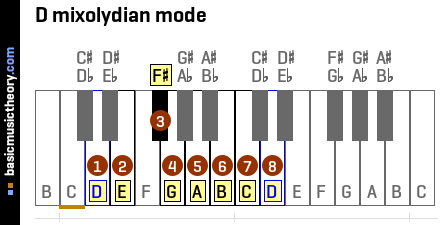
It starts off in Bm, then for the chorus it moves to D, those are the roots, I mean the D is I, and the Bm is vi [D=I Em=ii F#m=iii G=IV A=V Bm=vi C#dim=vii]
the bassline in Bm, its a vi to vii movement, but its a minor 7th, which means the 7th note (C#dim of Dmajor scale) of the regular normal major scale (Ionian) is dropped a half tone....which means......the bassline is in.......drumrollll.........mixolodian. D mixolodian that is....which is the same as B Phrygian, so more correctly, the bassline is B Phrygian, because once it modulates to the Bm, it wants to resolve to the new root of Bm.....instead of Dmajor
so you can think of it also as a modulation from D mixolodian/B phrygian to D Ionian.......in terms of modes........or you can think of it like Bminor (with a flat 2nd) to Dmajor
the intoxicate one....it modulates between the keys of Dm and F........regular scales no prhyrigian or anything i dont think...
confused?
btw, youre right it is B PHRYGIAN, sorry almost forgot to write that lol, but this explains the music theory behind what your ears are telling you.
cheers

 |
|
|
| Zombie0915 |
I cheat with a lot of this stuff myself.
You can use something like the schwarzinator or most piano roll interfaces to confine your note input to just about any scale you can think of. Then you can transpose between them freely to explore different options with respect to feel etc. Using a sound to midi tool like aubio, you can sing a melody from your head and get it into the computer with very little knowledge of instruments or theory and then whip out the chord tool of your choice to pick your favorite from a menu of possible harmonies. Sure, it is better to learn an instrument, but nobody is grading you so you may as while cheat in the meantime. Most of the I just mentioned is available legally for free.
What I generally start with is a melody or baseline in my head, I sing it into my machine then find a few scales that fit it. I use a chord helper to plop out some pads, then I extend my melody with variations that (mostly) fit within the chord structure. I play with the transpose a bit and then the musical part is done and it's on to knob twiddling.
If you absolutely must use commercial tools though, melodyne will map anything into notes, Cthulhu will let you cheat with chords, most sequencers let you highlight the portion of the piano roll that fits the scale of your choice. |
|
|
|
|

