|
My wet dream
|
View this Thread in Original format
| DaveSaenz |
With most digital SLR cameras the CCD sensor, the digital equivalent of a film plane, is smaller than a "35mm" (24mm X 36mm) frame of film, though the image aspect ratio will usually remain the same (3:2) as a 35mm camera. Thus the lenses designed for the 24 X 36 format will have an increased magnification when placed on most digital SLRs. Likewise a lens will have decreased magnification when placed on a larger format film camera (6X4.5cm, 6X6cm etc). This is expressed in terms of a 'focal length X' number (e.g. 0.63X, 1.0X, 1.3X, 1.5X, 1.6X etc). For example a 100mm lens would create the same image as a 160mm lens on a digital camera with a 1.6X focal length multiplyer; a CCD sensor 1.6X smaller than 24mmX36mm. This can actually be a nice feature if you're an avid user of telephoto lenses, but wide angle lens users will be turned off. Personally I am a fan of both, so this is a big turn off about most (affordable) digital SLRs. Of course you can still use and keep a film body for wide angle use. :)
Anyone have $8,000 USD they are willing to lend me? :P This is quite simply put, the best digital camera in the world:
http://web.canon.jp/Imaging/EOS1DS/
http://www.bhphotovideo.com/bnh/con...t#goto_itemInfo

| quote: | 11.1 million pixels.
A full-frame CMOS sensor.
This is what professionals have been asking for.
The EOS-1Ds advantage starts at the imaging sensor.
And what a tremendous breakthrough it is. A full-frame CMOS sensor manufactured by Canon with an imaging area of 24 x 36mm, the same dimensions used by full-frame 35mm SLRs. It has 11.1 million effective pixels with a maximum resolution of 4,064 x 2,704 pixels. This is almost double the resolution currently considered state-of-the-art by most professionals.
Unprecedented file sizes, processed with unprecedented quality at unprecedented speed.
The EOS-1Ds's imaging engine is one of the keys to its exceptional image quality. This advanced "chip" processes and assembles image data captured by the sensor to achieve the same color accuracy and wide tonal range as regular film-based cameras. And even with almost twice the pixel resolution of previous pro cameras, the imaging engine still supports a 10-frame buffer memory at framing rates up to 3 fps!
3 fps continuous shooting for up to 10 shots, even at the highest quality setting.
Fast data reading by the CMOS sensor and rapid imaging processing by the high-performance imaging engine together achieve a continuous shooting speed of 3 fps, even at the highest quality setting. Canon has developed 2-channel reading to ensure that the EOS-1Ds delivers incredible 11.1 million pixel resolution with 3 fps shooting speeds into a reality.
Your wide-angle lenses act like wide-angle lenses.
Finally, every EF lens will work the same on a digital SLR as it does on your 35mm film cameras, with the same coverage. It's one less thing for the pro to think about on location, and it's one more thing to ease the transition from film into digital. Even for wide- angle shooters.
Battery life has been improved by reducing power consumption.
Battery longevity is an important consideration, particularly when shooting outdoors. Fortunately, CMOS sensors consume less power than CCD sensors of the same resolution. Moreover, the EOS-1Ds's electronic circuits ensure that electricity flows only to active components, in the absolute minimum required amounts. Thanks to the EOS-1Ds's efficiency, the NP-E3 battery pack lasts up to 600 exposures (at normal temperatures) on a single charge.
Extensive noise reduction measures ensure images of consistent high quality.
The EOS-1Ds reduces noise through various refinements. Dark current countermeasures and noise reduction processing in the imaging engine, for example, contribute to an extremely high S/N ratio, and an extremely low level of noise in the EOS-1Ds's images.
10 white balance (WB) modes and WB bracketing allow versatile response to different lighting conditions.
Accurate overall color balance in each and every image is achieved with an incredible array of white balance (WB) options, including a Canon exclusive manual adjustment of color temperature in 100K increments from 2,800K - 10,000K, and even a white balance bracketing function.
Adjust default imaging settings in the camera, using Parameters.
The EOS-1Ds places color control where it should be: in the hands of the photographer. The EOS-1Ds user has flexibility beyond the expected. Shooting in high or low contrast conditions? Add a parameter set with an adjusted Tone Curve, and call it up on the menu whenever you want. Similar changes can be made to the amount of JPEG compression, and two types of in-camera sharpening.
Color Matrix: your choice of color saturation and color space.
Canon's unique Color Matrix function lets you select any of five different color characteristics. The Color Matrix 4 setting, for example, is optimized for Adobe RGB 1998 and provides a broad color spectrum with low saturation.
Only digital cameras give you this kind of freedom with ISO speeds.
Any ISO speed in the normal 100 to 1250 ISO range can be selected in 1/3- stop increments. When specialized needs arise, a Custom Function allows you to choose an ISO setting of 50. ISO speed bracketing is also possible (±3 stops in 1/3- stop increments), enabling exposure to be varied while keeping the same shutter speed and aperture settings.
Simultaneous RAW and JPEG image recording for ultimate quality and convenience.
The RAW image format is ideal for printing and processing, while the JPEG format is convenient for quickly checking images and transferring data. With the EOS-1Ds you can record every shot in both of these formats simultaneously, at full speed, for maximum productivity.
High-speed IEEE1394 interface and large- capacity FAT32 format. The right combination for ultra high- quality image data.
The EOS-1Ds comes equipped with an IEEE1394 (FireWire) interface, allowing speedy plug-and-play data communication with computers. For studio photography, new 4.5m IEEE1394 cables are available. The camera automatically formats the CF card for either FAT16 or FAT32 according to the maximum storage capacity. FAT32 is selected for capacities higher than 2GB.
Capture the exact moment with a top shutter speed of 1/ 8000 sec. 45- point Area AF for framing freedom and reliable AF performance.
The same durable, high-speed, high-precision mechanical shutter that professionals have come to trust in the EOS-1v is employed in the EOS-1Ds. Shutter speed can be selected between 1/8000 and 30 seconds in 1/3- stop increments, with X-sync up to 1/250 sec. The Area AF system offers 45-point Automatic, 45-point Manual, 11-point Manual, and 9-point Manual settings. Points are spread over an 8 x 15mm AF ellipse that covers a large part of the image.
Six metering options, for total exposure control in almost any situation.
In addition to 21-zone Evaluative Metering, Canon's metering system allows your choice of Center- weighted Metering, Central Partial Metering, Central Spot Metering, Focusing Point-linked Spot Metering or Canon's unique Multi-Spot Metering - the EOS-1Ds can automatically average up to eight separate spot meter readings.
Highly durable, with excellent dust and moisture resistance, the EOS- 1Ds is built to take on the harshest conditions.
Lightweight yet durable, with a chassis and external covers made of magnesium alloy, the EOS-1Ds is thoroughly sealed and protected from water and dust infiltration. Its rugged design meets professional demands for even the most hostile environments.
The world's first digital SLR that can prove its images are unaltered, original files.
An optional accessory Data Verification Kit DVK-E1 consisting of a dedicated IC card and card reader, together with special Windows 2000/XP software is available to verify that EOS-1Ds image files are absolutely unaltered. This may well be a landmark for digital imaging in law enforcement and many other documentary uses.
New File Viewer Utility for more convenient handling of RAW images.
This new stand-alone application enables "development" of RAW images, viewing of images, and customization of camera settings right in the camera. It thus dramatically simplifies operation and accelerates image processing. The utility comes bundled with software that supports the latest operating systems and handles various tasks, including image viewing and management, remote control of the camera, layout printing and image editing.
A large, 2-inch TFT LCD monitor - with the option to magnify images.
The high-definition LCD monitor on the back of the EOS-1Ds can display vital information such as shooting and image data, a histogram and highlighted alerts. An enlargement mode available via Personal Function allows you to check the focus more closely by selecting and enlarging one of 25 sections of the image.
High Speed Respnse enhances ease of use.
With its shutter release time lag of 55ms and viewfinder blackout time of only 87ms, the EOS-1Ds's operation feels identical to that of the world's fastest 35mm AF SLR, the EOS-1v. |
|
|
|
| S-a-M-u-E-l |
| my dad has a canon 10-d, which is one setp down from that camera |
|
|
| DaveSaenz |
Ok, I'd settle for this one:
http://web.canon.jp/Imaging/EOS10D/
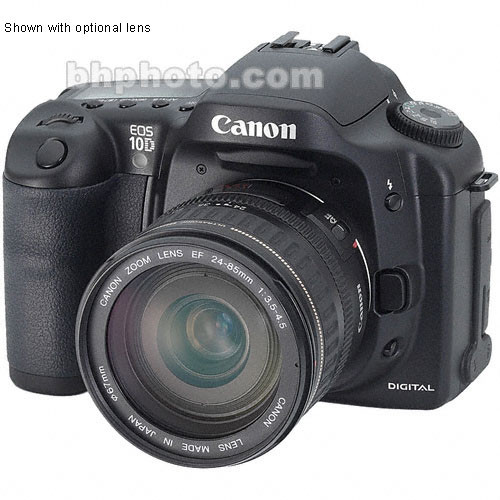
| quote: | Camera Type: Digital, single-lens reflex, AF/AE camera
Lens Mount: Canon EF mount
Focal Length Multiplier: 1.6x
Imaging Sensor: Single-plate CMOS sensor, 6.50 Megapixel resolution (3152x2068) with RGB primary color filter, and 3:2 Aspect ratio (22.7mm x 15.1mm), Non-removable Low-pass filter Located in front of the image sensor
Optical Resolution: 6.30 megapixels (3088x2056)
Color Depth: 36 Bit RGB (12 Bit A/D) with sRGB and Adobe RGB color spaces
Sensitivity: Basic Zone modes (Automatic), Creative Zone modes (Equivalent to ISO 100, 200, 400, 800, 1600, and ISO 3200 with ISO speed extension)
White Balance: 9 Settings (Auto, daylight, shade, cloudy, tungsten light, fluorescent light, flash, manual, color temperature setting), White balance bracketing (+/-3 stops in 1 stop increments)
Internal Memory None
Memory Card: CompactFlash (type I & II)
Image Modes: File Formats: JPEG (DCF & EXIF compliant), RAW (12-bit)
Resolution options: RAW (3072x2048)
Large (3072x2048)
Medium (2048x1360)
Small (1536x1024)
Image Quality Modes: Fine
Normal
* JPEG Files comply with DCF, Exif Ver.2.2 (EXif print) and DPOF Ver.1.1.
Images with Included Memory No Memory Included - file sizes listed
Fine Normal
RAW + Large 8.0MB 6.7MB
RAW + Medium 6.8MB 6.2MB
RAW + Small 6.4MB 6.0MB
Large 2.4MB 1.2MB
Medium 1.3MB 0.7MB
Small 0.8MB 0.4MB
Burst Rate 3 fps (at 1/250 sec. or faster speeds), Max. burst of 9 shots
Video Mode No
Audio Annotation No
LCD Display 1.8" TFT color liquid-crystal monitor, 5 Levels Brightness Control
Interface USB 1.1 (with dedicated cable), Direct Print USB with compatible Canon Printers
Video Out Yes
Focusing Type TTL-CT-SIR with a CMOS sensor (TTL secondary image-registration, phase detection), 7 AF points, AF working range of EV 0.5-18 (at 20°C & ISO 100)
Focus Modes One-Shot AF, AI Servo AF, AI Focus AF, Manual focusing (MF); AF point selection (Automatic selection, manual selection, home position), Active AF point indicator (Superimposed in viewfinder and indicated on LCD panel), AF-assist beam (Stroboscopic flash)
Exposure Metering TTL full aperture metering with 35-zone SPC; Evaluative metering (linkable to any AF point), Partial metering (approx. 9% of viewfinder at center), Centerweighted average metering; Metering Range of EV 1-20 (at 20°C with 50mm f/1.4 lens, ISO 100)
Exposure Modes Program AE (Full Auto, Portrait, Landscape, Close-up, Sports, Night Portrait, Flash Off, Program), shutter-priority AE, aperture-priority AE, depth-of-field AE, manual exposure, ETTL autoflash, Manual (+/-2 stops in 1/2- or 1/3-stop increments (can be combined with AEB)), AE lock Auto (in One Shot AF mode with evaluative metering)
Exposure Compensation +/-2 stops in 1/2 or 1/3 stop increments
Auto Bracketing +/-2 stops in 1/2 or 1/3 stop increments
Shutter Type Electronically-controlled focal-plane shutter
Shutter Speed 1/4000 - 30 sec. (1/2 or 1/3-stop increments), bulb, X-sync at 1/200 sec.
Built-In Flash Auto pop-up E-TTL autoflash (retractable) Approx. 3 sec. Recycling time, Flash exposure compensation (+/-2 stops in 1/2 and 1/3-stop increments)
External Flash Sync E-TTL autoflash set with EX-series Speedlites, PC Terminal (X-sync at 1/200 sec.)
Viewfinder Eye-level Pentaprism with 0.88x magnification (-1 diopter with 50mm lens at infinity), Fixed - Laser Matte Focusing screen
Vewfinder information:
AF (AF points, focus confirmation light), exposure (shutter speed, aperture value, manual exposure, AE lock, exposure compensation amount, AEB level, partial metering area), flash (flash ready, red-eye reduction lamp on, high-speed sync, FE lock, flash exposure compensation amount), warnings (exposure warning, improper FE lock warning, CF card full warning, CF card error warning, no CF card warning, busy), maximum burst for continuous shooting, shots remaining Depth-of-field preview: Enabled with depth-of-field preview button
Self Timer 10-second delay
Remote Control N3-type remote control (optional)
Depth Of Field Preview Yes
Mirror Lock-up Yes
Diopter Correction -3.0 - +1.0 diopter
LCD Panel Info Aperature/Shutter settings, Resolution/Quality settings, Exposure Modes, Flash Settings, Shots remaining, Power remaining
Power Source BP-511 or BP-512 Battery Pack & CR2025 lithium battery (Date/time back-up), AC Adapter (optional)
Dimensions 5.9" x 4.2" x 3.0" (149.7 x 107.5 x 75.0mm) (body only)
Weight 27.9 oz. (790 g) (body only)
System Requirements Windows 98SE, 2000, ME, XP
Mac OS 8.6-9.x, OS X (10.1)
Special Features Custom Functions:
17 Custom Functions with 61 settings
Direct Print Capable:
Direct print JPEG images with compatible Canon printers, 3 Available Settings (Print quantity, style (image, paper, borders, date), and trimming
Playback Modes:
Single image, Single image with info (including histogram), Magnified view (1.5x - 10x in 15 steps, browsable), 9 image index, Auto play, Image rotation, Jump
Auto Rotation:
On (playback uses orientation data in file header), Off
Menu Languages:
English, French, German, Spanish, Italian, Dutch, Swedish, Norwegian, Danish, Finnish, Chinese, Japanese
|
|
|
|
| DaveSaenz |
| quote: | Originally posted by S-a-M-u-E-l
my dad has a canon 10-d, which is one setp down from that camera |
Actually it's two steps down, but yeah it looks like a great camera too and still costs some $1500. Being poor sucks, but once I get my PHD from Raul's Upstairs University, I'll be in the money! Go RUU! Canon EOS is the best because they have the most money for R&D, or maybe I'm just biased since I own so much Canon stuff. :P |
|
|
| o0moonman0o |
| nikon D100 is quality too, |
|
|
| k.k.d. |
| EOS 1Ds was my wet dream for almsot a year now... Godly camera... The shots made with it are just amazing in quality... :) |
|
|
| MrSquirrel |
A friend of mine just got the digital Rebel. He loves it....
I personally don't believe that digital photography is inherently better than the old fashioned way. I think for taking misc snapshots and stuff digital is probably better, but for good quality prints you shoudl always go with the film.
Of course that is my opinion. :toothless
MrS |
|
|
| Mako |
| i'm liking the sony v1, carl zerss lens 5 MP and IR feature w00t :D |
|
|
| Vivid Boy |
| i wanted to hear abt the chick in ur wet dream not ur damn camera bah |
|
|
| whiskers |
well, the question is, do you really need a camera that costs 8,000 dollars? if you're a professional photographer, then yes, but otherwise it's too bulky and too costly if it gets stolen or lost....
i'm interested in cameras with different-sized CCD matrices. like with film, you have large, medium, and small grains, these cameras contain different sized receivers at once so that the picture quality is even better. anyone ever heard of it or is it old news? |
|
|
| whiskers |
| by the way, does anyone know, what is the best digital macro-mode camera? or does depend on the SLR lenses? how about built-in macro with medium-end ($300-$1200) cameras? just curious. |
|
|
|
|


