|
CAn some one translate (pg. 3)
|
View this Thread in Original format
| Origin |
| quote: | Originally posted by Delay Llama
Monoxide, I don't think it would be easy for an European person not to confuse Cantonese and Mandarin because of one simple reason: tones and ideograms (sp?).
1) In order to find out the difference between both languages, you need to know that Cantonese has 6 (or 8) tones whereas Mandarin has 4. These tones are ignored in most European languages (I remember Swedish has them and Lithuanian might have them too, I'm not sure), but even in these languages which have this feature, they're not so similar to the Chinese counterpart.
2) You would need to know the set of vowels and consonants of both languages. Cantonese has a wider set of vowels, mandarin has more consonants, but unless you've studied one of these languages, it's hard for a person to know that mandarin has many retroflex consonants (try to say "sh" and "r" in English at the same time: this is the retroflex version of "sh") and Cantonese, as far as I know, don't.
3) There are Chinese languages (they're too different to be dialects!) other than these two. That's why it's tricky to say exactly what is what.
4) Cantonese has some special characters which are different from the Mandarin ones, as you can see here (Cantonese is above)...
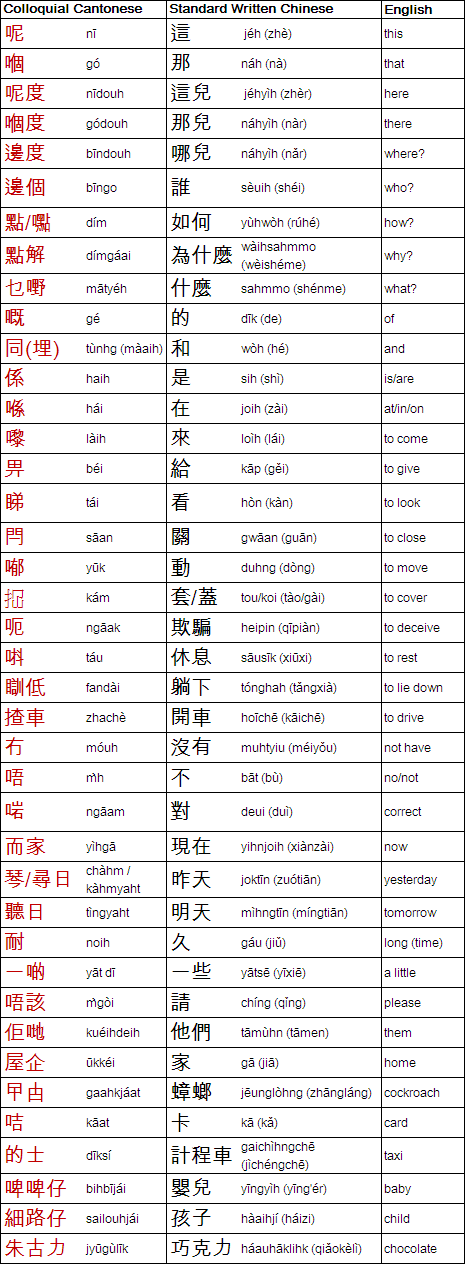
... if you say you know all these symbols, I'm taking you do speak both languages.
Unless you study these two languages (and you know the sounds) I don't think it's easy to know the difference. The same for Portuguese and Spanish: Portuguese has many more phonemes than Spanish, and there are too many variations of these two languages (Galician, Brazilian Portuguese, American Spanish,...).
Sorta.
Check PM :) |
!!! this is complex !!! |
|
|
| monoxide |
| quote: | Originally posted by Delay Llama
Unless you study these two languages (and you know the sounds) I don't think it's easy to know the difference. The same for Portuguese and Spanish: Portuguese has many more phonemes than Spanish, and there are too many variations of these two languages (Galician, Brazilian Portuguese, American Spanish,...). |
ok, not always would i recognize these dialects. i have basic knowledge about cantonese, cuz i had a girlfriend from china, but that doesn't change a fact: russian and polish differs like fire and water. just the fact that russians use cyrylic (kirilica) and polish - latin alphabet means a lot [but that's the written part].
now about croatian, i do understand it because i have a good russian knowledge [needless to say that Lithuania is former USSR state, so i never studied russian, but i know it from the childhood perfectly]. but never to say, that croatian = screwed up russian, it's rude and ignorant. i would get offended too if someone have said that screwed up Sanskrit sounds like lithuanian [which is unique and is qualified as one of the hardest to learn in the world and the hardest in europe]. moreover, i would never mix any form of spanish/portugese - it's simply shameful not to know the sound of every spanish dialect for anyone who studied spanish - this is one of the easiest languages in the world!
| quote: | Originally posted by Delay Llama
try to say "sh" and "r" in English at the same time: this is the retroflex version of "sh" |
heh - i've tried - it's one of the easiest thing, cuz lithuanians use this sound. we even have words that begin with this sound "shratas" [ball of steel]. now an exercise for you: pronounce "r" and "ie" not in english way, but in the way that they should be realy pronounced - in latin way. i give 1:1000000000 that you won't pronounce it right.
cheers, monoxi |
|
|
| DrUg_Tit0 |
| quote: | Originally posted by monoxide
now about croatian, i do understand it because i have a good russian knowledge [needless to say that Lithuania is former USSR state, so i never studied russian, but i know it from the childhood perfectly]. but never to say, that croatian = screwed up russian, it's rude and ignorant.
|
Yeah, after all, it's not croatian that's missing the vocative declension! :p |
|
|
| Delay Llama |
| quote: | Originally posted by monoxide
ok, not always would i recognize these dialects. i have basic knowledge about cantonese, cuz i had a girlfriend from china |
So you've been exposed to these languages, but it's naive to think that all people have.
| quote: | Originally posted by monoxide
but that doesn't change a fact: russian and polish differs like fire and water. |
They differ like water an ice: they share the root. Thai and Norwegian, on the other hand, differ like fire and water. Do you really expect people to know the differences between Russian and Polish? They're related, and they share words (usually the most well known) in common.
| quote: | Originally posted by monoxide
just the fact that russians use cyrylic (kirilica) and polish - latin alphabet means a lot [but that's the written part]. |
That's how I know when it's Russian and when it's Polish :)
| quote: | Originally posted by monoxide
now about croatian, i do understand it because i have a good russian knowledge [needless to say that Lithuania is former USSR state, so i never studied russian, but i know it from the childhood perfectly]. but never to say, that croatian = screwed up russian, it's rude and ignorant. i would get offended too if someone have said that screwed up Sanskrit sounds like lithuanian [which is unique and is qualified as one of the hardest to learn in the world and the hardest in europe]. |
When a language sounds "screwed up" to someone else, that's because it reminds them of their own language, but they just can't understand. That's why Croatian sounds screwed up to Russians and vice-versa.
As for Lithuanian being one of the hardest languages to learn, sorry to disappoint you, but that's not true. Although languages spoken by small comunities usually have more complex grammars, there's no way you can say that a language is harder than another. Lithuanian has no articles (like "the" and "a" in English), whereas many other European languages have. In Lithuanian, you use "Jûs" as the plural form of "you" and in respectful speech. In other languages, such as Spanish, they have a more complex way of saying it (not only there's "tu" and "vosotros", there's "usted" and "ustedes"), and I won't even get started with Asian languages. Finnish has an absurd amount of declinations, Latin languages have way too many verbal tenses, English has lots of irregular verbs... native speakers of these languages could (and do) claim their language is hard or the hardest one.
| quote: | Originally posted by monoxide
moreover, i would never mix any form of spanish/portugese - it's simply shameful not to know the sound of every spanish dialect for anyone who studied spanish - this is one of the easiest languages in the world! |
Por supuesto es muy facil, es la tercera lengua mas hablada en el mundo ;) If all these people speak Spanish, it can't be that difficult.
| quote: | Originally posted by monoxide
heh - i've tried - it's one of the easiest thing, cuz lithuanians use this sound. we even have words that begin with this sound "shratas" [ball of steel]. now an exercise for you: pronounce "r" and "ie" not in english way, but in the way that they should be realy pronounced - in latin way. i give 1:1000000000 that you won't pronounce it right.
|
Are you sure we're speaking of the same sound? In all guides to Lithuanian I've ever read, the letter "r" in Lithuanian is pronounced as in Spanish, with a thrilled "r". I'm talking about the letter "r" in English, in which you "swallow" your tongue :p Anyway, if you managed to say it, nice, you now know what sound is separates mandarin for cantonese.
As for "ie", do you want me to pronounce it like in the Russian word "net", but with a thrilled "r" before (or during) it? Sure, I can give it a shot, but if I fail, there's no problem because none of the languages I speak require this hability from speakers (and if they secretly do, and I'm not aware of it, no one has ever misunderstood me, so I don't need to worry so much). That's why there's accent: while you grow up, you get used to the set of sounds of your native language, automatically ditching all the potential you have for distinguish other sounds. That's natural, why would the Japanese learn the difference between "l" and "r" if both mean the same for them? They won't (need to) do it unless they learn a Western Language :) Many languages have "rare" sounds, like the "r" with an inverted ^ in Czech, the soft "l" that exists in Mongolian and Gaelic... |
|
|
| dstrukt |
| Despite that guys nationality he's a 1st class ing prick. |
|
|
| Nabistai |
| Kinda frustrating, on the one hand you'd like to kick that mothering guys balls off, but on the other hand he has like 10 'cool' friends with him :nervous: |
|
|
| monoxide |
| quote: | Originally posted by dstrukt
Despite that guys nationality he's a 1st class ing prick. |
yes he is. i had gone off topic for a bit, but the video is kinda disturbing...
delai llama: sorry, you really do NOT know anything about lithuanian language if you say that. you should consult any linguist with experience or... you can wait for my PM, cuz i don't see a point in arguing about languages in public. |
|
|
| bpm687 |
| Ill just stick to english:) |
|
|
| Delay Llama |
| quote: | Originally posted by monoxide
delai llama: sorry, you really do NOT know anything about lithuanian language if you say that. |
When I was little I was taught how to say "" and "take a in a bottle" in Lithuanian, does it count? :D
All the stuff I said about Lithuanian was taken from books, but obviously I'm not willing to argue against a native speaker because you sure know more about the language for obvious reasons. I also know that it is some sort of link from European languages in general to what can be considered that proto-indo-european language.
| quote: | Originally posted by monoxide
you should consult any linguist with experience or... you can wait for my PM, cuz i don't see a point in arguing about languages in public. |
I'd like to read more about the language, if you're willing to talk about it via PM, I'll be glad to read :)
We were not arguing about languages, but on why you can't expect people to know the same stuff we know (specially because they always know stuff we don't) and that difficulty of a language is relative since they just reflect the needs of the speakers.
I thought a public discussion could have more contributions but if you want to take this to PM, okie dokie ;) |
|
|
| TranceGeek |
ed up video, but w/e, its not uncommon for europe
anyways, astroboy, whats your nationality? |
|
|
| blazed it |
it's easy to pick apart mandarin from cantonese (these 2 i believe are the largest of the myriad chinese dialects). Cantonese is much more gutteral and harsh than is mandarin. Mandarin is smoother, but cussing imo is much more satisfying in cantonese. It sounds so much more venomous than mandarin. Kinda like cussing in english vs. in french. hehe
as for the guy going on a rampage because he didn't get a cig, thats ed up. If yuo don't have your own pack and your trying to bum a cig from somebody, off if they don't have it or they don't want to give it.
btw, whats up with that guy that seems to be like checking out if everything is cool, reffing it between the attacker and the victim? why does he punch him afterwards? |
|
|
| whiskers |
| i speak russian and i'm telling y'all to ÐÅÒÅÓÔÁÔØ ×Ù£ÂÙ×ÁÔØÓÑ. |
|
|
|
|

