|
Palestine = Anne Frank's Annex (pg. 4)
|
View this Thread in Original format
| shaolin_Z |
8.6. The Crematoria Ovens of Auschwitz and Birkenau
http://vho.org/GB/Books/dth/fndcrema.html

| quote: | 4.4.1. Crematoria
When discussing the capacity of the Auschwitz crematoria, I will not reinvent
the wheel. Since the beginning of the 1990s, Italian engineer Franco
Deana and Italian historian Carlo Mattogno have analyzed thousands of SS
documents seized at Auschwitz. These are documents produced by the firm
that built the crematory ovens. Mattogno and Deana also analyzed all kinds of
professional literature and trade publications of that time, which pertained to
the technology and performance of crematory ovens in general. Based on
these documents, Deana and Mattogno carried out some very detailed calculations.
[101]
Let me summarize the results of their extensive research here:
Table 10: Some characteristics of the crematories at Auschwitz-Birkenau
_____________________________Crematoria II & III _____________ Crematoria IV & V
Ideal coke consumption per muffle: 15.5 kg/h ................................... 11.7 kg/h
Actual coke consumption per muffle: 22 kg/h .......................................16 kg/h
Time required per corpse...................... 1 h ........................................... 1 h
No. of muffles .......................................30 ............................................16
Maximum hours of operation per day ........20 h .......................................20 h
Maximum no. of corpses per day ............600 ..........................................320
Total no. days in operation ....................888 ...........................................276
Total maximum capacity 532,800 .........................................................88,320
This total maximum capacity of 600,000 corpses still looks huge. But these
numbers are misleading because they are theoretical maximum numbers.
There are two parameters that allow us to estimate the numbers of bodies that
were actually cremated.
One of these is the amount of coke delivered to the crematoria, which is
completely documented for the period of February 1942 to October 1943 (see
Table 11.)[186] First I would like to direct your attention to some truly amazing
facts. During the operating period of the six-muffle crematory in the main
camp (the only crematory at the time), from February 1942 until February
1943, the average monthly consumption of coke came to around 30 tons, or 5
tons per muffle.
The extremely large coke delivery made in March 43 served for drying and
preheating Crematories II and IV, which went into operation at that time. In
addition to this, there was probably a backlog of corpses on account of the
typhus epidemic raging in Birkenau at that time, so the crematories were
probably in uninterrupted operation at the beginning of this period.
It is amazing that coke consumption
rose only by a factor of
2.5 when the new crematories
came into operation, since they
contained almost eight times as
many muffles as the old crematory.
Even if we consider that the
new ovens were somewhat more
efficient than the old one had
been, it is still clear that the new
crematories were not nearly as
intensively operated as the old one
had been when it had to carry the
entire workload alone.
In other words, the SS created a huge overcapacity which they never used.
At an average coke consumption of 20 kilos per corpse,[187] we see that a total
of 51,625 corpses could have been cremated with 1,032.5 tons of coke over a
period of 21 months. This order of magnitude corresponds to the number of
victims registered in the Auschwitz death books, which do not include gassing
victims.[188]
Another parameter for determining utilization of the new crematories in
Birkenau is the durability of the fireproof brickwork in the ovens. The Topf
firm, which constructed the ovens at Birkenau, listed the life expectancy of
this brickwork as 3,000 cremations, which at that time was 50% above the
norm.[189]
When we consider that the Birkenau crematories were operated and maintained
by unskilled and hostile personnel, namely prisoners, we can see that
the Topf estimate was a very optimistic maximum. After 3,000 cremations,
the brickwork had to be replaced, which necessitated an expensive and time
consuming overhaul of the entire crematory.
It is a fact that in the extremely detailed documentation of the Auschwitz
Central Construction Office, in which practically every single nail or screw is
itemized, there is nothing to suggest that the fireproof brickwork of even a
single oven in the crematories at Birkenau was ever replaced!
From this we can conclude that the maximum number of cremations (46
muffles × 3,000 = 138,000) was not exceeded.
Again, this is very nearly the number given as “natural” deaths by the authorities:
the total excluding deaths by gassings or other acts of mass murder.
[190]
C. Mattogno has also assessed the maximum capacity of the new crematorium
of Majdanek: roughly 100 corpses per day.191 This is in agreement with
Leuchter’s figures. This crematorium was in operation for merely one year
between summer 1943 and summer 1944, which also matches Leuchter’s data.
[186] APMO, D-AuI-4, segregator 22, 22a; cf. J.-C. Pressac, op. cit. (note 35), p. 224.
[187] As a matter of fact, the coke consumption of the old double-muffle ovens in the main camp was somewhat
higher then that of the new ovens in Birkenau.
[188] Staatliches Museum Auschwitz-Birkenau (ed.), Die Sterbebücher von Auschwitz, Saur, Munich 1995.
[189] R. Jakobskötter, “Die Entwicklung der elektrischen Einäscherung bis zu dem neuen elektrisch beheizten
Heißlufteinäscherungsofen in Erfurt,” Gesundheits-Ingenieur, 64(43) (1941), pp. 579-587, here p. 583.
[190] Add to this the six muffles of the old crematorium in the main camp = max. 24,000 corpses. |
(The Leuchter Reports Critical Edition p. 105-107.)
So Altogether the capacity of the crematoria ovens was 162,000.
In addition: Cremating multiple bodies in one muffle would have been futile. If two adult bodies were burned together in one muffle, then the cremation time (of 1 hour) would have doubled (to 2 hours). Although smaller bodies would have not increased the cremation time as much as the adult bodies, they still would have considerably increased the time.
http://vho.org/GB/Books/dth/fndcrema.html
And yes we have now refuted this document (which the holocaust believers always cite):

From this document, without any scientific boundaries, we could also calculate the 4 million death toll of Auschwitz, just like the Soviets.
There are two essays at holocaust-history, which tried to refute Mattogno's research:
http://www.holocaust-history.org/au.../body-disposal/
http://www.holocaust-history.org/auschwitz...se-to-mattogno/
Mattogno answered them both, long ago:
http://vho.org/aaargh/fran/techniqu...iminarieng.html
http://vho.org/GB/c/CM/jcz.html
http://www.vho.org/GB/c/CM/Risposta-new-eng.html
(Holocaust-history has not answered to Mattogno anymore.) |
|
|
| shaolin_Z |
8.7. Open Air Incinerations
8.7.1. How?
"The crematorias were not big enough and they could only burn around 1,000 bodies a day. But in the pits they could burn up to 15,000. In the three pits, they were very large pits - around 6 to 8 meters long and 2 meters wide - in each pit they threw in a 1,000 people and it only took a few minutes to burn them completely, maybe 30 minutes and they were completely burnt, or badly burnt. There was still a few hands or feet that had fallen out to the side and we had to put them back on the fire. Nothing should have remained from these people, just a bit of ash."
(Testimony of Jehosuha Rosenblum at Judea Declares War on German, runtime 28:52 - 31:43. He is also being interviewed in the Documentary Hitler's Holocaust 4 of 6 - Death Factory, runtime 40:43- 41:00 and onwards. In this documentary there are also other eyewitnesses speaking of having seen "fires shooting out of chimneys" and "gassed bodies were bluish and from their noses and ears came blue stuff".)
http://www.youtube.com/watch?v=-hd-6XVj7UA
| quote: | 2. What Events Are Reported?
2.1. BUNKER 1
According to witness testimony there was an old farmhouse to the north of the Birkenau camp which as of May 1942 was allegedly used as gas chamber for the killing of human beings, cf. Illustration 3. In its vicinity, the accounts state, there were mass graves which later were allegedly also used to burn corpses.[6] It must be noted that there are no indications of where this Bunker 1 allegedly stood.[7] The witness Benroubi testified:[8]
"They [the Sonderkommando men] put them [the corpses] in front of graves about 20m long, 3m wide and 2.50m.
There were about ten graves ready to receive the martyrs. Parallel to these open graves there were some that had been covered with earth and these extended over about 300 meters [...]"
Witness Buki stated :[9]
"We took the trolleys to a grave about 40 meters long and I think about 6 meters wide [240 m2], which was about 100 meters away from the house."
Witness Garbarz said:[10]
"We saw big rectangles traced on the ground twenty or thirty meters wide by fifty or 60 meters long. In one of these rectangles the ground was stained red."
The witness indicates that he understood the rectangles to be grave plots. Later on he adds, regarding the depth of the pit, that it was approximately 1.5 m deep.[10]
There is no documentary evidence to corroborate these claims. Even J.-C. Pressac questions some of these witness statements, which furthermore are quite contradictory with respect to the number and size of the pits as well.[11]
2.2. BUNKER 2
Regarding this house, located to the northwest of the camp, witnesses also tell of gassings and of incinerations in pits from June 30, 1942 until spring of 1943 (Illustration 3). This 'Bunker' was allegedly brought back into operation in May/June 1944.[12] In this area, foundations of former buildings used for unknown purposes can indeed be made out today, and they are also recorded on a Polish map of this region.[13]
Regarding the pits, the witness Dragon states, for 1942:[14]
"On the other side of the cottage there were four pits 30 meters long, 7 meters wide and 3 meters deep."
The witness Dr. Nyiszli states for 1944 (which we shall come back to in 2.2.4):[15]
"The pyre was a ditch 50 yards long, six yards wide and three yards deep [...]"
A second Soviet sketch dated March 3, 1945, shows a burning pit of 30 m2, see Illustration 2.[16] Again the discrepancies regarding size are considerable. There are also no corroborative documents.
2.3. BURIAL AND LATER CREMATION OF TYPHUS VICTIMS
Various witnesses tell of the burial of victims of the first typhus epidemic, and of the burning of these bodies after their exhumation between September 21, 1942 and November 30, 1942 (Illustration 3).[17] The files of the Russian State Archive of War in Moscow[18] report in detail about the first epidemic, which had been introduced from outside by civilian labor personnel.[19] It began on July 1, 1942. Crematorium I, which at this time was the only one available, was not of sufficient capacity to cremate all the victims, which were therefore buried in Birkenau. Other casualties had already been buried in the same area earlier. The numbers given vary from 50,000 to 107,000. The 'body toxins' resulting from the decomposition process threatened to poison the ground water, which was used for the drinking water supply for the entire area. Hence, the corpses had to be exhumed again. They were then cremated, first on funeral pyres, later in pits. Thus go the reports. No publication that we know of makes any mention of the number of pits.
2.4. BURNING PITS AT CREMATORIUM V
Witnesses tell of burning pits in the area north of Crematorium V between the building and the ditch in front of the fence, in May to June 1944 (Illustration 3). Since the crematoria were out of service due to damage, a situation arose "[...] that open-air incineration ditches had to be rapidly dug [...]."[20]Pressac also mentions "five small incineration ditches" near Crematorium V. These, he says, became necessary because Crematorium IV had been closed since May 1943 and Crematorium V could not be adequately repaired.[21] As witnesses to these pits, Pressac quotes Dragon:[22]
"[...] Jews were burned in five ditches dug behind Crematorium V.",
as well as the witness Tauber:[22]
"It was realized that the ditches incinerated the corpses better, [than the furnaces; auth....] once the ditches entered service"
The witness F. Müller, whom Pressac accuses of errors and lies,[22] reports:[23]
"[...] work on digging five pits behind Crematorium V was soon [...] begun."
"The two pits that had been dug were 40 to 50 m long, about 8 m wide and 2 m deep "
There then follows a detailed description of the "[...] drainage channel for the human fat [...]" in the pits. On page 211, F. Müller continues:
"In the back yard of the Crematorium, Moll ordered three more burning pits excavated, so that he had five at his disposal there now."
The measures of these alleged pits result from these statements: total area = 5 pits of each 40 m or 50 m × 8 m = 1,600 or 2,000 m² and a total volume of excavated earth (2 m deep) of 3,200 or 4,000 m³. This earth had to be disposed somehow, leaving visible traces, but nothing of this is ever mentioned. Further, F. Müller mentions a concrete surface of 60 × 15 m = 900m2, where bones that had not burned up were allegedly crushed. Of course, the allied air photos taken in 1944 show no traces of this concrete surface, any more than they show the pits themselves, their excavation, or the access roads for the transport of bodies and fuel.[24]
The fire in the burning pits could generate heat of several 100°C, even 1,000°C. The question is: how close can a person not wearing protective clothing approach to such a blaze? According to the eyewitness testimony, a team of laborers worked there without any protective gear. Any fireman could comment on this.
Pressac's 'Document 8'[25] also contradicts the eyewitness testimony. This cost estimate for Crematorium II, reviewed on May 26, 1944, shows clearly that the oven pit for the cremation ovens for Crematorium V was built as a waterproof tub and that during the excavation of this pit the ground water of the immediate vicinity was artificially frozen to prevent it from filling up the construction pit.[26] The cross-section diagram of this building, No. 1678,[27] shows that the upper edge of the base of the tub lay about one meter below ground level. Crematorium V did not have a cellar underneath. This proves that this oven pit stood in the ground water!
But if this oven pit had to be protected against the ground water, this proves that no burning pits as described in the foregoing could have been possible at this location.
It must also be remembered that the grounds of the camp sloped downwards in a northerly direction, as the Polish ordnance survey maps, scale 1:25,000, prove (Illustration 6).
One section of a work authored by the late Dr. Jan Sehn, former Auschwitz inmate and director of the Auschwitz Museum, needs to be mentioned here, since it had caused some irritations:[28]
"At the bottom of the pit, thick wooden logs were piled up, followed by increasingly small branches and twigs. Corpses were thrown on top of this base. After that, the SS men supervising this work poured petrol into all four corners of the pit, lit a rubber comb and threw it onto the spots moistened by petrol."
Every boy scout in the world knows that there is no way one can light a fire in a pit this way. Yet this statement was never criticized. There is apparently not a single former boy scout under the world's historians! Such examples could be quoted continuously for pages on end. But this is not the purpose of this paper. Such examples could only emphasize why we pose questions like: how could it happen that such witness statements passed unchallenged for so long? And why does there not exist any research into the reasons for the many errors made by these witnesses?
|
(By By Dipl.-Ing. Michael Gärtner and Dipl.-Ing. Werner Rademacher: http://vho.org/tr/2003/1/GaertnerRademacher3-12.html, sources also found on that link.)
8.7.2. Some Scientific Boundaries
| quote: | 5.4.4.3. Open-Air Incineration in Pits
In general, it is of course possible to burn corpses in open-air pits, though it certainly takes more time and fuel than any cremation in a crematorium, and it also leaves many more traces due to incomplete combustion. In 1999, Dr. Myroslaw Dragan conducted an experimental incineration of an 80 lb. deer in a pit roughly 1 m deep, 70 cm wide, and 1.2 m long. This incineration with a relatively small amount of wood lasted some 4-5 hours and was almost completely successful.[310] Dr. Dragan found out that for open-air incinerations, small, narrow holes are advantageous over large, wide holes or, even worse, cremations on ground level, since the soil walls of a pit act like the walls of a crematorium oven, storing and reflecting a great deal of the heat produced by the fire-provided that the soil has a considerable amount of clay stabilizing the wall of the pit, and, of course, that no ground water flows into the pit and extinguishes the fire.
The situation in Birkenau, however, was drastically different from that. Not only did the witnesses claim that those pits were very wide, but as Gärtner, Rademacher, and Carlo Mattogno have shown, the extremely high ground water table in the areas around the alleged location of those cremation pits was so high that it would have been impossible to dig such deep pits, arrange hundreds of corpses and fuel in them, and maintain a fire for many hours without these pits quickly filling with water. These findings show clearly that the attested burning of corpses in pits many meters deep was impossible under such conditions, since these pits would have filled up with ground water rather quickly.

Fig. 57: Then and today-the unchanged ground water state in the Birkenau camp, here in midsummer 1991, in a construction trench in front of the Zentralsauna, approximately 70 cm. Incinerations of corpses in pits many meters deep, in accordance with witness testimony, were not possible. |
http://www.germarrudolf.com/work/trr/5.html#5.4.4.3.
8.7.3. The Very High Groundwater
| quote: | 7.1. TEXT REFERENCES TO THE GROUND WATER LEVEL IN BIRKENAU
From a building description of October 30, 1941:[40]
"The ground water table varies between depths of 0.30 and 1.20 m." (Emph. added)
In a letter dated October 17, 1942, regarding Crematorium II:[41]
"[...] the building reaches more than 2 m into the ground water [...]" (Emph. added)
In a letter dated March 17, 1943, regarding the large delousing facility (BW 32, 'Large Disinfestation Facility' i.e. the so-called 'Central Sauna'), with reference to structural engineering:[42]
"[...] highest ground water level may be taken as 0.30 m below the surface."
In another letter dated June 4, 1943, regarding the same building:[43]
"[...] heating pits are relatively deep, and so insulation from the ground water, which is about 20 cm below the surface, is necessary [...]" (Emph. added)
[...]
9. Summary of Preliminary Examinations and Conclusions
The primary basis for our assessment is an "Explanatory report for the preliminary design of the new construction of the POW camp of the Waffen-SS, Auschwitz O/S", dated October 30, 1941.[40] The soil at the construction site is described as follows:
"Soil consistency is poor. The humus soil is followed by loam and shale [a fossil-rich, grayish blue, plastic marine clay from the Tertiary period], in which gravel and sand particles of minor size are embedded. The ground water level varies between 0.30 and 1.20 m. Parts of the terrain are boggy." (Emph. added) |
http://vho.org/tr/2003/1/GaertnerRademacher3-12.html
Holocaust believer, pharmacist, Jean-Claude Pressac agrees with this:
| quote: | | The nature of the land at Birkenau, where the groundwater is almost at surface level (unlike the main camp, where it lies deeper), meant that the two Leichenkeller [“corpse cellars”] could no longer be directly under the building, as had probably been initially planned, but had to be raised to form semi-basements. |
http://www.holocaust-history.org/auschwitz...essac0269.shtml
Carlo Mattogno has also done similar research into the Auschwitz groundwater, which corroborates the above quoted research:
http://vho.org/tr/2003/1/Mattogno13-16.html
8.7.4. Aerial Photos
In very short: aerial photos show no evidence about the massive open air incinerations in the area of Auschwitz (no huge clouds of smoke). http://air-photo.com/english/
8.7.5. Conclusions
The groundwater was way too high, for open-air incinerations in pits.
We have already concluded that the alleged 1 million bodies could not have been incinerated in crematoria ovens and now we have concluded that they could not have been incinerated in pits either.
In Auschwitz and in Auschwitz-Birkenau, 1 million people could not have been gassed and then incinerated. Impossible! |
|
|
| shaolin_Z |
8.8. The Other Side of Auschwitz

Aerial view of the main camp.
8.8.1. Surprises in Auschwitz
| quote: | Culture
Theater;1239 cinema, cabaret,1236 orchestra of all nationalities, members most
Jews;1240 Alma Rose, nice of composer Gustav Mahler, was conductor of the
women’s orchestras;1241 Ignaz Speiser as famous violinist, Szymon Laks, composer,
violinist, conductor of the camp orchestra;1242 choirs;1243 Russian ballet,
Italian orchestra.1244
Sport and Fitness
sport field; soccer games between SS soldiers and inmate functionaries;1245
children playground, table tennis;1246 kindergarten, school for Jews from
Theresienstadt;1247 green areas for inmates to rest, flower beds;1248 swimming
pool, water polo; 1236 sauna;1249 brothel.1250
Contact from and to the Outside World
Sending and receiving letters;1251 parcel reception for Jews;1252 50,000 parcels
to Jews;1253 one parcel per month and Jew;1254 releases;1255 inmates worked together
with Polish civilians and British POW, smuggling mail and documents;
1256 inmates with special ID leave camp without guards;1257 good escape
chances, 90% successful;1258 visit by commission of the International Red
Cross in September 1944;1259 listening to Allied radio stations.1260
Bureaucracy
Welfare department replies to inquiries from outside, gives advice in legal affairs,
inheritances, births, weddings, deaths, and release of property of deceased
inmates to relatives;1261 camp administration reports any unnatural death to
public prosecutor;1262 30 signatures necessary for death certificate;1263 urn de-
pot, remainders of deceased inmates sent to relatives;1264 death notification for
relatives in Czechia.1265
Work and Family
Harmony between Aryan and Jewish colleagues and colleagues in higher
positions;1266 women labor camp with sewing room and weaving mill;1267 only
a fraction of all inmates works, in May 1944 11,331 are not capable to
work;1268 family camp for gypsies;1269 inmates wear civil clothes and long hair,
many births within the camp;1270 children block for orphans;1271 family camp
for Jews from Theresienstadt.1272
Food and Health
Inmate cantine;1251 inmate hospital with several hundred beds;1273 sick
books;1274 recovery for future labor;1275 double food rations, surgery rooms, xray
equipment;1276 dentist office;1277 woman confined to bed due to nerve disease
well taken care of, testifying after war;1278 typhus epidemic in summer
1942: more than 200 casualties each day, also under civilians and SS men; SS
physician Dr. Schwela succumbs;1279 proper food for inmates;1280 1,800 calories
per day;1281 foreign workers for hard labor get up to 4,000, more than a
German engineer; 4,800 sick and immobile inmates remain in Auschwitz under
supervision of physicians;1282 inmates oppose relocation to other camps.1283
L: Although this list contradicts the common notion of Auschwitz, it sure fits well
into all the other evidence we have learned about during these lectures.
R: To give you one example of the mind-boggling admissions of former Auschwitz
inmates, let me quote what former Auschwitz inmate Prof. Dr. Marc Klein
wrote in his memoirs under the headline “Auschwitz I Main Camp”:1284
“During Sun- and holydays,
when most commandos had the
day off, working hours were different.
The roll call took place
at noon; during the evening one
relaxed or dedicated his time to
a selection of athletic or cultural
activities. Soccer, basketball,
and water ball games (in
the outdoor pool that had been
built by inmates within the
camp) attracted the spectator
masses. It should be noted that
only the fit and well nourished
inmates, who were spared from
hard labor, could get engaged
in such games that attracted the vivid applause of the masses of the other
inmates.”
R: Such descriptions do not dominate the survivor literature, of course. They are
usually mentioned only in passing, beside the well-known horrors and atrocities.
Only when intentionally searching these things and putting them together,
one realizes how paradox the image is that the witnesses draw of Auschwitz –
and not just of Auschwitz. |
(Lectures on the Holocaust, p. 475-478. Numbers 1236-1284 are footnotes, you'll find the sources in the book: http://vho.org/dl/ENG/loth.pdf)
8.8.2. The Somewhat Different 'Horror' Tour of Auschwitz

The famous Auschwitz swimming pool in the main camp, behind the blocks 6 and 7, in the back alley.
Tourist guides seem to be avoiding talking about this swimming pool. When visiting Auschwitz, I pointed out to a Japanese girl in our tourist group the swimming pool, and she went to ask the guide about it. The guide tried to explain that: "Well... it was built as a "water reservoir" to look like a swimming pool... Some former inmates said that prominent people also swam on it". Closer inspection of the swimming pool shows that it is 300 m^3, has ladders on both ends and a springboard. Later I stated, pretending to be surprised, to tourist group: "Oh, there's a ladder and a springboard in the pool: it really does look like a swimming pool!". (I had quite a fun time investigating the pool.)

A wedding announcement at Auschwitz, 1944.

The Auschwitz theater.

A laundry building in Auschwitz.

The first building on the left: a brothel at the top floor, a library at the bottom floor - according to some inmates.

Postcard sent from Auschwitz.

The camp hospital, krhm: the SS hospital (behind the fake Krema I building).

Auschwitz kitchen, at the main camp (the building with many chimneys).
8.8.3. So Auschwitz was a Paradise?
Oh yes, EXCEPT...
- the inmates were held there against their will during the war
- they were cheap forced labor, so they had to work (sometimes very hard work)
- often their entire property was confiscated
- some German guards definetely had some BAD feelings towards many Jews and other prisoners, so they weren't always treated fairly
- death sentences were common
- malnutrition was very common, especially at the late war years
- also diseases were very common and devastating, especially the typhus epidemics
- tens of thousands (over 100,000) of people died because of disease epidemics (many of these people were propably friends or relatives of other surviving inmates)
- some people (for example the sonderkommando) had to cremate the tens of thousands of diseased bodies (which propably wasnt the best of the jobs)
- after the war, many people didnt anymore have homes left where to return (bombed etc.)
8.8.4. The Documented Death Toll of Auschwitz
According to the Auschwitz deathbooks and other documentation, altogether about 130,000 people of all causes died in the camp (does not include the 'gassed victims').
http://www.historiography-project.o...deathbooks.html
(This figure also supports Carlo Mattogno's calculated capacity of the crematoria ovens.) |
|
|
| shaolin_Z |
9) Aktion Reinhard - Belzec, Sobibor and Treblinka
See http://www.onethirdoftheholocaust.com
| quote: | "Einsatz Reinhard" - code name for the extermination of Polish Jewry in the former Generalgouvernement and the Bialystok area, better known as "Aktion Reinhard".
The term was taken in remembrance of SS-Obergruppenführer Reinhard Heydrich, the coordinator of the Endlösung der Judenfrage (Final Solution of the Jewish Question) - the extermination of the Jews living in the European countries occupied by German troops during WW2.
[...]
Starting from 1 November 1941 (Timeline, Time Table, and Comparison of Dimensions), three extermination camps were constructed to cope with the population of adjacent ghettos and other victims from surrounding areas: first Belzec, then Sobibor, and finally Treblinka. They were located in the far east of Poland near the borders with Byelorussia and Ukraine. The camps had to be located near main railway lines as victims were to be transported by rail, and in sparsely populated areas because of secrecy. As a guise the victims were told that they were being transported (Deportation Transports) east for resettlement and work.
[...]
The extermination process in Belzec, Sobibor, and Treblinka was similar to the "well-tried" method used in the six euthanasia killing centers in Germany and Austria:
Deception ("You must get a shower in the bathroom!").
Handing over the valuables (enrichment for the German Reichsbank).
Undressing (realization of the clothings and finding of hidden jewelry).
Cooping up the victims in the gas chamber (as narrow as possible to minimize the air volume).
Use of carbon monoxide gas (CO) (discharged through gaspipes).
Cremating the corpses (covering up all tracks).
[...]
In course of Aktion Reinhard approximately 2 Million Jews lost their lifes in Belzec, Sobibor, Treblinka, and Majdanek. |
http://www.deathcamps.org/reinhard/reinhardintro.html
The killing method more precisely, nowadays in 2007, is described as:
| quote: | | In 1942, systematic mass killing in stationary gas chambers (with carbon monoxide gas generated by diesel engines) began at Belzec, Sobibor, and Treblinka, all in Poland. |
http://www.ushmm.org/wlc/article.php?lang=...duleId=10005220 ('Gassing Operations' -article)
Leading holocaust authors Raul Hilberg (The Destruction of the European Jews) and Yitzhak Arad (BELZEC, SOBIBOR, TREBLINKA : The Operation of Reinhard Death Camps) also describe in their books the killing method as diesel engines.
9.1. Treblinka
http://vho.org/GB/Books/t/

9.1.1. Victim numbers claimed for Treblinka
| quote: | 3,000,000 Wassili Grossmann623
2,775,000 Samuel Rajzman624
1,582,000 Ryszard Czarkowski625
1,200,000 Franciszek Zabeki626
1,074,000 Rachel Auerbach627
974,000 Frank Golczewski628
912,000 Manfred Burba629
900,000 Wolfgang Scheffler630
881,390 Yitzhak Arad631
870,000 Encyclopedia of the Holocaust632
731,600 – 800,000 Zdzislaw Lukaszkiewicz,633 Stanislaw Wojtczak634
750,000 Raul Hilberg39
> 700,000 Helmuth Krausnik,635 Uwe Dietrich Adam636
200,000 – 250,000 Jean-Claude Pressac637
623 Wassili Grossmann, Treblinski Ad (Die Hölle von Treblinka), Verlag für fremdsprachige Literatur,
Moskau 1946.
624 USSR-337. GARF, 7445-2-126, p. 240.
625 Ryszard Czarkowski, Cieniom Treblinki, Wydawnictwo Ministerstwa Oborony Narodowey, Warsaw
1989, pp. 189-202.
626 Head of railway station in Treblinka, acc. to Gitta Sereny, in: Eberhard Jäckel, Jürgen Rohwer, op. cit.
(note 151), pp. 158.
627 Rachel Auerbach, “In the fields of Treblinka” in: A. Donat, op. cit. (note 198).
628 In: W. Benz (ed.), op. cit. (note 42), p. 495.
629 Manfred Burba, Treblinka. Ein NS-Vernichtungslager im Rahmen der “Aktion Reinhard,” Göttingen
1995, p. 18.
630 Expert report for the Düsseldorf Schwurgericht, A. Rückerl, NS-Vernichtungslager im Spiegel
deutscher Strafprozesse, dtv, Frankfurt 1977, p. 199; Ino Arndt, Wolfgang Scheffler, “Organisierter
Massenmord an Juden in nationalsozialistischen Vernichtungslagern,” in: Vierteljahrshefte für Zeitgeschichte,
24 (1976), pp. 127f.
631 Y. Arad, op. cit. (note 198), pp. 392-397.
632 I. Gutman, op. cit. (note 112), vol. 4, p. 1486.
633 URSS-344. GARF, 7445-2-126, pp. 323-323a (p. 9f. of the report); Zdzislaw Lukaszkiewicz, “Obóz
zaglady Treblinka,” in: Biuletyn Glównej Komisji Badania Zbrodni Niemieckich w Polsce, no. 1,
Poznan 1946, pp. 133-144, here p. 142.
634 Stanislaw Wojtczak, “Karny obóz pracy Treblinka I i olrodek zaglady Treblinka II,” in: Biuletyn
Glównej Komisji Badania Zbrodni Hitlerowskich w Polsce, Warsaw 1975, XXVI, pp. 151f.
635 Expert Report for the Düsseldorf Schwurgericht, A. Rückerl, op. cit. (note 630), pp. 197f.
636 Uwe Dietrich Adam, “Les chambres à gaz,” in: l’Ecole des Hautes Etudes en Sciences Sociales, op. cit.
(note 151), pp. 248f.
637 V. Igounet, op. cit. (note 414), pp. 640f. |
Lectures on the Holocaust, p. 275
9.1.2. Killing Methods in Treblinka
| quote: | 3.5. Treblinka
3.5.1. Scenes of Mass Murder
R: Now let’s take a big leap over to the alleged “extermination camp” Treblinka.
When summarizing what has been reported about that camp, I resort to a study
which attempted to bring together all sources relating to the camp and to criti-
cally analyze them.622 We are told that between summer 1942 and summer
1943 at least 700,000, if not even as many as three million persons, practically
all belonging to the Jewish faith, were murdered in the eastern Polish camp of
Treblinka.
L: That’s a pretty broad span.
R: Yes, like Auschwitz. I have listed some of the numbers in Table 12.
As murder weapon, various witnesses alleged the following: Mobile or stationary
gas chambers; poison gas, both fast and slow acting; quicklime; steam;
electricity; machine guns; vacuum chambers; chlorine gas; Zyklon B; and exhaust
from diesel engines.
L: Stop! That is enough! Such a mish-mash makes no sense at all.
R: I didn’t say that it makes sense. I just report, you decide!
According to the witnesses, the bodies of the victims were piled up as high as
multistory buildings and then burned, with little or no fuel.
L: What was that? Without fuel?
R: Ich merely report,…
L: But there is no way that could work!
R: Just let me finish summarizing the picture that arises from witness testimonies.
Then we can discuss it later.
The concept of Treblinka that finally prevailed in mainstream historiography is
summarized in the Encyclopedia of the Holocaust.638 According to this they assume
today that the exhaust of diesel engine was used as murder weapon.
When the deportees arrived at Treblinka, the victims are said to have been sent
directly to the gas chambers under the pretense of having to shower. We are
told that there were 13 of these in Treblinka, three in an old building (160
square feet each) and after 1943 ten more in a new building (around 320 square
feet each). Until the beginning of 1943, the corpses were said to have been buried
in mass graves. These bodies were exhumed early in 1943, however. The
old corpses as well as those of newly murdered victims were then burned on
huge bonfires. These bonfires were placed in deep trenches and the bodies were
laid on a grill made of railroad tracks.
3.5.2. The Murder Weapon
R: In today’s mainstream accounts, you won’t find the above mentioned confusion
about the alleged murder weapon used at Treblinka. The mainstream literature
censors out all the witness statements that dispute the present dogmatically prescribed
picture639 as Prof. Nolte had already noted (see page 135). One of the
alleged methods of execution was said to have been pumping out all the air
from the gas chamber thus creating a vacuum. However, creation of a deadly
vacuum inside simple masonry walls is a technical impossibility, since the
walls would give way to external pressure and the structures would immediately
collapse. The statements given by witnesses during and after the war
overwhelmingly agree that people were murdered at Treblinka with steam.
L: Now saunas have turned into weapons for mass murder.
R: That is right. Interestingly enough, there was a sauna for prisoners at Auschwitz640
and possibly elsewhere. This could be the source of the rumor. Concerning
this the British Jewish mainstream historian Gerald Reitlinger made the
following remark:641
“It is difficult to see how people could be exterminated by steam, […]”
R: For this reason the steam chamber was then also replaced in the mainstream
literature step by step by diesel engines. We are now told that diesel exhaust
gas was used as a murder weapon.642
I will skip over a detailed discussion of the claimed technique of the gas chambers
at Treblinka, since the witness testimonies concerning these buildings are
too self-contradictory and ineffectual to allow any logical conclusions.643
I will, however, refer to a little Treblinka curiosity. It arises from the allegation
that on account of overloading the first “gas chamber” building, which had
only three execution chambers, an additional large building was built containing
ten additional chambers. According to the Encyclopedia of the Holocaust,
construction of the new building continued into October of 1942. Therefore we
assume that this system went into operation in November 1942.632 According to
this same Encyclopedia, the chambers in the old building had a total area of
(3×4×4 m2=) 48 square meters while the new one had an area of (10×8×4 m2=)
320 square meters. Thus after November 1942 there was allegedly a total area
of (48 m2+320 m2=) 368 square meters available for mass executions in camp.
Therefore the ratio of surface area available for mass murder before and after
November 1942 was 48 square meters to 368 square meters, which gives a ratio
of 1:7.66.
According to the official version, 694,000 persons had been murdered in Treblinka
by the end of October 1942, but afterwards “only” 187,390 more.644 Thus
the ratio of persons murdered until the end of October 1942 to persons murdered
subsequently is 1:0.27. And if one assumes that the three small original
“gas chambers” had been utilized at 100% capacity through October 1942 (otherwise
there would have been no need to build bigger ones), then the rate of
utilization of the 13 chambers after November 1942 was only (0.27÷7.66=)
3.5%! (See Table 13.)
L: According to this, the ten big new “gas chambers” were not even needed.
R: That is exactly right. There is contradiction between the alleged mass murders
in the time periods listed and the massive expansion of extermination capacity
alleged by witnesses. This is a strong indication that the allegation of construction
of a larger gas chamber does not rest on facts, but that it has a propagandistic
origin instead. Three “gas chambers” were not considered monstrous
enough. The infernal nature of the National Socialists even here had to be reinforced
with ever more “data.” |
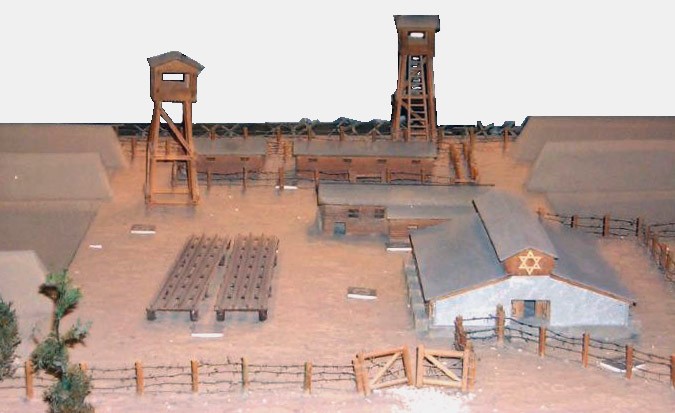
A model of the Treblinka 'gas chamber' and the 'railway track grill'.
More models and photos found at: http://www.deathcamps.org
9.1.3. The "Sheer Impossibility" of the Diesel Engines in Mass Murders
| quote: | Walter Lüftl. In his paper “Holocaust – Believe versus Facts,” which caused him to
lose his position, he explained the following regarding the problem of diesel
motors:268
“What the Holocaust writers have obviously overlooked is the fact that diesel
motors are particularly unsuited for the efficient production of carbon
monoxide (CO). The SS would have gone over to spark-ignition [gasoline]
engines immediately after the first alleged attempts to kill the victims with
diesel exhaust gases. Spark-ignition engines can certainly produce eight
percent carbon monoxide by volume with poor idle adjustment, but diesels
are practically CO free. […]
Just what does this mean in plain language?
It means that nobody can be gassed with diesel exhaust. Instead, victims
would more readily suffocate from using up the oxygen in the ‘gastight’
chambers.[…]
The victims – who would otherwise die quickly [of suffocation] – would easily
live longer as a result of ‘gassing’ with diesel exhaust, because of its high
oxygen content. This means that the diesel engine is not suited for quick killing,
assuming this could be done at all. […]
This proves that the testimonies about mass killings with diesel exhaust gas
[…] are objectively untrue.” |
Killing by diesel engine gas would have killed people in hours, about 3 hours, not quickly as the so-called eyewitnesses claimed:
http://vho.org/GB/c/FPB/ToxDiesel.html
U.S. engineer Friedrich Paul Berg has investigated the question of the conditions under which diesel exhaust could be deadly:
http://ihr.org/jhr/v05/v05p-15_Berg.html
http://vho.org/GB/Books/dth/fndieselgc.html
http://vho.org/GB/c/FPB/NizkorLies.html
Berg's website:
http://www.nazigassings.com
There was also a controversy about a newspaper article written by Patrick J. Buchannan, concerning the problem of the diesel engines:
http://www.vho.org/tr/2000/2/tr02patdiesel.html#
The so-called industrial genocide of the Jews by diesel engines was impossible!
9.1.4. Body Disposal at Treblinka
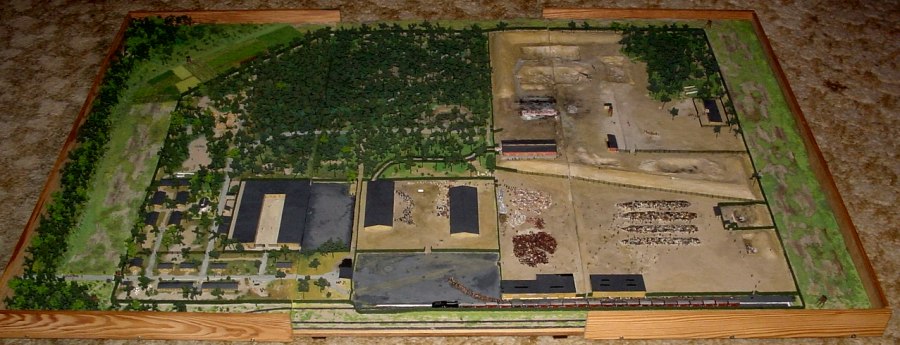
A model of the Treblinka camp.
First they buried the hundreds of thousands of bodies into mass graves. Months later they dug up the bodies and incinerated them at the pyres or at a "grill made out of railway tracks"...
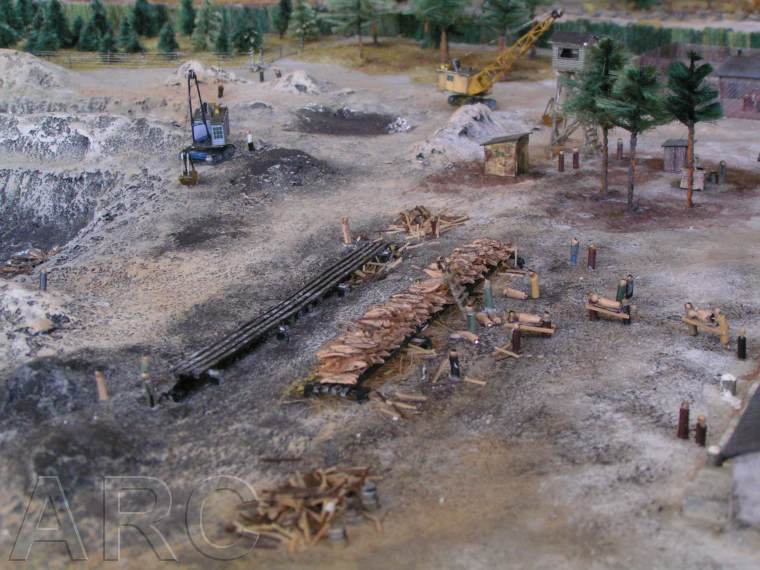
Another model showing the 'railway track grills'.
This is so absurd that I just quote:
| quote: | 3.5.4. Burning Corpses without a Trace
R: I would now like to address the assertion that at Treblinka the bodies of murdered
victims were burned without a trace.662
According to official historiography most of the victims killed at Treblinka are
supposed to have been buried in mass graves before being burned. The question
then arises regarding what characteristics these mass graves would have
had?
Based on the investigations made of the mass graves at Hamburg – Anglo-
American carpet bombing of July 1943 – Katyn – the 1940 Soviet mass murder
of Polish officers – as well as Bergen-Belsen – mass deaths because of typhus
epidemic in the spring of 1945 – John Ball concluded that one may assume the
maximum density to be six corpses per cubic meter.663 Based on this calculation,
Table 14 reveals the resulting characteristics of these mass graves.
The reports about the area where the gas chambers and graves are supposed to
have been located – and later the burning pits – indicate that what is asserted to
have occurred there would have needed five times as much space than what is
claimed. The graves and the excavation mounds would have actually covered
half of the entire camp.
L: Perhaps the witnesses simply got it wrong.
R: Well, let’s see what the gigantic open air fire grates would have looked like, on
which it is claimed that 870,000 corpses were burned.
L: Treblinka therefore did not have any crematories like Auschwitz?
R: No. The Polish examining magistrate Zdzislaw Lukaszkiewicz, who investigated
Treblinka after the war, stated:669
“In Treblinka there were no crematories in the form of furnaces, only primitive
provisions of fire grates.”
L: But if Treblinka had been a pure “extermination camp,” would it not have been
more important to build crematories there than for example at Auschwitz?
R: That would appear to be logical. All important concentration camps – Dachau,
Sachsenhausen, Buchenwald, Mauthausen, Flossenbürg, Neuengamme, Groß-
Rosen, Niederhagen, and Ravensbrück – were equipped with fixed or mobile
cremation furnaces. Lublin/Majdanek and Auschwitz Birkenau, which served
allegedly at the same time as concentration and extermination camps, had several
crematories. Even for a simple prisoner of war transit camp in Russia a
crematory was established.670 And then to top it off: When it turned out that the
SS had bought a few too many cremation furnaces, all camps were asked if
such furnaces were needed there.671 But neither from Treblinka nor from Belzec
or Sobibor did anyone request a need for such furnaces.672
But now let’s list some of the characteristics, which the legendary fire grates
are supposed to have had according to witness testimonies. In view of the
strongly varying testimonies, the values shown in Table 15 are to be regarded
only as rough estimates. They are only to help us gain a picture of what is being
claimed about Treblinka.
Without wood between the corpse layers each pyre would have been 9 meters
high, and with wood between the layers over 26 meters, making it a total of
over 700 metric tons per pyre for a successful cremation.
L: You mean 700 metric tons on a few rails? Well, the fire would have soon bent
them.
L: For that to happen you don’t need fire because the rails would have bent even
before lighting the pyre. But how could you have done this stacking of corpses
without a huge crane? Or did they have such cranes?
R: It is maintained that in Treblinka there were excavators that did this work.
There are even pictures of an excavator in Treblina, which is just an ordinary
excavator as one would find at any gravel pit.683
L: Therefore not with a reach of nine or even 26 meters?
R: No, perhaps four meters. One must know that there was another camp in the
vicinity of this alleged extermination camp, a penal labor camp where workers
extracted gravel from a pit. The pictures of the excavator probably originate
from this camp.
L: But even if you had such cranes, how do you keep a pile like that from collapsing?
I mean, these pyres are claimed to have been just 3 m wide, but 9 or even
26 m high? That would never work!
R: Even if you manage to build such a pile, as soon as you light the fire, it is only
a matter of time when the corpses fall over to one side, because fires never burn
evenly. Realistically seen, therefore, you cannot really build a stable pile that is
higher than it is wide.
L: As to the time required to burn down such a pyre and clear the ashes, I doubt
very much that it can be done in a day.
R: You are right. Experiences with large-scale cremations of cattle on pyres indicate
that it takes at least a week before such huge fire places can be cleared, as I
already mentioned in connection with open air incinerations in Auschwitz (see
p. 212). Of course, if we increase the time required to seven days, but keep
only two pyres, the height of each load would rise by the factor seven, which
would be utterly absurd. Or we have to increase the number of pyres to 14,
which contradicts both the witness statements and the space available.
A further very interesting point is the fuel requirement to maintain the claimed
pyres. I must add here that some witnesses claimed the SS developed a method
of cremating corpses without using any kind of fuel. This is, of course, pure
nonsense. In the next lecture I shall quote some of these statements. If that were
true, then, for example, one of India’s main problems would be solved, where
the deceased are usually cremated on wooden funeral pyres. In the last decades
this has almost completely denuded India of wood.
L: But I heard that bodies can spontaneously and without a fuel burn up completely.
R: What you are referring to is often called “spontaneous human combustion,” and
only recently this phenomenon has been explained. It is not a spontaneous
combustion but rather accidents where a small fire burns close to a corpse with
a high fat content. If there is an object on this corpse that can act like a candle
wick – cotton clothes for example – then it can happen that the fat-rich trunk
burns slowly like a candle. However, this procedure takes many hours and
burns only the trunk but not the limbs which have less fat content. It does also
not burn the head.684
L: So humans can burn without fuel after all.
R: Not completely, not fast, and certainly not with a low body fat content. This
method is certainly not suited for a speedy cremation of thousands of corpses in
few hours. Such large quantities require an additional fuel source, and then in
huge quantities: here about 140,000 metric tons. According to witnesses this
wood supply was procured by a wood felling commando.685
This would have had to work every day for 122 days, cut 1,148 metric tons of
wood, saw it up and transport it into the camp! That is at least 760 trees per
day, which would have filled up 76 fifteen-tonner trucks. Richard Glazar
claimed he was one of the inmate wood cutters, and there were 25 of them at
Treblinka according to his testimony.686
L: That is 30½ trees per man, per day, or 2½ trees per hour for a 12 hour day – cut
the trees down, cut the branches off, saw the trunks into transportable lengths,
and then transport these to the camp. That is quite impossible. Two men can
perhaps cope with one tree per day. That means that hundreds of wood cutters
had to have been at work.
R: And this means that about 280 hectares of forest (2.8 km2, a little more than a
square mile) would have been cleared.687 There is not the slightest trace to be
found on air photos taken of Treblinka.688 Also missing are the huge mountains
of ash that such cremations would have created. If one would have distributed
the ash evenly within the camp where the extermination is alleged to have happened,
as it is claimed, then this whole area would have been raised by almost
four meters.
One can also not assume that such cremation method would completely reduce
all corpses to ash. Large quantities of bone fragments and charred corpse parts
as well as wood and charcoal remnants would have been left over – uncounted
millions of such fragments. |
Lectures on the Holocaust, p. 284-289.
9.1.5. Aerial Photos
... show no evidence.

Air photo of concentration camp Treblinka B of May 15, 1944.

Air photo of concentration camp Treblinka B of November 1944.
http://vho.org/GB/Books/dth/fndaerial.html
9.1.6. Documentary Evidence

| quote: | L: So prisoners did die in Treblinka?
R: Of course. For example in autumn 1943 a typhus epidemic broke out in the
penal labor camp, causing 148 prisoners to die between November 12 and December
12, 1943.692 The graves of these victims were also found by Lukaszkiewicz.
L: So the SS did not even bother to cremate these bodies.
R: Correct.
L: What documentary proof exists that supports the mass murder thesis?
R: Very few documents about Treblinka have been preserved. There is no documentation
about the plan, organization, procuring of materials, personnel,
budget, etc. that would support the gigantic act of extermination. Nothing, absolutely
nothing at all.
Concerning the deportations to Treblinka a whole set of documents exists,
which speak of “evacuation” and/or “resettlement” to the east, however.
L: These are camouflage terms for murder.
R: So the prevailing view. An interesting demographic study of what really happened
to the Jews during that time was written in 1943 by mainstream Professor
Eugene Kulischer in Canada. In his detailed investigation Kulischer relied
on the data provided by many respected global organizations, all of which were
hostile towards the Third Reich. This is how Eugene Kulischer sums it up:693
“For the Polish ghettos are not the last stage in the forced eastward migration
of the Jewish people. On 20 November 1941, the Governor General,
Hans Frank, broadcast the information that the Polish Jews would ultimately
be transferred further east. Since the summer of 1942 the ghettos and
labour camps in the German-occupied Eastern Territories have become the
destination of deportees both from Poland and from western and central
Europe; in particular, a new large-scale transfer from the Warsaw ghetto
has been reported. Many of the deportees have been sent to the labour
camps on the Russian front; others to work in the marshes of Pinsk, or to the
ghettos of the Baltic countries, Bielorussia [Belarus] and Ukraine.”
R: Kulischer had nothing to report about any extermination camps.
|
Lectures on the Holocaust, p. 290-291.
9.2. Belzec
http://vho.org/dl/ENG/b.pdf
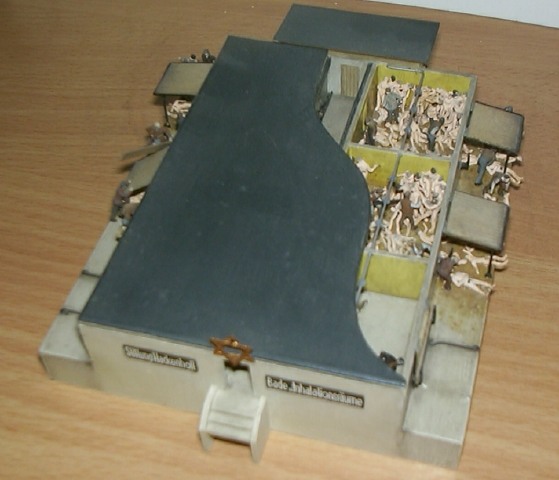
A model of the Belzec 'gas chamber'.
| quote: | Table 16: Victim numbers claimed for Belzec
3,000,000 Rudolf Reder.696
2,000,000 Zeuge Eugeniusz G.697
1,800,000 Eustachy Ukrailski698 and T. Chrólciewicz699
1,000,000 Michael Tregenza700
800,555 Robin O’Neil701
600,000 Polish Central Commission,702 Y. Arad,703 W. Scheffler704
550,000 Tatiana Berenstein705
>300,000 Minimal number of the Jury Court Munich706
100,000 – 150,000 Jean-Claude Pressac637
[...]
For Belzec as well, wildly differing murder methods are claimed:
diesel gas chambers; quick lime; electric current; vacuum chambers. The
corpses were then burned on huge pyres – leaving no traces.
L: Thus essentially the same what is said about Treblinka.
R: Generally, yes, except for some revealing differences. In Belzec the diesel engine
emerged rather late as the murder weapon of choice. Initially there were
more statements made about electric chambers. The most detailed and at the
same time the most famous comes from Stefan Szende, from which I select
some quotes:695
“One had to work several months and build. […] Hundred of thousands of
working hours were spent on it, and tens of thousands of tons of valuable
material were required to establish the human mill in Belcec. […] The human
mill covers an area of approximately 7 square kilometers. [appr. 2.7 sq
miles…] The trains full of Jews would travel through a tunnel into the underground
rooms of the execution place. There the Jews disembarked. […]
The naked Jews were brought into enormous halls. Several thousand humans
at one time could fit into these halls. They did not have windows, and
they were made of metal with a floor that could be lowered. The floors of
these halls with thousands of Jews standing on them were lowered into a water
basin below it – but only so far that the humans standing on the metal
place would not be completely submerged. When all the Jews standing on
the metal were submerged in water up to their hips a strong electric current
was sent through the water. After a few moment thousands of Jews were
dead.
Then the metal floors were raised out of the water and on them lay the executed
corpses. Another electric cable was switched on and the metal plate
was turned into a crematory coffin, white-hot, until all corpses were burnt to
ashes.
Massive cranes then lifted the enormous crematory coffins and emptied the
ash. Huge factory chimneys eliminated the smoke.”
L: I assume there is nothing left of this enormous underground plant.
R: Of course, neither documents nor material traces remain. These and other similar
outrageous stories about the high voltage executions in Belzec are today rejected
as false, and established historians willfully ignore them (see Prof. Nolte’s
remark, quoted on p. 135).
L: So they are telling us only half the truth about what has been reported about
Belzec.
R: Well, I would say they are only telling us a fraction of it, just like they do about
Treblinka. For example, there are statements that report on a soap factory in
Belzec where the fat from murdered Jews was allegedly turned into soap. And
the other killing methods – quick lime, which killed the deportees while traveling
in trains, as well as vacuum chambers – were also secretly dropped.714
The diesel engine story emerged mainly because of Kurt Gerstein’s statements,
a mining engineer who was responsible for the SS hygiene, and in this role had
visited Belzec and is alleged to have witnessed a diesel motor gassing. We shall
return to Gerstein in our next lecture.
L: And were there any forensic investigations undertaken at Belzec?
R: The first forensic investigations at Belzec were undertaken in October 1945 and
then again in 1997 and 1999, whereby the latter were far more thorough: Core
samples were drilled out of the soil at five meter intervals covering the whole
camp site, which altogether resulted in 2,227 samples.715 Of these samples, 236
revealed a disturbance of the earth layer in 33 different, highly irregular
shapes.716 And of these, 137 were “relevant” enough to have their data published.
However, only six of these contained human remains, that is a mere 3%
of all samples with a disturbed earth layer or only 0.3% of all samples taken.
The largest corpse layer found was only 75 cm thick (2.5 ft). What one generally
found was a scattering of thin layered ashes largely mixed with earth rich
in sand.
L: Which means it is proven that at Belzec humans died and their bodies were
cremated.
R: True, but no one denies this. But this does not clarify to what extent this happened,
nor what caused the deaths. For that we have to analyze the results more
closely. The drillings determined that approximately 21,000 m3 of soil had
been disturbed. According to the official version, 600,000 corpses would have
had to fit into this area, because in Belzec the burning of corpses is said to have
begun after the murder phase had allegedly ended.
Similar to Treblinka, Table 17 lists the data derived from witness statements
about the mass graves and the mass cremations in the center column, whereas
the right column gives data derived from the sample drillings mentioned.
L: According to this information, then, only 21% of the number of alleged victim
would have fitted into these discovered pits, thus about 126,000, something that
would confirm Pressac’s estimate of the number of victims at Belzec.
R: That would be the case if these graves had been full of ash, but that is not so.
Only occasionally one finds soil mixed with ash.
L: But why are there so many pits in Belzec, if they were not used?
R: The solution of this mystery lies in what happened in the camp area between
1945 and 1965. The Polish researcher Andrzej Kola wrote:717
“Additional disturbances in archeological structures were made by intensive
dig-ups directly after the war while local people were searching for jewellery.
The facts make it difficult for the archeologists to define precisely the
ranges of burial pits.”
R: On April 11, 1946, the public prosecutor of Zamosc had already explained
what some witnesses confirmed:718
“At this time the camp area has been totally turned upside down by people
coming from the surrounding district to search the area for precious
articles. As a result of this activity ash and human body parts and wood,
charred bones as well as partly charred bones came to the surface.”
R: In other words: the pits found through the sample drillings are not only mass
graves, but to a large extent the remnants of wild excavations made by treasure
hunters after the war. This also explains why the pits found are completely irregular
both concerning their sizes, shapes, and orientations as well as their
contents and the position, arrangement, and composition of the earth layers in
them.
If one considers that at least 90% of the material of the sample cores exhibited
neither human remnants nor ash, then the maximum number of the corpses that
could have been buried in these pits – 126,000 – is at least to be reduced by a
factor of 10, because the number 126,000 is based on the premise that the
corpses were packed as tightly as possible in all of these pits.
L: Therefore the mass murder at Belzec is a maximum of 126,000, but realistically
probably only a few ten thousand?
R: Or only in the thousands, whereby I would rather talk of “mass dying” instead
of “mass murder,” because the most frequent causes of death at Belzec were
probably diseases, exhaustion, etc. The results of these forensic investigations
have consequences beyond the mere reduction of the victim number. Owing to
a British secret service intercept of an SS secret radio report of January 1, 1943,
we know that 434,500 Jews were deported to Belzec.719 If, however, not more
than 126,000 could have been buried at Belzec – but probably much less than
that – what happened with the majority of these deported Jews, which were not
buried at Belzec? They were obviously not killed in Belzec.
L: Then they must have been brought elsewhere.
R: Correct, which confirms the revisionist thesis that Belzec was a transit camp.
By the way, during the sample drillings a search for the remains of the gas
chambers was also made. However, no traces of buildings approximated anything
that resembled what witnesses reported.
What was found were the ruins of a multiple car garage.
L: A garage building?
R: Correct, recognizable by a repair pit.
L: After the graves were located through the drillings, did one actually exhume the
mass graves and examine their contents?
R: Surprisingly, no.
L: But that would have been the only possibility of determining the accurate size
of the graves and the number of the corpses lying in them.
R: It appears that once the gigantic mass graves containing hundreds of thousands
of victims or their remains were not located, there was little interest to do any-
thing else. Anyway, in 2004 a
monument was built at Belzec,
720 which says as much that
from now on there is not to be
any more research done here,
something that would disturb
the dead, but now it is time to
grieve, pray, and sob.
L: And what do the documents say
about Belzec?
R: The few documents discovered or released so far state that at its beginnings
Belzec was a labor camp, wherein harsh discipline against the Jews was maintained.
They were badly treated, and it did happen that the sick and the weak
were summarily shot. However these procedures are embedded in the contexts
of the usual language used when talking about forced labor and deportations,
and they contradict the thesis of systematic extermination at Belzec. Why
would you, if you are intent on killing
all Jews, go to the trouble of taking
out and executing the sick and
weak?722 |
Again the same ludicrous story.
And no evidence in the air photos:

Belzec, May 16, 1944.
http://vho.org/GB/Books/dth/fndaerial.html
9.3. Sobibor
Three victim numbers claimed for Sobibor
2,000,000 Zelda Metz724
200,000 W. Scheffler704
30,000 – 35,000 Jean-Claude Pressac637
And again the same story!
| quote: | L: And what about the last of the
claimed extermination camp close to
the Polish town of Sobibor?
R: There is so far no detailed critical
study available on Sobibor, but in
their critical study of Treblinka,
Carlo Mattogno and Jürgen Graf in
passing dealt with Sobibor. The discovered
documents also embed this
camp within the German deportation
and forced labor politics.
Finally I would like to mention that
all three camps discussed here were
situated on the demarcation line between
German and Soviet occupied
Poland (see Ill. 96). From this geographic
fact it can be assumed that
these camps served as transit camps
for the deportation of Jews “into the
east.” It must be noted that in con-
trast to the rest of
Europe the Soviets
used broad gauge
railway tracks. Therefore,
each transport
towards the east had to transfer its people at this demarcation line from trains of
the Europeans system to those of the Russian system. To my knowledge it is
revisionist researcher Steffen Werner in his study of the Jewish deportations
who was the first one to point this out.427 This would also explain why so many
witnesses talked about delousing and showering procedures, that is, hygienic
measures during the interruption of their deportation, which today are falsely
regarded as deceptive measures preluding the mass murder.
L: But if the Jews were deported by the hundreds of thousands, or even millions to
Belarus, as Mr. Werner asserts and as quoted by you, where are they then today?
R: Let me quote from three documents. There is first the indictment speech of the
Soviet general R.A. Rudenko before the IMT, according to which the Germans
had left hundreds of thousands of unfit children, women, and the aged in camps
during their retreat from the Soviet Union.725 The Soviet chief prosecutor
Smirnov submitted to the IMT a document, which elaborated further on these
camps in Belarus.726 Carlo Mattogno collected a series of documents, which
gives further information on “the final goal of the Jews” deported to the east.727
A particularly illuminating example is the following message of the French-
Jewish underground paper Notre Voix, which in 1944 reported the following:728
“Thank you! A message, which will please all Jews in France, was spread
by Radio Moscow. Who of us doesn’t have a brother, a sister, relatives of
those deported from Paris? And who will not feel a deep joy, if he remembers
that 8,000 Paris Jews were saved from death by the glorious Red Army!
[…] They were all in the Ukraine, when the last Soviet offensive began, […]
they were immediately welcomed by the Red Army and all are at present in
the Soviet Union.”
L: Werner’s thesis that many Jews were actually settled in the east turns out to be
correct. But that does not answer my question.
R: I think that at the end of war a part of these Jews went towards the west, following
the usual flow of emigrating Jews. Another group was taken by Stalin’s
executioners to the GULag, where most of them perished. The rest may have
been scattered throughout the Soviet Union. It might be difficult to determine
the exact fate of these deported Jews. There is without a doubt room for more
research. |
9.4. Conclusion
The various CENSORED killing methods (by holocaust writers) - mobile or stationarygas chambers; poison gas, both fast and slow acting; quicklime; steam; electricity; machine guns; vacuum chambers; chlorine gas; Zyklon B; and exhaust from diesel engines - really reveal what the alleged extermination claims were: wartime atrocity propaganda, without any evidence. If all the other killing methods were false (= atrocity propaganda), then why would diesel engines be any different? It is funny to note that decades after censoring the majority of the propaganda killing methods, it turns out that the "real" killing method - the diesel engine - is not even capable of killing people! (quickly, as alleged).
In addition it turns out that there is no evidence about the mass graves - into which hundreds of thousands of bodies were buried - and the alleged burnings of bodies WITHOUT crematoria ovens were also impossible. The alleged "death camps" even had the possibility to request for the cremation ovens, but it seems that they were not needed.
And then it turns out that the documentation about the three alleged death camps shows that the camps were only transit camps, from which hundreds of thousands of people were transferred to the East. Belzec and Sobibor were also labor camps.
The only conclusion I can come to is that Belzec, Sobibor and Treblinka were not 'extermination camps'. They were just transit camps in which tens of thousands of people died of dieseases. |
|
|
| shaolin_Z |
If you ever read something from wikipedia concerning the Holocaust, I advice you to read it very carefully and accept the information as valid only if they have cited a source to their claim (and it would be could to check that source also).
http://en.wikipedia.org/wiki/Holocaust
One example how incredibly wrong and absurd information can be put to wikipedia:
See that photo, it is clearly claimed by wikipedia that this is "the ruins of the gas chamber at Auschwitz-Birkenau".
(Picture is too big, so I'm not taking it directly here.)
http://en.wikipedia.org/wiki/Holoca...rmination_camps
I've been to Auschwitz and I've read many books on this issue and I can tell you with 100% certainty that this claim is absolutely false. This photo is not a picture of the gas chamber, it is a picture of the sewer building.
This is the real pictures about the ruins of the "gas chamber" at Krema II:

Another example of false information
http://en.wikipedia.org/wiki/Auschwitz#Auschwitz_I
In there it is alleged that in Krema I "morgue->gas-chamber->air-raid-shelter":
| quote: | | from 1941 to 1942, during which time some 60,000 people were killed therein |
Wikipedia doesnt even have a source to that claim. The source would have been Soviet Union's "investigations" right after the taking of the camp, in which they speculated that about 60,000 people might have been cremated there, not gassed.
So keep this in mind if you ever read some of wikipedia's "holocaust 'DENIAL'" articles. |
|
|
| shaolin_Z |
10) Majdanek
http://majdanek.pl/gallery.php?gid=17&mref=19
(Aerial view of the camp.)
| quote: | The German concentration camp in Lublin, popularly called Majdanek, was initiated by Heinrich Himmler’s decision. Visiting Lublin in July 1941, Himmler entrusted Lublin district SS and police commander, Odilo Globocnik, with building a camp “for 25-50,000 inmates who would be used to work in SS and police workshops and at construction sites”.
The camp was going to be the source of a free workforce for the realization of the plans to build a German empire in the east.
[...]
From the very beginning of their stay at the camp, the prisoners were inevitably accompanied by hunger, fear, backbreaking work and diseases. For all real and imagined offences prisoners were severely punished and persecuted. Prisoners’ lives were constantly threatened. They died in the aftermath of wretched living conditions, they were executed and murdered in gas chambers. Among an estimated 150,000 prisoners who entered Majdanek, 80,000 people, including 60,000 Jews, were killed according to the most recent research.
In order to remove the traces of the crimes, the corpses of those who died and the murdered were burnt on pyres or in the crematorium. |
http://majdanek.pl/articles.php?acid=45&mref=1 (Majdanek museum).
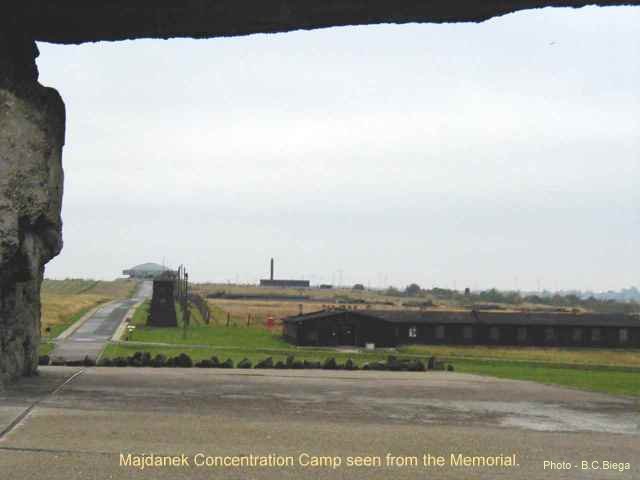
10.1. Majdanek Death Toll
| quote: | 1,700,000 Penal Court Lublin734
1,500,000 IMT735
1,380,000 Lucy Dawidowicz40
360,000 Zdzislaw Lukaszkiewicz,736 Israel Gutman737
250,000 Wolfgang Scheffler,738 Enzyklopädie des Holocaust739
235,000 Czeslaw Rajca15
160,000 Józef Marszalek740
125,000 Martin Gilbert (Jews only)741
100,000 Jean-Claude Pressac637
50,000 Raul Hilberg (Jews only)39 |
Lectures on the Holocaust, p. 299
10.2. The 'Gas Chambers'

Lets hear what the U.S. gas chamber designer and excecution technology expert, Fred Leuchter, had to say about Majdanek:
| quote: | At Majdanek, there are several facilities of interest: the original crematory,
now removed; the crematory with the alleged execution gas chamber, now
rebuilt; the Bath and Disinfection Building #2, which was apparently a delousing
facility; and Bath and Disinfection Building #1, which contained a shower,
delousing and storage room and the alleged experimental CO and HCN gas
chambers.
The first free standing crematory, which has been removed, has been discussed
earlier. For Bath and Disinfection #2, although closed, an inspection
through the windows confirms its function was only a delousing facility, similar
to those at Birkenau. The rebuilt crematory and alleged gas chamber, although
discussed earlier, will be considered briefly again. The furnaces are the
only portion of the original facility which has not been rebuilt. The basic
structure appears to be of wood, as are the other facilities at Majdanek (except
for the experimental chambers). However, closer inspection reveals that much
of the building is of reinforced concrete, totally inconsistent with the remaining
portions of the camp. The alleged execution gas chamber is adjacent to the
crematory with apparently no means of containing the HCN gas.
The building is not sealed and would be inoperable for its alleged purpose.
Allegedly rebuilt from an original plan, which does not exist, it physically
appears to be nothing more than a crematory with several morgues. It is by far
the smallest and most insignificant alleged gas chamber of all.
The delousing/storage area at Bath and Disinfection #1 is an L-shaped room
with an internal wooden partition and door. It comprises some 7657 cu. ft. of
volume and has an area of 806 sq. ft. It has stuccoed walls, beam construction
and two ungasketed roof vents. It contains an air circulatory system which is
improperly designed, whereby the inlet and outlet are in close proximity to
each other. Blue staining, apparently caused by ferric-ferro-cyanide pigment,
visibly coats the surface of the walls. It would appear from its design that this
was a delousing room or storage room for deloused materials. The roof vents
are only capable of providing long term airing of stored materials. The doors
are not gasketed and are not designed to be tight. The room is not sealed inside
or out with sealant. There were several areas in this building that were
permanently sealed and not available for the author’s inspection. This room
clearly was not an execution chamber and meets none of the described criteria.
See drawing.
If this were utilized as a presumed execution chamber, it would hold 90
people, at most, and require 2.0 lbs. of Zyklon B gas. Venting time should be
at least one week. Maximum usage execution rate – 90 people/week.
The alleged experimental gas chambers, located at Bath and Disinfection
Building #1, are a brick building connected to the main facility by a loose
wood structure. This building is surrounded on three sides by a depressed
concrete walkway.[100] There are two chambers, an unknown area and a control
booth, which has two steel cylinders, allegedly having contained carbon monoxide,
which was piped into the two chambers. There are four steel doors with
a rabbet, presumably for a gasket. The doors open out and are fastened shut
with two mechanical latches and a locking bar (hasp).
All four doors have glass peep holes and the two inner doors have chemical
test cylinders to test the air in the chamber.[150] The control booth has an open
window of some 6 inches by 10 inches, never having provision for glass or
gasketing, barred horizontally and vertically with reinforcing rods and opening
into chamber #2. See drawing. Two of the doors open into chamber #1,
one front and one rear, to the outside. One door opens into chamber #2 in the
front. The remaining door opens into an unknown area behind chamber #2.[151]
Both chambers have piping, allegedly for carbon monoxide gas, but in chamber
#2 it is incomplete, having apparently never been completed. Chamber #1
has finished piping, terminated in gas ports at two corners of the room. Chamber
#2 has provision for a roof vent, but it appears never to have been cut
through the roof.[152] Chamber #1 has a heater/circulatory system for the air,
which is not properly designed (the inlet and outlet are too close) and has no
provision for venting.
______________________
[150] Probably for a thermometer, since at least one of the rooms had been equipped with a heater for hot air
disinfestations, see below.
[151] This room has no means to introduce Zyklon B from the outside or to ventilate it, therefore cannot be
seriously considered for executions.
[152] It is claimed to have been a hole through which Zyklon B was thrown. There is no provision to close
this hole. The roof of this building is not original.
The walls are of stucco, the
roof and floor are of poured
concrete, none of which has
been sealed, inside or out.
There are two heater circulators built as sheds on the side of the building, one
for chamber 31 and the other for something in the Bath and Disinfection facility,
forward, (see drawing) neither of which are properly designed and have no
provision for vent/exhaust. The walls in chamber #1 have the characteristic
blue ferric-ferro-cyanide staining. The building is unheated and damp.[153]
Although at first glance these facilities appear properly designed, they fail to
meet all the required criteria for an execution gas chamber or a delousing facility.
First, there is no sealant on any of the inside or outside surfaces. Second,
the depressed walkway is a potential gas trap for HCN, making the building
extremely dangerous.100 Chamber #2 is incomplete and probably was
never used. The piping is incomplete and the vent has never been opened in
the roof. Although chamber #1 is operational for carbon monoxide, it is poorly
vented and not operational for HCN.[154] The heater/circulator is improperly
installed. There is no vent or stack.
Therefore, it is the author’s best engineering opinion that chambers #1 and
#2 were never used, and could not ever be used, as execution gas chambers.
None of the facilities at Majdanek are suitable, or were used, for execution
purposes.
Chamber #1 has an area of 480 sq. ft., a volume of 4240 cubic feet, will hold
54 persons, and use one pound of Zyklon B gas. Chamber #2 has an area of
209 sq. ft., a volume of 1850 cubic feet, will hold 24 persons, and use 0.5
pounds of Zyklon B gas. Assuming gas chamber usage, the maximum weekly
execution rate would have been the figures set out in Table 7.
______________________
[153] Except for the room with heater/circulator.
[154] Although the blue staining proves that it was used for HCN delousing purposes at least, as this facility
was just that: a delousing facility. For more about this, see chapter 4.3. |
The Leuchter Reports Critical Edition, p. 53-55

Note how the Zyklon B has formed the prussian blue stains all the way to the roof. As was previously pointed out, it would have been expected to see the same blue stains in Auschwitz-Birkenau in the interior roof of the Krema II 'gas chamber', had Zyklon B ever used there to kill hunders of thousands of people.

| quote: | R: Since the end of the war the concentration camp Lublin-Majdanek has continued
to lose its significance in Holocaust propaganda.731 Majdanek was the first
concentration camp, which was occupied by the Red Army in summer 1944.
The press frenzy was accordingly huge, because in Majdanek they found cremation
furnaces, delousing chambers, cans of Zyklon B as well as the huge pile
of shoes, about which I spoke at
the beginning of the first lecture.
Although all these objects
had life-saving functions – except
for the shoes, of course –
Soviet propaganda turned them
into their opposite. A particularly
horrible picture of the Majdanek
cremation furnaces did
the rounds, see Ill. 97.
L: There are human skeletons
scattered about. That is really
gruesome.
R: Yes, but the question to ask is:
Did the Germans really leave
behind such a scene, or was it
fabricated by the Soviets in order
to indict the Germans
through such a gruesome scene.
There was certainly no shortage
of corpses on the eastern front.
L: But doesn’t it take months, if
not years, before a corpse decays
into a skeleton? And you
cannot really pull skeletons out
of a cremation oven in one
piece. So it may be assumed
that this scene was staged.
R: That is quite plausible. The
destruction of the crematories at
Auschwitz by the Germans before
their retreat, by the way,
may have been done as a result
of this picture and similar Soviet propaganda photos, because no one in Germany
wanted to see more of such photos from appearing.732
In Table 19 the number of victims said to have died at Majdanek is listed.
The only number of victims based on documents, which was ever mentioned in
a study on Majdanek, states about 42,200.733
L: And how many of these dead were Jews?
R: This cannot be determined exactly, but probably more than half. By the way in
the orthodox historiography of Majdanek there is also mention of mass murder
through shooting: On November 4, 1943, 17,000 Jewish armament workers are
supposed to have been shot there. For some unknown reasons Holocaust
literature has set in concrete this alleged massacre.
L: Imagine, at the end of 1943 Germany was desperate for workers in the
armament factories and the Nazis shoot 17,000 of them?
R: Yes, it is indeed absurd. More likely the Germans would have killed old people,
the sick, or others not capable of working! In Chapter 9 of the Majdanek
book co-written with Jürgen Graf, revisionist historian Carlo Mattogno gathered
a large number of arguments, which point out that the alleged mass shooting
of November 1943 is indeed a figment of someone’s imagination.742
L: It appears that exaggeration and lies were told about nearly all of the camps.
R: You are absolutely right. After Auschwitz
and the “pure extermination camps” had
moved into the foreground of Holocaust
propaganda step by step, the number of victims
claimed for Majdanek was reduced.
Let me now look at the alleged homicidal
gas chambers at Majdanek in somewhat
more detail. Since the middle of 1942, allied
propaganda had reported that in the
concentration camps mass extermination of
prisoners was being carried out with poisoned
gas. Not surprisingly, when the Soviets
liberated the first camps, they would assert
this extermination was a fact. It therefore
does not surprise that the existence of
homicidal gas chambers at Majdanek was
“confirmed” by a Polish-Soviet investigation
commission in August 1944.744 However,
in order to sell the gas chambers successfully
to future generations, the Polish
and Russian propagandists had to overcome
two obstacles:
1. All documents by the Central Construction
Office of the Majdanek camp found
so far refer to the rooms labeled as
“homicidal gas chambers” by the Soviets as delousing or disinfestation
rooms.
2. In contrast to Auschwitz, Treblinka, and Belzec, there are no witness testimonies
that describe the claimed homicidal gassing procedure for Majdanek.
The first problem was solved by the Polish historians in the old fashion way:
Without any kind of evidence it is claimed that the Germans had used a code
language for Majdanek.
Since the second problem could not be solved, one simply used a semantic trick
of circular reasoning: They claimed that the existence of the homicidal gas
chambers is simply proven by the fact that the rooms, which are claimed to
have served as homicidal gas chamber, do indeed exist. Contrary to what happened
at Auschwitz and at the three pure extermination camps Treblinka, Belzec,
and Sobibor, at Majdanek the complete buildings continue to exist to this
day in their (almost) original state.
Finally, the fact that Zyklon B was supplied to Majdanek serves as supporting
circumstantial evidence for homicidal gassing.
L: If the Poles and Soviets were so clever in changing Majdanek’s delousing
chambers into extermination chambers, then why didn’t they do that at Auschwitz
as well?
R: That is a good question about which I can only speculate. The fact is that for
the Soviet propaganda the cremation ovens were extremely important because
of the horror pictures and imaginations that could be linked to them: cremations
of living persons, pictures of half-burned bodies or decaying corpses lying next
to the ovens. That may have been a reason why it was decided that at Auschwitz
the rooms within the crematories were designated to be homicidal gas
chambers.
L: If hydrogen cyanide was used in the Majdanek delousing chambers as an agent,
then should one not find the famous blue colorations on the walls of these
rooms?
R: Absolutely. The walls of these chambers are stained blue just like the walls of
the delousing chambers at Auschwitz or Stutthof.745
L: How does one prove that these remnants were not caused by homicidal gassings?
R: With chemical analyses that could not be done. One can logically undermine
the homicidal gas chamber thesis, because the large building, in which most of
these gas chambers are claimed to have been located, was one of the most important
buildings in Majdanek according to all documents: the hygienicsanitary
complex with delousing and disinfestation facilities and prisoner
showers. Here the relevant rooms were part of the “delousing complex for the
Lublin fur and clothing workshop,” to which clothes were originally meant to
be sent from the Lublin clothes workshops for cleaning and disinfestation.746
L: So in Majdanek not only were shoes repaired and cleaned but also clothes?
R: Exactly. The functioning principle of the Zyklon B delousing chamber with air
heater resembles a primitive kind of DEGESCH circulation device that I mentioned
earlier. The fact that these rooms actually served sanitary purposes as
claimed in the documents is also confirmed by the condition of the buildings,
that is, by the material evidence itself. There is thus no doubt that the delousing
chambers were used as such.
L: But it does not mean that they were not also used for homicidal gassings in a
secondary function.
R: Although that is correct, there is other evidence that permits us to exclude killings
in these rooms. Let us look at all five rooms that are claimed to have been
misused as homicidal gas chambers, which to this day still exist.747
– Room III (see Ill. 99), equipped with the air heater referred to above and
without a doubt exposed to hydrogen cyanide – recognizable by the bluecolored
walls – has no device through which Zyklon B could have been in-
troduced from the outside. Zyklon B was
obviously scattered inside by a person
wearing a gas mask, which is possible
during delousing, but not during executions.
– Room IV, which shows blue wall discolorations
like Room III, is labeled in all
documents as a delousing chamber, has a
normal window that panicking prisoners
would have broken (see Ill. 101) as well
as a door, whose lock can be opened from
the inside.
L: What proves that this window was already
there at that time?
R: The window frame is discolored blue and was therefore exposed to hydrogen
cyanide. But further:
– Of the two doors of Room IV, the northern one can be opened and locked
only from the inside. The prisoners could thus not have been locked in.
– It is documented that the two openings in the ceiling of Room IV served as
ventilation ducts. Today it is falsely claimed that they served as Zyklon B introduction
holes. These holes were, however, connected by means of shafts
to a chimney. If Zyklon B would have been thrown into the chimney, it
would have landed at the bottom of the chimney, and not in the shafts.
– If the shafts of these openings had been removed to allow the insertion of
Zyklon B – as it is the case today after the building had been changed by the
Soviets – then the room would have had no ventilation. The southern door
opened to the shower room and could therefore not have been used for ventilation
purposes, because the whole building would thereby have been flooded
with poison gas. The northern door opened to the inside. Even if it could
have been locked from the outside, it would have been impossible to open it
after the gassing, because of the mountain of corpses pressing against it from
inside.
– The Rooms I and II did not have any provisions for ventilation.
– The Rooms I and III are said to have been converted to gassings using carbon
monoxide after their initial use for murder with Zyklon B. It is claimed that
carbon monoxide from gas bottles has been introduced by means of a metal
pipe still in place today. Carbon monoxide is, however, not readily available
as bottled gas and it is very expensive.748 One would probably have fallen
back on exhaust gases from gasoline engines or generator gas (see p. 282).
L: If mass murder with Zyklon B was so efficient, as is always asserted, then why
should the chambers have been converted to taking carbon monoxide?
R: There is no logical reason. And as a matter of fact, the conversion thesis is
wrong, because:
– two of the five gas bottles found in another area of Majdanek were set up in
an area close to these rooms. However, they carry the clearly readable inscription
“CO2,” thus carbon dioxide.
L: Therefore one gassed there with carbon dioxide?
R: No, that would have been really inefficient, since CO2 is not poisonous. Carlo
Mattogno suggested that these rooms were temporarily used as mortuaries,
when the number of deaths in the camp far exceeded the capacity of the old
crematory in summer 1942, similarly as at Auschwitz. According to Mattogno,
the room was filled with CO2 in order to delay the decaying process of the
corpses.749
But now let me continue with my overview of the most important characteristics
of the alleged gas chambers of Majdanek:
– Room I has an opening in a wall, into which an iron grate is let in, but no
provision for a window (see Ill. 100). Poisonous gas would therefore have
escaped outwards. Likewise in the concrete ceiling of this room there is a
roughly cut hole, which cannot be sealed.
– Like Room I, Room II also has a rough hole cut through the steal-reinforced
concrete ceiling. Both holes were probably only made after the war.
– Finally, the room labeled as a gas chamber in the new crematory is completely
surrounded by other rooms, has two openings to the mortuary that
cannot be closed, and has no ventilation system. One opening in the concrete
ceiling was made where the reinforcement rods were not even removed. (see
Ill. 102).
In view of this situation it does not surprise that even French mainstream historian
Jean-Claude Pressac is very skeptical whether these rooms were ever used
as gas chambers.750 As a matter of fact, none of them could ever have been
used as such for very obvious technical and architectural reasons.
L: Therefore at Majdanek the fraud is easier to expose than in Auschwitz.
R: Owing to the essentially intact buildings and plants. Thank God |
Lectures on the Holocaust, p. 298-304.

Historian David Irving in Majdanek, in 2007, looking at the prussian blue stains in the walls of the delousing rooms.
Detailed study of the Majdanek camp:
http://vho.org/dl/ENG/ccm.pdf
10.3. Conclusion
The alleged gas chambers of Majdanek were not homicidal gas chambers, instead they were only delousing chambers in which Zyklon B was indeed used to delouse clothes - the prussian blue stains in the walls prove this.
Majdanek was an ordinary labor camp in which, as in other camps as well, tens of thousands of people died of dieseases (like typhus). Just like other concentration camps, Majdanek also had crematoria ovens to quickly incinerate the dieseased bodies to prevent them from spreading more diseases. |
|
|
| shaolin_Z |
Expert Opinion About the Revisionist Book Dissecting the Holocaust
Joachim Hoffmann, Dr. phil., born 1930 in Königsberg, East Prussia; studied modern history, eastern European history and comparative ethnology at the University of Hamburg and Berlin’s Free University. He received his PhD in history in 1959. Between 1960 and 1995, he was historian at the Militärgeschichtliche Forschungsamt der Bundeswehr (Research Department for Military History of the German Army). His field of expertise was “Armed Forces of the Soviet Union”; Dr. Hoffmann has authored numerous articles and books about political, diplomatic and military history of the 19th century and about the history of the German-Soviet war. In 1991, he was granted the “Dr. Walter-Eckhardt” Award, and in 1992 the “General Andrej Andrejewitsch Wlassow” Cultural Prize. He died in February 2002.

| quote: | Preamble
Accredited chemist Germar Rudolf[...] has written me to request an expert statement regarding an anthology titled Grundlagen zur Zeitgeschichte: Ein Handbuch über strittige Fragen des 20. Jahrhunderts, edited by Ernst Gauss and published in 1994 by Grabert-Verlag in Tübingen, Germany. The foremost issue was to be the question of the work's scientific, i.e., academic nature, rather than the content per se.
As an historian specializing in recent and East European history, and on the basis of my decades of professional experience and practice in the academic service of the Federal Republik of Germany, I am qualified and entitled to give an expert opinion on the matter in question.
Regarding my personal qualifications, I wish to state that I was a member of the Militärgeschichtliche Forschungsamt [Centre for Research in Military History] in Freiburg from 1960 to 1995. For almost three decades my work has focused exclusively on matters related to the German-Soviet war. Through the publication of academic books and periodical articles on this topic I am well established as an expert in my field, both at home and abroad. Accredited chemist Rudolf [...] and the co-authors of the anthology at issue are not personally known to me.
The Formal Aspect
As pointed out in the anthology in question, the book does not offer a comprehensive overview of the course of the National Socialist persecution of the Jews during World War Two. Rather, the focus is on specific individual topics regarding disputed and controversial aspects of killings of the Jews. The various contributions to the book are expertly written in a predominantly investigative style. Where detail and completeness are concerned, the body of supporting and documenting references leaves little to be desired and is extremely helpful to a reader seeking further information, not least of all since sources from the opposing subject literature are also cited without reservation. It appears, therefore, that this anthology is part of the large-scale academic dispute over a serious contemporary issue which reaches far beyond its actual academic scope and into the political realm.
The individual contributions to this anthology are logically consistent and objectively descriptive in structure, even though at times a polemic note does become evident - as is perhaps inevitable in such emotionally charged topics, and as is also quite common in political and historical controversies. In any case, a striving for new understanding is tangibly apparent throughout the book. From this perspective, therefore, the anthology cannot be denied an academic character, particularly if one compares it with many a publication from its opposing side, whose academic nature is also never questioned. There is much in the various contributions that strikes one as thoroughly convincing. Much else may be merely noted with objective interest. Elsewhere, doubts and criticisms also come to mind. The issue may perhaps be simplified by pointing out that what we are dealing with in this great controversy is a rather more accusatory style of literature on the one hand, and a rather more apologetic one on the other. This is to suggest that in the heat of controversy, both sides may be overly inclined to overshoot the mark and to leave the solid ground of provable facts behind. One might perhaps summarize by saying that the time for conclusive declarations regarding the great persecution of the Jews has not yet come.
The Problem of Self-Evidentness
There can be no doubt about the fact that genocide was committed against the Jewish people by the Einsatzgruppen of the Security Police and the SD and by the SS personnel in charge in the concentration camps in the former General Government of Poland. Hitler, Himmler and Dr. Goebbels clearly admitted these misdeeds on several occasions. The anthology's editor, Ernst Gauss, also considers this as given in his chapter. And in fact, the genocide provides an unspoken backdrop for the anthology at issue. To rule out any misunderstanding, it would perhaps have been better to spell these things out unambiguously and to clarify that an academic controversy today can no longer dispute the mass killings per se, but rather only the numbers of victims and the methods of murder. In this respect, we admittedly may expect to see far-reaching modifications as yet. In this context as well, the rather overused concept of self-evidentness is in need of limitation, or at least of a more precise definition.
Two Important Examples
We shall give two especially significant examples of this.
1) [Downward Revision of the Number of Auschwitz Victims]
From 1945 to 1990, the figure of 4 million victims in Auschwitz was considered self-evident and was accorded judicial notice in the Federal German courts. But where did this figure come from? It originated with Soviet war propaganda. On March 1, 1945, an official Soviet announcement stated for the first time that "at least five million people were exterminated" in Auschwitz. This figure was then reduced to four million in the official Soviet communiqué of May 7, 1945. This number of 4 million victims - put about by Soviet war propaganda, in other words by the NKVD, and in no way proven by any evidence whatsoever - was adopted by the public in western countries, and persisted unchanged until 1990, when it was officially reduced to 1.5 million virtually overnight. Currently the number of Auschwitz victims is set at a remaining 631,000 to 711,000, and a further reduction has not been ruled out.
2) [The Total Number of Jewish Victims]
To this day the total number of Jewish victims is generally given as 6 million. According to the current opinion of the German experts on contemporary history, this figure was first provided to the Americans by SS Sturmbannführer Dr. Hoettl in spring 1945, and repeated at the IMT in Nuremberg on November 26, 1945. It must be noted, however, that this selfsame figure was demonstrably first put forth in the foreign press as early as January 4, 1945, several weeks prior to the January 27, 1945, liberation of the Auschwitz concentration camp (with its alleged 4 million victims) - put about by none other than the infamous Soviet Minister of Propaganda, Ilya Ehrenburg. Thus it was Ehrenburg who came up with the figure of six million. [cf. Joachim Hoffmann, Stalin’ s War of Extermination 1941 – 1945, Theses & Dissertations Press, Capshaw, AL, 2001, pp. 189f.]
Regarding Ehrenburg himself, it must be mentioned that in 1941 Stalin had given him the general order to incite a boundless national and racial hatred against all Germans. Ehrenburg's years-long unbridled frenzies of hatred culminated in his call to "put an end to Germany" and in an effort which he described as "modest and honorable", namely "to reduce the population of Germany", towards which end the only thing left to decide was whether it would be better "to kill the Germans with axes or with clubs".
Both examples show that new evidence can immediately overthrow something that is allegedly self-evident, and, accordingly, it is the duty of any contemporary historian to call allegedly conclusive findings into question. Even in matters involving grave charges, the principle of self-evidentness has been known to become invalidated. As an example one need only consider the claim (widely accepted in Germany in particular, but now denied by Yad Vashem itself) that the Germans had manufactured soap from the bodies of murdered Jews - a fabrication that also goes back to Soviet war propaganda. Therefore, the anthology at issue here does not commit anything unlawful, but rather engages in a justified and necessary pursuit in its attempt to critically examine allegedly self-evident issues on the basis of new evidence or findings, as it is in fact the natural task of historiography to do.
The Problem of Eyewitness Testimony
Several contributions to this anthology point out, and rightly so, that the testimony of eyewitnesses is unreliable; these contributions back their claims with numerous examples, some of which are indeed truly grotesque. Such experiences certainly agree with those of other historians of the Second World War. This is not to say that eyewitness statements are entirely superfluous, but practical experience definitely has shown that they must always be examined and corroborated with authentic documents. My personal experience has been that as early as 1970 eyewitness testimony about details of the events of the war was so unreliable that it would have been a breach of professional duties to base a historical treatise on them alone.
Benz's Anthology
On the whole, the contributions to the anthology here at issue frequently manifest a profound understanding of the subject and its associated literature, even though some suggestions made do appear questionable at times. However, the establishment literature about the Holocaust also often contains factual errors. One example in this context is Benz's 1991 anthology Dimension des Völkermords, which displays a downright disarming ignorance of the state of affairs on the Soviet side. The authors of the Gauss anthology object, and correctly so, that Benz bases his studies uncritically on the announcements made by Soviet war propaganda and on the publications about Soviet show trials. The anthology edited by Benz attempts, by means of elaborate statistical minutiae, to prove the correctness of the six-million figure. Anyone who has worked with demographic statistics knows what serious errors can enter into such complex analyses even under a strictly objective agenda. Benz is entirely unaware that Ehrenburg had already introduced the six-million figure into the annals of war propaganda on January 4, 1945. Thus, he will have to accept the charge that, though unwittingly, he has really only worked to confirm a propaganda figure of Ehrenburg's. From this perspective, his and his co-authors' research findings offer a foothold for fundamental criticism.
Babi Yar
The mass execution of Jewish inhabitants of Kyiv, known as the massacre of Babi Yar, is also subjected to justified and necessary criticism in the anthology here at issue. Over time, the actions of Einsatzkommando 4a of the Security Police and the SD under Blobel have experienced propagandistic inflation to the point where restoring the actual facts to their real dimensions is an obligation for anyone striving for historical veracity. Of course this does not impinge on the fact that thousands of Jews were killed in Kyiv.
Overall Impression
The overall impression evoked by this anthology edited by Gauss is that its contents must be acknowledged - with critical common sense, of course - no less than is always undisputedly and unrestrictedly done with the 'official' literature about the Holocaust. The principle of audiatur et altera pars [let the other side be heard] must apply in this case as well! A suppression of this carefully documented work would represent a forcible obstruction of the legitimate striving for scientific and academic understanding. The state of knowledge is never static. Experience has shown that exaggerations and errors always grind themselves down in the course of a normal academic controversy. One must not deny a mature and free researcher and reader his ability to exercise his critical faculties. It would then be only a small step from suppressing unpopular books, to burning them; and then, though with different motivations, we would be right back where the entire misfortune began.
Conclusion
As historian officially commissioned by the Militärgeschichtliche Forschungsamt I have spent two-and-a-half decades studying the Soviet military literature about the history of the Red Army and the Second World War in its original documentary texts - an endless chain of misrepresentations, fabrications, distortions and slander. But even this historical literature turned up the occasional truths. I could not have carried out my academic duties if I had rejected the Soviet publications out-of-hand as being unacademic. The same goes infinitely more for the anthology here at issue, which is on a respectable academic level and which doubtless contributes much to our understanding of aspects of the war, despite any reservations one may have.
[sgd.] Dr. J. Hoffmann, Acad. Director (retired)
[written on September 28, 1995] |
http://vho.org/GB/Books/dth/
http://vho.org/GB/Books/dth/fndHoffmann.html
This was the expert opinion of a PhD level historian, presented in court. |
|
|
| shaolin_Z |
11) The Einsatzgruppe Shootings
This is the one issue which I am least skeptical.
Shooting people in great numbers, especially unarmed people, is simple and easy: gather the people to be shot in one place; aim and pull the trigger; and then bury them into mass graves. If there is a World War (2), especially in the Eastern Front where about 25-30 million people die during 4 years, then people indeed will be shot! So this in itself is not a problem at all.
However, because I have dealt with all the other issues and questions, I will of course deal with this also. This issue will be also dealt with critically, looking at the details, just like the others have been dealt with critically. And there indeed are some problems with these Einsatzgruppe shootings also.
10.1. What happened?
| quote: | Einsatzgruppen (in this context, mobile killing units) were squads composed primarily of German SS and police personnel.
[...]
Einsatzgruppen had among their tasks the murder of those perceived to be racial or political enemies found behind German combat lines in the occupied Soviet Union.
[...]
These victims included Jews, Roma (Gypsies), and officials of the Soviet state and the Soviet Communist party.
[...]
Many scholars believe that the systematic killing of Jews in the occupied Soviet Union by Einsatzgruppen and Order Police (Ordnungspolizei) battalions was the first step of the "Final Solution," the Nazi program to murder all European Jews.
[...]
The Einsatzgruppen following the German army into the Soviet Union were composed of four battalion-sized operational groups.
[...]
Shooting was the most common form of killing used by the Einsatzgruppen.
[...]
Einsatzgruppen came directly to the home communities of Jews and massacred them.
[...]
Einsatzgruppe detachment 4a massacred 33,771 Kiev Jews in the ravine at Babi Yar.
[...]
By the spring of 1943, the Einsatzgruppen and Order Police battalions had killed over a million Soviet Jews and tens of thousands of Soviet political commissars, partisans, Roma, and institutionalized disabled persons. |
http://www.ushmm.org/wlc/article.php?lang=...duleId=10005130 Article title: EINSATZGRUPPEN (MOBILE KILLING UNITS).
10.2. Table 23: Victim numbers claimed for the Einsatzgruppen
3,000,000 Solomon M. Schwarz 818
2,200,000 H. Krausnick, H.H. Wilhelm 819
1,300,000 Raul Hilberg 820
Over 1,000,000 [821]
818 Solomon M. Schwarz, Jews in the Soviet Union, Syracuse Univ. Press., Syracuse 1951, p. 220.
819 H. Krausnick, H.H. Wilhelm, op. cit. (note 811), p. 621.
820 1,3 Mio.: Raul Hilberg, op. cit. (note 39), p. 1219; Hilberg considers only some 650,000 to 800,000
Soviet Jews to have fallen victim to “the Holocaust,” ibid., p. 1218. (Lectures on the Holocaust, p. 322.)
[821] Encyclopedia of the Holocaust; U.S. Holocaust Memorial Museumhttp://www.ushmm.org/wlc/article.php?lang=en&ModuleId=10005130
So, is it 3,000,000 or 1,000,000?
10.3. Babi Yar Massacre
10.3.1. Table 22: Victim numbers claimed for Babi Yar
300,000 Vitaly Korotych 795
200,000 Vladimir Posner 796
150,000 Speech during inauguration of memorial 797
110,000 – 140,000 New York Times 798
100,000 Western Encyclopedias 799
80,000 Soviet Commission 800
70,000 Soviet Encyclopedias 801
52,000 Gerhard Riegner 802
50,000 Genadi Udovenko 803
38,000 Polish resistance 804
33,771 Activity- and Situation Report No. 6 805
30,000 Leni Yahil 806
10,000 Grand Dictionnaire Encyclopédique Larousse 807
3,000 Encyclopedia of Ukraine 808
795 John Dornberg, The New Tsars, Russia Under Stalin’s Heirs, Doubleday, New York 1972, pp. 148f.;
Oleh Kalugin, “KGB During Gorbachov’s Era,” The Hornylo, Lviv, vol. 4, 1991, p. 13.
796 V. Posner, H. Keyssar, Remembering War: a US-Soviet Dialogue, Oxford University Press, New York
1990, p. 206.
797 By an unnamed Jew, Ukrainian TV, Kiev, Dec. 6, 1991.
798 “Murder of 140,000 Upheld By Germany,” The New York Times, May 1, 1945.
799 Encyclopaedia Judaica, Keter Publishing Ltd., Jérusalem, 1971, vol. 2, p. 27; Encyclopaedia Britannica,
vol. 1, Chicago 1991, p. 769; also “Kiev Lists More Victims, Letter to Stalin Says 100,000 Were
Massacred by Nazis,” New York Times, Dec. 4, 1943.
800 “50,000 Kiev Jews Reported Killed,” New York Times, Nov. 29, 1943; the article itself speaks of 50-
80,000 victims.
801 Great Soviet Encyclopedia, Moskau 1970, vol. 2, p. 501; Ukrainska Radyanska Encyklopedya, Kiev,
vol. 1, 1959, p. 391; “At Babi Yar Only Four Spectators,” New York Times, Dec. 14, 1968.
802 World Jewish Congress, “Nazi Execute 52,000 Jews in Kiev: Smaller Pogroms in Other Cities,” Daily
Bulletin of the Jewish Telegraphic Agency, Nov. 16, 1941.
803 Ambassador of the Ukraine at the U.N., acc. to “Infectious Nationalism,” Washington Times, Sept. 5,
1991, p. G4.
804 Secret telex no. 346/KK of Nov. 13, 1941, sent by the Polish resistance in Lemberg to London, Hoover
Library, File Komorowski, single page document, Box no. 3, Nov. 13, 1941.
805 Document R-102 in IMT, vol. 38, pp. 292f.
806 Leni Yahil, The Holocaust, Oxford University Press Inc., New York, 1990, p. 257.
807 Grand Dictionnaire Encyclopédique Larousse, Paris, vol. 1, 1982, p. 953.
808 Encyclopedia of Ukraine, vol. 1, 1988, p. 154. (Lectures, p. 319.)
10.3.2. What Happened?
| quote: | | On September 28, 1941, members of Einsatzgruppe (mobile killing unit) C, supported by other SS and German police units and Ukrainian auxiliaries, murdered more than half of the Jewish population of Kiev at Babi Yar, a ravine northwest of the city. This was one of the largest mass murders at an individual location during World War II. As the victims moved into the ravine, Einsatzgruppe detachments shot them in small groups. According to reports by the Einsatzgruppe to headquarters, 33,771 Jews were massacred in two days. In the months following the massacre, German authorities stationed at Kiev killed thousands more Jews at Babi Yar, as well as non-Jews including Roma (Gypsies), Communists, and Soviet prisoners of war. It is estimated that some 100,000 people were murdered at Babi Yar. |
http://www.ushmm.org/wlc/article.php?lang=...duleId=10005421 Article title: KIEV AND BABI YAR.
10.3.3. What Really Happened?!
| quote: | One of the first critical studies of this alleged event indicates that the claimed
death figure varies from 3,000 to 300,000.[793] According to the established version
the Jews of Kiev were driven to the edge of the ravine Babi Yar – old
woman ravine – then were shot and thrown into it.
Other sources claim the murders occurred in a cemetery, outside a cemetery, in
a forest, in the ravine itself, in a brickyard, in the city of Kiev, in gas vans, or in
the river Dnjepr.
The murder weapon was supposed to have been machine guns, submachine
guns, automatic rifles, rifle butts, clubs, rocks, tanks, mines, hand grenades, gas
vans, bayonets and knives, live burial, drowning, injections, and electrical
shocks.[794]
L: Heavens above! That is worse still than the chaos around Treblinka!
R: The parallels do not stop there, however. After conclusion of this action the
ravine is said to have been blown up, whereby the corpses are claimed to have
been buried under the rubble. When in autumn 1943 the war front moved again
dangerously close to Kiev, the Germans are said to have forced Ukrainians to
take all corpses out from under the rubble and to burn them on pyres within a
few days, all without leaving a trace. That is why there is today no evidence of
this horrible crime.
L: Exactly the same as in Treblinka, Belzec, and in other places of murderous acts
committed by the Germans – not leaving any evidence behind.
R: Well observed. The logistic and technical problems with the cremations would
have been the same. But that is not my concern here. What concerns me here is
the analysis of air photos, which were taken between 1939 and 1944 by German
reconnaissance planes over Kiev and which the Americans collected and
stored in their National Archives after the war. |
(Lectures, p. 317-319.)
10.3.4. Air-Photo Evidence
| quote: | The Canadian air photo interpreter
John C. Ball analyzed some of these pictures, one taken on May 17,
1939, another from September 26, 1943,809 and a third from June 18, 1944.
These photos are interesting for two reasons. First of all, they are so good in
their resolution that distinct objects can be recognized, like large shrubs, trees,
and cars. Secondly, the first photo is made before the time the alleged Babi Yar
massacre happened. The last photo analyzed was taken nine months after the
Red Army reconquered the area. The most interesting photo, however, may be
the one of September 26, 1943, because that was exactly the time, when the
huge pyres are said to have been burning at Babi Yar |
(Lectures, p. 319.)

Illustration 3: Luftwaffe air photo of the Babi Yar ravine, taken on Sept. 26, 1943.

Illustration 4: Enlargement of a portion of the Luftwaffe air photo taken of the Babi Yar ravine on Sept. 26, 1943. This portion shows the part of the valley near the Jewish cemetery.
"We may conclude with certainty that no part of the Babi Yar ravine was subjected to topographical changes of any magnitude during the war years right up to the Soviet reoccupation of the area. The vegetation in this valley was also not disturbed.[16] Hence, there can have been no mass graves in these locations, and the mass cremations attested to can also not have taken place at this time." http://vho.org/GB/Books/dth/fndaerial.html (Same air photos also found in the ushmm's article: KIEV AND BABI YAR)
And AGAIN no evidence in the air-photos. Surprise, surprise...
10.3.5. Any Evidence?
| quote: | German mainstream historian Dr. Joachim Hoffmann wrote:[810]
“The NKVD introduced the previously unknown Ravine of the Old Woman
into Soviet war propaganda in November 1943 for the first time in connection
with the desperate attempts at concealment in the Katyn case. Soon
after the recapture of the Ukrainian capital, a party of Western press correspondents
was invited by the Soviets to inspect the ravine of Babi Yar, now
alleged to be the location of the massacre. Material proof, however, seems
to have been a bit scanty. An evaluation of the numerous air photos in recent
years apparently leads to the conclusion that, in contrast to the clearly
visible, extensive mass graves dug by the NKVD at Bykovnia (Bykivnia),
Darnica, and Bielhorodka, and in contrast to the clearly visible mass graves
at Katyn. […] the terrain of the ravine of Babi Yar remained undisturbed
between 1939 and 1944, i.e., including the years of German occupation. To
shore up the allegation that the Germans shot ‘between 50,000 and 80,000
Jewish men, women, and children with machine guns,’ in the ravine of Babi
Yar, the NKVD rehearsed three so-called witnesses in 1943, whose tales,
however, merely aroused the skepticism of news correspondents, particularly
Lawrence, the experienced representative of the New York Times. On
November 29, 1943, the New York Times published an article, purged of the
crudest Soviet untruths relating to ‘Soviet partisans’ and ‘gas vans,’ entitled
‘50,000 Jews Reported Killed,’ nevertheless, accompanied by the remarkable
subtitle, ‘Remaining Evidence is Scanty,’ indicating that the NKVD
efforts to convince the world had been something of a failure.”
L: Did anyone search for traces there since the collapse of the USSR?
R: No, no one ever search for anything.
L: But the documentation of this murder of over 30,000 Jews in Kiev is set in
concrete, particularly because several German documents refer to this number,
though Babi Yar is not explicitly mentioned. So perhaps the murders occurred
elsewhere.
R: Well, yes, but then we must reject all statements in this regard as wrong
regarding the location of this massacre. But the air photos do not show any
mass graves of the claimed magnitude anywhere in the area.
L: How can one seriously doubt the authenticity of the German documents? In the
situation reports from the USSR, for example, everything is finely documented
with letterhead and in parts even with the signature of the Gestapo chief
Heinrich Müller. There are over 2,900 typewritten pages, and each one was
copied 30 times, and then sent to all possible places in the Third Reich.[811]
Therein are mentioned not only this massacre but hundreds of others with detailed
victim numbers that are altogether in the hundreds of thousands.
R: Thus we come to the problem of the Einsatzgruppen in general.[812] Since this is
a complex topic, let me offer you some background information. |
(Lectures, p. 319-321)
10.4. The Problems With the Einsatzgruppe Shooting Numbers
10.1. The Problems With the Partisans
| quote: | The German “Einsatzgruppen der Sicherheitspolizei und des SD” (deployment
groups of the security police and the security service) were officially created in
order to carry out security missions in the occupied hinterland behind the eastern
front primarily to fight partisans. As is well known the defeat of the German
armed forces in the east is in large part attributed to the Soviets’ organized
guerilla warfare.[813] The number of partisans acting behind German army lines
was at the beginning of 1942 approximately 80,000-90,000, a number that constantly
rose, until it reached about half a million at the beginning of 1944.[814]
Concerning the German soldiers and civilians killed by partisans the data vary
between 1.5 millions – from Soviet propaganda sources – and about 35,000-
45,000 from German sources, but the latter number is surely too low, since
numbers are incomplete from the year 1944 because of the collapse of the
German army group center in the summer of 1944.[815] |
(Lectures, p. 321)
I just want to add that to fight a partisan warfare against the occupying enemy, and his supply lines, it is not necessary to have superiority in numbers of troops. Partisans know in advance where the German supply lines go so they just move enough of their troops to the known place and ambush the unknowingly German soldiers, delivering the supplies. This can be done even when partisans are inferior in troops against the occupiers. Ambushing Machine guns can do wonders to unawar enemy.
So the partisans were a strong and constant payne in the ass, who required a lot of troops to hunt them. And as was already shown, this payne just kept growing and demanding even more troops to hunt them.
The vast majority of the Einsatzgruppen and their helpers, were very busy fighting against the partisans.
10.4.2. The Problems With the Strength, Time and Distances
| quote: | Initially the strength of the Einsatzgruppen amounted to only 4,000 men, but by
summer 1942 it had increased to approximately 15,000 Germans and 240,000
auxiliaries, which were mostly volunteers from other nations, for whom the
German invasion of the Soviet Union came as liberation from Stalinist oppression
(Ukrainians, Estonians, Latvians, Lithuanians, but also many Russians).[823]
This increase is not surprising, because the partisan activities also rose. In view
of the relative failure of the battle against the partisans it is obvious that the
Einsatzgruppen were completely overburdened in controlling this huge area –
more than 1.2 million square kilometers (almost half a million sq miles) –
through which important German supply lines went, which the partisans interrupted
with ever increasing efficiency.
These same Einsatzgruppen are also supposed to have killed Jews in large
numbers and then buried them in countless mass graves. But even here the victim
numbers vary considerably, see Table 23.
These same Einsatzgruppen are supposed to have dug up those mass graves
created before in 1943, when the eastern front was in retreat, and then to have
burned the partly decayed corpses on the usual gigantic pyres without leaving a
trace. Babi Yar mentioned above is only the most well-known of all examples. |
Now lets pause for a minute and think about this.
The size of the area which the Germans controlled in the end of 1941 was huge:

In the end of 1942 it was even larger:

Even in the late 1943, it was still huge:

Also see this map:
http://www.ushmm.org/wlc/media_nm.php?lang...amp;MediaId=342
In order to fully understand how enormous this area really was, view this area with Google Earth or google maps http://maps.google.com/ and start counting all the cities and towns, and the distances between them.
While doing that, you might also wonder these simple questions:
1) Were ALL of the Jews of the Soviet Union, located in one place?
2) In how many cities and towns were they distributed?
3) Were ALL of the Jews of the towns' and cities's always gathered in one place ready to wait for the Germans to come and shoot them, and did they obediantly wait for them?
4) How big were the towns/cities, and how many houses and other buildings did the cities/towns have? (where the Jews could have hid).
5) Wouldn't the Jews - after having heard or seen Germans coming into the town going from door to door looking for Jews - likely had escaped from the Germans, or at least gone into forests nearby to hide the Germans?
6) How long distances were there between the thousands of towns and cities?
7) How many Einsatzgruppe-/helper- soldiers were available to hunt the millions of Jews in the Soviet Union's thousands of towns and cities, tens of thousands? (Assuming that the vast majority of Einsatzgruppen and their helpers were busy fighting the partisans.)
8) How many vehicles would have been required for these transportations of the Einsatzgruppens and their helpers plus to the excequted Jews?
9) How much scarce fuel would this have required?
10) How much time, would ALL this have required?
My short answers:
The vast majority of the Einsatzgruppen and their helpers were very busy fighting the fierce partisans, so only some tens of thousands (maybe 50,000) were available to do all the Jew-hunting. They would have to have traveled thousands of kilometers from hundreds (or even thousands) of towns to towns, from hundreds of cities to cities. This in itself would have required already a lot of time. They also had to have lot of vehicles so that the searching of the Jews in towns would have been swift, and so that they could have transported them quickly into a forest or field were they would have shot them and buried them; this would have taken A LOT of scarce fuel. Searching for the Jews in towns would have required a lot of time. Going from door to door and searching inside every room in one house, and breaking the locked doors, would have required much more time. Especially in cities in which there are tenement buildings, much much more time would have been required, many many days. And then the Germans would have to have also spent time hunting the escaped Jews, otherwise only a fraction of the "over 1,000,000" would have been killed.
All this would have required too much time. The number of "over 1,000,000" is therefore excaggerated many times.
| quote: | L: And this gigantic action was accomplished by only a few thousand Germans
and their willing foreign auxiliaries, who at the same time had to fight the hundreds
of thousands of partisans as well?
R: So the dominant view. It sounds nearly ironically when German mainstream
historian Heinz Höhne states:[830]
“Heydrich’s death messengers started on their gruesome adventure: 3,000
men hunted Russia’s five million Jew.”
R: Likewise Israeli “Nazi hunter” Efraim Zuroff is unwillingly comical when he
writes:[831]
“The Einsatzgruppen […] numbered a total of approximately 3,000 men.
[…] These units had to cover an enormous area that stretched from the suburbs
of Leningrad in the north to east of the Sea of Azov in the south, a front
hundreds of miles long. […] The means at their disposal to achieve this goal
[of murdering all Jews] were in most cases solely conventional fire arms –
machine guns, rifles and pistols. […] Yet despite this limitation and the fact
that the relatively small number of men in these units had to operate over
such a wide geographical area, the Einsatzgruppen managed to murder approximately
900,00 Jews within 15 months.”
R: It appears as if they fought the hundreds of thousands of partisans as a hobby,
after a day’s work so to speak. None other than the mainstream Holocaust expert
Gerald Reitlinger stated that this was completely unbelievable.[832] |
(Lectures, p. 324)
I agree.
10.4.3. The Documentary Evidence
| quote: | These same Einsatzgruppen are supposed to have dug up those mass graves
created before in 1943, when the eastern front was in retreat, and then to have
burned the partly decayed corpses on the usual gigantic pyres without leaving a
trace. Babi Yar mentioned above is only the most well-known of all examples.
This gigantic action of evidence destruction, which is said to have begun in the
summer 1943, allegedly ran under the cover name “Aktion 1005.”824
L: And are there any traces left of these crimes?
R: The official historiography comments succinctly:[825]
“Although burning the bodies from the mass graves did not efface the Nazi
crimes, it did cause difficulties in determining the facts of the crimes and in
drawing up statistics on the numbers of victims. In many cases, the commissions
investigating Nazi crimes in the USSR and in Poland found no trace of
the mass graves, and they encountered difficulty in reaching estimates.”
L: Thus in other words: There is no proof.
R: To date I am not aware of a single case that has been presented to the world
public where a mass grave or traces of graves of that magnitude have been discovered.
L: Had I been in Stalin’s place, I would also not have searched for these German
mass graves, because even if those horrible deeds had been committed by the
Germans – which he himself probably did not believe – then the two million
murdered Jews would nevertheless only have made up a small percentage of
the tens of millions of victims of communism, who were never cremated
“without trace” and who fertilize nearly each square meter of Russian soil.
L: And to that would have to be added the many mass graves of the ten million
fallen German and Soviet soldiers, who also must lie somewhere. How do you
distinguish in such an enormous mountain of corpses between Jews and non-
Jews, between victims of the Einsatzgruppen and those of communism or the
war?
R: As time passes it will become more difficult, but where there is a will, there is
also a way. That is what the city administration of Marijampol, Lithuania, must
have thought when they decided in 1996 to build a monument to the tens of
thousands of Jews allegedly murdered there.
In order to establish the monument in the correct place, excavations were conducted
where witnesses claimed the mass graves were located. A huge area was
excavated, but unfortunately nothing was found.[826]
L: Well, how do you expect to find anything when the corpses were burned without
a trace?
R: Therefore within a year the members of the “Aktion 1005” dug up and burned
one and a half to over three million corpses – depending on the source.[827] That
includes countless graves spread over 1.2 million square kilometers – and no
material and documentary traces were left?
L: Thus, the Einsatzgruppen must have kept exact account from the outset concerning
all their mass graves and must have registered them in maps, so that
they could find them later
R: Not only they, but also the armed forces, all police districts, and all the others
who were involved in these murders, because their mass graves are said to have
been opened and their criminal content made to disappear “tracelessly” as well.
There are no such maps. And there are also no air photos available, on which
these graves and the gigantic pyres are shown. German mainstream historian
Thomas Sandkühler is almost spot-on when he writes:[828]
“On account of the strict secrecy ‘Action 1005’ written sources are rare.”
R: There are actually no written sources for this Action, as C. Mattogno has
shown![829]
[...]
As early as 1988, one of the most renowned experts on the Einsatzgruppen,
German mainstream historian Hans Heinrich Wilhelm, stated that he is not certain
if the numbers in the Einsatzgruppen reports sent to Berlin are correct.
These reports are the only existing evidence; hence they are used to compute
the number of Jews killed. Wilhelm warned his colleagues:[833]
“If the non-statistical reliability of [these reports] is not higher [than their
low reliability concerning numbers], as could be confirmed only by a comparison
with other sources from the same region, then historical research
would be well advised if in future it made less use of all SS sources.”
L: So Wilhelm, so foremost expert on these documents, basically doubts that they
contain any reliable information. I wonder what we would dare to write if
German penal law would not threaten him…
R: Wilhelm’s remark is consistent with what he wrote in his first book, where he
doubted the reliability of these documents as well:[834]
“the fact that at least some ten thousand killed Jews were added to increase
the total number of the otherwise unjustifiably low partisan numbers.”
R: In other places he notes the fact that one of the activity reports of the Einsatzgruppen
was obviously manipulated by inserting a zero, thus increasing the
victim number from 1,134 11,034.[835] Obviously the fabricators – that is what
this is all about – must have had an interest in presenting a large number of victims
to someone. If the Einsatzgruppen falsified the numbers, then perhaps that
was done because Berlin wanted to see as many Jews murdered as possible.
L: After all we have heard here there is little likelihood of that.
R: Then somebody else must have manipulated these numbers.
L: Surely not some anti-fascist liars doing this out of some honorable demagogic
motives to re-educate the people?
10.4.4. The Case of Field Marshal von Manstein
R: Questions and more questions. It is a fact that all data on population statistic in
areas once occupied by the Germans in the former Soviet Union indicate that
no mass murders occurred there. Let me give you a final example in order to
prove that this is indeed the case.
In 1949, German General Field Marshal Erich von Manstein stood before a
British military tribunal because as the commander in chief of the Germany’s
11th Army he was accused as an accomplice to the murders of Einsatzgruppe D
on the Crimea. Manstein’s defense counsel, the British lawyer Reginald T.
Paget, wrote in his memoirs:[836]
“It seemed to me that the S.D. claims [in the Einsatzgruppen reports] were
quite impossible. Single companies of about 100 with about 8 vehicles were
reporting the killing of up to 10,000 and 12,000 Jews in two or three days.
They could not have got more than about 20 or 30 Jews who, be it remembered,
thought they were being resettled and had their traps with them, into
a single truck. Loading, travelling at least 10 kilometres, unloading and returning
trucks would have taken nearer two hours than one. The Russian
winter day is short and there was no travelling by night. Killing 10,000 Jews
would have taken at least three weeks.
In one instance we were able to check their figures. The S.D. claimed that
they had killed 10,000 in Simferopol during November and in December
they reported Simferopol clear of Jews. By a series of cross checks we were
able to establish that the execution of the Jews in Simferopol had taken place
on a single day, 16th November. Only one company of S.D. were in Simferopol.
The place of execution was 15 kilometres from the town. The numbers
involved could not have been more then about 300. These 300 were probably
not exclusively Jews but a miscellaneous collection of people who were being
held on suspicion of resistance activity. The Simferopol incident received
a good deal of publicity because it was spoken of by the prosecution’s only
witness, an Austrian corporal called Gaffa who said that he heard anti-
Jewish activities mentioned on an engineers’ mess when he was [an] orderly
and had passed the scene of the Simferopol execution. As a result we [Manstein’s
defense team] received a large number of letters, and where able to
call several witnesses who had been billeted with Jewish families and also
spoke of the functioning of the local synagogue and of a Jewish market
where they bought icons and similar bric-a-brac right up to the time that
Manstein left the Crimea and after.
It was indeed clear that the Jewish community had continued to function
quite openly in Simferopol and although several of our witnesses had heard
rumours about an S.D. excess committed against Jews in Simferopol, it certainly
appeared that this Jewish community was unaware of any special
danger.” |
(Lectures, p. 322-326) |
|
|
| shaolin_Z |
10.5. Holocaust Expert Raul Hilberg Under Cross-Examination About the Einsatzgruppen
| quote: | So it wasn't just Jewish-Bolshevik commissars that had to be killed. It was Jewish people, was it?, asked Christie.
"Well, this particular problem is the one that caused a lot of discussion," said Hilberg. "There is no precise, clear answer as to what the exact wording was. We could only deduce from subsequent explanations by lower ranking individuals who passed on this particular command, particularly to the Einsatzgruppen, what it was that was being ordered."
This was the commissars order to the Einsatzgruppen, was it?, asked Christie.
"Ultimately it was the order not only to the Einsatzgruppen, it was to the armed forces as well."
I want to understand clearly, said Christie. This order says, 'Annihilate Jewish Bolshevik commissars', right?
"Mm-hmmm," said Hilberg. (4-836)
And you interpret that to mean 'Annihilate Jewish people and Bolshevik commissars', right?
"Correct."
But it doesn't say 'Jewish people and Bolshevik commissars', said Christie. |
http://www.ihr.org/books/kulaszka/09hilberg.html
Mm-hmmm, indeed...
10.6. The Conclusion
Some tens of thousands, or maximum of few hundred thousand people - including many Jews, partisans and other people - were probably shot by the Einsatzgruppen and their auxiliaries. The figures of 1,000,000-3,000,000 or 1,000,000 - 1,300,000 are excaggerated. |
|
|
| shaolin_Z |
12) National Socialist Policy Concerning the Jews, the Final Solution
12.1. Speeches
| quote: | R: On pp. 191f., we discussed why the testimonies of persons who might be
prejudiced with regards to an event – either emotionally or ideologically – are
usually less reliable than testimonies of entirely neutral and impartial observers.
Particular care must be taken also with regards to persons with some relationship
to the disputing parties. In regards to the Holocaust, this refers to the
alleged criminals on the one hand, and the alleged victims on the other.
L: But then there wouldn’t be anybody left. Hardly anybody is a neutral impartial
observer.
R: Can anybody really remain neutral where the Holocaust is concerned? The
problem is a basic one: Everything we hear about the Holocaust is so heavily
loaded with emotion that hardly anybody can be a sober, detached observer.
The whole Second World War split practically the whole world into good and
evil as never before in human history. You could just as easily say, and quite
correctly, that there can be no witness testimonies with regards to the Holocaust,
only testimonies by one or the other party to the matter in dispute.
What I want is simply to make you aware that the testimonies of both sides
must be viewed with skepticism, as is the case in any other civil or criminal
case: One must expect the surviving victims to exaggerate or even invent things
due to feelings of hatred and a desire for revenge. On the other hand, one must
expect the criminals, out of self-preservation, to minimize or deny events.
L: All the more reason for me to find the confessions of the criminals more convincing.
R: And that is just where we wish to begin. Let us take a good look at the confessions
of the “criminals” for once. Before we begin with some of the quotations
of leading National Socialists frequently cited as proof of the Holocaust by orthodox
historians, we must first clarify the meaning of several German terms.
The question is: What did leading National Socialists mean when they used
words like “Vernichtung” (annihilation) or “Ausrottung” (extermination)? If
you look into a modern German dictionary, things seem to be clear. In most
cases, these words refer to a physical elimination, that is to say: to killings. But
there are exceptions. “Vernichtung,” for example, can also be used in a mere
social or professional sense, were it means the loss or destruction of one’s financial
basis or social network of friends, for example. A “vernichtende Niederlage”
(annihilating defeat) in sports does of course not mean that the athletes
of the defeated team were murdered. The term “Ausrottung” is less ambivalent,
but it, too, does not have to mean murder.
During the 1920s and early 1930s, the leaders of National Socialism, who later
became Germany’s leading politicians, evolved politically in an atmosphere of
permanent civil war. The language used by the more radical parties involved in
this struggle was quite often inflammatory and violent. Words said in the heat
of the moment were not always considered to be taken literally. This, too,
needs to be kept in mind.
Let me now quote a few examples of statements made by leaders of NS Germany,
in which words like annihilation or extermination did occur, but were
they obviously did not mean murder:
1. Rudolf Hess, Hitler’s deputy until 1941, remarked in a speech in Stockholm
on May 14, 1935:847
“National Socialist legislation has intervened in a corrective manner
against [Jewish] foreign infiltration.
I say corrective, since [the fact that] Jewry is not, for example, being ruthlessly
exterminated in National Socialist Germany is proven by the fact
that, in Prussia alone, 33,500 Jews are active in industry and handicrafts,
98,900 in trade and transport – and is further proven by the fact that, with
a proportion of 1% of the population of Germany, 17.5% of all lawyers are
still Jewish, and, for example, in Berlin, almost 50% of all non-Aryan physicians
are still permitted to participate in the social security system.”
The word exterminate (ausrotten) obviously cannot have been meant in the
sense of murder in this connection, since in 1935 nobody had accused the
Third Reich of ruthlessly killing the Jews in whole or even in part. This assumption
was so absurd at that time, that it is inconceivable that the second
most powerful man in the country after Hitler would have quasi-denied a
partial physical extermination of the Jews by means of this statement of
opinion. Hess’ wording can only be taken in the social sense of the word: the
National Socialists had not yet destroyed the Jewish influence in Germany
using all means (ruthlessly), but had, rather, only begun to correct and restrain
their influence by moderate means of forced affirmative action. It is
obvious that this repression cannot have occurred through any killing of the
Jews, but rather in forcing them to have recourse to other professions or
causing them to emigrate.
2. In a memorandum on the Four Year Plan in August 1936, Hitler remarked
that the Wehrmacht and the German economy had to be ready in four years
to wage war on the Soviet Union. If the Soviet Union ever conquered Germany,
that would mean the annihilation of the German people.848 Naturally,
Hitler cannot have meant that the Soviets would have killed 80 million Ger-
mans in such a case. Rather, the meaning was that Germany would be eliminated
as an independent, politically powerful and cultural factor.
3. On Nov. 10, 1938, Hitler remarked to the National Socialist press that there
was a need to annihilate the class of German intellectuals.849 Here as well, he
cannot have meant a physical extermination of the intellectuals, but rather,
only the end of their influence.
4. Only a few days before the above mentioned Reichstag speech of Jan. 30,
1939, Hitler received the Czech Foreign Minister. During the conversation
Hitler criticized, among other things, the liberal attitude of the Czechs with
regards to the Jews, and referred to the Jewish policy of his government with
the words “In Germany, they are being annihilated.” It is obvious that he
cannot have meant a physical annihilation of the Jews, since nothing of the
sort is alleged to have been going on at the time.850
5. Felix Kersten, Himmler’s masseur, quotes Himmler as follows in a diary entry
dated Dec. 12, 1940:
“We must wipe out the Jews, that is the will of the Führer.”
On Apr. 18, 1941, Himmler, according to Kersten, is supposed to have said:
“The Jews must be annihilated by the end of the war. That is the unambiguous
wish of the Führer.”
It was Yehudah Bauer of Jerusalem University, one of the most highly respected
mainstream Holocaust historians, who noted that there was not yet
any intention to exterminate the Jews, when these entries in Kersten’s diary
were made, and that they are thus extremely problematic.851 But in the context
of the above examples, these entries are much less problematic than they
may first appear: “Wipe out” (ausradieren) and “exterminate” (ausrotten)
were not meant to mean physical extermination, but, rather, the removal of
the Jews from Germany and/or Europe.
6. This becomes clear from a Hitler statement during a table talk in his head
quarters on July 4, 1942, when he reported his threat relating to the expulsion
of the Czechs from Bohemia and Moravia, which he expressed to Czech
President Hacha. According to this threat, Hacha declared that all persons
advocating a pro-Soviet policy in the Protectorate would have to be “exterminated”
(ausgerottet). From the context, it is clear that this means removal
from their positions and expulsion.852
Now to some statements of leading NS politicians which are frequently quoted
to support the extermination thesis. Since these statements were made long before
the end of the war, this automatically eliminates in advance the possibility
that they were extorted by force, as must be taken into consideration in the case
of confessions of defendants given in Allied prisons.
First of all, let us look at the oft-quoted passage from Adolf Hitler’s speech of
Jan. 30, 1939, i.e., seven months before the outbreak of the war:853
“Today I will once more be a prophet: If the international Jewish financiers
in and outside Europe should succeed in plunging the nations once more
into a world war, then the result will not be the Bolshevization of the earth,
and thus the victory of Jewry, but the annihilation of the Jewish race in
Europe!”
R: Here you have Hitler’s world view in a nutshell: Jews control international high
finance and are the power behind Bolshevism; they intend to get financial and
political control over the entire world, if necessary by gigantic wars, but Hitler
sees himself as the driving force to prevent that and to annihilate the Jewish
race in order to prevent the subjugation of the world under the Jewish yoke.
But did he mean the annihilation of their physical existence or merely of their
political and social influence? The continuation of this quote, which is regularly
hushed up by mainstream historians, makes things clearer:
“For the time when the non-Jewish nations had no propaganda is at an end.
National Socialist Germany and Fascist Italy have institutions which enable
them when necessary to enlighten the world about the nature of a question of
which many nations are instinctively conscious, but which they have not yet
clearly thought out.”
R: So here you have it: Hitler will annihilate the Jews by enlightening the world
about their evil plans and deeds. Even Israeli historian Yehuda Bauer contradicted
the notion that Hitler meant physical murder in this speech. He emphasized
that this passage was no more than a vague, overly-dramatic threat, diametrically
opposed to the rest of the speech.434 This speech was Hitler’s reaction
to Roosevelt’s boycott threats in his so-called “Quarantine Speech,” in
which Roosevelt called Hitler’s Germany a country infected by a dangerous,
infectious bacillus, which deserved to be kept in quarantine, i.e., boycotted and
avoided by other nations. Hitler’s answering speech contains lengthy passages
describing the implementation of his policy relating to the peaceful emigration
and resettlement of the Jews.
L: But the threat relates only to the case of a possible outbreak of war anyway.
R: That is correct. But even if we assume that Hitler meant murder here, this
overly-dramatic counter-threat in reacting to Roosevelt’s threat cannot be used
as proof of a crime committed at a later time, particularly when the following
sentences say that the world will be enlightened as to the Jews. Yehuda Bauer
himself provides more evidence against such an intention, namely, a document
from May 1940, that is, after the outbreak of the war, in which Himmler rejected
“the Bolshevik method of physical annihilation of a people […] as un-
Germanic” and Adolf Hitler commented upon this by writing “Quite correct” in
the margin.854
On Jan. 30, 1941, Hitler himself, in a speech before the Reichstag, returned to
his prophecy of 1939 and explained:855
“And I should like to repeat the warning that I have already once given, on
1. September 1939 [correct: Jan. 30, 1939], in the German Reichstag:
namely, the warning that if Jewry drives the world into a general war, the
role Jewry plays in Europe will be all over!”
R: So once more: annihilation of the Jews in terms of ending the influential role
Jewry played in economy, politics, and culture. Hitler made similar remarks on
Jan. 30, Feb. 24, Sept. 30, Nov. 8, 1942, and on Feb. 24, 1943.856 According to
this, he saw two possibilities for the outcome of the world war then in progress:
either the extermination of the Aryan race or that of Jewry. That he did not
mean that, in the event of defeat all the peoples designated by him as Aryan
would be physically exterminated, may be considered certain. What Hitler understood
“annihilation of Jewry” to mean later, he commented to his closest
confidants on October 25, 1941, i.e., after the expansion of the war into a
World War. During a Table Talk, he came back to his speech of Jan. 30, 1939,
and declared that he understood “annihilation” to mean the destruction of the
political influence of the Jews in Europe through their deportation to the Russian
swamps:857
“This race of criminals has the two million dead of the [First] World War on
their conscience, and now hundreds of thousands more. Let no one say: How
can we ship them off into the swamps!”
L: Maybe Hitler didn’t want to call a spade a spade.
R: I consider it very improbable that Hitler, even in the company of his closest
confidants, would have felt obliged to use camouflage words or fail to refer to
things by their proper name.
But now to the statements of other prominent National Socialists on the “annihilation
of Jewry” during wartime. First, there is the entry by Propaganda Minister
Josef Goebbels of Mar. 27, 1942:858
“Beginning in Lublin, the Jews are now being deported from the Generalgouvernement
to the east. This is a somewhat barbaric procedure and not
one to be further described here. There is not much left of the Jews themselves.
In general, one can state that 60 percent will have to be liquidated;
only 40 percent will be able to be put to work.”
R: The problem with this quotation is the same as with the others. Namely when
one regards the actual policy, one must conclude that the 60% “liquidated”
Jews were those who were unable to work and were therefore “deported to the
east.” This is clear from a Goebbels diary entry, which he made only 20 days
earlier:859
“The Jewish question must be solved within the framework of Greater
Europe. There are still over 11 million Jews in Europe. They must first be
concentrated in the east. Eventually, after the war, they can be sent to an island,
like Madagascar. At any rate, there will be no peace in Europe until
the Jews are completely excluded from the European territory.”
R: On the basis of documents from that time Carlo Mattogno has stated that, at
that time, i.e., after the Wannsee Conference, a resettlement of the Jews began
in the General Government, which was anything but an “annihilation action”
(Vernichtungsaktion).860 Due to the significance of these documents, I would
like to summarize them at this point. After the first transports of resettled Jews
had arrived at their destinations, the receiving authorities had to be warned as
follows in the beginning of 1942:861
“I am asking you to take great care to ensure that the Jews are received and
correctly transported at their final destination, wherever you have decided
that they should go; they should not, as has occurred in other cases, arrive
at their final destination without any supervision at all, and then disperse
themselves all over the countryside.”
R: If the transports were sent to extermination camps, something like this could
never have happened. Another document has the following to say, among other
things, on the treatment of the Jews at the destination:862
“After their arrival in their new settlement areas, the Jews are to be placed
under medical supervision for 3 weeks. Every case of suspected typhus infection
must be reported to the responsible district physician without fail.”
R: Gassed Jews would hardly have had to be supervised for their health for three
weeks. The “barbaric” methods of resettlement are revealed by a document
dated March 22, 1942, five days before Goebbels’ diary entry:863
“On March 22, 1942, there was an evacuation of 57 Jewish families, a total
of 221 persons, from Bilgoray to Tarnogrod. Every family was provided with
a vehicle to transport their furniture and beds. The arrangements and supervision
are to be taken over by the police and Special Service Command. The
action went ahead according to plan and without incident. The evacuated
persons were lodged in Tarnogrod on the same day.”
L: But if that is so, why should Goebbels have referred to this as a “barbaric procedure”
and that there was “not much left of the Jews”?
R: The forced mass resettlement of human beings is “barbaric” according to Western
standards, don’t you think? The massive forced resettlement of the Germans
from their eastern territories after the Second World War is considered
barbaric, too. I think that the images that always occur when we imagine the
Holocaust have blunted us emotionally to the extent that we are no longer able
to recognize the everyday barbarity of the world. In view of the horrors that we
have all heard about the Holocaust, anything less doesn’t seem so bad at all.
L: With that kind of argument, you can sweep all kinds of barbaric treatment of
our fellow human beings under the carpet as “not so bad,” which is what happens
everywhere today, from the conflict in Bosnia and Kosovo or Chechyna,
to the massacres in Rwanda and Darfur, to the oppression of the Palestinians.
R: That is right. Let us not forget: Goebbels was not emotionally hardened by
Holocaust propaganda. For him, the forced resettlement of entire families to the
economically barren east was “barbaric,” and he was quite right in this. His testimony
that “not much is left” where the Jews were concerned can only have
been intended to mean to refer to their political, economic, and social presence
in Europe. He cannot have been referring to their murder.
Thus, Goebbels understood the “liquidation” of 60% of the deported Jews to
refer to their evacuation to the eastern territories and therefore the liquidation
of any economic, political, and social influence of these people in western and
central Europe. Accordingly, the expression “liquidation” in this Goebbels diary
entry has the same meaning for Goebbels as “annihilation” and “extermination”
did for Hitler.
The next thing worth mentioning is the speech of the Governor of Poland, Hans
Frank, given on Dec. 16, 1941, that is, approximately one month before the
Wannsee Conference. In this speech, Frank remarked:864
“[…] if the Jewish tribe in Europe survives the war, while we have sacrificed
our best blood in the protection of Europe, then this war will only have
been partly successful. Basically, therefore, with regards to the Jews, I must
simply assume that they are to disappear. They will have to go.”
L: That’s very clear as well.
R: It looks like it. It was also quoted, for example, by Prof. Nolte as proof of a
Holocaust.865 But Prof. Nolte has forgotten the rest of the quotation, which continues:
“I have initiated negotiations for the purpose of deporting them to the east.
In January, there will be a big conference on this matter in Berlin [Wannsee],
to which I will send State Secretary Dr. Bühler. This conference will be
held in the Reich Security Main Office of SS-Obergruppenführer Heydrich.
A great Jewish migration will set in at any rate.”
L: It looks almost as if Prof. Nolte falsified the quotation by taking it out of context.
R: Again I must say: not too fast! The quotation continues:
“But what is supposed to happen to the Jews? Do you think they are going
to be housed in settlement villages in the eastern territories? They’ve told us
in Berlin: What’s all the fuss? We cannot do anything with them, either in
the eastern territories or in the Reich Commissariat [occupied Ukraine], liquidate
them yourselves! […] We must destroy the Jews, wherever we find
them, in order to maintain the overall structure of the Reich here. […] We
cannot shoot 3.5 million Jews, we cannot poison them, but we will undertake
measures leading to their successful destruction in some way or other, of
course, in connection with the overall measures to be undertaken by the
Reich, as discussed here. The Government General must become as free of
Jews as the Reich. Where and how this happens is a matter of the authorities
to be created in these areas, the jurisdiction of which I will inform you about
in due time.”
L: So what does it mean? Resettlement or annihilation?
R: Why not both? Frank is obviously speaking with relation to the same thing:
resettlement and annihilation are synonymous. And he also says expressly:
“We cannot shoot 3.5 million Jews, we cannot poison them.” Can it be any
clearer that they were neither to be shot nor to be gassed with poison?
The fact is that this ambivalence disappears as soon as one views these text
passages in the context of other documents, such as the Goebbels diaries entries
or other documents by Hans Frank.866 These make it clear that both Frank and
Goebbels had no doubt that Jews who were unable to work were to be resettled
to the east, while the rest of them were to be used for forced labor.
Lastly, I must refer to a Himmler speech of Oct. 4, 1943, which is generally
referred to as his “secret speech.” The following is an excerpt:867
“I am thinking now of the evacuation of the Jews, the extermination of the
Jewish people. It is one of those things that is easy to say: ‘The Jewish people
will be exterminated,’ says every Party comrade, ‘that is quite clear, it is
in our program: deactivation [Ausschaltung] of the Jews, extermination;
that is what we are doing.’ And then they all come along, these 80 million
good Germans, and every one of them has his decent Jew. Of course, it is
quite clear that the others are pigs, but this one is one first-class Jew. Of all
those who speak this way, not one has looked on; not one has lived through
it. Most of you know what it means when 100 bodies lie together, when 500
lie there, or if 1,000 lie there. To have gone through this, and at the same
time, apart from exceptions caused by human weaknesses, to have remained
decent, that has made us hard. This is a chapter of glory in our history
which has never been written, and which never shall be written; since we
know how hard it would be for us if we still had the Jews, as secret saboteurs,
agitators, and slander-mongers, among us now, in every city – during
the bombing raids, with the suffering and deprivations of the war. We would
probably already be in the same situation as in 1916/17 if we still had the
Jews in the body of the German people.
[…] We had the moral right, we had the duty to our own people, to kill this
people which wanted to kill us.”
L: There we have an explanation that evacuation was a camouflage word for
physical extermination.
R: No, the other way around: For Himmler, “extermination” was a synonym for
evacuation, since the Party Program of the National Socialist German Workers’
Party (NSDAP) contained nothing relating to any physical extermination of the
Jews, but rather, that they could not be citizens,868 which is equivalent to expulsion
from Germany.
L: And what about the bodies mentioned by Himmler?
R: This passage may relate to the Germans with the “decent Jews,” who did not
understand the hard measures against the Jews, because they had never seen
hundreds or thousands of bodies lying side by side: “Of all those who speak
this way, not one has looked on; not one has lived through it.” This means that
these could obviously not have been Jewish bodies, since if the Germans with
their “first-class Jews” had ever seen hundreds of Jewish bodies, they would
have been even less sympathetic to any anti-Jewish measures, and might even
have taken to the barricades. But Himmler’s audience, who were soldiers – all
Higher SS and Police Leaders –, understood the anti-Jewish measures, because
they had seen these bodies. But seeing Jewish bodies wouldn’t have made these
men any more inclined to accept anti-Jewish measures either. You only accept
harsh measures when you are convinced that they are justified, that they are a
punishment. But a punishment for what? For the mass deaths of human beings;
for responsibility for the war. Attention should be paid in this connection to
Hitler’s frequently-repeated warning to the effect that: “If the international
Jewish financiers in and outside Europe should succeed in plunging the nations
once more into a world war,” then woe to them! That Hitler and his followers
blamed the Jews for both World Wars, can bee seen from a great many of their
statements. Just read the one Hitler made on October 25, 1941, once more (p.
339). In it, Hitler blames the Jews for the victims of the war and right after that
talks about their punishment: “ship them off into the swamps,” which can only
have meant the swamps of Belarus, in which German soldiers were also
bogged down at that same time.
It was these bodies – the victims of the war – which were to make those Germans
understand anti-Jewish measures, and which would also make Himmler’s
listeners understand why hard measures against Jews were allegedly necessary.
This is why Himmler and his listeners adopted such a merciless attitude in
those days.
L: But at the end of the day, Himmler really claimed that he had the moral right to
kill the Jews.
R: That is what it says, but it makes little sense, since not even the most extreme
National Socialist ever claimed that the “Jews” had planned to commit genocide
against the entire German people. The National Socialist ideology and
propaganda spoke of Jewish bolshevism and Jewish high finance, both of
which wished to subjugate and enslave the German people. So if reciprocity
were to be restored, then “killing,” in this context, would mean that he had the
right to subjugate and enslave the Jews, which is exactly what happened at that
time. This means that it is also incorrect to interpret this passage literally, because
Himmler speaks in the past tense: “we had […] the duty […] to kill this
people […].” But even according to mainstream historiography, the murder of
the Jews was by no means a matter of the past in October 1943. At that time,
there were still millions of Jews in Europe: The Hungarian Jews had not even
been bothered yet; in Poland, nobody had yet been deported from the large
ghetto of Lodz; in France, three fourths of the Jews remained until the end of
the war, and almost 90% of the Jews with French citizenship were spared from
deportation.
[...]
Himmler’s speech must be
viewed in the context of all his other speeches and documents, for example, his
declaration in Bad Tölz on November 23, 1942:869
“The Jewish question in Europe has completely changed. The Führer once
said in a Reichstag speech: If Jewry triggers an international war, for example,
to exterminate the Aryan people, then it won’t be the Aryans who will
be exterminated, but Jewry. The Jews have been resettled outside Germany,
they are living here, in the east, and are working on our roads, railways etc.
This is a consistent process, but is conducted without cruelty.”
R: In a general way, therefore, it is clear that the speeches and diary entries of
leaders of the Third Reich can only be interpreted correctly in the context of all
speeches. And even then these statements of leading NS politicians at most represent
the intentions or views of these leaders, but cannot provide information
as to what actually happened.
847 Quoted from the publication of the Rudolf Hess Association, “Dokumentation no. 9: Rede von Herrn
Reichsminister Hess am 14. Mai 1935 in der Deutsch-Schwedischen Gesellschaft in Stockholm,” Postfach
11 22, D-82141 Planegg.
848 Cf. W. Treue, Vierteljahrshefte für Zeitgeschichte, 3 (1955), pp. 184f.
849 Bundesarchiv, NS 11/28, pp. 30-46; cf. H. von Kotze, H. Krausnick (ed.), Es spricht der Führer,
Gütersloh 1966, p. 281; VfZ 1958, p. 188; for a contrary opinion on National Socialist usage of words,
cf. M. Shermer, “Proving the Holocaust,” Skeptic, 2(4) (1994), pp. 44-51; cf. Shermer, Why People Believe
Weird Things, Freeman & Co., New York 1997, pp. 211-241.
850 See also, Joseph Billig’s remarks in La solution finale de la question juive, Beate Klarsfeld, Paris 1977,
p. 51.
851 Y. Bauer, op. cit. (note 434), p. 273, note 10.
852 H. Picker, op. cit. (note 435), p. 435; this example, as well as examples 2 and 3, were pointed out for
the first time by D. Irving in, “On Contemporary History and Historiography,” JHR 5(2-4) (1984), p.
277.
853 Max Domarus, Hitler Reden und Proklamationen 1932-1945, Löwit, Wiesbaden 1973, vol. II, p. 1058.
854 Y. Bauer, op. cit. (note 434), p. 57.
855 Max Domarus, op. cit. (note 853), p. 1663.
856 Ibid., pp. 1828f., 1844, 1920, 1937, 1992.
857 W. Jochmann (ed.), Adolf Hitler. Monologe im Führerhauptquartier 1941-1944. Die Aufzeichnungen
Heinrich Heims, Knaus, Hamburg 1980, p. 106.
858 Ralf Georg Reuth (ed.), Joseph Goebbels – Tagebücher, 2nd ed., vol. 4, Piper, Munich 1991, p. 1776.
859 Roger Manvell, Heinrich Fraenkel, Goebbels. Eine Biographie, Kiepenheuer & Witsch, Köln-Berlin,
1960, p. 256.
860 Cf. C. Mattogno, op. cit. (note 605).
861 Józef Kermisz, Dokumenty i materialy do dziejów okupacij niemieckiej w Polsce, vol. II, “Akcje” i
“Wysiedlenia,” Warsaw-Lodz-Krakau 1946, p. 11.
862 Ibid., p. 15.
863 Ibid., p. 46.
864 PS-2233, IMT, vol. 29, pp. 502f.
865 E. Nolte, Streitpunkte, op. cit. (note 263), p. 296.
866 Cf. in this regard, and in more detail, C. Mattogno, op. cit. (note 605); cf. also Germar Rudolf, “Some
Comments about the NS-Language with Regards to Jews,” TR 3, in preparation.
867 PS-1919, IMT, vol. 29, pp. 110-173, here pp. 145f. A short audio extract from the speech may be heard
on line at www.vho.org/VffG/1997/4/Himmler041043_2.wav.
868 Point 4 of the Program: “Staatsbürger kann nur sein, wer Volksgenosse ist. Volksgenosse kann nur
sein, wer deutschen Blutes ist, ohne Rücksichtsnahme auf Konfession. Kein Jude kann daher Volksgenosse
sein.” – Citizen can only be who is a member of the people. A member of the people is who is
of German blood, with no regard to the confession. No Jew can therefore be a member of the people.
869 Bradley F. Smith, Agnes F. Peterson (ed.), Heinrich Himmler. Geheimreden 1933 bis 1945 und andere
Ansprachen, Propyläen, Frankfurt 1974, p. 200. |
Lectures on the Holocaust, p. 335-345.
So there you have it.
Even if you dont agree with these interpretations, speeches of Hitler, Goebbles, Himmler, or others, do not show what really happened to the Jews. |
|
|
| shaolin_Z |
12.2. Documents about the Real Final Solution
| quote: | R: First of all, let me digress from the framework of our subject by briefly mentioning
what I will not cover here, namely the entire history of the National Socialist
camp system as such. From the various categories of prisoners in those
camps, we clearly see the original purpose of the NS camps: to isolate and reeducate
political opponents.
L: Re-education by extermination?
R: I am referring to the early period of the camps, following the abolition of the
communist party in early 1933. No one has claimed that systematic murder of
prisoners took place at that time. In those years, attempts were made to convert
those political prisoners to National Socialism. However, people who oppose a
government on political grounds are usually well-educated and intellectual,
whereas the SS men serving in those camps and who tried to instruct the prisoners
were usually not the smartest people in town. It can therefore not surprise
that these early attempts at political indoctrination were hardly successful. The
German government’s economic and foreign policy achievements did more to
sway the population than any repressive measures in the camps, which often
produced the opposite result from what was intended. Later on, the camps were
also used to segregate criminal and asocial elements that were deemed to be incorrigible.
Homosexuals and gypsies were included in these categories. Following
the so-called “Crystal Night” of Nov. 8, 1938, Jews first began arriving
in the camps simply because they were Jews. However, nearly all of these were
released after a short time. The changeover to the so-called “Final Solution of
the Jewish Question” and mass deportation to the camps did not occur until the
beginning of the Russian campaign in summer 1941.
L: Then you are admitting the irrefutable: there was a “Final Solution!”
R: Of course there was, and now we are coming to the real subject of our lecture.
The National Socialists spoke quite specifically about the “Final Solution.” It is
well known that from the outset they favored the removal of Jews from Germany.
419 All historians agree that until shortly before the invasion of Russia,
the Jewish policy of the Third Reich was not directed toward extermination at
all. Rather, it was to encourage as many Jews as possible to emigrate from the
German sphere of influence.420 To accomplish this, Hermann Göring commissioned
Reinhard Heydrich to organize the Reichszentrale für jüdische Auswanderung
(Central Reich Office for Jewish Emigration) with the goal of “encouraging
Jewish emigration by all means available.”421 However, Germany’s
enormous territorial conquests beginning in the early summer of 1940 drastically
changed the situation. Huge numbers of Jews in Poland, France, and other
countries now came under German jurisdiction, while the war made emigration
much more difficult. For this reason, Heydrich informed the German foreign
minister Joachim von Ribbentrop on June 24, 1940, that it was now necessary
to subject the overall problem to a “territorial solution.”422 In response to this
directive, the Foreign Ministry developed the so-called Madagascar Plan,
which provided for deportation to Madagascar of all Jews living in the German
sphere of influence.423
L: But why Madagascar? That sounds so exotic, even fantastic.
R: Madagascar was a French colony and therefore, following the defeat of France,
an “object for negotiation.” Palestine, in contrast, was under British control;
and besides, the National Socialists were not particularly interested in alienating
their potential Arab allies by creating Israel. It is a fact that these plans
were seriously considered and not completely abandoned until the beginning of
1942, when they were overridden by decisions in the context of the notorious
Wannsee Conference.424
The so-called “Final Solution” was introduced by a directive written by
Hermann Göring dated July 31, 1941, when Germany was expecting the momentary
collapse of the Soviet Union following colossal early successes of the
Wehrmacht in the east:425
“As supplement to the directive already given to you by the edict of Jan. 14,
1939, to solve the Jewish question through emigration or evacuation in a
most favorable way according to the prevailing conditions, I hereby instruct
you to make all necessary organizational and material preparations for an
overall solution to the Jewish question in the German sphere of influence in
Europe. Insofar as the responsibilities of other authorities are affected, they
are to be involved.
I further instruct you to promptly provide me with an overall conceptual
plan regarding the organizational and material requirements for carrying
out the desired final solution to the Jewish question.”
L: Well there is no mention of murder.
R: To the contrary: Governmental policy from Jan. 14, 1939, until the summer of
1941 was in fact directed towards emigration and deportation. Heydrich’s
original mission was not superseded by his new directive but rather “supplemented,”
that is to say, expanded territorially. In 1939 his activities had been
restricted to the Reich, but after the summer of 1941 they were extended to
nearly all of Europe. This is exactly what the Göring directive prescribes: develop
an expanded plan that provides for emigration and evacuation of all the
Jews from the German sphere of influence in Europe.
L: And did Göring still have Madagascar in mind as destination, or was he already
thinking about Russia?
R: The document does not say anything about that. From Goebbels’ diary we do
know that as early as August 1941, Hitler was talking about deporting the Jews
to the east.426 After that, references to Russia as a destination appear more and
more frequently.427
One of the reasons why it was eventually decided to deport the Jews to Russia
may be the decision of the Soviets from August 28, 1941, to deport the three
million Germans, which had settled along the Volga river during the 17th and
18th century, as members of an enemy nation to Siberia. This mass deportation
was indeed implemented with the greatest brutality imaginable during subsequent
months. It is assumed that a great many of those Germans died during
this process.428 The reaction of the German government to this ethnic cleansing
can be seen from the directives given to German radio stations, in which the
National Socialist German government threatened the carriers of “Jewish Bolshevism”
with retaliation:429
“In case the actions against the Volga Germans are implemented as announced
by the Bolsheviks, the Jews of central Europe will also be deported
to the eastern most parts of the areas controlled by the German administration.
[…] If the crime against the Volga Germans becomes reality, Jewry
will have to pay for this crime many times.”
L: So the German government viewed the final solution as a kind of retaliation?
R: That is at least what German radio propaganda claimed. Fact is, however, that
the German government had planned the forced resettlement of the Jews already
earlier, just as Stalin had planned and started the deportation of the Volga
Germans already before August 28, 1941. At any rate, in 1941 the terror apparatus
controlled by Stalin could no longer be called “Jewish,” because the
dominant role of Jews in the Soviet government had been broken by Stalin in
1938 by the most violent purges.430 As such, the central European Jews were
the wrong target for this announced retaliation not just because collective guilt
is not permissible anyway, but also because Jews no longer predominated in
the Soviet Union.
The Madagascar plan was definitively abandoned after the Wannsee Conference
in February 1942.431 However, the decision to deport Jews to the east
must have been made still earlier, since Himmler on Oct. 23, 1941, had ordered
“that effective immediately, the emigration of Jews has to be prevented.”432 On
the very next day, Oct. 24, 1941, police chief Kurt Daluege gave a directive for
the evacuation of Jews according to which “Jews shall be evacuated to the east
in the district around Riga and Minsk.”433 In a discussion in the Führer headquarters
on the following day, Oct. 25, 1941, Hitler referred to his speech before
the Reichstag of Jan. 30, 1939, in which he had predicted the extermination
of European Jewry in case of war.434 He mentioned the more drastic pol-
icy, now going into effect, of deporting the European Jews to the swampy regions
of Russia.435
L: Well it certainly looks as though Hitler’s order for the change in the final solution
was given in October 1941.
R: That could well be. The succession of documents indicating a territorial solution
continues without interruption. On Nov. 6, 1941, Heydrich mentioned his
directive to prepare for “the final solution” which he had received in January
1939 and which he had characterized as “immigration or evacuation.”436 The
new goal of a “territorial final solution” was discussed during the Wannsee
Conference. In its important passages, the protocol reads as follows:437
“Another possible solution of the problem has now taken the place of emigration,
i.e. the evacuation of the Jews to the east, provided that the Fuehrer
gives the appropriate approval in advance.
These actions are, however, only to be considered provisional, but practical
experience is already being collected which is of the greatest importance in
relation to the future final solution of the Jewish question.”
L: According to that, what happened during the war was not the Final Solution,
but merely a provisional measure.
R: That is certainly true as far as the protocol is concerned, and it agrees with what
is found in numerous other documents of that period. Here are some more examples:
– On Aug. 15, 1940, Hitler mentioned that the Jews of Europe were to be
evacuated following the end of the War.438
– On Oct. 17, 1941, Martin Luther, the head of the Germany department in the
Foreign Office, composed a document which discusses “comprehensive
measures relating to a Final Solution of the Jewish Question after the end of
the War.”439
– On Jan. 25, 1942, five days after the Wannsee Conference, Reichsführer SS
Heinrich Himmler wrote the following to Richard Glücks, Concentration
Camp Inspector:440
“You will make preparations to receive 100,000 Jews and up to 50,000
Jewesses in the concentration camps in the coming weeks. Large scale
economic tasks will be assigned to the concentration camps in the coming
weeks.”
– In the spring of 1942 the chief of the German chancellery, Hans Heinrich
Lammers, mentions in a document that Hitler wanted to “postpone the final
solution of the Jewish question until the end of the War.”441
– On Apr. 30, 1942, Oswald Pohl, chief of the SS economic administrative
main office, reported:442
“The war has brought about a visible structural change in the concentration
camps and their tasks regarding the employment of inmates. The increase
in number of prisoners detained solely on account of security, reeducation,
or preventive reason is no longer in the foreground. The primary
emphasis has shifted to the economic side. The total mobilization of
inmate labor, first for wartime tasks (increase of armaments) and then for
peacetime tasks, is moving ever more to the forefront. From this realization
arise necessary measures which require a gradual transformation of the
concentration camp from its original, exclusively political form into one
commensurate with its economic tasks.”
– On June 24, 1942, Hitler announced at his headquarters that after the war he
would “rigorously defend his position that he would hammer on one city after
another until the Jews came out and emigrated to Madagascar or some
other national state for the Jews.”443
– On Aug. 21, 1942, Martin Luther produced a summary of the Jewish policy
of National Socialism.444 In it, he referred to the Wannsee Conference as being
preparation for “evacuation of the Jews” to the “occupied eastern regions”
and observed that the number of transported Jews would be inadequate
to cover the shortage of labor.445
– September 1942: In the so-called “Green Map” for the “Administration of the
Economy in the Occupied Eastern Regions,” it is stated that “After the War,
the Jewish question will be solved overall throughout Europe,” which is why
until then everything would merely be “partial measures.” It admonished that
“thuggish measures” against Jews would be “unworthy of Germans and must
be avoided by all means.”446
– On Sept. 5, 1942, Horst Ahnert of the Paris security police wrote that in conjunction
with the “final solution to the Jewish question” the “deportation of
Jews for purpose of labor” was about to begin.447
– On Sept. 16, 1942, one day after his meeting with Armaments Minister Albert
Speer, Oswald Pohl reported in writing to Reichsführer SS Heinrich
Himmler that all prisoners of the Reich were to be conscripted for armaments
production:448
“This means the Jews destined for eastern migration will have to interrupt
their journey and work at armaments production.”
– On Dec. 1942, ministerial adviser Walter Maedel summarized the Jewish
policy of National Socialism as “the gradual freeing of the Reich from Jews
by deporting them to the east.”449
– On Dec. 28, 1942, Concentration Camp Inspector Richard Glücks gave the
following instructions to the commanders of 19 camps:450
“The head camp physicians have to ensure, by all means at their disposal,
that the death rates in the individual camps decrease significantly. […]
More than heretofore, the camp physicians have to oversee nutrition of the
prisoners and in accordance with the directors, make recommendations for
improvement to the camp commandants. Furthermore these recommendations
are not to remain on paper, they are to be effectively carried out by
the camp physicians. […] The Reichsführer SS has ordered that the death
rate must unconditionally decrease.”
– On Oct. 26, 1943, Oswald Pohl wrote the following to all concentration camp
commandants:451
“In the context of armaments production, the concentration camps […] are
of vital significance to the war. […]
In the context of reeducation, it might have been insignificant in previous
years whether a prisoner performed productive labor or not. Now, however,
prison labor is very significant. It is vitally important that all measures
be taken by the commandants, leaders of V-Dienst (Information Services)
and physicians to ensure the maintenance of health and the capacity
of prisoners to work. Not from mere sentimentality, but because we need
them with their sound bodies, because they must contribute to the great victory
of the German nation: therefore we must insure the welfare of the
prisoners.
I am setting as a goal: A maximum of 10% of all prisoners may be incapable
of work on account of illness. Through common endeavor, all responsible
persons must achieve this goal. To achieve it, the following is necessary:
1. A proper diet appropriate to the prisoner’s task.
2. Proper clothing appropriate to the prisoner’s task.
3. Application of all natural measures for health and hygiene.
4. Avoidance of all unnecessary exertions which are not directly required
by the prisoner’s task.
5. Performance rewards. […]
I shall personally monitor compliance with the measures reiterated in this
message.”
L: Assuming the correctness of your statements, how do you explain the various
remarks by National Socialist officials made before or during the war, in which
they speak of the extermination of Jews?
R: Aside from remarks by Hitler made in his confidential circles, which never
mention extermination, I quote here only bureaucratic documents. Together
will all other bureaucratic documents, these never mention physical extermination.
The situation is a bit different when we come to diaries, speeches, or
postwar memoirs. In principle we are dealing there with written testimonies of
party witnesses, which I will discuss in detail in the next lecture, where I deal
with confessions made by accused persons.
L: But what if the official documents are lying, if “evacuation” and “deportation”
were code words for murder?452
R: In that case we have a logical problem. There is no disagreement that, until the
middle of 1941, the terms “emigration,” “evacuation,” “transfers,” and “deportation”
meant what they say. How, then, could it have been made clear to the
recipients of official orders after mid 1941 that these same terms had suddenly
become code words meaning something altogether different from what they
say, namely mass murder? We must keep in mind that during the Third Reich,
government officials are considered to have been obedient and subservient.
They were expected to carry out orders literally and unquestioningly. Whether
that was really the case is a different matter. It is a fact that disobedient conduct
was severely punished. This would have been all the more true if the orders had
been to transport and force prisoners to labor at vital wartime production, and
the recipients of these orders had murdered them instead.
The point is: how could the people giving orders have made it clear to those
receiving orders that they suddenly, at a specific instant, had to reinterpret their
orders and do something entirely different from what the orders instructed?
Furthermore, how could those giving orders have hindered those receiving
them from re-interpreting them when they were not meant to be re-interpreted?
L: They would have had to be given entirely different orders everywhere!
R: Exactly. The problem is quite simply that in connection with the “Final Solution,”
there are no documents stipulating definition and “re-interpretation” of
presumed code words. Such orders would have undermined secrecy, and secrecy
was the claimed reason for the alleged use of coded language in the first
place.
L: The murderers would have been completely stupid if they had put all that down
in writing. They would have abandoned their code language. Such orders
would have to be given orally and passed on down the chain of command.
R: Wouldn’t this have meant that the thousands of people who were involved in
the final solution actually participated in mass murder without asking questions,
simply because some superior gave an oral order that was diametrically
opposed to the written orders?
L: Yes.
R: Well, what if you received a written note from the head of your company instructing
you to move your company’s computer system to another building,
but your section chief tells you the boss secretly told him that you were supposed
to smash it to bits. Would you take an axe and go to the computer room
and make kindling out of everything?
L: Aaargh!
R: And consider this: in those days, the punishment for unauthorized killings, like
the punishment for sabotaging the war effort, was always death. In view of the
extremely harsh penalties exacted during the Third Reich, one could only have
expected that such offenses would be severely punished.
The fact that to this very day no document has been found, which orders the
mass murder of Jews453 or which gives directives about when and how to reinterpret
certain “code words,” has caused a real headache for established historiography.
In fact, not even a bureaucratic trace of such an order or directive
exists. Keep in mind that the alleged crime was the greatest genocide of all
time. It involved six million people over a period of three years, extending over
an entire continent and involving countless agencies and minor officials. In the
Second Lecture I quoted Prof. Raul Hilberg’s absurd explanation of telepathic
commands within the Third Reich (see p. 180).
Telepathy is precisely what would have been required for the implementation
of such monstrous orders that were never written down, contradict all the
documents that were written, and were allegedly disseminated without leaving
a bureaucratic trail.
417 Cf. for this the already quoted statements of the court expert witness Walter Lüftl, p. 186 of this book.
418 R. Bender, S. Röder, A. Nack, Tatsachenfeststellung vor Gericht, 2 vols., Beck, Munich 1981, vol. 1, p.
173.
419 For Hitler’s early statements see: E. Deuerlein, “Hitlers Eintritt in die Politik und die Reichswehr,”
Vierteljahrshefte für Zeitgeschichte, 7 (1959), p. 204, R.H. Phelps, “Hitlers ‘grundlegende’ Rede über
den Antisemitismus,” in: Vierteljahrshefte für Zeitgeschichte, 16 (1968), p. 417.
420 Summarized by Ingrid Weckert, Jewish Emigration from the Third Reich, Theses & Dissertations
Press, Chicago 2004. Cf. also Francis R. Nicosia, The Third Reich and the Palestine Question, Univ. of
Texas Press, Austin 1985.
421 NG-2586-A.
422 T-173.
423 Magnus Brechtken, Madagaskar für die Juden. Antisemitische Idee und politische Praxis 1885-1945,
Studien zur Zeitgeschichte, vol. 53, 2nd ed., Oldenbourg, Munich 1998; Hans Jansen, Der Madagaskar-
Plan. Die beabsichtigte Deportation der europäischen Juden nach Madagaskar, Herbig, Munich
1997; cf. the review by Ingrid Weckert, “‘Madagaskar für die Juden,’” VffG 3(2) (1999), pp. 219-
221.
424 Cf. Wulf von Xanten, “Die Wannsee-Konferenz,” VffG, 1(2) (1997), pp. 60-69.
425 NG-2586-E. PS-710; Martin Luther from the German Foreign Office thinks that the order by Göhring
was a result of the Heydrich letter of June 24, 1940, mentioned above, NG-2586-J.
426 Cf. Martin Broszat, “Hitler und die Genesis der ‘Endlösung.’ Aus Anlaß der Thesen von David Irving,”
Vierteljahrshefte für Zeitgeschichte, 25 (1977), p. 750.
427 Steffen Werner quotes a long list of such documents: Die 2. babylonische Gefangenschaft, 2nd ed.,
Grabert, Tübingen 1991 (www.vho.org/D/d2bg; Engl.: www.vho.org/GB/Books/tsbc); cf. also the
summary by Carlo Mattogno, Jürgen Graf, Treblinka, op. cit. (note 198), pp. 179-201.
428 Ingeborg Fleischhauer, Das Drittte Reich und die Deutschen in der Sowjetunion, Deutsche Verlags-
Anstalt, Stuttgart 1983.
429 I. Fleischhauer, “‘Unternehmen Barbarossa’ und die Zwangsumsiedlung der Deutschen in der UdSSR,”
Vierteljahrshefte für Zeitgeschichte 30 (1982), pp. 299-321.
430 Cf. on p. 33 of the present book.
431 Letter by Franz Rademacher, Auswärtiges Amt, Referat D III (Jewish Affairs), to Harold Bielfeld,
Head of AA Pol. X (Africa and Colonial Affairs), Feb. 10, 1942, NG-5770 and Akten zur Deutschen
Auswärtigen Politik 1918-1945, Series E, vol. 1, p. 403.: “The Führer accordingly has decided that the
Jews shall not be deported to Madagascar but to the East.” (www.vho.org/GB/c/RW/inconmad.html)
432 T-394: “Reichsführer SS and Chief of the German Police has ordered that the emigration of Jews has to
be prevented immediately.”
433 PS-3921.
434 Often quoted as evidence for Hitler’s intention for extermination; acc. to Yehuda Bauer, however, this
was only an unspecific statement made in the heat of the moment, since an intention of extermination
contradicts the rest of Hitler’s speech: Jews for Sale? Nazi-Jewish Negotiations, 1933-1945, Yale University
Press, New Haven 1994, p. 35f.; cf. my review: VffG 1(1) (1997), pp. 45f.
435 Henry Picker, Hitlers Tischgespräche im Führerhauptquartier, Seewald, Stuttgart 1963, Oct. 25, 1941.
There are many similar references in those confidential talks by Hitler in the circle of his closest
friends, all referring to the resettlement or deportation of Jews to eastern Europe and elsewhere: 1941:
Aug. 8-11; Oct. 17; Nov. 19; 1942: Jan. 12-13; Jan. 25; Jan. 27; Apr. 4; May 15; June 24.
436 PS-1624.
437 NG-2586-G. Cf. chapter 2.13. in this book.
438 Memo by Luther for Rademacher of Aug. 15, 1940, in: Documents on German Foreign Policy 1918-
1945, Her Majesty’s Stationery Office, Series D, Volume X, London 1957, p. 484.
439 Politisches Archiv des Auswärtigen Amtes (Berlin), Politische Abteilung III 245, ref. Po 36, vol. I.
440 NO-500.
441 PS-4025.
442 R-129.
443 Henry Picker, op. cit. (note 435), p. 456.
444 NG-2586-J.
445 NG-2586.
446 “Richtlinien für die Führung der Wirtschaft in den besetzten Ostgebieten” (Grüne Mappe), Berlin,
September 1942. EC-347. IMT, vol. XXXVI, p. 348.
447 Centre de Documentation Juive Contemporaine, vol. XXVI-61.
448 Pohl report to Himmler of Sept. 16, 1942, on armament works and bomb damages, German Federal
Archives (Bundesarchiv) Koblenz, NS 19/14, pp. 131-133.
449 NG-4583.
450 NO-1523.
451 Archiwum Muzeum Stutthof, 1-1b-8, pp. 53ff.
452 The thesis of a code language was summarized in a classic fashion by E. Kogon et al., op. cit. (note 96).
The book even has an introductory chapter called “Enttarnung der verschlüsselten Begriffe” in the
German edition and “A Code Language” in English edition, p. 5-12.
453 See the collection of quotes by Richard Widmann, “The Missing Hitler Order,”
www.vho.org/GB/c/RW/inconorders.html. |
Lectures, p. 193-201
So, the documentary proof proves that the Final Solution was about Jewish migration. |
|
|
|
|


