|
Global Warming Debate (pg. 3)
|
View this Thread in Original format
| Lira |
There are things I just don't understand. For example, why is this and creationism even being debated?
I do think science and politics should be somewhat independent from one another, and all citizens should have a say about what politicians should do with the data gathered by scientists. I can't see why anyone would decide to go against a reliable source but, well, to each his own.
However, more often than not, these discussions involve laymen talking about science as if they were experts. Even if we read scientific books, most people haven't dedicated their lives to the study of a particular branch of knowledge as most scientists have.
The topic should be: "Should we listen to scientists?". Personally, I can't think of a single reason why we shouldn't do that. |
|
|
| Clovis |
| quote: | Originally posted by Lira
There are things I just don't understand. For example, why is this and creationism even being debated?
I do think science and politics should be somewhat independent from one another, and all citizens should have a say about what politicians should do with the data gathered by scientists. I can't see why anyone would decide to go against a reliable source but, well, to each his own.
However, more often than not, these discussions involve laymen talking about science as if they were experts. Even if we read scientific books, most people haven't dedicated their lives to the study of a particular branch of knowledge as most scientists have.
The topic should be: "Should we listen to scientists?". Personally, I can't think of a single reason why we shouldn't do that. |
I think everyone here agrees we should listen to scientists. Some just want us to listen to the 2% who think global warming is a complete hoax. |
|
|
| Q5echo |
| quote: | Originally posted by Clovis
Yes, actually it does, because if you truly understand the scope of the problem, you should be very ing alarmed. |
"very ing alarmed", huh? as opposed to what, Al?
are you living-in-a-tree-drinking-your-own-piss alarmed? or are you parroting-demagogue-rhetoric-to-ridicule-others-who-don't-completely-agree-with-you while-living-the-life-of-Ryan alarmed?
i can't question the commingling of science and marketing, and look at a broader perspective of counter arguments in order to make an informed decision about how i live without some uppity 20-something who thinks he's got everything figured out already telling me i'm delusional. way to engender society, .
thats great you understand the "scope of the problem". better than anybody else i assume? the acual source of the problem is beyond debate, right? wtf then separates you pschologically from the deists you mock at the drop of a hat? |
|
|
| Fir3start3r |
| quote: | Originally posted by Q5echo
thats pretty vague. man will always have an influence on the environment.
i think you meant to ask, do i buy completely into anthropogenic global warming. my answer would be no. |
+1
I believe man has a part in polluting the environment, but to actually cause warming on a global scale? |
|
|
| Lira |
| quote: | Originally posted by Clovis
Some just want us to listen to the 2% who think global warming is a complete hoax. |
Still, I'm astonished by their influence. Isn't Palin a creationist, for example? I wonder how many parents leave their children vulnerable to deadly diseases because of loonies such as Jenny McCarthy, for example.
That is completely unheard of, down here in Brazil. |
|
|
| atbell |
| quote: | Originally posted by Q5echo
look, just because i'm not alarmed by it like you are doesn't make me delusional. |
Good point.
Being alarmed is probably counter productive but being complacent isn't a good way to be either. |
|
|
| Renegade |
| quote: | Originally posted by pkcRAISTLIN
Most denialist arguments will incorporate more than one of the following tactics: Conspiracy, Selectivity, False Experts, Impossible Expectations/Moving Goalposts, and Argument from Metaphor/violations of informal logic. |
I'd also add the "six strategies of science-deniers" that Sean Carrol references in this book (in the context of chiropractic medicine, interestingly enough, but it works just as well for creationism, climate-change skepticism or any other denial of mainstream science):
- 1. Doubt the science: ("There is no evidence that global warming is man-made! Scientists just haven't properly considered the role of the sun / volcanoes / natural climate variation!")
- 2. Question the motives of scientists: ("Scientists just feel compelled to toe the line on global warming because otherwise they'd lose their funding!")
- 3. Magnify disagreements among scientists and cite gadflies as authorities: ("Here, let me point you in the direction of this non-peer reviewed article from a 'scientist' who disagrees with the conclusions of the mainstream scientific community but for some reason never gets noticed. Can't you see how divided the 'scientists' are?")
- 4. Exaggerate potential harm: ("If we do anything about global warming, we'll completely destroy the economy!")
- 5. Appeal to personal freedom: ("The global-warming skeptics have a right to be heard. How come the 'MSM' is so reluctant to publish our views?")
- 6. Claim that acceptance of mainstream conclusion repudiates key philosophy: ("If we act on the realities of global warming then the lefties / government / fear-mongerers / market-interveners / godless scientific community / sheeple will have won!")
| quote: | Originally posted by Magnetonium
I'll be frank with you. The most important factor in climate change - the sun. The sun fluctuates in temperatures. Temperature fluctuations in the sun play a critical role on Earth. Here's an analogy - I suppose humans have caused global warming on other planets, too? You do the math. CO2 emissions alone dont explain the rise of temperatures. While human-driven destruction of forests around the world does (which releases CO2, btw). |
The science of global-warming isn't concerned with global temperature "fluctuations" but rather with global temperature trends. The trend, as it happens, is pretty ing unmistakable:

There is clearly an anomalous climactic trend here, and there is simply no credible explanation for this other than the role played human emissions. Solar activity has not been anomalous (beyond the usual cycles) since formal measurement began, so I really don't understand how it is that "skeptics" can link solar activity to global climate change.
As evidence, just compare the above graph to this one, which details fluctuations in solar activity:
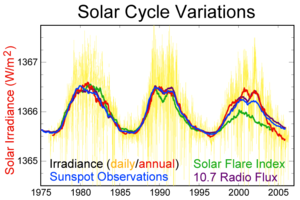
Spot any correlation? Didn't think so.
| quote: | Its that simple. Of course there's more to it, and humans ARE contributing to the climate change, BUT the effects are minimal. Humans are primarily damaging and destroying the environment, if thats what you're implying - thats correct.
A volnanic eruption does more to offset climate change than a full year of human-caused emissions, for Christ's sake. |
Nope:
| quote: | Claims that volcanoes emit more CO2 than human activities are simply not true.
[...]
Measurements of CO2 levels over the past 50 years do not show any significant rises after eruptions. Total emissions from volcanoes on land are estimated to average just 0.3 Gt of CO2 each year – about a hundredth of human emissions (pdf document). |
http://environment.newscientist.com...-change/dn11638
| quote: | Originally posted by Fir3start3r
I believe man has a part in polluting the environment, but to actually cause warming on a global scale? |
It doesn't take much. Understand that CO2 is more efficient than the atmosphere as a whole at retaining solar radiation: this is an unavoidable fact of chemistry. Also understand that CO2 concentration in the atmosphere has increased from 280 ppm to 382 ppm since industrial times: this change, clearly, is the result of human influence.
Now, seeing as CO2 is more efficient than the rest of the gases in the atmosphere at retaining solar radiation, increasing the atmospheric concentration of CO2 will - ceteris paribus - increase the retention of solar radiation, which can be measured in terms of wattage. Spreading that increase of CO2 evenly across the globe, you end up with an increased solar radiation retention rate of about 1.66 watts per square metre (link).
Put simply, that energy has to go somewhere: this is the first law of thermodynamics. In lieu of any mitigating factors (such increased evaporation and therefore cloud-cover, which may reflect some light away; or "Global Dimming" caused by the related emissions of soot particles; etc.) this increased atmospheric wattage will be expressed as heat. Even if the skeptics want to deny the reality of anthropogenic global warming now, it is basically undeniable that an increased atmospheric concentration of CO2 will - by some difficult to define level of future concentration - begin to increase global temperatures.
The only remaining question is what we should do to avoid that. |
|
|
| Q5echo |
| quote: | Originally posted by Renegade
Solar activity has not been anomalous (beyond the usual cycles) since formal measurement began, so I really don't understand how it is that "skeptics" can link solar activity to global climate change.
As evidence, just compare the above graph to this one, which details fluctuations in solar activity:
Spot any correlation? Didn't think so. |
did you mean to say "global climate change", or "global climate warming" that solar activity has not been anomalous to?

Drop in solar activity has potential effect for climate on earth.
The sun has reached a milestone not seen for nearly 100 years: an entire month has passed without a single visible sunspot being noted.
The event is significant as many climatologists now believe solar magnetic activity – which determines the number of sunspots -- is an influencing factor for climate on earth.
According to data from Mount Wilson Observatory, UCLA, more than an entire month has passed without a spot. The last time such an event occurred was June of 1913. Sunspot data has been collected since 1749.
When the sun is active, it's not uncommon to see sunspot numbers of 100 or more in a single month. Every 11 years, activity slows, and numbers briefly drop to near-zero. Normally sunspots return very quickly, as a new cycle begins.
But this year -- which corresponds to the start of Solar Cycle 24 -- has been extraordinarily long and quiet, with the first seven months averaging a sunspot number of only 3. August followed with none at all. The astonishing rapid drop of the past year has defied predictions, and caught nearly all astronomers by surprise.
In 2005, a pair of astronomers from the National Solar Observatory (NSO) in Tucson attempted to publish a paper in the journal Science. The pair looked at minute spectroscopic and magnetic changes in the sun. By extrapolating forward, they reached the startling result that, within 10 years, sunspots would vanish entirely. At the time, the sun was very active. Most of their peers laughed at what they considered an unsubstantiated conclusion.
The journal ultimately rejected the paper as being too controversial.
The paper's lead author, William Livingston, tells DailyTech that, while the refusal may have been justified at the time, recent data fits his theory well. He says he will be "secretly pleased" if his predictions come to pass.
But will the rest of us? In the past 1000 years, three previous such events -- the Dalton, Maunder, and Spörer Minimums, have all led to rapid cooling. One was large enough to be called a "mini ice age". For a society dependent on agriculture, cold is more damaging than heat. The growing season shortens, yields drop, and the occurrence of crop-destroying frosts increases.
Meteorologist Anthony Watts, who runs a climate data auditing site, tells DailyTech the sunspot numbers are another indication the "sun's dynamo" is idling. According to Watts, the effect of sunspots on TSI (total solar irradiance) is negligible, but the reduction in the solar magnetosphere affects cloud formation here on Earth, which in turn modulates climate.
This theory was originally proposed by physicist Henrik Svensmark, who has published a number of scientific papers on the subject. Last year Svensmark's "SKY" experiment claimed to have proven that galactic cosmic rays -- which the sun's magnetic field partially shields the Earth from -- increase the formation of molecular clusters that promote cloud growth. Svensmark, who recently published a book on the theory, says the relationship is a larger factor in climate change than greenhouse gases.
Solar physicist Ilya Usoskin of the University of Oulu, Finland, tells DailyTech the correlation between cosmic rays and terrestrial cloud cover is more complex than "more rays equals more clouds". Usoskin, who notes the sun has been more active since 1940 than at any point in the past 11 centuries, says the effects are most important at certain latitudes and altitudes which control climate. He says the relationship needs more study before we can understand it fully.
Other researchers have proposed solar effects on other terrestrial processes besides cloud formation. The sunspot cycle has strong effects on irradiance in certain wavelengths such as the far ultraviolet, which affects ozone production. Natural production of isotopes such as C-14 is also tied to solar activity. The overall effects on climate are still poorly understood.
What is incontrovertible, though, is that ice ages have occurred before. And no scientist, even the most skeptical, is prepared to say it won't happen again.
Article Update, Sep 1 2008. After this story was published, the NOAA reversed their previous decision on a tiny speck seen Aug 21, which gives their version of the August data a half-point. Other observation centers such as Mount Wilson Observatory are still reporting a spotless month. So depending on which center you believe, August was a record for either a full century, or only 50 years.
>LINK< |
|
|
| atbell |
| quote: | Originally posted by Renegade
It doesn't take much. Understand that CO2 is more efficient than the atmosphere as a whole at retaining solar radiation: this is an unavoidable fact of chemistry.
|
Is it?
This is where my complaint comes. I've had trouble confirming this fact. The Stern Report on global warming refers to two papers that I picked up in it's science section, neither of them had any math. Both papers refered to a swedish guy named Arhenius who had expanded on Fourier's work in thermodynamics. I couldn't find anything by the Swede at the University library I was near at the time (UBC in Vancouver) and found that Fourier's work was actually mostly math without much application.
I'd like to look at this part of the science a bit more because if it turns out that CO2 isn't the cause of the temperature trends then the world scientific comunity is chasing a burning red heron. |
|
|
| atbell |
| quote: | Originally posted by Q5echo
The sun has reached a milestone not seen for nearly 100 years: an entire month has passed without a single visible sunspot being noted.
The event is significant as many climatologists now believe solar magnetic activity – which determines the number of sunspots -- is an influencing factor for climate on earth.
According to data from Mount Wilson Observatory, UCLA, more than an entire month has passed without a spot. The last time such an event occurred was June of 1913. Sunspot data has been collected since 1749.
|
How long does a sun spot last? What are these things? Are they solar flares that burst and dispurse in a matter of minutes, seconds, hours? |
|
|
| Krypton |
| I think the sun has a role to play, but I also think man does to by altering the natural balance of atmospheric gasses. It's not as black and white as critics and proponents make it out to be. There is a gray area! |
|
|
|
|

