|
The Oldskool Series: history of EDM (1964-2004)
|
View this Thread in Original format
| 2rip |
This is a series dedicated to charting the progression of electronic dance music. Each week will feature a different piece of research combined with a mix session that charts some of the music during that time period. Each mix is about 30 minutes in length so it's not a huge burden to listen to them. I'll be covering everything from disco and electronic rock to house music, hardcore, drum & bass, trance, breaks, techno and electro.
THANKS IN ADVANCE FOR FOLLOWING THESE EPISODES. I WILL MAKE A NEW POST EVERY MONDAY MORNING WITH A NEW EPISODE.
The first episode will be featured on Monday, September 15th. |
|
|
| 2rip |
Precursor - the history of house & techno music

DOWNLOAD: http://2rip.podomatic.com/enclosure...20_01-07_00.mp3
It can be awe-inspiring to investigate the very roots of a culture and even more-so to realize how fast an evolution has spawned. The Moog synthesizer was developed in 1964 and was the first subtractive synthesizer to use a keyboard as a controller. Since it's conception we have seen electronic music develop for over 4 decades.
Kraftwerk's album "Autobahn" from 1971 is often considered the first electronic music pressed to disc and marketed. During this time other electronic groups such as Tangerine Dream were also pressing discs. Such music had inspired Juan Atkins from Detroit who soon began a duo called Cybotron. Under this name Juan Atkins and his partner James Davis released several songs including the first pressing labeled as techno which was titled "Alleys of Your Mind" in 1981. They coined the term techno to describe any electronic sounding band such as Kraftwerk. Many people often argue that music produced by Cybotron should be considered "electro."
Looking back again at the 70's there was another notable revolution. A style of music was being produced on the Salsoul record label that featured latin drums, funk guitar and strings. The label was releasing uptempo music geared for dancing. This sound became known as disco and the movement sprang forward very quickly after the release of the hit movie Saturday Night Fever. The Salsoul label was also the first to release a 12" inch single which featured extended remixes that were geared specifically for dj's. These 12" inch records were also known as the disco maxi-single.
Disco had hit it big and dj's Frankie Knuckles and Larry Levan had already become established nightclub dj's from playing the gay music circuit. The two were soon invited to play records at The Paradise Garage on 84 King Street in New York City in 1977. "The Garage" became Larry Levan's dj residency while Frankie Knuckles packed up and moved to Chicago to take his place at The Warehouse nightclub. In New York Larry Levan played eclectic dance music, mixing out of disco and into Van Halen records or obscure avant garde fare like Tangerine Dream. In Chicago, Knuckles was pushing continuous mixes of disco at The Warehouse. Knuckles was very fond of vocal tracks with inspirational messages.
By the turn of the eighties, few people were recording vocal disco music. Rock radio DJ Steve Dahl organized the 1979 Disco Demolition Derby at Cominskey Park in Chicago where one hundred thousand disco records were dynamited and broke out into a riot. Immediately after, the record industry had proclaimed that disco was dead. Many labels dropped their dance departments but Frankie Knuckles continued to push on by playing the songs he revered.
A record store in Chicago named "Imports Etc" was eventually the only record store that continued to carry classic Philly/Salsoul-style records. With Frankie Knuckles being at the forefront of this style, other dj's were associating the Salsoul flavor with The Warehouse nightclub. The record store labeled the crates holding these releases as "House Music" or "As Played At The Warehouse" to market them. This is where the term "house music" is said to have come from.
Starting in 1981 DJ's soon began running drum machines and using EQ cuts to reshape and remix the music live, taking mixing to the next level. This club-style mixing inspired by The Warehouse made it's way to Chicago airwaves with a WBMX disc jockey crew called The Hot Mix 5. The Hot Mix 5 included notable talents such as Farley "Jackmaster" Funk and Ralphi Rosari. Suddenly more dj's were coming out of the woodwork as The Warehouse flavor of music continued to inspire the black gay community in Chicago.
In 1983 The Music Box opened in Chicago with resident DJ Ron Hardy. Ron Hardy was addicted to heroine during the times of his residency so he was usually high while he was dj'ing. As a result of the drugs, he often felt as if music needed to be faster. This is likely where his nickname "Heart Attack Hardy" came from.
As Derrick May recalls, Ron Hardy played some of the most sensational sets of his time. Hardy always opened his sets with Welcome to The Pleasuredome by Frankie Goes To Hollywood. One of his trademarks was playing records backwards. Many do not realize this but Ron Hardy was also the first dj to drop "Acid Tracks" by Phuture on a club system. "Acid Tracks" was produced in 1987 and was the first record to use the squelching acid sound made by a Roland TR-303. Oddly enough the first time this record was dropped, the crowd cleared the dancefloor.
No longer the only dj in town, Frankie Knuckles felt that it was time to step up his game. Other dj's soon caught on and it was a constant competition to one-up each other. These dj's began using two copies of the same record to extend breakbeats or cut out parts of a song that they did not wish to use. They added drum machines to their setups as well and their styles involved using more EQ cuts and faster mixing.
The competition got to be so intense that dj's soon started working on their mixes in the studio, using the facilities to add more originality to the music. Clubbers began to realize how easy it was to make tracks using samplers and drum machines. This led to many non-dj's taking a step into the studio themselves, releasing their music on reel-to-reel tapes. Many of these productions consisted of nothing more than a bassline and a drum pattenr. In a matter of months the producers of these tapes began adding samples, effects, and melodies.
This podcast illustrates the sounds of early electronica as well as the Salsoul disco sound. All of these tracks were playlisted by Larry Levan, Frankie Knuckles & Ron Hardy. There are some mixing styles blending in to illustrate how dj's would extend a breakbeat by backspinning as well as sampled drums beneath disco tracks.
Kraftwerk - Numbers
Kraftwerk - The Robots
Cybotron - Alleys Of Your Mind
Frankie Goes To Hollywood - Welcome To The Pleasuredome
The Salsoul Orchestra - Ooh I Love It (Love Break)
The Salsoul Orchestra - Ooh I Love It (Original 12")
Skyy - First Time Around
Instant Funk - I Got My Mind Made Up
First Choice - Let No Man Put Asunder |
|
|
| Magnetonium |
Thats it. Now you've done it. I'll make my next mix a super underground disco mix. Not that I am dissing the Salsoul stuff. I love that Instant Funk song, especially the long 9 minute version which blows my mind. Kraftwerk had better tunes in the 70s. Plus I want to hear some of your 60's electronic stuff ;-) where's the 1964-1971 music gap? :toothless hint: Klaus Schulze & Tangerine Dream, perhaps?
Good mix, I was particularly interested in hearing that Skyy track, otherwise all other tunes are very established jams and I've heard them all b4. Cybotron track really brought memories. Though his Techno City track is much better suited for this mix ;)
EDIT: Ron Hardy sucked balls. I know I am not going to please some of the die-hard fans out there, but none of his mixes/remixes/productions interested me. Just subtle stuff with no soul or energy. I dunno, maybe its just me. Plus its waaaaay overpriced. |
|
|
| Floorfiller |
| quote: | Originally posted by Magnetonium
Thats it. Now you've done it. I'll make my next mix a super underground disco mix. Not that I am dissing the Salsoul stuff. I love that Instant Funk song, especially the long 9 minute version which blows my mind. Kraftwerk had better tunes in the 70s. Plus I want to hear some of your 60's electronic stuff ;-) where's the 1964-1971 music gap? :toothless hint: Klaus Schulze & Tangerine Dream, perhaps?
Good mix, I was particularly interested in hearing that Skyy track, otherwise all other tunes are very established jams and I've heard them all b4. Cybotron track really brought memories. Though his Techno City track is much better suited for this mix ;)
EDIT: Ron Hardy sucked balls. I know I am not going to please some of the die-hard fans out there, but none of his mixes/remixes/productions interested me. Just subtle stuff with no soul or energy. I dunno, maybe its just me. Plus its waaaaay overpriced. |
please do. was pretty sure what was coming hence my lol post. as soon as someone starts talking about the history of electronic music, but doesn't even mention ambient or space music you can pretty much predict that it will consist of very mainstream hits...
liked your recent canada house mix. would love to do some mixes myself, but obviously don't have the record collection to do so hehe...but i'm working on it hehe. sometime this next year maybe :p |
|
|
| 2rip |
| quote: | Originally posted by Floorfiller
please do. was pretty sure what was coming hence my lol post. as soon as someone starts talking about the history of electronic music, but doesn't even mention ambient or space music you can pretty much predict that it will consist of very mainstream hits...
liked your recent canada house mix. would love to do some mixes myself, but obviously don't have the record collection to do so hehe...but i'm working on it hehe. sometime this next year maybe :p |
This project will span a considerable length of time which will allow me to go back and do more research.
Tangerine Dream was totally going to be on this mix but I didn't want to delve into ambient just yet. That is my jam but it's been limited considering the amount that I'm trying to cover in a short span of time (25 episodes). Will go back eventually to elaborate on this. |
|
|
| THE_Chris |
| quote: | Originally posted by 2rip
That is my jam |
:stongue: |
|
|
| Echo of Silence |
| Okay, I think I might be interested in this kind of project. |
|
|
| Nrg2Nfinit |
damn... this was my idea.. i've already compiled 70 % of my tracklisting too :(
anyways.. it will be great to see how this turns out :) |
|
|
| 2rip |
| quote: | Originally posted by Nrg2Nfinit
damn... this was my idea.. i've already compiled 70 % of my tracklisting too :(
anyways.. it will be great to see how this turns out :) |
no reason for you not to run yours as well. there's so many records out there that were produced so i'm sure there would be a healthy diversification between our mixes. i'd subscribe! |
|
|
| 2rip |
it i'm posting this a couple days early...
Episode #2: The House That Jack Built
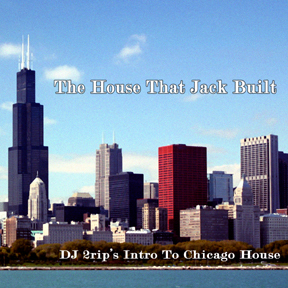
DOWNLOAD: http://2rip.podomatic.com/enclosure...11_58-07_00.mp3
"In the beginning there was Jack... and Jack had a groove. And from this groove came the groove of all grooves. And while one day viciously throwing down on his box Jack boldly declared LET THERE BE HOUSE. And house music was born."
Jacking was a form of dance that spawned from "punking out." Punking out involved bending a girl over on the dancefloor and grinding on her backside. The humping motion carried over and people began doing humping, jumping & pushing motions that were then considered to be "jacking." People would be seen inside the clubs jacking each other, jacking speakers, jacking the dj booth, jacking doorways, and jacking walls. It was a release for people to go to the clubs and "jack their bodies." This release was inspired by the house music.
In 1983, Jesse Saunders & Vince Lawrence produced a stripped down interpretation of a song by First Choice. Jesse was also entertained by the idea of Laid Back's "White Horse" where the vocalist would proclaim "Bitch!" This exclamation shows up throughout their release. The tape was titled "On & On" and was eventually committed to vinyl in the same year, being recognized as the first official house music pressing. Jesse and Vince were still teenagers at the time.
In 1984 Keith Farley aka Farley "Jackmaster" Funk recorded an influential Chicago house track titled "Funkin With The Drums." Other similar records became prevalent after this. All of these records were produced with drums only and were known as beat tracks or rhythm tracks.
Chicago soon had two major house record lables, DJ International and Trax. In 1986 these labels brought several hits like Farley "Jackmaster" Funk's "Jack Your Body." Farley produced his first major release with Jesse Saunders, Duane Buford & Vince Lawrence. They needed a singer that could bring a lot of soul. That singer was Darryl Pandy. The release was titled "Love Can't Turn Around." It reportedly reached Number 10 on one of Britain's music charts in 1986.
Marshall Jefferson was also making waves as he created a piano rhythm that would show up on acid house tracks for years to come. This record that was released as "Move Your Body" helped house music skyrocket from where it stood in 1986 and became noteably the first major anthem for the genre.
Laid Back - White Horse (Ultimix)
Jesse Saunders - On & On
Farley Jackmaster Funk - Funking With The Drums Again
Housemaster Boyz - House Nation
Ron Hardy - Baby, Baby, Baby, Aw Shucks
Kenny "Jammin" Jason & Fast Eddie - Don't Want It
Jillian Mendez - Get Up
Nitro Deluxe - This Brutal House
M. Doc & Steve "Silk" Hurley- It's Percussion
Risse - House Train
LNR - Work It To The Bone
Farley Jackmaster Funk - Love Can't Turn Around
Ce Ce Rogers - What Is House Music |
|
|
| Acetate Junkie |
| This thread is going to spark some new life in the old farts that lurk here. Nice job. |
|
|
|
|

