|
Everything that is wrong about Rush thread (pg. 6)
|
View this Thread in Original format
| Lebezniatnikov |
| quote: | Originally posted by The17sss
why are you completely dismissing the study I posted yesterday showing an indisputable example of tax cuts working in 2003, and how it affected the economy? The numbers don't lie. Do you think it would slow economic growth if the corporate tax rate was dropped from 35% to 20%? Do you believe businesses hiring and investment would stay stagnant and not begin hiring people again? |
Because we've had this exact conversation before, where I've posted a number of links to studies disemboweling the myth that tax cuts lead to macroeconomic growth.
| quote: | | What about in 1981 when Regan took office and inherited a 70% tax rate? It was down to 28% in 1989 when he left, and during that time a major boom of financial wealth swept the 80's. |
:wtf:
| quote: | | Even in the middle of the 80's, during a small recession in 1986 when the GDP was down over 6%? What happened? Tax cuts and the economy took back off. |
So did that "major boom of financial wealth" include 1986 or no?
:conf: |
|
|
| The17sss |
| quote: | Originally posted by Lebezniatnikov
Because we've had this exact conversation before, where I've posted a number of links to studies disemboweling the myth that tax cuts lead to macroeconomic growth. |
So that means the data I showed is false? Not only does it explain with real economic data that the tax cuts lead to economic growth and job creation, it also explains how giving welfare checks to millions of people doesn't lead to macroeconomic growth.
What... Jimmy Carter's destruction of the economy isn't documented? There wasn't 21% interest rates, massive inflation, gas lines, and a 70% tax rate? Regan didn't lower it into the 20's and there was no economic growth during the 80's? :conf:
| quote: | | So did that "major boom of financial wealth" include 1986 or no? |
Major in comparison to what happened under Carter, certainly. 20 million jobs created during Regan's tenure, and that's a fact. But what I was saying about 1986 was that for a short time in the mid 80's there was a small recession, which by definition does not last longer than 11 months, and some tax cutting did the trick... not entitlement expansion. |
|
|
| Lebezniatnikov |
So what you're saying is that in the first six years of Reagan's presidency, tax cuts led to recession. Then, miraculously, in the last two years of his presidency, tax cuts got us out of the recession.
Look, this isn't worth arguing for two reasons. One, tax cuts are so ideologically ingrained in your mind that you really do believe the trickle-down theory, and you're going to cling to that one economic survey that might suggest tax cuts have some macroeconomic effect, despite the fact that occ, myself, and many others have posted studies demonstrating that they have little observable effect on macroeconomic indicators.
Hell, even Martin Feldstein (a conservative economist) - whose article I posted yesterday in this very thread - noted that only 15% of Bush's tax rebate was actually spent - meaning that very little of the income the government lost was actually used to "stimulate" the economy.
Here, a pretty thorough debunking of the effectiveness of the Bush tax cuts:
| quote: | TAX CUTS: MYTHS AND REALITIES
Since 2001, the Administration and Congress have enacted a wide array of tax cuts, including reductions in individual income tax rates, repeal of the estate tax, and reductions in capital gains and dividend taxes. Nearly all of these tax cuts are scheduled to expire by the end of 2010. Making them permanent would cost about $4.4 trillion over the next decade (when the cost of additional interest on the federal debt is included). (http://www.cbpp.org/1-31-07tax.htm)
Because important decisions about these tax policies must be made in the next few years, it is essential to understand their effects on deficits, the economy, and the distribution of income. Supporters of the tax cuts have sometimes sought to bolster their case by understating the tax cuts’ costs, overstating their economic effects, or minimizing their regressivity. Here, we address some of the myths heard most frequently in recent tax-cut debates. (For a discussion of myths specific to the estate tax debate, see http://www.cbpp.org/pubs/estatetax.htm. For a discussion of issues surrounding the Alternative Minimum Tax, see http://www.cbpp.org/2-14-07tax.htm.)
Tax Cuts and Deficits
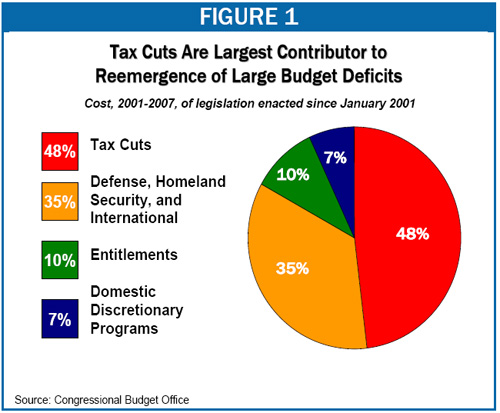
Congressional Budget Office data show that the tax cuts have been the single largest contributor to the reemergence of substantial budget deficits in recent years. Legislation enacted since 2001 added about $3.0 trillion to deficits between 2001 and 2007, with nearly half of this deterioration in the budget due to the tax cuts (about a third was due to increases in security spending, and about a sixth to increases in domestic spending). Yet the President and some Congressional leaders decline to acknowledge the tax cuts’ role in the nation’s budget problems, falling back instead on the discredited nostrum that tax cuts “pay for themselves.”
Myth 1: Tax cuts “pay for themselves.”
“You cut taxes and the tax revenues increase.” — President Bush, February 8, 2006
“You have to pay for these tax cuts twice under these pay-go rules if you apply them, because these tax cuts pay for themselves.” — Senator Judd Gregg, then Chair of the Senate Budget Committee, March 9, 2006
Reality: A study by the President’s own Treasury Department confirmed the common-sense view shared by economists across the political spectrum: cutting taxes decreases revenues.
Proponents of tax cuts often claim that “dynamic scoring” — that is, considering tax cuts’ economic effects when calculating their costs — would substantially lower the estimated cost of tax reductions, or even shrink it to zero. The argument is that tax cuts dramatically boost economic growth, which in turn boosts revenues by enough to offset the revenue loss from the tax cuts.
But when Treasury Department staff simulated the economic effects of extending the President’s tax cuts, they found that, at best, the tax cuts would have modest positive effects on the economy; these economic gains would pay for at most 10 percent of the tax cuts’ total cost. Under other assumptions, Treasury found that the tax cuts could slightly decrease long-run economic growth, in which case they would cost modestly more than otherwise expected. (http://www.cbpp.org/7-27-06tax.htm)
The claim that tax cuts pay for themselves also is contradicted by the historical record. In 1981, Congress substantially lowered marginal income-tax rates on the well off, while in 1990 and 1993, Congress raised marginal rates on the well off. The economy grew at virtually the same rate in the 1990s as in the 1980s (adjusted for inflation and population growth), but revenues grew about twice as fast in the 1990s, when tax rates were increased, as in the 1980s, when tax rates were cut. Similarly, since the 2001 tax cuts, the economy has grown at about the same pace as during the equivalent period of the 1990s business cycle, but revenues have grown far more slowly. (http://www.cbpp.org/3-8-06tax.htm)
Some argue that, even if most tax cuts do not pay for themselves, capital gains tax cuts do. But, in reality, capital gains tax cuts cost money as well. After reviewing numerous studies of how investors respond to capital gains tax cuts, the Congressional Budget Office concluded that “the best estimates of taxpayers’ response to changes in the capital gains rate do not suggest a large revenue increase from additional realizations of capital gains — and certainly not an increase large enough to offset the losses from a lower rate.” That’s why CBO, the Joint Committee on Taxation, and the White House Office of Management and Budget all project that making the 2003 capital gains tax cut permanent would cost about $100 billion over the next ten years. (http://www.cbpp.org/policy-points4-18-08.htm)
Myth 2: Even if the tax cuts reduced revenues initially, they boosted revenues and lowered deficits in 2005 to 2007.
“Some in Washington say we had to choose between cutting taxes and cutting the deficit… Today’s numbers [the updated 2006 budget projections] show that that was a false choice. The economic growth fueled by tax relief has helped send our tax revenues soaring.” — President Bush, July 11, 2006
Reality: Robust revenue growth in 2005-2007 has not made up for extraordinarily weak revenue growth over the previous few years.
When discussing revenue growth since the enactment of the tax cuts, Administration officials typically focus only on revenue growth since 2004. This provides a convenient starting point for their arguments, as it sets a very low bar. In 2001, 2002, and 2003, revenues fell in nominal terms (i.e. without adjusting for inflation) for three straight years, the first time this has occurred since before World War II. Measured as a share of the economy, revenues in 2004 were at their lowest level since 1959. Given this historically low starting point, it is not surprising that revenues have recovered since then. Supporters of the tax cuts selectively cite revenue growth over just the past three years to argue that the tax cuts fueled increases in revenues.
Table 1:
Total Real Per-Capita Revenue Growth in 22 Quarters after the Last Business Cycle Peak
2001-2007 : 1.7%
Average for All Previous Post-World War II Business Cycles : 12.0%
1990s Business Cycle (Following Tax Increases) : 16.2%
Even taking into account the growth in revenues in fiscal years 2005-2007, total revenues have just barely increased over the 2001-2007 business cycle, after adjusting for inflation and population growth. (The business cycle began in March 2001, when the 1990s business cycle hit its peak and thereby came to an end.) In contrast, six and a half years after the peak of previous post-World War II business cycles, real per-capita revenues had increased by an average of 12 percent, and in the 1990s, real per-capita revenues were up 16 percent (see Table 1). Revenues in 2007 were still more than $250 billion short of where they would have been had they grown at the rates typical in other recoveries.
Further, while the Administration has credited the tax cuts with the drop in the fiscal year 2007 deficit to “only” $162 billion, the 2007 budget would have been in surplus were it not for the tax cuts. Based on Joint Committee on Taxation estimates, the total 2007 cost of tax cuts enacted since January 2001 was $300 billion (taking into account the increased interest costs on the debt that have resulted from the deficit financing of the tax cuts). This means that even with the spending for the wars in Iraq and Afghanistan, the federal budget would have been in surplus in 2007 if the tax cuts had not been enacted, or if their costs had been offset. While supporters of these tax cuts claim that their positive economic effects have lowered their cost, the non-partisan Congressional Research Service found in a September, 2006 report that “at the current time, as the stimulus effects have faded and the effect of added debt service has grown, the 2001-2004 tax cuts are probably costing more than their estimated revenue cost.”
Looking out over the next several decades, when deficits are projected to be far larger (because of the impact on the budget of the continued rise in health care costs and the retirement of the baby boomers), the tax cuts, if extended, will still be a major contributor to the nation’s fiscal problems. (http://www.cbpp.org/1-29-07bud.htm) To put the long-run cost of the tax cuts in perspective, the 75-year Social Security shortfall, about which the President and Congressional leaders have expressed grave concern, is less than one-third the cost of the tax cuts over the same period. (http://www.cbpp.org/3-31-08socsec.htm)
Tax Cuts and the Economy
A consistent finding in the academic literature about the effects of tax cuts on the economy is that these effects are typically modest. In the short run, well-designed tax cuts can help to boost an economy that is in a recession. In the longer run, well-designed tax cuts can have a modest positive impact if they are fully paid for. For example, the recent Treasury analysis found that if the President’s tax cuts were made permanent and the costs of the tax cuts were paid for by reductions in programs, economic growth would increase by a few hundredths of one percentage point annually. Meanwhile, studies by economists at the Joint Committee on Taxation, the Congressional Budget Office, the Brookings Institution, and elsewhere have found that if tax cuts are not paid for with spending reductions, they are likely to have modest negative effects on the economy over time, because of the negative effects of the increased deficits. Tax-cut proponents often claim that the economy will be badly damaged if the tax cuts are not extended; these claims are without foundation.
Myth 3: The economy has grown strongly over the past several years because of the tax cuts.
“The main reason for our growing economy is that we cut taxes and left more money in the hands of families and workers and small business owners.” — President Bush, November 4, 2006
Reality: The 2001-2007 economic expansion was sub-par overall, and job and wage growth were anemic.
Members of the Administration routinely tout statistics regarding recent economic growth, then credit the President’s tax cuts with what they portray as a stellar economic performance. But as a general rule, it is difficult or impossible to infer the effect of a given tax cut from looking at a few years of economic data, simply because so many factors other than tax policy influence the economy. What the data do show clearly is that, despite major tax cuts in 2001, 2002, 2003, 2004, and 2006, the economy’s performance between 2001 and 2007 was from stellar.
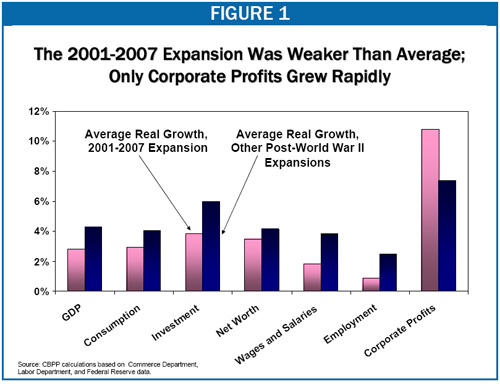
Growth rates of GDP, investment, and other key economic indicators during the 2001-2007 expansion were below the average for other post-World War II economic expansions (see Figure 2). Growth in wages and salaries and non-residential investment was particularly slow relative to previous expansions, and, while the Administration boasts of its record on jobs, employment growth was weaker in the 2001-2007 period than in any previous post-World War II expansion. (http://www.cbpp.org/8-9-05bud.htm)
Median income among working-age households, meanwhile, fell during the expansion. Census data show that among households headed by someone under age 65, median income in 2006, adjusted for inflation, was $1,300 below its level during the 2001 recession. Similarly, the poverty rate and the share of Americans lacking health insurance were higher in 2006 than during the recession. (http://www.cbpp.org/8-28-07pov.htm)
Myth 4: Even if economic growth and the job market were weak during the early stages of the recovery, the capital gains and dividend tax cuts turned the economy around in 2003.
“Since the tax rates on capital gains and dividends were reduced in 2003, we have seen strong steady economic growth, resulting in higher employment.” — Representative Bill Thomas, then Chair of the Ways and Means Committee, May 17, 2006
Reality: The available evidence indicates that the capital gains and dividend tax cuts were not the cause of improvement in the economy in 2003.
The President and other tax-cut advocates have credited the capital gains and dividend tax cuts with the fact that the economy performed better between 2003 and 2007 than in the earlier part of the expansion. But they have produced no evidence to support their leap from correlation (the tax cuts coincided with improvement in the economy) to causation (the claim that the tax cuts caused the improvement). Furthermore, they have ignored evidence that indicates there was little or no causal connection.
Notably, informed observers such as Federal Reserve Chairman Ben Bernanke (then a Federal Reserve Board governor) were predicting improvement in the economy before the 2003 tax cuts were enacted. In addition, supporters of enacting these tax cuts, such as conservative economist Gary Becker, acknowledged at the time that, whatever the tax cuts’ long-run effects on economic growth, they would not boost the economy in the short term.
Also striking is the fact that the expansion of the 1990s followed a pattern similar to the 2001-2007 expansion, especially with respect to investment growth (which the dividend and capital gains tax cuts were supposed to encourage). Investment was weak in the early 1990s and then began to improve about two years into the expansion. But in the 1990s, that improvement — which was greater than the improvement in the early 2000s — coincided with a tax increase (see Figure 3). If one accepts the notion that any economic change that follows a tax change must have been caused by the tax change, one would have to conclude that tax increases promote stronger investment growth than tax cuts. The more reasonable conclusion, of course, is that weak recoveries eventually tend to return to historical norms.
Moreover, even growth since 2003 has been less than impressive. GDP, wage and salary, and employment growth have remained below average for a post-World War II recovery, while growth in non-residential investment has only matched the historical norm. (http://www.cbpp.org/7-10-07tax.htm)
Myth 5: Extending the tax cuts is important for the economy’s long-run health.
“To keep this economy growing and delivering prosperity to more Americans, we need leaders in Washington who understand the importance of letting you keep more of your money, and making the tax relief we delivered permanent.” — President Bush, October 28, 2006
Reality: Extending the tax cuts without paying for them would be more likely to reduce economic growth over the long run than to increase it.
Researchers at the Joint Committee on Taxation, the Congressional Budget Office, and the Brookings Institution have all found that large unpaid-for tax cuts reduce economic growth over the long run. For example, a study by Brookings Institution economist William Gale and then-Brookings economist (now CBO director) Peter Orszag concluded that making the 2001 and 2003 tax cuts permanent without offsetting their cost would be “likely to reduce, not increase, national income over the long run.” Similarly, in a study in which it examined the economic effects of reductions in individual and corporate tax rates and an increase in the personal exemption, the Joint Committee on Taxation found, “Growth effects eventually become negative without offsetting fiscal policy [i.e. without offsets] for each of the proposals, because accumulating Federal government debt crowds out private investment.” (http://www.cbpp.org/3-19-07bud.htm)
The reason behind these results is that, even if tax cuts have modest positive effects on work and savings decisions, those effects are outweighed by the negative consequences of higher budget deficits. In claiming that tax cuts will boost savings, investment, and GDP growth, supporters often seem to forget that national savings has two components: private and public (i.e., government) savings. Tax cuts could positively affect private savings, although, as the Congressional Research Service has noted, studies have failed to find large effects. But when the federal government runs a deficit, it pays for the deficit by borrowing money from the private sector, which reduces national savings. By adding to deficits, unpaid-for tax cuts thus generally reduce national savings.
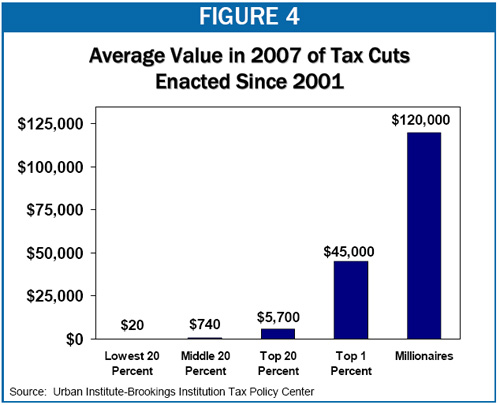
Making the tax cuts permanent would add about $4.4 trillion to deficits over the next decade, when the additional interest costs on the national debt are included. The resulting decrease in national savings would mean fewer funds available for investment, reducing the size of the capital stock (the total supply of equipment, buildings, and other productive capital in the economy). With less capital available, future workers would be less productive, and as a result, national income over the long run would be lower than it otherwise would be. (As discussed above, even if paid for, the positive effects of the tax cuts on the economy would be quite small. Moreover, paying for the tax cuts with spending cuts would require deep cuts in federal programs, as discussed below in Myth 8.) |
http://www.cbpp.org/9-27-06tax.htm
Furthermore, since I'm guessing that your next argument is that the types of tax cuts found in the stimulus package are simply "the wrong kind" and that we should merely be focused on capital gains and upper-level income tax reduction, here's some information on how that's wrong.
http://www.taxcutfacts.org
| quote: | | After noodling with it, it’s pretty clear that unless you’re banking over $250,000 a year, you’re going to be getting either a break or no effect on your current taxes. I can understand where high-income people are coming from, with not being able to afford gold toilets and all, but realize that if you are making over $250k a year after this horrid recession you’re really sitting nicely. We have people out there who are straining not to lose their homes, and high-income earners are bitching about their wallets hurting. ing pathetic. |
http://blog.synthesis.net/2008/10/2...ost-beneficial/
After all, who do we need to help weather a recession? The rich people who will still be rich after the recession, but maybe overspent despite the fact that they're obscenely rich? Or the middle class Americans who are in danger of losing homes, jobs, and the ability to send their kids to college?
I know you consider middle class individuals in danger of joining the unemployment statistics simply another welfare burden for the state, but most of us are a little bit more clear about who needs help. |
|
|
| The17sss |
| quote: | Originally posted by Lebezniatnikov
So what you're saying is that in the first six years of Reagan's presidency, tax cuts led to recession. Then, miraculously, in the last two years of his presidency, tax cuts got us out of the recession.
Look, this isn't worth arguing for two reasons... |
No, I'm saying there was a small speed bump along the way in 1986 that was worked out. Markets fluctuate. And you're right, this conversation won't go anywhere because you are also so ingrained in your belief that giving free money to people and trickle up economics works best for the "middle class," whatever your definition of that is. Obama is a snake oil salesman who is trying to re-define what the middle class is. He's breaking it down to include all of his constituent groups... giving them welfare checks while ignoring small businesses who provide the bulk of the jobs in this country, leaving them open to further unionization out of necessity. Union workers, the ACORN's of the world, etc... those are the people who Obama wants to define as the middle class and give money to (by taking it from the private sector) and just keep buying those votes. How do you not see this?
For every dollar you give someone, it comes from someone else who worked for it. Just because I posted 1 study doesn't man there aren't thousands more I can find to support what I'm saying. In case you aren't aware, you have to have wage payers in order to have wage earners... therefore tightening the belt on corporate taxes, payroll taxes, etc. is counterproductive. |
|
|
| Lebezniatnikov |
| quote: | Originally posted by The17sss
And you're right, this conversation won't go anywhere because you are also so ingrained in your belief that giving free money to people and trickle up economics works best for the "middle class," whatever your definition of that is. |
Do you even know what I believe in? Because I'm not a proponent of simply ramping up welfare programs to fight a recession either. Welfare programs alleviate a symptom of a bad economy; they don't necessarily treat the cause.
I'm for public works projects for two reasons - I was in Minneapolis the night the bridge went down and know how badly we need it - and we need to stimulate the economy by creating jobs and injecting capital back into the economy.
| quote: | | Obama is a snake oil salesman who is trying to re-define what the middle class is. He's breaking it down to include all of his constituent groups... giving them welfare checks while ignoring small businesses who provide the bulk of the jobs in this country, leaving them open to further unionization out of necessity. Union workers, the ACORN's of the world, etc... those are the people who Obama wants to define as the middle class and give money to (by taking it from the private sector) and just keep buying those votes. How do you not see this? |
:wtf:
I have no idea what you're talking about. Why do you mention ACORN in almost every post? They're hardly relevant here... or do you not know what it is they do? |
|
|
| Lebezniatnikov |
| quote: | Originally posted by The17sss
w...wh...wha....what??? :wtf: Now, these guys are actual journalists (supposedly) who are supposed to show objectivity in reporting, and you're trying to tell me they are not extreme?? I mean, you probably think I'm crazy to say Limbaugh isn't extreme in the same way I think you're crazy to say that about Olberduche and Matthews, so I guess it's just par for the course.
|
| quote: | Tonight on Hardball, Chris Matthews admitted to John Heilemann and Michael Scherer that he voted for newly-minted RNC Chairman Michael Steele when Steele ran for the U.S. Senate seat in Maryland against Ben Cardin in 2006.
Nothing wrong with that, of course. Steele's enjoyed broader-than-average appeal throughout his political career, and media people, like everyone else, have to vote for someone.
Still, is it not notable that Matthews just nonchalantly tossed out that he had voted for the new chairman of the Republican Party? Would he not draw a fresh round of castigation from the right if he just up and talked about voting for Obama?
|
http://www.huffingtonpost.com/2009/...o_n_162702.html
Think Rush ever voted for a Democrat?
Wamp wamp. |
|
|
| Groundhog Boy |
| quote: | Originally posted by The17sss
Union workers, the ACORN's of the world, etc... those are the people who Obama wants to define as the middle class and give money to (by taking it from the private sector) and just keep buying those votes. How do you not see this? |
Wait, so are you saying that union workers aren't middle class? |
|
|
| Lebezniatnikov |
| quote: | Originally posted by Groundhog Boy
Wait, so are you saying that union workers aren't middle class? |
Yeah, I don't know what the hell he's talking about. If you listen to McCain, middle class starts at $750,000/year. If you listen to the17sss, middle class starts at unemployment. |
|
|
| The17sss |
| quote: | Originally posted by Lebezniatnikov
Do you even know what I believe in? Because I'm not a proponent of simply ramping up welfare programs to fight a recession either. Welfare programs alleviate a symptom of a bad economy; they don't necessarily treat the cause. |
Bingo
| quote: | | I'm for public works projects for two reasons - I was in Minneapolis the night the bridge went down and know how badly we need it |
Not sure if you know, but it was finally revealed that it's collapse was due to engineering design flaws from the beginning, not a lack of maintenance. Democrats Amy Klobuchar, Elwyn Tinklenberg, and James Oberstar blasted Tim Pawlenty for opposing a gas tax increase, which they claimed cut bridge maintenance short. Politicians in both parties, and both presidential nominees, used it to talk about the lack of investment in infrastructure.
| quote: | Original designers of the Interstate 35W bridge in Minneapolis likely neglected to calculate the size of key gusset plates that eventually failed, a human mistake that culminated 40 years later when 13 people died after the span collapsed, federal safety investigators have found.
They also have determined that corrosion of certain gusset plates, extreme heat and shifting piers did not contribute to the bridge’s collapse on Aug. 1, 2007, according to sources with direct knowledge of the probe. In three weeks, investigators will present their findings to the National Transportation Safety Board (NTSB), which will publicly review the draft report in a hearing Nov. 13 at the board’s Washington headquarters. After that, the board will use the draft as the basis for its final report on the probable cause of the collapse and recommendations for preventing future disasters.
Had key steel gusset plates been designed properly — they were one-half inch thick instead of an inch — the bridge would have been able to withstand tons of concrete and steel added in two renovation projects as well as the 287-ton construction load on the bridge the day it collapsed, sources said. |
According to the article, it's ironic because the bridge collapse got hastened by the maintenance being performed on it that day, thanks to the miscalculation of the strength of the gusset plates. Bet the Huffpo didn't mention this story ;)
http://www.startribune.com/local/33308279.html?elr=KArks:DCiUHc3E7_V_nDaycUiD3aPc:_Yyc:aULPQL7PQLanchO7DiU
| quote: | | I have no idea what you're talking about. Why do you mention ACORN in almost every post? They're hardly relevant here... or do you not know what it is they do? |
Because they are getting $4.8 billion dollars, and they are nothing more than agitators who double as Obama's army, which is relevant. |
|
|
| The17sss |
| quote: | Originally posted by Groundhog Boy
Wait, so are you saying that union workers aren't middle class? |
no |
|
|
| Lebezniatnikov |
The maintenance was overdue which was the problem, and the fact that the structural deficincies were noted by MNDOT but not acted upon for many years was also problematic.
| quote: | | Sixteen fractured gusset plates in the center span on Interstate 35W were a main cause of the deadly bridge collapse in Minneapolis last August, the National Transportation Safety Board (NTSB) said on Tuesday. The plates, which connected steel beams in the truss bridge, were roughly half the thickness they should have been because of a design error. How that flaw made it into the bridge is unclear; according to NTSB chairman Mark Rosenker, investigators couldn’t find the original design calculations. Extra weight from construction was also a factor in the tragedy, which killed 13 people and injured 100. The findings confirmed forecasts by investigators from three months after the collapse—and by engineering experts in the immediate aftermath—and underscored the dire state of America’s crumbling infrastructure. |
http://www.popularmechanics.com/tec...on/4245065.html |
|
|
| The17sss |
| I have to believe that the structural design flaws certainly outweighs the lack of maintenance. We know for sure now that those gusset plates were the cause of the the collapse.... one can only speculate whether the maintenance or lack of played a role at all after the aforementioned structural discovery. |
|
|
|
|

