|
A universe from nothing... (for space/science nerds) (pg. 11)
|
View this Thread in Original format
| Lira |
| quote: | Originally posted by Renegade
I'm sure you're playing devil's advocate to an extent here Lira, but I can't in good faith let all this slip by unopposed. ;) |
It's my pleasure to continue this debate with you, James :)
| quote: | Originally posted by Renegade
Of course. I'd be worried if the average theist were not more familiar with theology than the average atheist, but that's beside the point. I'm sure that the average numerologist knows more about numerology than the average non-numerologist, but that surely tells us nothing about the efficacy of numerology as applied to the world we all share? The failure of theology is not that it is incapable of sophistication, but that it lacks any real application to the world-in-itself - what can theology teach us that any other system of thought cannot teach us in a far more parsimonious (or - better yet - more accurate) way? |
Oh, but I agree with you there. What I'm opposed to is the hubris, present in the very beginning of this discussion, regarding atheists and their "superior" beliefs. That's why I actually like the point John Safran makes in that video: it's not just what you know that matter, but how you came to know that.
Numerologists, Astrologists, and other zany -logists, base their knowledge on pretty shaky grounds, and their explanations are so full of ad hocs as to become useless. But, as Carl Sagan (naïve as I think he is) defends in his "Candle in the Dark", it's way more important to know "Why we know the Earth is round", than simply stating it is round. The answer "because I was told so" gives you little reason to brag. Giving a person (or a group) unchecked trust is a recipe for disaster.
| quote: | Originally posted by Renegade
Fwiw, I'm actually quite capable of appreciating theology on its own terms. For reasons I don't really understand, I actually enjoy reading scholarship concerning - say - what the Biblical authors thought concerning the nature of Jesus. |
Yeah, I noticed that on Goodreads :p
| quote: | Originally posted by Renegade
Did they consider him the Son of God? If so, what was their understanding of when this "sonship" was "appointed"? What it with his resurrection (Rom 1:3-4), his baptism (Mk. 1:11), his conception (Mt. 1:18, Lk. 1:26-35) or was he the logos that pre-exists existence itself (John 1:1-2)? These are interesting debates on their own terms, but they still have ultimately no bearing on anything meaningful: deciding in which sense we can call Jesus the "Son of God" surely won't change our understanding of the universe or the means by which we should live our lives.
Theology has the potential to be sophisticated and interesting, but let's call a spade a spade: it's still bull from top to bottom. |
And, once again, I wholeheartedly agree with you.
| quote: | Originally posted by Renegade
Well, religion is ultimately based on "minimally counterintuitive" facts - i.e. facts that are slightly incredible, but not so incredible as to defy all belief (see this link - I've posted it before but it deserves to be reposted). You won't find religions predicated on the fact that humans can breathe underwater, but you will find religions which assert that certain, special human beings can walk on water, or survive in the belly of a large fish underwater for three days. You won't find religions predicated on the fact that human beings can fly, but you will find religions predicated on the fact that the human soul can fly to certain places under certain circumstances, say in a dream or after death.
In any case, the fact that certain beliefs are universally present within all theologies - and others universally absent - is surely evidence of their cognitive origins. I can think of no other way that supposedly ineffable truths would have made themselves known to such a distinct array of religious traditions. |
Regarding your last sentence, they could have been with us long enough to be part of very early human culture. Suppose language arose just once, in Africa, before the most adventurous of our ancestors departed to other continents: that could explain its ubiquity. Same with this kind of religion.
Now, back to actual facts and "minimally counterintuitive" facts. Sure, life is infinitely more fantastic through the light of religion, but it still needs to be credible enough to strive, and that's the only claim I'm prepared to defend here. The human soul must exist, according to different religions, because living beings need an elán vital of some sort. It's still an answer to a question, and the question arose out of facts perceived in the outer world. That's what I'm trying to get at.
By the way, do you happen to know if Boyer is Jewish? I'm sure I'm already acquainted with his work, but I think I read another article of his, in which he talked about this very same phenomenon. He gave the example of a Jewish tradition in which his father would drink wine as he would ran across the house (or something) and then his father would claim some saint figure drank the wine.
| quote: | Originally posted by Renegade
I think you're giving theology more credit than it deserves here. The universal inefficacy of prayer is not hard to demonstrate, nor is the universal non-violation of natural laws - can differences in perception really account for that fact? |
Hey, I said it was an answer, I never said it was any good :p
(Though, as I recall it, prayer can have an effect similar to placebo, so it's literally better than nothing, reason why it must've been a belief worth having in the past).
| quote: | Originally posted by Renegade
Haha, steady... :p
Philosophy often lends itself to "insights" that scarcely improve our understanding of the world or our capacity to engage with it, but at least there's a certain intellectual rigour behind it. The analogy that Dan Dennett used - and that I'm going to badly paraphrase because I can't be bothered looking it up - is that if philosophy is a game of tennis, then theology is a game of tennis with the net removed and all the court lines scrubbed off: they're both playing by a set of somewhat arbitrary and self-contained rules, but at least there are ways of "losing" at philosophy. Can you think of a theological idea that was ever rejected for anything other than decretal or otherwise arbitrary reasons? |
No, not really.
| quote: | Originally posted by Renegade
Religious practice changes quite fluidly, but theology really doesn't - at least not once a central dogma's been laid down. One can trace the trajectory of Christian thought almost by the decade for the first century or so, but it comes to a standstill pretty soon after that. I mean, can you find me a Christian who disagrees strongly with anything St. Augustine had to say in the 4th century? Can you find me a scientific discipline that looks to 4th century ideas as an equivalent source of inspiration? |
Yes, and no. Here, regarding your first question:
| quote: | With the scriptures it is a matter of treating about the faith. For that reason, as I have noted repeatedly, if anyone, not understanding the mode of divine eloquence, should find something about these matters [about the physical universe] in our books, or hear of the same from those books, of such a kind that it seems to be at variance with the perceptions of his own rational faculties, let him believe that these other things are in no way necessary to the admonitions or accounts or predictions of the scriptures. In short, it must be said that our authors knew the truth about the nature of the skies, but it was not the intention of the Spirit of God, who spoke through them, to teach men anything that would not be of use to them for their salvation. – De Genesi ad literam, 2:9, nicked from Wikipedia due to lack of time :p
|
If contemporary Christians read this passage of Saint Augustine, they'd stop being so antagonistic to science. Actually, I think Christianity would benefit a lot if this were taught more frequently.
Now, back to your second question: No, not really. And this is the best thing about science!
| quote: | Originally posted by Renegade
Well I agree with you about placing unwarranted faith in any epistemic method (scientific or otherwise), but Lysenkoism isn't an example of what happens when you place to much faith in the scientific method, it's an example of what happens when you completely ignore the scientific method and go off searching for whatever method happens to validate your world view. Millions of people died basically because the Marxists couldn't accept the fact that Lamarckism is bull - science can't justly wear the blame for that one. |
Still, the Soviet scientific community that didn't die off was to blame to an extent :p
Now, I've been trying to debunk the idea that science is supreme and religion was useless (and that if you hear what scientists have to say, without knowing why you should do that, you're insta-smart), but that does not mean I believe the opposite.
Here, let me explain what my stance is.
First of all, I don't believe either religion or science can claim to be True, with a capital "T", for I don't believe we'd not even know if we ever arrived at the Truth. That being said, I think religion is egregiously flawed (reason why I'm not religious), but science cannot be considered to be perfect. Does it have a special epistemological status, and way more reliable than anything else we've got? Yes. However, not unlike humans in pre-scientific eras (when they had to count on religion), we may just be relying too much on the best option out of a lousy lot. We need to be open to new ideas as much as possible. I never really understood why people oppose science and religion so often, when art, literature, and philosophy, are also part of this battle. Personally, I think art is a better path to human salvation than religion, and philosophy is almost as fruitful as science... but it's too entangled in its own problems to go ahead.
Ideas can help us achieve things. They're tools. That's why science is more praiseworthy than religion. But, in order to use these tools, we need to understand how they work, reason why ignorance on one side of the spectrum isn't much better than faith on the other. If I were to put it in a graph (how I perceive your arguments, and how I perceive mine), it would look like this (green being desirable, red being undesirable):
| Utility | Traditional truthfulness |
Very Useful
Fairly useful
Useful
Not much useful
Utterly useless
| True
False |
Now, what is useful, and what isn't? Well, phrenology is utterly useless, but at least one of its insights (brains and function) showed to be very useful. Religion could even be considered to be completely useless if you don't need it, but that does not mean some of its insights may not be of some use. Buddhist metaphysics has greatly helped me make sense of language evolution, and Christian Ethics is not that bad. We need to oppose different ideas in order to compare (and see why it is that science is more useful nowadays than religion), but we should avoid making science the pinnacle of truth, otherwise we may miss the opportunity to find something even better in the future.
ps.: Naturally, I reckon the discussion is much more complicated than this, but I've got homework to correct and stuff. Any book on Pragmatism should be able to give you the basics of my unorthodox thinking :p |
|
|
| Gauss |
| quote: | Originally posted by Domesticated
He answered that.
"If you were to go "up" or "down" you wouldn't travel to any of our planets. You would come out of the planetary disk and sort of look at them from above or below. There are however galaxies "above" us and "below" us and all around us. The "flat coins" are distributed all around us" |
I think you misunderstood me. :) Look at the bottom image on this picture:
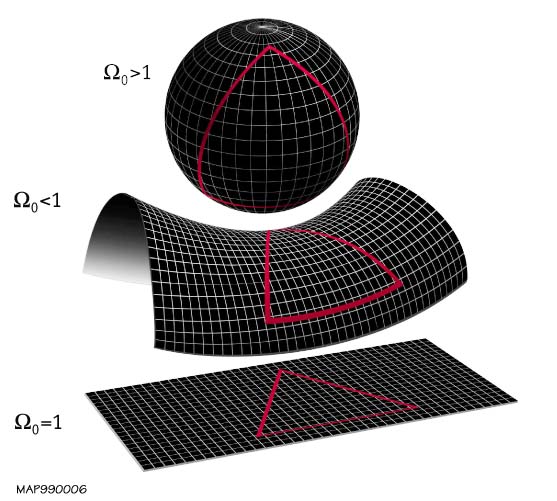
If space were shaped like that, you could move in only 2 dimensions, length and width, but not height. What would happen if you turned up or down and moved forward in that case? |
|
|
| Capitalizt |
| quote: | Originally posted by Gauss
If space were shaped like that, you could move in only 2 dimensions, length and width, but not height. What would happen if you turned up or down and moved forward in that case? |
Space IS shaped like that bottom picture.;) It's copy n paste time..
| quote: | When one says that "space is flat", one doesn't mean that the universe is flat like a "skin of a balloon" as you say, rather "flat spacetime" refers to what is know as Minkowski space.
In relativity, the three spacial dimensions are combined with a time-like to create the four dimensional spacetime, which in special relativity is described by Minkowski space. However, one can only use Minkowski space to describe the universe where it is locally flat, that is where there is not significant gravitation. Where there is significant gravitation, we say that spacetime has become curved. Four dimensional space is very difficult to visualize since we are intuitively only aware of the three dimensions, however one can 'draw' a 3D projection of spacetime. See here:
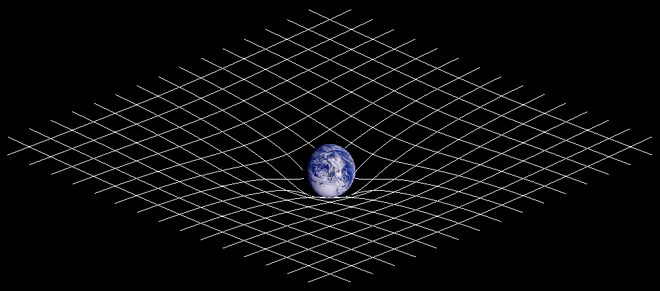
You can see space can be curved by mass and energy in local areas..but the amount of matter in the universe is practically invisible compared to the amount of empty space. Planets, suns, and galaxies barely register in the grand scheme of things..so on the whole, spacetime is not curved. Calling it "flat" is not 100% accurate, but it is a very good approximation because curvature only occurs around a few rare clusters of matter floating through massive amounts of empty (flat) space. |
paste #2 | quote: | | Now for the abstract bit. As I understand, the universe's 'shape' isn't like a real shape, but corresponds to the average distribution of energy in spacetime throughout the universe. So a 'flat' universe doesn't correspond to flatness like a flat surface, but instead means that on the average the energy distribution throughout a "flat" universe is almost the same everywhere when you look at the whole universe. To help you understand this, think of how light REALLY curves as it passes a black hole, which is REALLY dense. In fact, it is said light gets 'trapped' within black holes, which is a consequence of this curvature, which is itself a consequence of high energy density. On the average, the whole universe is not curved because the density everywhere is about the same. So the bottom line: flat spacetime on a universe size scale really refers to a pretty uniform (meaning everywhere about the same) energy density (meaning anything causing spacetime to curve). Curvature only occurs in insignificant local areas of the universe where matter is gathered and doesn't register at all on large scales. |
|
|
|
| Cloudburst |
| quote: | Originally posted by Gauss
I think you misunderstood me. :) Look at the bottom image on this picture:
If space were shaped like that, you could move in only 2 dimensions, length and width, but not height. What would happen if you turned up or down and moved forward in that case? |
:wtf:
Clearly you can move in three dimensions in space so those pictures are just simplifications on how the universe is shaped. |
|
|
| Fledz |
Space is 3D. Why planets are arrayed the way they are around a star has already been explained a couple of times in this thread. It's to do with gravity and the way the solar systems formed.
| quote: | Originally posted by Lira
Oi, I'd like to remind you that linguistics is a social science, and social sciences are 67% a science. Therefore, roughly speaking, I'm two thirds a scientist, one third an anarchist, and one third a smart-arse :D |
Social science :stongue: :stongue: :stongue: |
|
|
| EgosXII |
| quote: | Originally posted by Lira
Here, let me explain what my stance is.
First of all, I don't believe either religion or science can claim to be True, with a capital "T", for I don't believe we'd not even know if we ever arrived at the Truth. That being said, I think religion is egregiously flawed (reason why I'm not religious), but science cannot be considered to be perfect. Does it have a special epistemological status, and way more reliable than anything else we've got? Yes. However, not unlike humans in pre-scientific eras (when they had to count on religion), we may just be relying too much on the best option out of a lousy lot. We need to be open to new ideas as much as possible. I never really understood why people oppose science and religion so often, when art, literature, and philosophy, are also part of this battle. Personally, I think art is a better path to human salvation than religion, and philosophy is almost as fruitful as science... but it's too entangled in its own problems to go ahead.
Ideas can help us achieve things. They're tools. That's why science is more praiseworthy than religion. But, in order to use these tools, we need to understand how they work, reason why ignorance on one side of the spectrum isn't much better than faith on the other. If I were to put it in a graph (how I perceive your arguments, and how I perceive mine), it would look like this (green being desirable, red being undesirable):
| Utility | Traditional truthfulness |
Very Useful
Fairly useful
Useful
Not much useful
Utterly useless
| True
False |
|
agree with this.
i guess my overall problem with the whole thing is the belief in the Big T Truth, which is ridiculous imo. I guess science annoys as well because everybody knows religion is lacking in any kind of real 'provability' (even though proof denies religion anyway so it's a silly anti-religious argument in the first place), but, even though falsifiability and a sense of truth in flux is inherent in scientific research, n00bs STILL have the audacity to boast about it, denying other world-views just because they have heard about a few conclusions...
also, don't go dissing philosophy! not only is it the historical epitome of intelligence and theoretical advancement, but even today i think you will find that most abstract theorists in any discipline will be, essentially, philosophers. Scientific philosophy is hugely important, for example the works of Kuhn (paradigm), and Popper (falsifiability).
also, science and mathematics wouldn't exist without philosophers at work as far back as the 500 bcs... |
|
|
| pkcRAISTLIN |
| quote: | Originally posted by Domesticated
Ugh. Lira was saying that if you don't understand science yet believe in it, then you are basing your assertions on blind faith, just as with religion. Thus science would be a 'fairy tale' if you didn't understand the fundamentals behind it. |
this isn't true. we are surrounded and utilise scientific proofs every single day. i dont need to be an encyclopedia of the specifics to know science works, much more than any person of faith can claim to know how god works. |
|
|
| MrJiveBoJingles |
Philosophy is a joke.
It has regrettably drawn a lot of bright minds whose time would have been spent better in science or math. |
|
|
| pkcRAISTLIN |
| quote: | Originally posted by MrJiveBoJingles
Philosophy is a joke.
It has regrettably drawn a lot of bright minds whose time would have been spent better in science or math. |
Hahaha. don’t be so down on yourself JBJ. I for one enjoy reading your posts, your entire degree hasn’t been a total loss :p |
|
|
| Lira |
| quote: | Originally posted by Fledz
Social science :stongue: :stongue: :stongue: |
| quote: | Originally posted by MrJiveBoJingles
Philosophy is a joke. |
 |
|
|
| EgosXII |
| quote: | Originally posted by MrJiveBoJingles
Philosophy is a joke.
It has regrettably drawn a lot of bright minds whose time would have been spent better in science or math. |
in what way?
it permeates every other field of study that i can think of..
fair enough if you're talking about the metaphysics angle, but i think philosophy as a field of study is still extremely valid.
saying philosophy is a joke is like saying logic is a joke.. |
|
|
| Lira |
| quote: | Originally posted by EgosXII
in what way?
it permeates every other field of study that i can think of..
fair enough if you're talking about the metaphysics angle, but i think philosophy as a field of study is still extremely valid.
saying philosophy is a joke is like saying logic is a joke.. |
He's just bitter about his degree, never mind :p |
|
|
|
|

