|
A universe from nothing... (for space/science nerds) (pg. 12)
|
View this Thread in Original format
| MrJiveBoJingles |
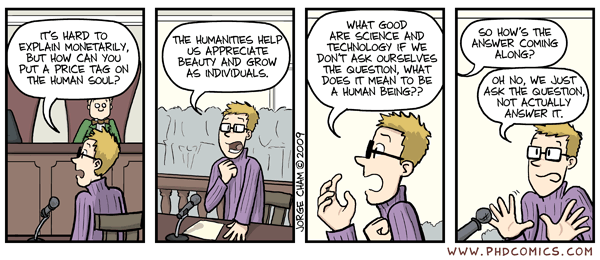
I love that comic. Here is another good one:
 |
|
|
| Lira |
| quote: | Originally posted by MrJiveBoJingles
I love that comic. Here is another good one:
|
I like this one too... as a matter of fact, I love PhdComics :D |
|
|
| MrJiveBoJingles |
| quote: | A colleague in theoretical computer science once showed me a Ph.D. thesis that a logician of his acquaintance had sent him. He found it rather strange in form, compared with the sort of mathematical thesis he was accustomed to reading. I looked at it and laughed. It followed precisely the standard form for a thesis in philosophy. (I think Pirsig describes this in "Zen and the Art...") In chapter 1, the author states the subject he is going to address. In chapters 2 to 8 he writes a detailed history of everything of significance that has ever been written on the subject. In chapter 9 he introduces his own modest contribution, and in chapters 10 to 12 indicates how it relates to the history. A scientific thesis, on the other hand, begins with a similar chapter 1, surveys the previous literature in chapter 2, going back only far enough to establish the context for his work, and the remainder is all about the author's own work.
No subject is worth anything whose entry qualification is a thesis of the first form. It would be interesting to write press-release style digests of current papers in philosophy, summarising their findings in bite-sized chunks:
* What we studied.
* What we discovered.
* How we discovered it.
* Why it matters.
I don't think it could be done other than as a work of satire. Maybe it should be. Any iconoclastic grad students in philosophy want to give it a go? |
http://lesswrong.com/lw/fy/what_is_...ur_thoughts/cqf |
|
|
| Lira |
Hey, that's actually quite interesting. Reading science and reading philosophy is indeed, very different... but I'm curious to see how experimental philosophy is going to bridge that gap, if it ever does. |
|
|
| EgosXII |
| quote: | Originally posted by Lira
He's just bitter about his degree, never mind :p |
righto, wrote mine before i saw yours :(
those comics are awesome :stongue: |
|
|
| Gauss |
| quote: | Originally posted by Cloudburst
:wtf:
Clearly you can move in three dimensions in space so those pictures are just simplifications on how the universe is shaped. |
I know that, but it confuses me how can space be a flat plane if world is 3D. |
|
|
| MrJiveBoJingles |
| The "flatness" of space refers to gravitational flatness, not to the literal flatness of a sheet of paper. |
|
|
| Fledz |
| quote: | Originally posted by Gauss
I know that, but it confuses me how can space be a flat plane if world is 3D. |
It's flat when your reference point is the source of the gravitational pull of an object, ie the sun in our solar system. It's not flat if you look at the big picture. It's just a way to describe how gravity works if limited to a certain area of space. |
|
|
| HardTranceProd |
Don't get me wrong, I love Dawkins and agree with him 100% on everything...
But there's something childish and indecent about a man of Dawkins' (and Krauss') stature stooping to the level of debating creationists in the political arena. A scientist who starts playing political football kinda loses his professionalism. Prior 2000 Dawkins was a respected biologist best known for his gene/meme theories. These days, he's best known for having (and losing, I'm sorry to say) shouting matches with Bill O'Reilly. In these soundbite debates, the academic will always lose to the meatheads.
Another irritant is that the more books he writes, the less he actually "gets through" to people. He's kinda dug himself into a hole where the more he does, the less productive it is. His books, widely praised as they are, are NOT the best. He gets too emotional and doesn't write very clearly, and likes to go off on tangents.
So yeah, I like Dawkins and admire him, but he's not perfect... |
|
|
| HardTranceProd |
Don't get me wrong, I love Dawkins and agree with him 100% on everything...
But there's something childish and indecent about a man of Dawkins' (and Krauss') stature stooping to the level of debating creationists in the political arena. A scientist who starts playing political football kinda loses his professionalism. Prior 2000 Dawkins was a respected biologist best known for his gene/meme theories. These days, he's best known for having (and losing, I'm sorry to say) shouting matches with Bill O'Reilly. In these soundbite debates, the academic will always lose to the meatheads.
Another irritant is that the more books he writes, the less he actually "gets through" to people. He's kinda dug himself into a hole where the more he does, the less productive it is. His books, widely praised as they are, are NOT the best. He gets too emotional and doesn't write very clearly, and likes to go off on tangents.
So yeah, I like Dawkins and admire him, but he's not perfect... |
|
|
| Lumps |
| Great vid. Thank you. |
|
|
| Renegade |
| quote: | Originally posted by Lira
Oh, but I agree with you there. What I'm opposed to is the hubris, present in the very beginning of this discussion, regarding atheists and their "superior" beliefs. That's why I actually like the point John Safran makes in that video: it's not just what you know that matter, but how you came to know that. |
Would agree with you there.
| quote: | | Regarding your last sentence, they could have been with us long enough to be part of very early human culture. Suppose language arose just once, in Africa, before the most adventurous of our ancestors departed to other continents: that could explain its ubiquity. |
Well you'd almost certainly know more about it than me, but aren't most theories of universal grammar based on cognitive rather than cultural explanations? I mean, a shared cultural origin would almost certainly explain more the superficial similarities between related languages (say, vocabulary or formal syntax) but it doesn't explain how it is that children, say, are able to grasp the rules behind the grammatical construction of sentences without any explicit instruction. I think you've tried to explain this to me once before, but feel free to take me through it again. :p
| quote: | | Same with this kind of religion. |
It's possible, but I'd still say that a purely cultural explanation fails to adequately explain things like the universal features of religion across widely disparate cultures, why religious beliefs hold an emotional salience that other kinds of beliefs do not, or why children are capable of the kind of thinking that makes religion possible (to use the jargon, they engage in "promiscuous teleology", "hyperactive agency detection" and so on) without explicit instruction. Something interesting that Boyer does in his book (while we're still talking about him) is list a set of propositions that are universally absent from just about any religious belief system you care to name, such as "gods exist, but only on certain days", "gods exist, but they are unaware that humans exist", or "gods exist, but they punish people who follow their commands". If religion were a largely arbitrary set of culturual propositions based on things unseen, then such universal absenses within religious traditions (when coupled with the universal features of religion - like ritual, the belief in miniminally counter intuitive agents with access to socially useful information etc.) would be, I would imagine, extremely difficult to explain.
| quote: | | The human soul must exist, according to different religions, because living beings need an elán vital of some sort. It's still an answer to a question, and the question arose out of facts perceived in the outer world. That's what I'm trying to get at. |
But that of course raises the question as to why such animistic beliefs are so universal when - really - they needn't be. If we are cognitively predisposed to a kind of Aristotelian essentialism, which causes us to intuitively infer that a living thing has a living "essense" (the "spirit" that distinguishes animate beings from inanimate ones), then it's a short step to reifying this "essense" as being a fundamentally distinct substance from the body (perhaps we're predisposed to a kind of Cartesian dualism as well?) that can leave the body when we die or dream.
I agree that it's an "answer to a question" and predicated on "facts" in the sense that it's inferred from experiences that people have in their everyday lives, but the fact that such distinct cultures have arrived at such similar answers to the question probably tells us that the answer probably lies more in our shared cognitive evolution than out of some universally shared pragmatic need to answer questions about the world.
| quote: | | By the way, do you happen to know if Boyer is Jewish? |
Not sure, sorry.
| quote: | If contemporary Christians read this passage of Saint Augustine, they'd stop being so antagonistic to science. Actually, I think Christianity would benefit a lot if this were taught more frequently.
Now, back to your second question: No, not really. And this is the best thing about science! |
Haha, agree on both counts. :)
| quote: | | First of all... my unorthodox thinking :p |
Again, I'd agree with all that. I certainly don't want to give the impression that I believe the scientific method to be "true with a capital 'T'" as you put it, but I would still argue that it's a vastly superior epistemology (both in terms of "utility" and "traditional truthness") to any other that I've encountered.
| quote: | Originally posted by HardTranceProd
But there's something childish and indecent about a man of Dawkins' (and Krauss') stature stooping to the level of debating creationists in the political arena. |
Actually, I'm pretty sure that Dawkins has a self-enforced policy of not publicly debating creationists - he certainly doesn't engage with them in any formal way. As for books like his latest one where he addresses creationist arguments, I might take what Lira just said about pragmatism and point out that it's actually a very useful way of making evolutionary ideas more accessible.
We're all natural creationists in the sense that we have inherent mental obstructions to understanding evolution (for instance, it's difficult to understand the time scales involved, or how it is that an animal with one kind of essense can become an animal with a completely different essense if given enough time), so I've got no problem with creationist fallacies being used as a means of introducing otherwise complex evolutionary ideas. In fact, it's probably in the context of the creation / evolution "debate" that I first started taking an interest in evolutionary biology, and I'm sure I'm not alone there.
| quote: | | A scientist who starts playing political football kinda loses his professionalism. Prior 2000 Dawkins was a respected biologist best known for his gene/meme theories. These days, he's best known for having (and losing, I'm sorry to say) shouting matches with Bill O'Reilly. In these soundbite debates, the academic will always lose to the meatheads. |
Perhaps, but any sort of airtime is important for minority belief positions like atheism. Bill O'Reilly has a massive audience - and the audience that is probably most in need of being exposed to people like Dawkins - so I've got no problems with it at all.
| quote: | | His books, widely praised as they are, are NOT the best. He gets too emotional and doesn't write very clearly, and likes to go off on tangents. |
Yeah, he's never been a great "writer" in the literary sense. Very few scientists are. |
|
|
|
|

