|
The Stargaze Thread *Sticky* -- Stars, Constellations, and The Night Sky. (pg. 2)
|
View this Thread in Original format
| Specimen303 |
 |
|
|
| Lagrangian |
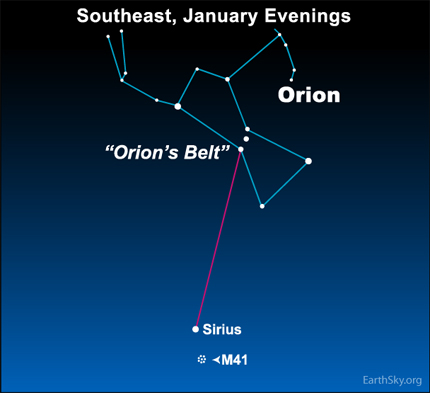
Draco was beautiful during the last days of December. Sirius was not really visible to me until well after new years eve. Yesterday, it stood there and shun like few stars I've seen these months. Flares of Blue, White, Purple, White, Purple, Blue, Red, Purple, etc
 |
|
|
| Lagrangian |
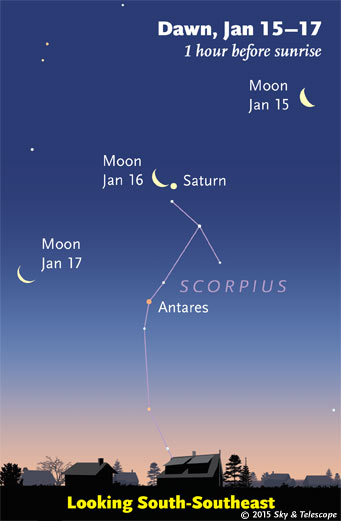
If you’re up before dawn on Friday – January 16, 2015 – look for the moon. The brightest object near it is the golden planet Saturn, and the moon and Saturn will be especially close together as seen from North America.. Below the waning crescent moon and Saturn, look for the ruddy star Antares, the brightest in the constellation Scorpius the Scorpion, lurking closer to the horizon.
If you have an optical aid – binoculars or a telescope – use them to enhance your view of the early morning scene. Scan the moon’s terminator – the shadow line dividing the lunar day and lunar night – for your best three-dimensional views of the lunar terrain. The terminator on the waning moon shows you where’s it’s sunset on the lunar disk.
 |
|
|
| Lagrangian |
Hey guys and gals, I've been away for a bit, but still vigilant observing the heavenly skies. I have a stargaze journal of the past 15 or so days that I would like to share with you, I also want us to delve a bit more on the constellation Aurigae. Tonight, Ursa Major is quite visible, check it out. we have clear skies here in the Bay, the warm northwestern sun and pacific breeze has definitely helped; the days have been gorgeous; the nights are chilly and clear. I want to give this moon-phase a patient run, by that I mean, nothing in our calendar is catching my eye outside of our solar system, but Jupiter, Mars, and Venus look beautiful at Sunset. I would, however, consider keeping a close eye while transitioning from full-moon days to new-moon days. Expect another cold wave in the Northern Hemisphere before we welcome Spring time.
http://www.theplanetstoday.com/ |
|
|
| Lagrangian |
Here we are:
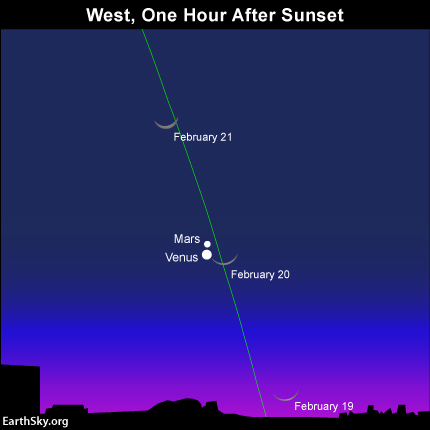
The planets Mars and Venus are about to be at their closest in our sky since 2008. They won’t be closer until 2017! Their nearest point is Saturday, but tonight – February 19, 2015 – you’ll find these two planets in the west after sunset, nearly as close as they will be then. Venus is the much brighter one. What’s more, the young moon is now returning to the west after sunset. And that means we’re about to have some incredible scenes in the western, twilight sky. Friday night’s sky scene will be especially grand.
Although the new moon fell yesterday, February 18, we still expect some observant people in the Northern Hemisphere – especially in North America – to catch the whisker-thin young crescent moon after sunset Thursday evening. Look westward, beneath Venus – the brightest planet and bright evening “star” – and near the horizon, starting an hour or less after sunset. Binoculars may be helpful!
It’ll be harder, though not impossible, to catch an even thinner lunar crescent from northerly latitudes in Europe – and harder yet at northerly latitudes in Asia. We expect few, if any, observers at temperate latitudes in the Southern Hemisphere to spot the young moon after sunset February 19. We tell you why later.
Whatever you do, just start watching the western twilight sky. Set a reminder on your phone if need be. The planets and moon won’t be up for long after sunset. And the views will be spectacular from now through Saturday night! |
|
|
| Serial Killer |
| quote: | Originally posted by Lagrangian
I would also like to extend this thread to include reports on UFO sightings; from an academic basis and purely empirical: objects and phenomena which are simply unidentifiable or explainable ; devoid from speculation. |
| quote: | | Originally posted by Lagrangian |
this is really cool
surprised that no one made a URANUS joke yet |
|
|
| Lagrangian |
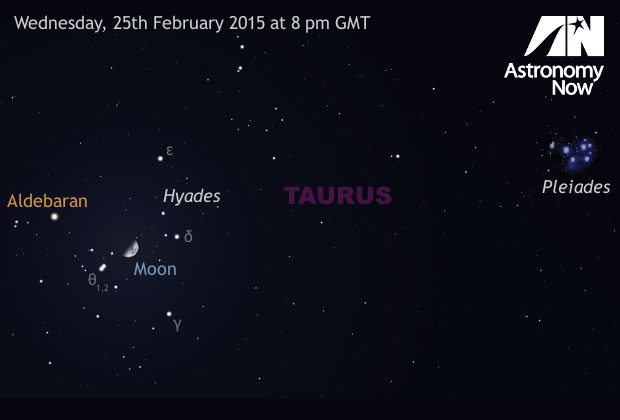
Once twilight fades on the evening of Wednesday, February 25th, observers in the British Isles can see the First Quarter Moon nestled in the V-shaped Hyades star cluster in Taurus. The Hyades is the closest open cluster to the Solar System at an average distance of about 150 light-years. It contains hundreds of stars that lie within a 10 light-year radius that are around 625 million years old.
Stars ε (epsilon), δ (delta), γ (gamma) and θ (theta) Tauri, plus the constellation’s brightest star, Aldebaran, form the distinctive V-shaped Hyades asterism that is known as the ‘head of the bull’. Aldebaran is an orange giant star some 65 light-years away, therefore much closer to us and unconnected with the cluster that happens to be in the same line of sight.

When you look at the sky at this time of year, one of the most prominent constellations you see is Orion the Hunter. It’s recognizable mainly for the short, straight row of three medium-bright “Belt” stars at its mid-section. See those stars on the photo above? Two very bright stars, Betelgeuse (left on this photo) and Rigel (right), lie on either side of the Belt stars. What you don’t see, with the eye alone, is the great complex of bright and dark nebulae – vast clouds drifting in our Milky Way – in and around Orion. That’s what Max Corneau has captured in this long-exposure (120 minutes) photograph.
http://earthsky.org/todays-image/ba...d-more-in-orion |
|
|
| kadomony |
this was a nice sight a couple days ago with a clear sky:
 |
|
|
| Lagrangian |
 |
|
|
| Lagrangian |
Beautiful night.
Some interesting things to see:
Algieba
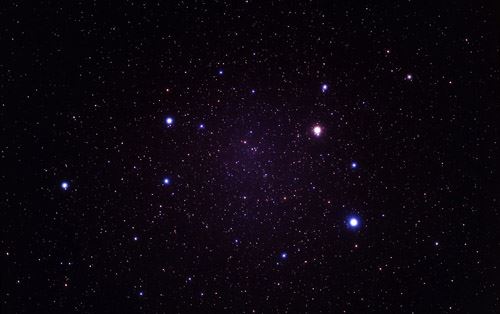
The name Algieba originates from the Arabic الجبهة Al-Jabhah, meaning the forehead. Despite this meaning, the star actually appears in the mane of Leo. The star's Latin name is Juba.
THE PLANET: In 2010, astronomers announced the discovery of a planet orbiting the brighter giant, Gamma-1 (Gamma Leo A), yet another large one with a minimum mass of 8.8 times that of Jupiter in an Earth-like orbit averaging 1.2 AU in size with a period of 1.2 years. A modest eccentricity takes it between 1.0 and 1.4 AU from Gamma-1. The planet is in modest violation of the general trend of planet-holding stars having higher metal contents than does the Sun. However, these figures are for a much lower stellar mass of 1.2 Suns. Raising the mass of Gamma-1 to 3 Suns increases the orbital radius of the planet to 1.6 AU and the planetary mass to at least 16 Jupiters, which places it into the realm of possible brown dwarfs (failed stars that cannot run full hydrogen fusion). But note that the evolutionary masses of the stars are also suspect, as they depend on the uncertain visual magnitudes. (Thanks to Jason Pero, who helped research this star and to Bill Hartkopf for expert commentary.)
http://en.wikipedia.org/wiki/Gamma_Leonis
Arcturus at about 14h 15 min at Midnight in the pacific NW.
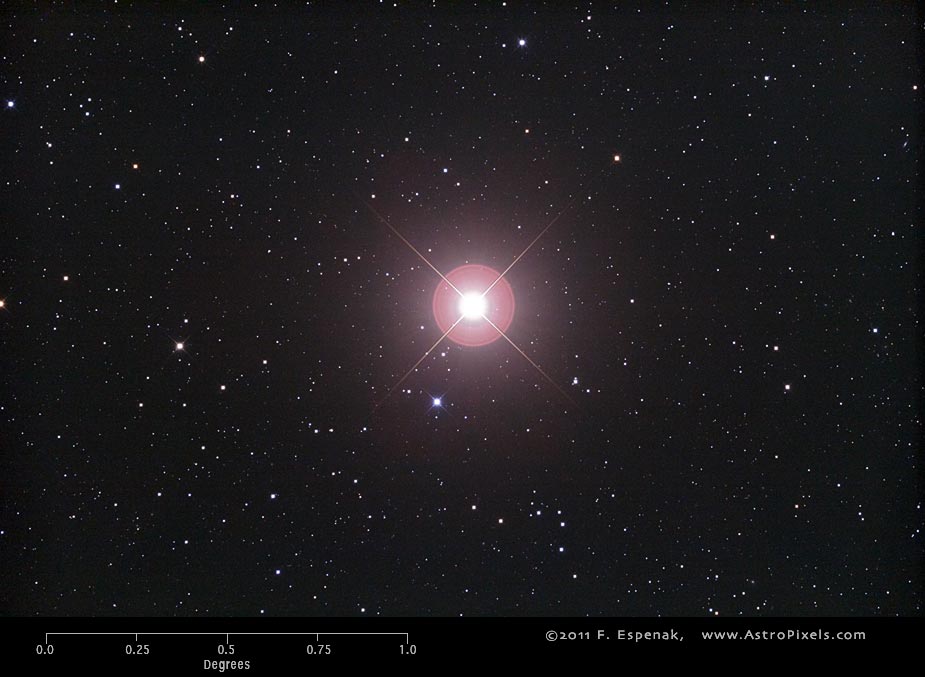
Arcturus is a type K0 III Red giant star. It is at least 110 times more luminous than the Sun in visible light wavelengths, but this underestimates its strength as much of the "light" it gives off is in the infrared; total (bolometric) power output is about 180 times that of the Sun. The lower output in visible light is due to a lower efficacy as the star has a lower surface temperature than the Sun. With a near-infrared J band magnitude of −2.2,[1] only Betelgeuse (−2.9) and R Doradus (−2.6) are brighter.
http://en.wikipedia.org/wiki/Arctur...lanetary_system
Denebola.

On a clear night, look south and you can pretty easily spot six bright stars roughly in the shape of an anvil. To the left at the narrow end is the bright star Denebola, our foreshortened version of the Arabic phrase dhanab al-asad, the lion’s tail. At the lower right of the anvil is Regulus, the brightest star in Leo. In the imagination’s star-lion, Regulus is at the joint of the front legs. Directly above Regulus is Eta Leonis (with no name of its own, oddly, just the Greek letter eta) in the lion’s chest, and above and slightly left is Algieba (al jabbah, the mane) at the shoulder.
If you track your eye above Algieba, you’ll see three more stars, not quite so bright, looping in a sort of backward question mark. These outline the lion’s head. Along the lion’s back, the star between Algieba and Denebola is Zosma, which sounds like a name out of some rambling fantasy trilogy and is actually a misapplied version of a Greek word for girdle. Arab astronomers more appropriately called it Al Thahr al Asad, the lion’s back.
If you imagine the sun traveling a great circle every year across the sky, that road — called the ecliptic — runs through the 12 constellations of the Zodiac (plus one other, Ophiuchus). Leo is one of the 12. To its east lies Virgo (still mostly down behind my trees on March evenings). To the west is Cancer, the Crab, made of four dimmer stars whose general location you can picture by the very bright object parked just in front of the lion’s face for now — Jupiter.
Like all the constellations, Leo also has a lot of interesting objects that you can’t see with your naked eye. But with a little help from the astronomers and their large telescopes and calculations, your mind’s eye can picture them.
Some are galaxies. About a third of the way from Regulus to Denebola and down a bit is the Leo I group of galaxies. They’re part of the Virgo Supercluster and are in the vicinity of 820,000 light-years from us, too faint to see without a telescope, of course. A little farther toward Denebola is the Leo Triplet group of galaxies, or M66 group, around 35 million light-years away.
Directly south of the Leo I group is the star Wolf 359, which also is invisible to us because it’s a red dwarf shining at a very dim magnitude 13.5. But it’s interesting to play with in thought because it’s the fifth-nearest star known, about 7.8 light-years away.
At the other extreme, Eta Leonis, bright in the anvil, is a supergiant far, far away, but so big we see it easily. The estimates vary, but this star is somewhere around 25 times as large as the sun and has a luminosity of 5,600 suns, or some think up to 9,500 suns. Robert Burnham, whose “Celestial Handbook” has a more or less scriptural presence among starwatchers, estimates it could be as luminous as 13,000 suns. Eta is somewhere between 1,300 and 1,800 light-years away from us. If it were 32.6 light-years from us (a standard used to compare stars’ brightnesses, called the absolute magnitude), it would outshine even Venus in the sky.
Southeast of Regulus is another supergiant you can see, Rho Leonis. Rho is estimated to be from 3,650 to 5,000 light-years away and has a luminosity of 165,000 or maybe up to 295,000 suns. To us it shines at magnitude 3.85, well within our naked-eye sight, but its absolute magnitude is probably around minus 5.7, even brighter than Eta.
One more for the road of your imagination: To the west of Regulus and slightly up is the star R Leonis, which sometimes you can pick out with your eye and other times you can’t. It’s not just your imagination. R Leonis is a variable star, meaning its brightness changes over time. In R Leonis’ case, the brightness changes radically over a long period of 312 days, from magnitude 5 — which you can see on a dark night if you know where to look — to magnitude 10.5, which is fainter than some of the galaxies in the Leo I and Triplet groups. |
|
|
|
|