|
The Stargaze Thread *Sticky* -- Stars, Constellations, and The Night Sky. (pg. 4)
|
View this Thread in Original format
| Serial Killer |
awesome stuff
here |
|
|
| Lagrangian |
The big meteor excitement in May is the possible strong shower on the morning of the 24th visible from the U.S. and Canada. But a more predictable shower, best for southerly skywatchers worldwide, should be at its peak activity before the dawns of May 5th, 6th, and 7th.
The Eta Aquariid shower is often the year's best for the Southern Hemisphere, with a zenithal hourly rate (that is, when viewed under optimal conditions) of about 60, and the show lasts for several days. Few of its meteors are seen from above latitude 40° north, since dawn begins earlier the farther north you go at this time of year. That doesn't give the shower's radiant in Aquarius time to rise very high.
However, the few Eta Aquariids that northerners do spot are long, graceful "earthgrazers" skimming the upper atmosphere far across the sky. They'll be coming out of the east-southeast, from the direction of the Water Jar in Aquarius.
The Eta Aquariids are, like the Orionids of October, bits of debris shed long ago by Halley's Comet. Earth intersects this same broad meteoroid stream at two different places in our orbit around the Sun.
- See more at: http://www.skyandtelescope.com/astr...h.PgsjK4fY.dpuf |
|
|
| Lagrangian |

Cavalier Nights.
Tonight, find the Hunting Dogs. The chart above looks directly overhead at nightfall or early evening in May, as seen from a mid-latitude in the N. Hemisphere. It’s as if we’re viewing the sky from the comfort of a reclining lawn chair, with our feet pointing southward. The constellation Leo the Lion stands high in the southern sky, while the upside-down Big Dipper is high in the north. Notice the Big Dipper and Leo. You can use them to star-hop to to the constellation Canes Venatici, the Hunting Dogs.
Many people know how to find Polaris, the North Star, by drawing a line through the Big Dipper pointer stars, Dubhe and Merak. You can also find Leo by drawing a line through these same pointer stars, but in the opposite direction.
Extend a line from the star Alkaid in the Big Dipper to the star Denebola in Leo. One-third the way along this line, you’ll see Cor Caroli, Canes Venatici’s brightest star. A telescope reveals that Cor Caroli is a binary star – two stars orbiting a common center of mass.
Cor Caroli (Latin for “Heart of Charles”) is named in honor of England’s King Charles I, who had his head cut off in 1649. The name first appeared on English star maps in the late 1600’s as Cor Caroli Regis Martyris (“Heart of Charles the Martyr King”). King Charles II, the son of King Charles I, founded the Royal Greenwich Observatory.

In Star Tales, Ian Ridpath points out that the name's first appearance on a star map was in the 1673 chart of Francis Lamb, who labelled it Cor Caroli Regis Martyris ("the heart of Charles the martyred king"), clearly indicating that it was seen as referring to Charles I
Bottom line: Star-hop to Canes Venatici, the Hunting Dogs, tonight! You can do it, if you can find the constellation Leo and the famous Big Dipper asterism.
 |
|
|
| Lagrangian |
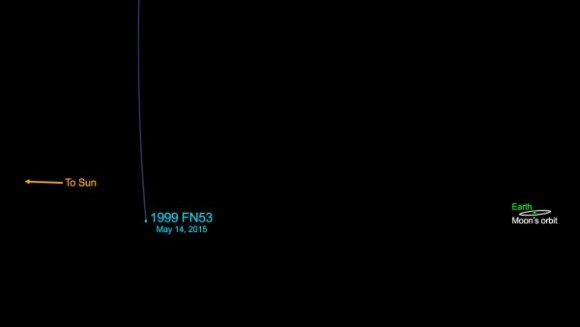
A space rock has caused quite a fuss in recent days. Some media reports (for example, here) have reported “worried astronomers” due to a “gigantic missile” that will “skim the Earth” today (May 14, 2015). But those assertions are misleading or incorrect. The asteroid has now been captured in radar images from Arecibo Observatory in Puerto Rico. The real facts are that asteroid 1999 FN53 will safely pass by Earth today no closer than 6.3 million miles away (10 million kilometers), which means the space rock will not be in close proximity and will not “shave Earth.”
New radar observations from Arecibo Observatory suggest that asteroid 1999 FN53 is a very large one, however, about 800 to 900 meters (3,000 feet, or almost a kilometer) wide. These observations confirm it will pass at more than 26 times the Earth-moon distance, so that impact probability is zero.
Arecibo has been tracking this asteroid since May 12 and will continue observing the space rock until tomorrow, May 15. Astronomers were able to send radio signals which bounced on 1999 FN53 allowing them to get preliminary radar images that show the space rock’s shape. The radar observations suggest the asteroid completes a rotation every 3.5 hours. |
|
|
| Lagrangian |
I saw some awesome 'Pseudostars' yesterday. They hovered for a while like all the rest, and suddenly started moving across the very vastness of darkness. Emitting an Indigo like hue, beautiful.
I am starting to feel a bit frustrated and wish they would let me stargaze in peace. |
|
|
| Lagrangian |

NGC 2207 and IC 2163 are a pair of colliding spiral galaxies about 80 million light-years away[2] in the constellation Canis Major. Both galaxies were discovered by John Herschel in 1835. So far, four supernovae have been observed in NGC 2207: |
|
|
| Serial Killer |
| quote: | | Originally posted by Heaviside |

looks awesome |
|
|
| Lagrangian |
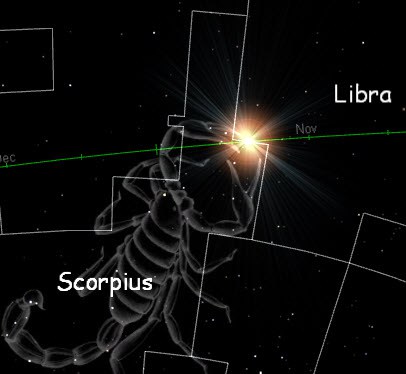
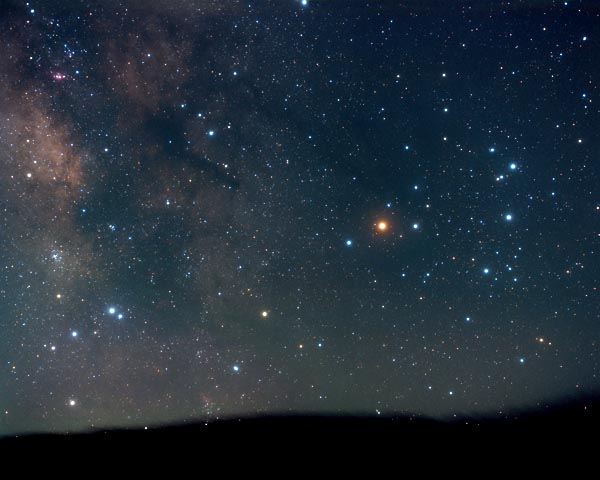
How to locate the constellation Scorpius. For evening viewing, July and August are prime-time months for observing this wondrous constellation. In the Northern Hemisphere, we associate the ruby star Antares – or Ant-ares, the Rival of Mars – with the hot summer season. And I personally associate Antares with the blooming of wild cardinal flowers on my favorite hiking trail. As the summer season wanes, Antares’ fading into the southwestern dusk presages the cooler days of autumn.
In early July, in either the Northern or Southern Hemisphere, Scorpius climbs to its highest point in the sky at about 10 p.m. local time (11 p.m. local Daylight Saving Time). Because the stars return to the same place in the sky about one-half earlier with each passing week, look for the celestial Scorpion in mid-July to soar highest up around 9 p.m. local time (10 p.m. local Daylight Time), and by late July around 8 p.m. local time (9 p.m. local Daylight Time).
 |
|
|
| Lagrangian |
Tonight, Tonight!
In any year, you can find the constellation Libra between the stars Antares and Spica (to the west of Zubenelgenubi, outside the chart). But in 2015, the planet Saturn acts as your guide to this fairly faint constellation. The green line depicts the ecliptic – Earth’s orbital plane projected outward onto the constellations of the Zodiac
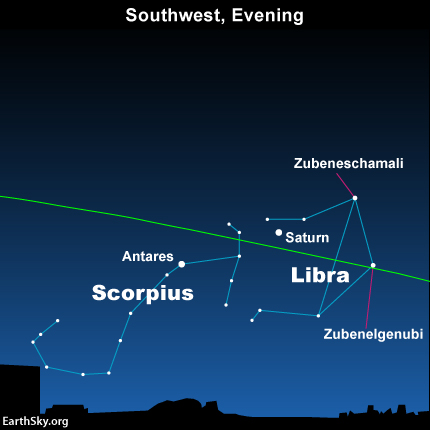
Zubeneschamali, aka Beta Librae, is the brightest star in the constellation Libra the Scales. It’s just a touch brighter than the other bright star in Libra, called Zubenelgenubi. The incomparable Burnham’s Celestial Handbook quotes the star enthusiast Willian Tyler Olcott, who refers to this star as “… the only naked-eye star that is green in color.” Some other stargazers agree. Others don’t. If, indeed, Zubeneschamali is truly green in color, it’s the only green star among the bright stars in the sky. |
|
|
| Lagrangian |
Why celebrate the solstice? Cultures universally have had markers, holidays, and alignments – all related to the solstice.
It has been universal among humans to treasure this time of warmth and light.
For us in the modern world, the solstice is a time to recall the reverence and understanding that early people had for the sky. Some 5,000 years ago, people placed huge stones in a circle on a broad plain in what’s now England and aligned them with the June solstice sunrise.
We may never comprehend the full significance of Stonehenge. But we do know that knowledge of this sort wasn’t isolated to just one part of the world. Around the same time Stonehenge was being constructed in England, two great pyramids and then the Sphinx were built on Egyptian sands. If you stood at the Sphinx on the summer solstice and gazed toward the two pyramids, you’d see the sun set exactly between them.

I always notice the two stars in the Dragon’s head when looking at the bright star Vega in the constellation Lyra. If you’re familiar with the Summer Triangle, draw an imaginary line from the star Altair through the star Vega to find the Dragon’s eyes glaring at you from high overhead on July and August evenings. These two stars are Rastaban and Eltanin – lovely, romantic names for the Dragon’s stars.
Watch Draco tonight as it circles around the North Star, Polaris.
Another noteworthy star in Draco is Thuban, which is high in the sky in the evening at this time of year. Thuban is an interesting star because – around 3000 B.C. – Thuban used to be the North Star.
The constellation Draco, by the way, has been associated with a dragon in many cultures. A Babylonian myth links Draco to the dragon god Tiamat, who was subdued by the god of the sun. |
|
|
| Serial Killer |
from the space station

Northern Lights Glow Over Northeast, Plains


 |
|
|
|
|

