|
After The Virus (pg. 3)
|
View this Thread in Original format
| Lira |
| quote: | Originally posted by Arbiter
Well aren't you all a sunny, optimistic bunch?
The most obvious and nearly-certain post-pandemic effects are increased totalitarianism and a steady, long-term erosion of civil liberties, justified by the supposed need for greater centralized authority as a means of preventing or responding to future pandemics.
I'd love to be wrong about this. But broad swaths of the global population readily accepting rather draconian restrictions on basic freedoms based largely on an appeal to authority has got to make any would-be dictator's mouth water. |
Did someone say sunny optimist? :gsmile:
The reason I tend to think we'll have more of the same, rather than an improvement or a descent into authoritarianism, is because little has changed during the pandemic:- governors in flawed democracies that work as federations (both Brazil and the US) had to take the helm because the federal government was about as disastrous as we could have imagined, and there are critics from both sides, as you would have expected;
- actual autocracies don't seem to have fared much better, either because they couldn't cope (e.g. Iran) or because we can't really trust them, can we? (e.g. China);
- also, much of the acceptance of restrictions are tied to an exceptional state of affairs, as we see in wartime. It's unlikely the general population will be as docile after the threat is long gone, even because rulers with iron fists tend to have a tighter grip when the economy is recovering, not when it's being driven to the ground.
Wouldn't you agree?
| quote: | Originally posted by Dykes_on_Jay
That's what Xi said. |
This is... this is probably the best use ever of this line so far. |
|
|
| Dykes_on_Jay |
| Black market Cialis is my superpower. |
|
|
| Arbiter |
| quote: | Originally posted by Lira
Did someone say sunny optimist? :gsmile:
The reason I tend to think we'll have more of the same, rather than an improvement or a descent into authoritarianism, is because little has changed during the pandemic:- governors in flawed democracies that work as federations (both Brazil and the US) had to take the helm because the federal government was about as disastrous as we could have imagined, and there are critics from both sides, as you would have expected;
- actual autocracies don't seem to have fared much better, either because they couldn't cope (e.g. Iran) or because we can't really trust them, can we? (e.g. China);
- also, much of the acceptance of restrictions are tied to an exceptional state of affairs, as we see in wartime. It's unlikely the general population will be as docile after the threat is long gone, even because rulers with iron fists tend to have a tighter grip when the economy is recovering, not when it's being driven to the ground.
Wouldn't you agree?
|
I don't disagree with "more of the same," since the developed world has already been trending towards increased totalitarianism and decreased civil liberties. The pandemic will probably further contribute to those trends.
Your comparison to wartime powers is an apt one, but considering recent U.S. history, it's not exactly reassuring. After all, the American public has yet to recoup many of the civil liberties given up to support the "war" on terror.
Indeed, the coronavirus crisis may share the war on terror's lack of an identifiable end-point. I have yet to hear a convincing, nonspeculative exit strategy from the current attempts to control the spread of the virus. Relaxing restrictions while most of the population remains vulnerable will probably just invite successive waves of the disease. So the planned return to normalcy seems to hinge almost entirely on developing a vaccine. But the development of a vaccine that's--(1) safe, (2) effective, (3) reasonably long-lasting even as the coronavirus mutates, and (4) capable of production, distribution, and administration on an unprecedented scale--is far from guaranteed to occur within the next year or two. It's possible we may never have one, or that we may not be able to get it to enough people even if we do.
There is therefore good reason to be skeptical that the threat will be "long gone" anytime soon, even if we define the "threat" as just COVID-19. But just as the war on terror went beyond Al Qaeda, pandemic-control efforts are likely to extend beyond COVID-19. SARS-CoV-2 is only the latest in a long line of uncommon or novel pathogens that have generated outbreaks in recent years, and the identification of new threats is highly likely to continue to be a regular occurrence. The vast majority will, of course, not pose the same problems as this coronavirus, which is particularly hard to contain for several reasons. But they will provide a convenient excuse for why at least some government powers seized during the COVID-19 pandemic can never be given up. |
|
|
| Zoso |
| Clearly, then, we just need targeted drone strikes against COVID-19 clusters! |
|
|
| pkcRAISTLIN |
| quote: | Originally posted by Lira
Did someone say sunny optimist? :gsmile: |
the technical term is unrelenting cheeriness. system-j has the registered trademark. you now owe him a dollar. and not one of your ty mexican pesos.
| quote: | Originally posted by Arbiter
I don't disagree with "more of the same," since the developed world has already been trending towards increased totalitarianism and decreased civil liberties. The pandemic will probably further contribute to those trends.
Your comparison to wartime powers is an apt one, but considering recent U.S. history, it's not exactly reassuring. After all, the American public has yet to recoup many of the civil liberties given up to support the "war" on terror.
Indeed, the coronavirus crisis may share the war on terror's lack of an identifiable end-point. I have yet to hear a convincing, nonspeculative exit strategy from the current attempts to control the spread of the virus. Relaxing restrictions while most of the population remains vulnerable will probably just invite successive waves of the disease. So the planned return to normalcy seems to hinge almost entirely on developing a vaccine. But the development of a vaccine that's--(1) safe, (2) effective, (3) reasonably long-lasting even as the coronavirus mutates, and (4) capable of production, distribution, and administration on an unprecedented scale--is far from guaranteed to occur within the next year or two. It's possible we may never have one, or that we may not be able to get it to enough people even if we do.
There is therefore good reason to be skeptical that the threat will be "long gone" anytime soon, even if we define the "threat" as just COVID-19. But just as the war on terror went beyond Al Qaeda, pandemic-control efforts are likely to extend beyond COVID-19. SARS-CoV-2 is only the latest in a long line of uncommon or novel pathogens that have generated outbreaks in recent years, and the identification of new threats is highly likely to continue to be a regular occurrence. The vast majority will, of course, not pose the same problems as this coronavirus, which is particularly hard to contain for several reasons. But they will provide a convenient excuse for why at least some government powers seized during the COVID-19 pandemic can never be given up. |
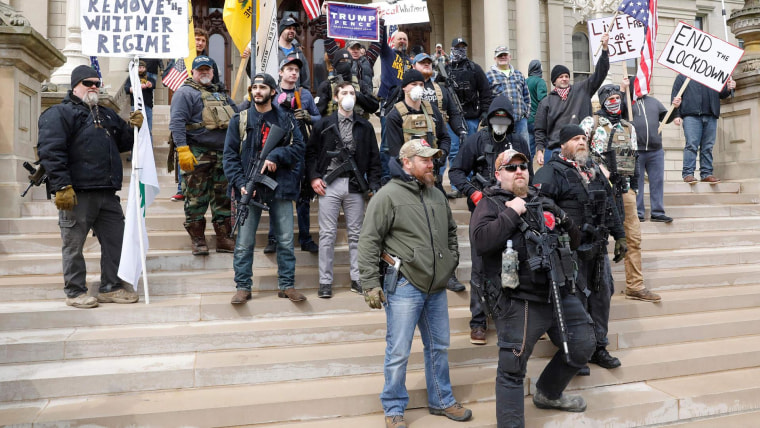
why so pessimistic? these guys have your back.
 |
|
|
| Arbiter |
| quote: | Originally posted by pkcRAISTLIN
why so pessimistic? these guys have your back.
|
With friends like these, who needs enemies?
But, even a stopped clock is right twice a day. When Donald Trump errantly tweeted that we "cannot let the cure be worse than the problem itself" late on March 22, he was roundly mocked. Yet little more than two weeks later, one of the world's leading ethicists says he was right!
Many, or perhaps most, of the attempts to lock down our societies and enforce social distancing to date could be justified. I'm characteristically skeptical, but I simply don't think we have enough information to be sure. But the utilitarian calculus becomes exceedingly untenable the longer the restrictions need to remain in place, or the more frequently they need to be reinstated. And yet the political caste has so deeply invested themselves in our current approach that I fear they will be deeply resistant to admitting that they may actually have been wrong.
Ironically, Donald Trump may be uniquely positioned to avoid this effect, since he could--and no doubt would--point to his initial recalcitrance as showing that he, and not the experts, was right all along. It would be quite something if he blundered his way into making good policy through sheer ineptitude and obliviousness. |
|
|
| SYSTEM-J |
I think the real question behind the question is the practicality (not to mention the ethics) of trying to go back to relative normality when a highly infectious and lethal virus is still in active circulation. I'm not simply talking about hospitals being swamped, either. I'm talking about everyday human behaviour in going to work or going to public places or interacting with strangers. How can we expect the significant percentage of the population deemed "highly vulnerable" to behave, for example? How can we expect to behave around them?
Letting this virus run amok through the population is still going to cause enormous social and economic upheaval. There's no avoiding it. There's no grinning and bearing it. Businesses won't go back to normal. People won't go back to normal.
The only way out I can see is to attack the problem from every angle, so we're not just relying on the social one. Every country needs the capacity for comprehensive testing and aggressive contact tracing. Every country needs to increase its healthcare capacity for more than just a temporary window. And we need some kind of effective drug treatment to be pulled from the fire of clinical trials to make the virus more manageable. At the moment, none of these things are in place in the majority of affected nations. |
|
|
| Zoso |
Hear, hear Jack! As a species, I fear we are collectively far too short-sighted to ever, as societies, evolve to the point where we have the societal structures/systems/safety nets in place to deal with this kind of emergency. When entire societies depend on fiat wealth derived from economic incentives...it's nearly impossible to tear down those systems that affect, essentially, 7 billion people and retool them for something else.
I often think of the movie Star Trek: First Contact in the scene where Picard et. al. have traveled back in time, and one of the humans from the past in on the Enterprise with Picard. Marveling at the size of the Enterprise, she says it must have cost a fortune to build. Picard explains that in his time, it didn't really "cost" anything, as societies no longer exist for the accumulation of wealth.
I think the idea of having society's basic needs (say the lower rungs on Maslow's hierarchy) "paid for" by society is admirable, but I have never seen a structured, viable plan for how we transition 7 billion people and their societies to that "utopia". |
|
|
| Arbiter |
| quote: | Originally posted by SYSTEM-J
I think the real question behind the question is the practicality (not to mention the ethics) of trying to go back to relative normality when a highly infectious and lethal virus is still in active circulation. I'm not simply talking about hospitals being swamped, either. I'm talking about everyday human behaviour in going to work or going to public places or interacting with strangers. How can we expect the significant percentage of the population deemed "highly vulnerable" to behave, for example? How can we expect to behave around them?
Letting this virus run amok through the population is still going to cause enormous social and economic upheaval. There's no avoiding it. There's no grinning and bearing it. Businesses won't go back to normal. People won't go back to normal.
The only way out I can see is to attack the problem from every angle, so we're not just relying on the social one. Every country needs the capacity for comprehensive testing and aggressive contact tracing. Every country needs to increase its healthcare capacity for more than just a temporary window. And we need some kind of effective drug treatment to be pulled from the fire of clinical trials to make the virus more manageable. At the moment, none of these things are in place in the majority of affected nations. |
You raise several good points. First, even in the absence of government-imposed measures such as travel restrictions, stay-at-home-orders, and forced business closures, the vast majority of the population is likely to change their behavior considerably for as long as the pandemic lasts. This means that we are certain to get some of the benefits, and incur of the costs, associated with such measures whether imposed by our governments or not. Sweden may someday prove to be an interesting case study for the merits of voluntary versus involuntary changes in behavior, but at this point the data are far too incomplete for any meaningful comparison.
Second, no approach realistically available will result in a quick or painless return to normalcy. Even if governments did nothing to try to slow the virus's spread, massive social and economic upheaval is indeed inevitable, both due to individuals' changed behaviors and, of course, the effects of the virus itself.
In the end, a genuine return to normal seems almost certain to require either herd immunity (whether acquired through infection or vaccine), or a treatment far more effective than anything we've previously developed for these types of respiratory viruses. So the question is ultimately: what is the best (or, perhaps more appropriately, least bad) way to get from where we are now to one of those outcomes?
Answering that question is partly a factual inquiry and also partly a value judgment. Unfortunately the data we presently have available make addressing the factual side of the equation very difficult. For example, attempts to estimate of the ratio of confirmed COVID-19 cases to undiagnosed cases with mild or no symptoms vary from 1:1 to 1:85! That creates incredible ambiguity both about the likely health consequences of widespread infection and about the efficacy of efforts to slow the virus's spread. Thus, improving the accuracy and fidelity of our data should be among our highest priorities regardless of what else we do. That means that contact tracing and especially testing capacity are indeed crucial goals, albeit challenging ones, considering that we may need to increase our testing capacity by multiple orders of magnitude even as we face reagent shortages at our current level of testing. Other key facts, such as how long it will take to develop a vaccine or treatment, are simply unknowable. At best, we can make educated guesses.
Improved data collection aside, there are a wide range of options available. Toward one extreme end, we could make little or no effort to stop the spread of the virus and simply hope to pick up the pieces after widespread infection. Toward the other extreme, we could impose strict, Wuhan-style lockdowns for potentially years or even decades until a sufficiently effective vaccine or treatment is available. The optimal path forward, in terms of overall human wellbeing, almost certainly falls somewhere between these extremes. But that still leaves open a very broad spectrum of possible responses at the government level, within which there is substantial room for reasonable disagreement. |
|
|
| Arbiter |
| quote: | Originally posted by Zoso
Hear, hear Jack! As a species, I fear we are collectively far too short-sighted to ever, as societies, evolve to the point where we have the societal structures/systems/safety nets in place to deal with this kind of emergency. When entire societies depend on fiat wealth derived from economic incentives...it's nearly impossible to tear down those systems that affect, essentially, 7 billion people and retool them for something else.
I often think of the movie Star Trek: First Contact in the scene where Picard et. al. have traveled back in time, and one of the humans from the past in on the Enterprise with Picard. Marveling at the size of the Enterprise, she says it must have cost a fortune to build. Picard explains that in his time, it didn't really "cost" anything, as societies no longer exist for the accumulation of wealth.
I think the idea of having society's basic needs (say the lower rungs on Maslow's hierarchy) "paid for" by society is admirable, but I have never seen a structured, viable plan for how we transition 7 billion people and their societies to that "utopia". |
We just need to eliminate scarcity, that's all... :)
But one small step forwards that could result from the coronavirus pandemic is an increased perception of healthcare systems, or at least some subset of them, as a public good in the same vein as national defense. |
|
|
| Trance-M |
| quote: | A British doctor says: "In Britain, medicine is so advanced that we cut off a man's liver, put it in another man, and in 6 weeks, he is looking for a job."
The German doctor says: "That's nothing, in Germany we took part of a brain, put it in another man, and in 4 weeks he is looking for a job."
The Russian doctor says: "Gentlemen, we took half a heart from a man, put it in another's chest, and in 2 weeks he is looking for a job."
The American doctor laughs: "You are all behind us. A few years ago, we took a man with no brain, no heart, and no liver and made him President.
Now, the whole country is looking for a job!" |
Funny and sad at the same time. |
|
|
| Paradox Lost |
| quote: | Originally posted by Trance-M
Simple answer, we won't go back to normal anytime soon. |
Is this something we actually want? I think we're imagining 'normal' in terms of the rhythm of daily life, which is certainly how I was using it, but that also includes all the institutional deficiencies that COVID has managed to expose, so if we never return to normal, then we should be so fortunate.
Otherwise, I think people are finally coming to terms that normal- as we once knew it- is a thing of the past for the indefinite future, and that we simply can't expect to shelter in place for a few weeks and then walk back out into the world as it once was. I think it's reasonable to believe that we'll basically be playing a game of COVID cat-and-mouse until herd immunity is achieved one way or the other, so, yeah, buckle up. |
|
|
|
|

