|
What are You Currently Reading? (pg. 41)
|
View this Thread in Original format
| stan229 |
anyone read the 'new' tolkien book?
http://www.amazon.com/Children-H%C3...89922942&sr=8-2
Looks interesting.. ive been looking for something to read after i finshed the last HP book (yes, dont ask.. it was hella addicting)
something similar to that and/or LOTR... any suggestions? |
|
|
| 3F05Q |
Just finished Orson Scott Card's Shadow of the Hegemon, sequel to Ender's Shadow.
I really recommend Ender's Game. It's a must read. Speaker for the Dead is the sequel to that. Ender's Shadow is an offshoot following the life of another character from Ender's Game.
Also just finished Michael Crichton's State of Fear. It sucked balls. I didn't think I'd toss the book to the floor upon reading the last page and say "that was crap." |
|
|
| Cloudburst |
Looks interesting, will check it out! |
|
|
| ikhouvanu |
| "The Secret" by Rhonda Byne |
|
|
| lücid |

my mom recommended it to me last week and i never ignore her recommendations for books. really good so far. :) |
|
|
| chimera66 |
| another book about why Putin is a bad person... |
|
|
| Surfmorworkless |
I'm now currently stuck on Haruki Murakamis writting.Good stuff.
 |
|
|
| stren |
 |
|
|
| Yan |
Just finished this one:

It was alright. An okay read. You don't miss anything if you skip on this one.
Currently Reading:

Welcome to the NHK - Novel that spawned the anime/manga.

Really funny! Read it if you can.
Excerpt:
| quote: | Here’s something we all have in common: flying on big airplanes and listening to the announcements. And
trying to pretend the language they’re using is English. Doesn’t always sound like it to me.
Preflight
It starts at the gate: “We’d like to begin theboarding process .” Extra word. “Process.” Not necessary.
Boarding is sufficient. “We’d like to begin the boarding.” Simple. Tells the story. People add extra words
when they want things to sound more important than they really are. “Boarding process” sounds
important. It isn’t. It’s just a group of people getting on an airplane.
To begin their boarding process, the airline announces they willpreboard certain passengers. And I
wonder, How can that be? How can people board before they board? This I gotta see. But before
anything interesting can happen I’m told to get on the plane. “Sir, you can get on the plane now.” And I
think for a moment. “Onthe plane? No, my friends, not me. I’m not gettingon the plane; I’m gettingin the
plane! Let Evel Knievel geton the plane, I’ll be sitting inside in one of those little chairs. It seems less
windy in there.”
Then they mention that it’s anonstop flight . Well, I must say I don’t care for that sort of thing. Call me
old-fashioned, but I insist that my flight stop. Preferably at an airport. Somehow those sudden cornfield
stops interfere with the flow of my day. And just about at this point, they tell me the flight has been
delayed because of achange of equipment . And deep down I’m thinking, “broken plane!”
Speaking of potential mishaps, here’s a phrase that apparently the airlines simply made up:near miss .
They say that if two planes almost collide it’s a near miss. Bull, my friend. It’s a near hit! Acollision is
a near miss.
[WHAM! CRUNCH!]
“Look, they nearly missed!”
“Yes, but not quite.”
Back to the flight: As part of all the continuing folderol, I’m asked to put myseat-back forward . Well,
unfortunately for the others in the cabin, I don’t bend that way. If I could put my seat-back forward I’d
be in porno movies.
There’s also a mention ofcarry-on luggage . The first time I heard this term I thought they said
“carrion,” and that they were bringing a dead deer on board. And I wondered, “What the hell would they
want with that? Don’t they have those little TV dinners anymore?” And then I thought, Carry on? “Carry
on!” Of course! People are going to be carrying on! It’s a party! Well, I don’t much care for that.
Personally, I prefer a serious attitude on the plane.
Especially on theflight deck, which is the latest euphemism for cockpit. I can’t imagine why they’d want
to avoid a colorful word like “cockpit,” can you? Especially with all those lovely stewardesses going in
and out of it all the time.
By the way, there’s a word that’s changed:stewardess . First it was hostess, then stewardess, now it’s
“flight attendant.” You know what I call her? “The lady on the plane.” These days, sometimes it’s a man
on the plane. That’s good. Equality. I’m all in favor of that.
The flight attendants are also sometimes referred to asuniformed crew members . Oh, good.
Uniformed. As opposed to this guy next to me in the Grateful Dead T-shirt and the YOU hat,
who’s currently working on his ninth little bottle of Kahlúa.
Safety First. Mine!
As soon as they close the door to the aircraft they beginthe safety lecture . I love the safety lecture.
It’s my favorite part of the flight. I listen very carefully. Especially to the part where they teach us how to
use the seat belt. Imagine that: a plane full of grown humans—many of them partially educated—and
someone is actually taking the time to describe the intricate workings of a belt buckle. “Place the small
metal flap into the buckle.” Well, at that point I raise my hand and ask for clarification.
“Over here, please, over here. Yes. Thank you very much. Did I hear you correctly? Did you say ‘place
the small metal flap into the buckle,’ or did you say ‘place the buckle over and around the small metal
flap’? I’m a simple man, I do not possess an engineering degree, nor am I mechanically inclined. Sorry to
have taken up so much of your time. Please continue with your wonderful safety lecture.” Seat belt.
High-tech !
The lecture continues. The next thing they advise me to do islocate my nearest emergency exit .
Well, I do so immediately. I locate my nearest emergency exit, and I plan my escape route. You have to
plan your escape route. It’s not always a straight line, is it? No. Sometimes there’s a really big, fat
sitting right in front of you.
Well, I know I’ll never be able to climb over him, so I look around for women and children, midgets and
dwarfs, cripples, elderly widows, paralyzed veterans, and people with broken legs. Anyone who looks
like they don’t move too well. The emotionally disturbed come in very handy at a time like this. It’s true I
may have to go out of my way to find some of these people, but I’ll get out of the plane a whole lot
quicker, believe you me.
My strategy is clear: I’ll go around the fat , step on the widow’s head, push those children aside,
knock down the paralyzed midget, and escape from the plane. In order, of course, to assist the other
passengers who are still trapped inside the burning wreckage. After all, I can be of no help to anyone if
I’m lying in the aisle, unconscious, with some big standing on my neck. I must get out of the
plane, make my way to a nearby farmhouse, have a Dr Pepper, and call the police.
The safety lecture continues: “In the unlikely event. . .” This is a very suspect phrase, especially
coming as it does from an industry that is willing to lie about arrival and departure times. “In the unlikely
event of asudden change in cabin pressure . . .” roof flies off!! “. . . an oxygen mask will drop down in
front of you. Place the mask over your face andbreathe normally .” Well, no problem there. I always
breathe normally when I’m in an uncontrolled, 600-mile-an-hour vertical dive. I also normally.
Directly into my pants.
Then they tell me toadjust my oxygen mask before helping my child with his . Well, that’s one thing
I didn’t need to be told. In fact, I’m probably going to be too busy screaming to help my child at all. This
will be a good time for him to learn self-reliance. If he can surf the ing Internet, he can goddamn, jolly
well learn to adjust an oxygen mask. It’s a fairly simple thing: just a little elastic band in the back. Not
nearly as complicated as, say, a seat belt.
The safety lecture continues: “In the unlikely event ofa water landing . . .” A water landing! Am I
mistaken, or does this sound somewhat similar to “crashing into the ocean”? “. . . your seat cushion can
be used as aflotation device .” Well, imagine that. My seat cushion! Just what I need: to float around
the North Atlantic for several days, clinging to a pillow full of beer farts.
The announcements suddenly cease. We’re about to take off. Time for me to drift off to sleep, so the
captain can later awaken me repeatedly with the many valuable sight-seeing announcements he will be
making along the way. I’m always amazed at the broad knowledge these men have of the United States.
And some of them apparently have really good eyesight:
“For you folks seated on the left side of the plane, that’s old Ben Hubbard’s place down there. And
whaddeya know, there’s Ben comin’ out onto his porch right now. What’s he doin? By God, he’s
pickin’ his nose. Wow! Look at that one! That is one prize booger. And look, he’s throwin’ it into a
bush. Ain’t that just like old Ben? Over on the right . . .”
Zzzzzzzz. |
|
|
|
| RJT |
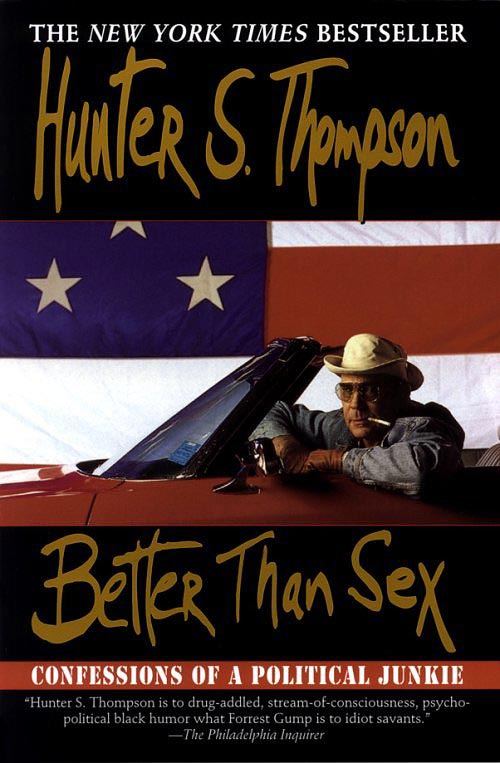
Picked this up this afternoon and spent the better part of today getting into it - already might be a new favorite from Thompson.
I've basically been reading him incessantly this election year - and finding his tales of prior election shenanigans far more informing than anything anyone is writing about the current political climate.
Highly recommended.  |
|
|
| MrJiveBoJingles |
Currently I'm nearly finished Anti-Intellectualism In American Life by Richard Hofstadter. He traces four different kinds of anti-intellectualism in American history:
Religious: the idea that education corrupts the spirit and makes people hard-hearted against conversion. Chronicles the descent of religion from the education-loving and very literate Puritans to the vulgar anti-college rants of evangelists like Billy Sunday.
Political: the idea that intellectuals are "unfit" for politics, not being men of action and possibly being deficient in masculinity. There's a startling bit about the acid rhetoric used by conservatives to ridicule the "fruity" Adlai Stevenson when he ran against Eiseinhower in the 1950s, and another section on the first campaign where intellect and "action" were set up in explicit opposition: John Quincy Adams running against Andrew Jackson.
Business: the idea that too much time spent in education spoils people for the working world, distracting them from the business of making money and making them unpractical, in addition to making everyday manual workers more thoughtful and dissatisfied. Interesting bits on the transition from the "gentleman businessman" who wanted to make a fortune and then retire, to the kind of money-lover who remained unsatisfied no matter how much he accumulated.
Educational: Anti-intellectualism in education? Well, yes. Hofstadter discusses the movement among "progressive" primary and secondary school educators at the turn of the twentieth century to downplay the "academic" side of the curriculum and focus on nebulous ideas of socialization and "life adjustment" at the expense of intellectual rigor. For advanced English they would substitute "business communication," for math "practical arithmetic," and instead of science kids would learn how to do things like pump gas or use ovens. These educators gave themselves out as being "scientific" and as wanting to change the curriculum (debase it, really) in the interests of "society" and "democracy."
I think Hofstadter is at his best in that last section, when he tears into the pretentious "education experts" who would hold kids back for the sake of their foolish theories. Some of the rants and quips had me laughing out loud.
:toothless
Very good book and interesting history of American cultural movements. Though it was published in 1964, I think much of its insight still applies today. |
|
|
| raverchikadee |
 |
|
|
|
|


