|
A Documentry recommendation thread (pg. 9)
|
View this Thread in Original format
| *~LiSa-LoO~* |
| quote: | Originally posted by geroin
Stanford Prison Experiment - Psychology of Imprisonment
The Stanford prison experiment was a psychological study of the human response to captivity, in particular, to the real world circumstances of prison life and the effects of imposed social roles on behavior. It was conducted in 1971 by a team of researchers led by Philip Zimbardo of Stanford University. Undergraduate volunteers played the roles of guards and prisoners living in a mock prison built in the basement of the Stanford psychology building. Prisoners and guards rapidly adapted to their assigned roles, stepping beyond the boundaries of what had been predicted and leading to genuinely dangerous and psychologically damaging situations. One-third of guards were judged to have exhibited "genuine" sadistic tendencies, while many prisoners were emotionally traumatized and two had to be removed from the experiment early. Despite the now highly unsanitary and out of control conditions evident, only one of 50 observers, graduate interviewer Christina Maslach, objected to the experiment. Zimbardo then ended the experiment early.
Ethical concerns surrounding the famous experiment often draw comparisons to the Milgram experiment, which was conducted in 1963 at Yale University by Stanley Milgram, Zimbardo's former high school friend.
Must Watch
VIDEO LINK
50minutes |
I've studied this in class. I didn't realize there was a video. |
|
|
| geroin |
| quote: | Originally posted by infinity HiGH
Pump Up The Volume: The Rise Of House Music
Part 1
Part 2
Part 3
Here's some history for you n00bies :p |
i've posted that before |
|
|
| Jem_hadar |
| quote: | Originally posted by Oreo_The_Cookie
[[ LINK REMOVED ]]
Daniel T. is a "super brain." He can calculate numbers to hundreds of decimal points in seconds and learn new languages in a week. Through a series of real world challenges and complex number problems, Daniel's amazing abilities are demonstrated. |
COOL!
(hehe, kinda like lisa from newsradio ;):p) |
|
|
| Oreo_The_Cookie |
| quote: | Originally posted by Jem_hadar
COOL!
(hehe, kinda like lisa from newsradio ;):p) |
I think I was actually more interested in hearing about Kim Peek, his abilities are oddly fascinating to me. |
|
|
| Lightshow |
| well i just watched the ecstasy documantary...i know realize that it is the best and safest drug...no wonder its my favourite! |
|
|
| MKpacha |
| quote: | Originally posted by *~LiSa-LoO~*
I've studied this in class. I didn't realize there was a video. |
|
|
|
| *~LiSa-LoO~* |
| quote: | Originally posted by Lightshow
well i just watched the ecstasy documantary...i know realize that it is the best and safest drug...no wonder its my favourite! |
:haha: :haha: :haha: |
|
|
| *~LiSa-LoO~* |
| A lot of these links are dead :( |
|
|
| Pett |
HotDocs Film Festival started this weekend and runs through next weekend, I'm going to check out hothouse on sunday.
http://www.hotdocs.ca/ |
|
|
| *~LiSa-LoO~* |
| quote: | Originally posted by Pett
HotDocs Film Festival started this weekend and runs through next weekend, I'm going to check out hothouse on sunday.
http://www.hotdocs.ca/ |
I saw this on Entertainment Tonight and they showed previews for some of them - really wish I could be there. There were a lot of interesting looking ones. |
|
|
| Porky |
| quote: | Originally posted by geroin
Stanford Prison Experiment - Psychology of Imprisonment
The Stanford prison experiment was a psychological study of the human response to captivity, in particular, to the real world circumstances of prison life and the effects of imposed social roles on behavior. It was conducted in 1971 by a team of researchers led by Philip Zimbardo of Stanford University. Undergraduate volunteers played the roles of guards and prisoners living in a mock prison built in the basement of the Stanford psychology building. Prisoners and guards rapidly adapted to their assigned roles, stepping beyond the boundaries of what had been predicted and leading to genuinely dangerous and psychologically damaging situations. One-third of guards were judged to have exhibited "genuine" sadistic tendencies, while many prisoners were emotionally traumatized and two had to be removed from the experiment early. Despite the now highly unsanitary and out of control conditions evident, only one of 50 observers, graduate interviewer Christina Maslach, objected to the experiment. Zimbardo then ended the experiment early.
Ethical concerns surrounding the famous experiment often draw comparisons to the Milgram experiment, which was conducted in 1963 at Yale University by Stanley Milgram, Zimbardo's former high school friend.
Must Watch
VIDEO LINK
50minutes |
there's a great autobiographical book on the topic of the pyschology of imprisonment (not the experiment)
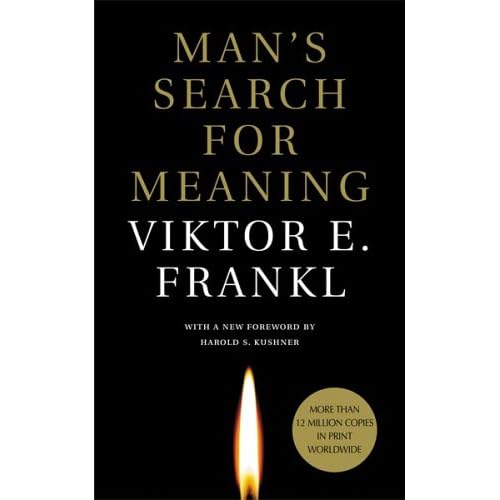
Man's Search for Meaning - by Viktor Frankl
he talks about his imprisonment at a concentration camp during the holocaust. a very powerful read, i recommend to most of my friends. a short read too, the main autobio is only 100 pages long.
 |
|
|
|
|

