|
sex is overrated (pg. 9)
|
View this Thread in Original format
| kuollutrunkkau5 |
| quote: | Originally posted by Lira
Really. To this day, no one can even come to a conclusion regarding how many principles and parameters there are and Chomsky swears by the God he doesn't believe in that linguistics is a branch of psychology... which is a lovely twist in this discussion. |
Maybe but all this has little to do with formal linguistics. This is at best a 'scientific wager'.
Formal linguistics isn't that empirical or based onto real languages. See it more as 'How powerful a computational system do I need to model a language that features these patterns?'
| quote: | | Well, I ask you. Are we ready to consider |
I have never seen any research that assumed that terms like 'language' and 'dialect' are destinct things and worked that. Only in introdictionary tales, no one really believes this and it's just for easy reference.
| quote: | | Yeah, and what did Einstein bring to the table then? |
The photo-electric effect more famously actually.
| quote: | So, what did Einstein do?
You're right when you Einstein mainly joined the dots, but don't you think you're overlooking a few things here? |
In the time that Einstein lived, it was becoming obvious due to Maxwell's aequations and all that light actually has a finite and absolute speed. Einstein simply took that given, and started to see what it implied.
It turned out it implied Newtonian mechanics in the case that the speed of an observer is sufficiently destinct from light, and then some.
| quote: | | No, no I don't. It's too naïve a position regarding science. Not everything is perfectly sound and falsifiable in science, specially the axioms upon which it is developed. |
Okay, then our definition of 'science' is different and yours is probably an unorthodox one at best.
Falsifiability is by most scientists considered to be an essential property wouldn't you say? Things like intelligent design are often called pseudoscience because they lack it.
| quote: | | What matters in the end is the power of prediction. If a theory is falsified, but still explains much of the data, we're not just going to ditch it - we try to fix it and make amendments. Only when it fails to explain too much of the stuff we want and we find a better theory to fit the data do we have a paradigm shift... and even then, only the younger generations jump on the new bandwagon. |
Praediction implies falsifiability. If a theory praedicts x, but y happens, where y is destinct from x. Then the theory is falsified.
However psychological theories lack praediction altogether. They rarely, if ever, praedict things that are not observed yet. Psychology and sociology at this point tries to find an explanation for things that are already observed, but that explanation is not sufficiently general to praedict things that have not been observed. And it's really hard to affirm or refute that it is the thing that explains it.
Basically, because psychology sees so much radical 'progress' and paradigm shifts and knowledge of 30 years ago nowadays is considered 'outdated' and incorrect. We can extrapolate that the same will happen in 30 years again. Ergo, what it thinks today is as wrong as what it thinks 30 years back.
| quote: | | There's a reason why both pomo madmen and logical positivists faded away: the two extremes were both too off the mark. |
Falsifiability is different to positivism.
Positivism is the believe that only through the sciences can come knowledge. And that all science produces is true, and all truth can be found through sciences.
Falsifiability is the belief that falsifiability is essential to sound science. You have to have a way to know if you're wrong. It says nothing about how true science it. It just says 'Well, if you can't check if you're completely on the wrong track? Then really, what can you say about your research?'
| quote: | | Edit: Now, can we go back to talking about sex? Do I need to post pictures of big breasts here so we can focus on what really matters? |
I still haven't in a simple clear answer seen answered the quaestion with 'yes' or 'no': Do you believe science can exist without falsifiability.
If you say 'yes', then our definitions of science are completely different and I'm not sure what you do consider a criterion of science and why for instance intelligent design doesn't fall under it. |
|
|
| Meat187 |
 |
|
|
| -FSP- |
Wow this thread got derailed, but at least I like Lira posts, so all is forgiven.
100% testable imo. Or not. DISCUSS. |
|
|
| MrJiveBoJingles |
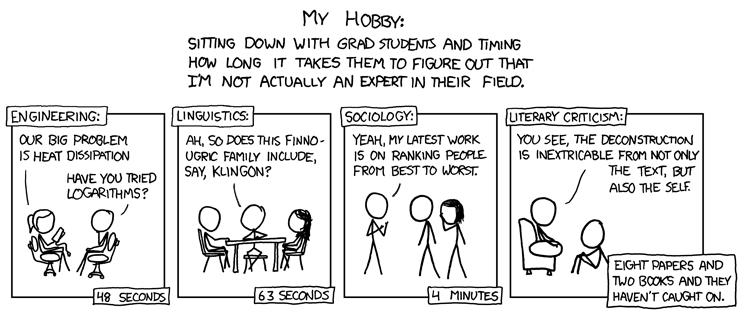
| quote: | People who make their livings in "soft" sciences and the arts are not entirely at ease in the company of chemists and physicists and other "hard" scientists. In such company, the psychologists and sociologists and the professors of English feel like touch-football enthusiasts who have wandered by mistake into the locker room of the Pittsburgh Steelers.
- Richard Mitchell, The Graves of Academe |
And for good measure:
http://www.paulgraham.com/resay.html
| quote: | I disagree with your generalization that physicists are smarter than professors of French Literature.
...Try this thought experiment. A dictator takes over the US and sends all the professors to re-education camps. The physicists are told they have to learn how to write academic articles about French literature, and the French literature professors are told they have to learn how to write original physics papers. If they fail, they'll be shot. Which group is more worried?
We have some evidence here: the famous parody that physicist Alan Sokal got published in Social Text. How long did it take him to master the art of writing deep-sounding nonsense well enough to fool the editors? A couple weeks?
What do you suppose would be the odds of a literary theorist getting a parody of a physics paper published in a physics journal? |
|
|
|
| Beats and Beeps |
psychology doesnt have to be unscientific at all anymore.
however, the primary historical examples of psychologists people think of, such as Freud, were completely unscientific. |
|
|
| Silky Johnson |
| quote: | Originally posted by kuollutrunkkau5
Or let's not forget the Sokal Hoax. Or ehh, the Rosenhan Experiment perhaps?
|
Actually, the Rosenhan experiment was shown the be terrible "research". Did you read the critique of this work by Spitzer? Made Rosenhan look like a moron, lol. |
|
|
| kuollutrunkkau5 |
| quote: | Originally posted by Miss Pie
Actually, the Rosenhan experiment was shown the be terrible "research". Did you read the critique of this work by Spitzer? Made Rosenhan look like a moron, lol. |
Yap, the critique of Spitzer was already discussed. I can't say I'm impressed with his "analogy".
The simple thing however is the fake impostor experiment where Rosenhan said he would send fake patients to a hospital (which agreed to his conditions) and they were supposed to filter them out. While he send none, and they had about 40 people on their list.
If I make a deal with a hospital I will send 40 people who will fake a leg fracture while they don't have one, and I send none, they will count none.
Interestingly, Spitzer himself is lately more and more starting to slide towards Rosenhan. He starts to admit more and more that the system of putting mental patients into discrete categories has its flaws. |
|
|
| Silky Johnson |
| Here's an excerpt from a paper I wrote based on both works explaining why Rosenhan was an idiot: |
|
|
| igottaknow |
a good blowjob is underrated
[[ LINK REMOVED ]]
|
|
|
| kuollutrunkkau5 |
Err, who talked about harm?
Again peope take this waaay to personal. It shows why human interpretation is best avoided. People really have trouble looking at facets of things. I never said psychology of psychiatry wasn't useful, I just said it wasn't scientific. I wouldn't call making my bread in the morning science, but it's a useful thing to do. Likewise, accupuncture is not a science, but it has no clear downsides and the placebo-effect alone justifies its practice to me. But it's not a science.
It's all so typically, typically human. People will always assume that when you have a judgement about some object x which is negative that you think that all parts of x are negative. If you call Armin 'dead handsome', people assume you like his music. If you call Nortt 'a total idiot', people will assume you don't like his music. I just said psychiatry and psychology are not rigorously scientific. If they are useful is completely beyond the scope of that.
Índeed, when people say 'pure science', they often imply that it has no practical use at all. |
|
|
| Silky Johnson |
| Rosenhan talked about harm to patients very clearly in his research. |
|
|
| kuollutrunkkau5 |
| quote: | Originally posted by Miss Pie
Rosenhan talked about harm to patients very clearly in his research. |
So what? I never said Rosenhan was a genious, nor did I defend him.
I'm just saying that his research demonstrates that psychiatry was at least at that time not at a level of science. If that was his intend or not is irrelevant to the fact if the research demonstrates it. For all it could have been simply a bizarre accident, an administrative failure which showed this without anyone trying to demonstrate anything.
Again, you people really have severe troubles seeing different facets of a situation as separate things.
it's perfectly possible for Rosenhan to be an idiot at the same time and his experiment still demonstrating that psychiatry is not a science. |
|
|
|
|

