|
What Are You Reading? Part Deux. (pg. 57)
|
View this Thread in Original format
| EgosXII |
| quote: | Originally posted by Lira
I'm not saying Nietzsche failed to do what he meant to (if it sounded like it, I apologise for being myself unclear). It's his project that I'm sceptical about... and maybe unfairly, as you say.
I do have some sympathy regarding continental philosophy because even though, as far as I know, Quine and the late Wittgenstein brought analytic philosophy to its knees and post-modernism imploded the continental tradition, Quine and Wittgenstein had fairly interesting views on language that weren't necessarily a disaster - however, Derrida's take on Saussure, which seems to have fuelled much of the post-modern critique of the continental tradition, was based on a misconception of Saussure's ideas (as a linguist, I'm much confident I know what Saussure was talking about)... so it was, in the end, extremely unfair.
Probably the appropriation of post-Nietzschean concepts by Derrida is one of the reasons for my anti-Nietzschean tendencies, but like I said before, I'm prepared to say this judgement is perhaps unfounded.
I demand a PDF! |
Love the blenders as fans analogy :stongue:
yeah sorry, I think i misunderstood what you meant-- If you just don't agree etc thats fair enough really, I DID think you were more having a go at his method (ambiguity of points etc) :o
Derrida's an interesting figure in the divide for sure: There was huge controversy when he was offered a honorary doctorate from (i think) cambridge... An analytic philosopher said he didn't deserve it and there was a big uproar, since the faculty can't give one out unless people agree to it :haha:
Derrida didn't really consider himself a continental philosopher, but the analytics really hated him, and considered him a non-philosopher (not all of them of course, but its interesting that he was so disliked that a philosopher would attempt to deny him an honorary doctorate...)
Wittgenstein is really interesting because both sides claim him; he was one of the first 'analytic' philosophers (even before Russel really delineated 'good' and 'bad' philosophy), but in modern times most people consider him a kind of phenomenologist, so its not really as clear cut as some of the more extreme phenomenologists and analytic guys whose allegiances are really clear... Its one of the reason ol' ludwig remains intreresting though, as its an area of debate, but he no doubt would have considered the divide retarded :p |
|
|
| Lira |
| quote: | Originally posted by EgosXII
Love the blenders as fans analogy :stongue: |
:D
| quote: | Originally posted by EgosXII
Derrida didn't really consider himself a continental philosopher, but the analytics really hated him, and considered him a non-philosopher (not all of them of course, but its interesting that he was so disliked that a philosopher would attempt to deny him an honorary doctorate...) |
So, what did he take himself to be?
| quote: | Originally posted by EgosXII
Wittgenstein is really interesting because both sides claim him; he was one of the first 'analytic' philosophers (even before Russel really delineated 'good' and 'bad' philosophy), but in modern times most people consider him a kind of phenomenologist, so its not really as clear cut as some of the more extreme phenomenologists and analytic guys whose allegiances are really clear... Its one of the reason ol' ludwig remains intreresting though, as its an area of debate, but he no doubt would have considered the divide retarded :p |
The bit I like the most about him is when he notices he's getting too close to pragmatism (in his later years) and starts getting all worked up about it :p
Never thought of him as a phenomenologist. Even in the Tractatus? |
|
|
| EgosXII |
| quote: | Originally posted by Lira
:D
So, what did he take himself to be?
The bit I like the most about him is when he notices he's getting too close to pragmatism (in his later years) and starts getting all worked up about it :p
Never thought of him as a phenomenologist. Even in the Tractatus? |
yeah sorry didn't make myself too clear-- I think Derrida considered himself neither, as he directly engaged with both sides, but analytics (who are more into what is and is not philosophy (even at my uni its ridiculous! Analytics be crazy!)) really didn't like him, and considered his work irrelivant (most likely similar to what you said about his stuff on the linguist, which might be entirely accurate, but its interesting how upset they get about it more than anything :p )
and about luddy, no, really only in investigations sorry, mostly because of his focus on everyday experience, private language arguments etc... for example, he thought that the existence of other minds was given before we came to prove it, since its written into our very experience of the world... Can't conceive of the world without other people etc... that's rough obviously, but is a very phenomenological approach to 'proving' things in the world... Basically he uses intersubjectivity and a kind of transcendental argument, which analytics generally don't like, but phenomenologists LOVEEEE long time!
If you're interested, Soren Overgaard has done a number of papers on Wittgenstein as a phenomenologist, mostly focusing around his take on mind (think he might have even done a whole book on it)-- I've read 2 of the papers, which are both really good, one is from 05 and is about witty & Levinas, and another is from 06, which I would recomend if you're interested :)
titled: "The Problem of Other Minds: Wittgenstein's Phenomenological Perspective." Compares Wittgensteing with Merleau-Ponty and others, and is pretty good :)
If you can't find it I can email it over to you too :) |
|
|
| woscar |
| quote: | Originally posted by EgosXII
\I think that philosophy should be mandatory for any student at university. Teaches you basic critical thinking, which god knows everyone needs a bit more of |
+ 1 million. |
|
|
| Ted Promo |
Created a goodreads account. scootsmagoo
add me for I yearn for books and more books. Bookingly. |
|
|
| EgosXII |
Just read Dostoyevski's Notes from the underground, which was ing brilliant.
Now reading "We", which is well and truly living up to the hype created in the other thread :D |
|
|
| srussell0018 |
 |
|
|
| knowhope |
| Started on LOTR and my god i was expecting a simple story. The first 10 pages talks about the Baggins family tree. Very detailed, i really can't wait to keep going. |
|
|
| Tasty Onions |
| quote: | Originally posted by Tasty Onions
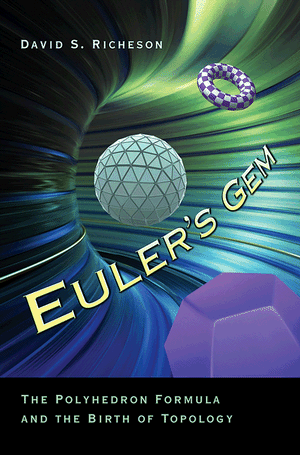 |
Close to finishing this, ing excellent. Real workout for the brain, too, at least for a math noob like me.
 |
|
|
| knowhope |
After reading that, i hope you're about to create a time machine by using a wormhole with your mind.
C0R: Wat ze hel did you reed? |
|
|
| Tasty Onions |
There's a formula from geometry called the Polyhedron Formula, which says:
Vertices - Edges + Faces = 2
This formula holds for "ordinary" polyhedra like cubes, spheres, and octahedrons, but also for some less familiar ones, too. Then you have more exotic shapes, like a torus ("donut"):

The formula doesn't hold the same for them. So the natural question is, what's the number for V-E+F in the case of a torus? Turns out it's 0. And what you can do is classify different shapes by the number you get with the formula V-E+F.
Topology is (partly) based around the idea that shapes with the same number (called "Euler Characteristic") are in some sense really the "same" shape, when viewed from a broader perspective. So, for example, you can view a cube as basically just a sphere that has been "deformed" into a different shape. You can get the ordinary polyhedra by poking and prodding a sphere, but you can't get a torus (for example) without doing something more drastic: cutting a hole in it.
[Edit: Wiki has a neat animation demonstrating "equivalence" between two different shapes, a coffee cup and a donut.]

That's just the beginning, but I won't babble on. The book goes into detail about the people who discovered different aspects of topology and related areas, and gives some of their proofs for theorems and stuff. |
|
|
| knowhope |
That animation doesn't show anything at all.
It just tells me that one shape can be made into another if it's play-doh. |
|
|
|
|

