|
Who doesn't want kids, ever? (pg. 3)
|
View this Thread in Original format
| ziptnf |
| quote: | Originally posted by Banora
Yeah, but it is generally frowned upon to give your kid up at the local pound when their behavior problems are too much (or they still crap on the floor). |
Hahaha wtf? Any parent can prevent most children's behavioral problems. And most "problems" are usually fairly common and easy to fix.
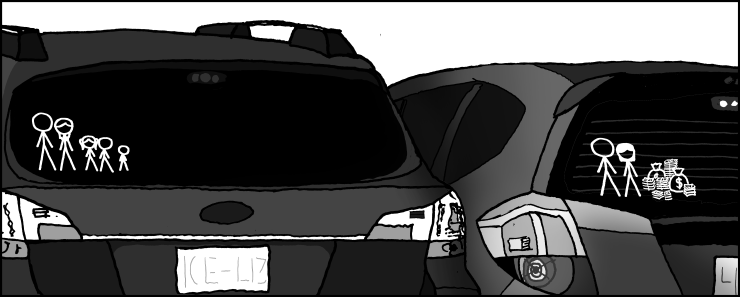
This thread reminds me of this comic:
 |
|
|
| Banora |
| quote: | Originally posted by ziptnf
Hahaha wtf? Any parent can prevent most children's behavioral problems. And most "problems" are usually fairly common and easy to fix.
|
Even easier fix if you can take them to the pound ;) |
|
|
| bananas |
| Yeah, Banora, I can understand that every child you've encountered has been annoying, but that's probably because every parent of those children has been annoying aswell |
|
|
| Banora |
| quote: | Originally posted by bananas
Yeah, Banora, I can understand that every child you've encountered has been annoying, but that's probably because every parent has of those children has been annoying aswell |
There have been a few cool children I've met, but it doesn't make my desire to be any less. |
|
|
| Arbiter |
| quote: | Originally posted by bananas
That's the thing. When I'm thinking about having kids, I'm thinking I'll have them when I can support them, when I'm in a good financial situation.
That's what I'm asking, theoretically, if everything's good, would you have children? I would. |
No matter how good my financial situation becomes, having children will always mean living at a lower standard of living than I otherwise would. And greater personal wealth would do little to relieve the burden on my personal freedom and free time. Not to mention the omnipresent possibility that your financial situation could suddenly take an unexpected turn for the worse, via divorce, or loss of employment. How can you account for that in deciding when it's safe to have children?
On the other side of the ledger, I have little use for children generally, and if my children were anything like I was as a child, it only stands to become a greater headache. So any upside is highly speculative, at best.
It seems to me that the cost/benefit equation is rather straightforward. Do you disagree? |
|
|
| Vector A |
| I don't even find kids that annoying, personally, at least once they get past the "bawling for no apparent reason" phase. They can be cute and amusing. But that doesn't mean I want my life to be devoted entirely to them. |
|
|
| ziptnf |
| quote: | Originally posted by bananas
Yeah, Banora, I can understand that every child you've encountered has been annoying, but that's probably because every parent has of those children has been annoying aswell |
Which in turn is a problem with society. If the only children she has encountered were terrible, then that means their parents were unfit to raise them.
I have taught children how to swim every weekend for the past 5 years. There are a few little monsters who I hate teaching and are annoying, but their parents reflect that same attitude. A majority of them are well-behaved, good listening students with polite attitudes and funny outlooks on life. One of them tells me about what she does in school and the books she reads. She's very advanced! I find that all children are capable of the same level of intelligence, only if they are properly guided through life and well-educated. |
|
|
| bananas |
| quote: | Originally posted by Arbiter
No matter how good my financial situation becomes, having children will always mean living at a lower standard of living than I otherwise would. And greater personal wealth would do little to relieve the burden on my personal freedom and free time. Not to mention the omnipresent possibility that your financial situation could suddenly take an unexpected turn for the worse, via divorce, or loss of employment. How can you account for that in deciding when it's safe to have children?
On the other side of the ledger, I have little use for children generally, and if my children were anything like I was as a child, it only stands to become a greater headache. So any upside is highly speculative, at best.
It seems to me that the cost/benefit equation is rather straightforward. Do you disagree? |
I agree that you, as we all know, are a robot, so bringing the argument of mental pleasure of having children would be fruitless. (sorry for my poor choice of words on the matter, english is far from my first language). |
|
|
| bananas |
| quote: | Originally posted by Vector A
I don't even find kids that annoying, personally, at least once they get past the "bawling for no apparent reason" phase. They can be cute and amusing. But that doesn't mean I want my life to be devoted entirely to them. |
So you think that once you have child your life is entirely devoted to him/her/it? |
|
|
| ziptnf |
| quote: | Originally posted by bananas
So you think that once you have child your life is entirely devoted to him/her/it? |
Well, I don't think you're a parent, but it's true. From everyone I've heard who has children, once their child is born, everything else becomes 2nd priority. |
|
|
| Vector A |
Not to rain on the parade of would be parents, but...
| quote: | "In what may have been the most influential article ever written in the field of developmental behavior genetics, Plomin and Daniels (1987) reviewed evidence that a substantial portion of the variability in behavioral outcomes could not be explained by the additive effects of genotype or the environmental influences of families. They suggested that this residual term, which they called the nonshared environment, had been neglected by environmentally oriented researchers who assumed that the most important mechanisms of environmental action involved familial variables, like socioeconomic status [SES] and parenting styles, that are shared by siblings raised in the same home and serve to make siblings more similar to each other. Indeed, Plomin and Daniels argued, once genetic relatedness has been taken into account, siblings seem to be hardly more similar than children chosen at random from the population."
In other words, despite a lifetime of proximity, your adopted child may bear no more similarity to you (in terms of, e.g., intelligence) than someone selected at random from the general population. The shared family environment that your children (biological or adopted) experience has little or no measurable effect on their cognitive development. While there are environmental effects on intelligence (the highest estimates of heritability for adult IQ are around .8, and some would argue for a lower value; see here for Turkheimer's work suggesting low heritability in the case of severe deprivation), they seem to be idiosyncratic factors that can't be characterized using observable parameters such as the parents' SES, parenting style, level of education, or IQ. It is as if each child experiences their own random micro-environment, independent of these parental or family characteristics.
...By now these results are well understood and accepted by experts, but not by the general population or even policy makers.
http://infoproc.blogspot.com/2009/1...nvironment.html |
The evidence seems to be that intelligence (and possibly other traits) is a product of genetics and non-familial environment. The effect of parenting and home life is pretty close to nil.
The guy who wrote the blog above has two kids, btw. |
|
|
| bananas |
| quote: | Originally posted by ziptnf
Well, I don't think you're a parent, but it's true. From everyone I've heard who has children, once their child is born, everything else becomes 2nd priority. |
No, I'm not a parent, and I've always felt that even if I have children, I still have life of my own. Maybe I'm wrong.:] |
|
|
|
|

