|
this isn't chill-out material. serious stuff here, guys (pg. 4)
|
View this Thread in Original format
| Gen3r4l1ty |
| Calling Poe's on this one. |
|
|
| LiquidX |
| quote: | Originally posted by Comrade Stalin
I can't get around Christians'...
1) Rejection of evolution
2) Damnation of everyone who isn't a Christian, including other monotheists
3) Self-indoctrination based on nothing but faith and perceived spiritual experiences (which would be called psychosis if it wasn't called religion)
Why should I believe in this religion? Just because. When it comes down to it, that is their answer. Just because. Well, that just isn't good enough. God is either a masochistic prankster or He isn't there. |
Don't forget that the "Christian" world is divided in many beliefs and interpretations of the Bible.. nevertheless, most major Christian denominations do fall into that category. In the same tone, you would add muslim, judaism, and every other major religion under 1 ore more of the above mentioned. |
|
|
| Bren-F |
| quote: | Originally posted by SYSTEM-J
No. If anything, it's more bull, because at least most modern Christians acknowledge that most of those stories about burning bushes and talking serpents were metaphorical. |
Which is one of the most bull things about Christianity.
I mean, of all the stories within the old and new testement, it seems the heads of the christian church have gone through over the ages and labelled the more outlandish ones as 'metaphores' or 'parables'
I mean, who exactly makes these decisions on what stories are and are not true in the Bible? On what information do they base this decision on? Why is Noah's ark less believable than walking on water?
It's all a load of . And as for this horse-:
| quote: | Originally posted by sixth seal
"In regards to Jesus Christ, there are only three possibilities:
1) The first possibility is this: Christ was a mad man, because any man who says that he is the Son of God and is not, even if he believes it in sincerity, is crazy, a mad man.
2) Jesus was a liar; that he knew he was not the Son of God and he lied and deceived more people than any false prophet in the history of mankind.
3) He is the Son of God
[U]Probably some of you say: 'Well Jesus was a good man, but I think he was not actually the Son of God.'
|
To even approach this debate, you have accept that Jesus ever existed.
There is no real evidence that he ever existed. The tales of his life are as confirmable as the bible - a wide selection of hearsay and fables passed around amongst fellow believers.
Even option one is in the realms of fantasy. |
|
|
| kadomony |
 |
|
|
| Zharen |
Hey if God wants to end the Earth in a couple of years then go for it. Who am I to tell him otherwise?
I just want to be able to tell him to his face what a horrible idea it was to let Man be in charge of this Earth, and that I guess even All-Mighty entities also make mistakes. |
|
|
| Zharen |
| quote: | Originally posted by kadomony
|
 |
|
|
| SYSTEM-J |
| quote: | Originally posted by Bren-F
Which is one of the most bull things about Christianity.
I mean, of all the stories within the old and new testement, it seems the heads of the christian church have gone through over the ages and labelled the more outlandish ones as 'metaphores' or 'parables'
I mean, who exactly makes these decisions on what stories are and are not true in the Bible? On what information do they base this decision on? Why is Noah's ark less believable than walking on water? |
Well, the whole book is open to interpretation, and people draw different conclusions from it. I'm not religious, so I think most of those conclusions are wrong. For me, God himself is quite obviously a metaphor.
However, the bull of a Church revising its understanding of a text in light of scientific evidence is considerably less than creationists/alien theorists flagrantly contradicting science and mangling facts and evidence to support their whimsical beliefs. |
|
|
| pkcRAISTLIN |
| quote: | Originally posted by Bren-F
To even approach this debate, you have accept that Jesus ever existed.
There is no real evidence that he ever existed. The tales of his life are as confirmable as the bible - a wide selection of hearsay and fables passed around amongst fellow believers.
Even option one is in the realms of fantasy. |
I think this is a fairly interesting argument regarding jesus’ existence (hey Lira, I found it!).
| quote: | Originally posted by Arbiter
He mysteriously appears in historical records beginning over a century after his supposed death, yet apparently made no impression on anyone within a lifetime of his supposed life. There will always be some metaphysical doubt, but his non-existence is the obvious conclusion. |
| quote: | Originally posted by Renegade
I think this is good evidence against some of the more extraordinary claims made about Jesus of Nazereth, but I don't think it can be used as positive evidence against his ever existing. If Jesus was an itinerant preacher from the backwaters of Galilee (as opposed to some messianic demi-god) then there is no reason to expect that his actions would have ever been recorded in the surviving historical documents from his day (which are primarily Roman in origin: there is no reason to believe that his fame should have ever have extended to the halls of Rome). This is hardly a strong argument for the historicity of Jesus in itself, but I think the alternative explanation - that Jesus, as a historical figure, never existed - is founded on arguments that become increasingly strained and unlikely upon closer inspection.
In the first place, if Jesus never existed then he must have been invented at some point. This is hardly an implausible scenario, but I think there are indications in the Bible (yeah, yeah, I know... bear with me) that this is the least likely of the competing possibilities. The Gospels, for instance, are in quite firm agreement on fairly incidental biographical details, but differ wildly on some of the more theological and metaphysical claims. For instance, all the gospels make mention of:
- Jesus being from Nazareth.
- Jesus' baptism by John the Baptist.
- The comparitive brevity of his ministry.
- His rampage in the temple.
- His audience before Pilate.
- His crucifixion.
And so on. Note that some of these biographical details are somewhat theologically inconvenient and they show in the way they are addressed by the gospel authors. Matthew and Luke believed (mistakenly) that Isaiah contains a prophetic passage indicating the messiah was to be born in Bethlehem. The authors had to invent convoluted (and completely contradictory) accounts as to how it was that Jesus could have been born in Bethlehem while growing up in Nazareth. If there was not a common belief that Jesus was from Nazareth then this would have been completely unnecessary.
Jesus' baptism is another example. In the earliest gospel (Mark) we see Jesus depicted as receiving the spirit (becoming "God's son") when he is baptised by John (Mark 1:10-11). Mark doesn't seem to have any problem with this, but later Christian thinkers apparently did: if John is capable of commanding the spirit of God, who is the real messiah here? By the time we get to the gospel of John (the last, and most theologically contrived of the canonical gospels) we still have John the Baptist baptising Jesus, but it is followed up with a quite gratuitous testimony from JTB assuring the reader that he was "not the Christ" and that is actually Jesus who was "sent by God" (John 1:29-34, 3:27-36). If Jesus was not actually baptised, I see no reason for such a detail to be invented, as it merely creates a theological ambiguity which necessitates the kind of ludicrous rationalistions that we see here given in the gospel of John.
On the other hand, the metaphysical / theological claims that became central to Christianity are extremely muddled and inconsistent between the gospels. They disagree on the matters of:
- The virgin birth: (Only mentioned by Matthew and Luke, who present contradictory nativity accounts. John (1:45) and Paul (Rom 1:3) claim that Jesus had a very human father: the existence of Joseph seems to be another inconvenient biographical detail that would not have been invented by anyone attempting to create the mythology of a divine saviour.)
- The resurrection: (Not mentioned by Mark (in the earliest manuscripts, the gospel ends amiguously at 16:9) and the other gospels offer contradictory accounts. The substance of the resurrection appears to be in doubt too. For John, for instance, the resurrection is a physical one (John 20:27) but for Paul it is a spiritual resurrection (1 Cor 15:35-44).)
- Salvation: (Mark, as far as I'm aware, makes no discernable reference to salvation. For Matthew and Luke salvation is earthly (when the Kingdom of God arrives) and requires the fulfillment of specific (though ambiguous and perhaps contradictory) works. For John, salvation is heavenly and requires only belief in Jesus. For Paul, the nature of salvation is spiritual and requires only faith in Jesus.)
- The Divinity of Jesus: (Only John conflates Jesus with God. Mark, Matthew, Luke and Paul are somewhat ambiguous about Jesus' relationship to the divine, though it is notable that none have him claiming divinity. The relationship between the nature of Jesus and the nature of god was only resolved (if you can really call it that) with the clumsy invention of the the trinity at the Nicene Council about 200 years after the final book in the NT was penned.)
Again, if Jesus was a mythical invention then surely these basic theological details would be the first articles created, would form the central, unambiguous foundation of the faith and would not have lent themselves quite so easily to such a divergent set of interpretations. The fact that it is biographical - as opposed to theological - details that are consistent across the earliest Christian literature, seems to indicate to me that Jesus was a historical figure who was later conflated with a whole lot of metaphysical, soteriological nonsense, rather than the other way round. |
|
|
|
| Bren-F |
| quote: | Originally posted by SYSTEM-J
Well, the whole book is open to interpretation, and people draw different conclusions from it. I'm not religious, so I think most of those conclusions are wrong. For me, God himself is quite obviously a metaphor.
|
Not a religious person myself either btw.
I actually like that answer though. It does seem that the more simple idea of God and his prophets has been expanded upon with outlandish stories to meet the advances and counter claims more modern knowledge by the more prominently placed believers of various faith systems (not exclusively Christianity).
Of course when you get to a period of time when the vast majority of the claims made by religious text can be disproved by science or common sense, they have to backtrack and remove the more outlandish of their claims. |
|
|
| Lira |
| quote: | Originally posted by pkcRAISTLIN
I think this is a fairly interesting argument regarding jesus’ existence (hey Lira, I found it!). |
Thanks! By the way, I'm coming to the conclusion that James and I are the only people around here that use the list thingy.
And I'm alone in my penchant for html code that isn't intended to annoy readers :p |
|
|
| igottaknow |
 |
|
|
| Lilith |
In 2010 Tiesto renounced the temptations of the evil, candy coated trance music and joined the happy born again house brigade which up to this point was slightly less sinful, but mostly just rubbish rehashed from the early 90's.
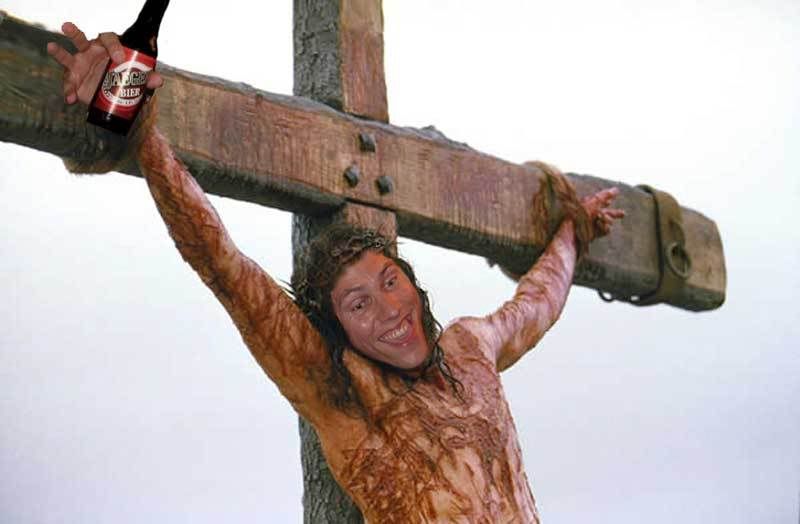
...there was much rejoicing. |
|
|
|
|

