Originally posted by rabbitjoker
Learn something about CANDU reactor technology and meltdown risk.
quote:
Fears of a nuclear meltdown in Japan have put the industry under scrutiny, with analysts predicting the ongoing crisis will lead to soul searching about the future of nuclear power.
Quebec and Ontario are prepared to handle a natural disaster comparable to the 8.9-magnitude quake that rocked Japan on Friday.
Even so, experts warn the disaster unfolding in Japan could lead to a shift in public opinion and bring about safety measures that will make nuclear power a more costly energy source.
“I think we're going to have a renewed, global conversation about the responsible management of the atom,” Tom Adams, an Ontario-based energy consultant, said in an interview.
“At minimum, it's going to send us back to the drawing board on the safety of existing reactors.”
Japanese officials have been scrambling to prevent meltdowns at two power plants after their units lost cooling ability in the wake of the powerful tremor and tsunami on Friday.
An explosion Saturday shattered a building housing one nuclear reactor, though officials said the radiation leak was decreasing and the actual metal enveloping the reactor was still intact.
A Nova Scotia-based expert on nuclear disasters called the problems in Japan a “major blow to the industry.”
David Mosey, author of Reactor Accidents, which chronicles the tragedy of Chernobyl and other nuclear disasters, said the industry will need to examine closely what could have been done differently.
On the whole, though, Mr. Mosey said nuclear energy has been relatively safe and every energy source has its hazards.
In some 14,000 cumulative reactor-years of commercial operation in 32 countries, there have been two major accidents – Chernobyl and Three Mile Island, according to the World Nuclear Association, an industry group.
In Canada, nuclear power saves about 90 million tonnes of greenhouse gases per year compared to coal-fired generation, according to the Canadian Nuclear Association.
That's about 12 per cent of Canada's total greenhouse gas emissions.
In addition, Canada's nuclear power stations contribute about $6.3-billion each year to the country's GDP.
The nuclear troubles in Japan, however, are unlikely to help Atomic Energy of Canada Ltd., the country's struggling nuclear energy research arm.
“I think AECL's prospects have dropped even further into the basement,” said Adams.
“Everybody is going to get caught in the downdraft.”
The federal government put AECL's CANDU reactor business up for sale in 2009, but has yet to find a buyer.
In the past, Mr. Adams said nuclear accidents and near-accidents have led to more stringent safety requirements.
That's a good thing, he said, but it also means nuclear power will become even more costly to produce.
For instance, the French reactor being built in Finland right now costs significantly more because it has the most modern safety systems, he said.
Canada has five nuclear reactor complexes: one in New Brunswick, one in Quebec, and three in Ontario.
Canada's nuclear regulator said it's confident Canadian reactors could withstand a tremor or a tsunami.
The Canadian Nuclear Safety Commission posted a statement on its website saying the country's nuclear plants “are among the most robust designs in the world” in the world and have tools in place to prevent damage in the case of such a natural disaster.
A spokeswoman for AECL said reactor sites in Canada are built on sturdy ground.
Robin Forbes said the sites have been “geologically screened to make sure that they are built in a location that is seismically stable.”
Concerns have been raised in the past, however, about whether a nuclear plant in Pickering, Ont. is located on a fault line.
Greenpeace Canada said in a release the events in Japan are “yet another reminder of the inherent risks of nuclear power, which will always be vulnerable to a potentially deadly combination of human error, design failure and natural disaster.”
(Courtesy of The Globe and Mail)
E2EK1EL
quote:
Originally posted by jester
:nervous: :nervous: :nervous:
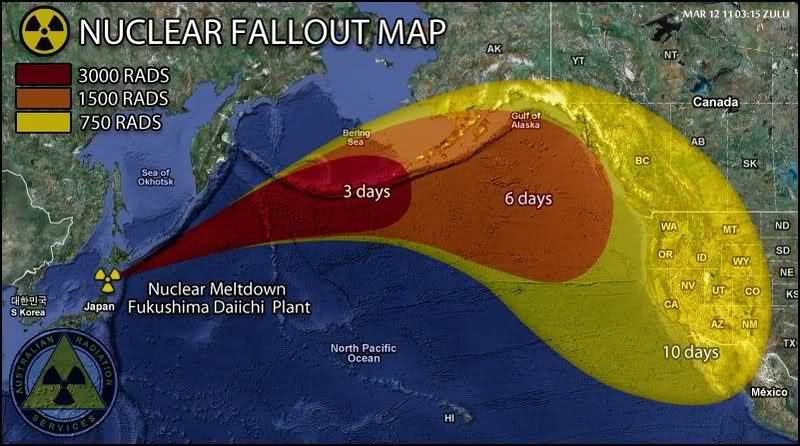
What if the wind isn't blowing east though?
They were talking about wind directions if the meltdown does happen, towards the land, towards the sea or worst case ... if it rains.
EDIT: Found something here about that map
http://yournewreality.blogspot.com/
"The Nuclear Fallout Map is fake simply because Australian Radiation Services don't issue such maps. It was likely chosen before ARS offices are closed until Monday, as they are most weekends, making it harder for journalists who decide to pursue it to make contact.
This unsourced and likely dodgy chart (nausia?) is also being heavily circulated, on social networking sites, forums and email, along with the fake Nuclear Fallout Map :
0-50 rads - No obvious short-term effects
80-120 rads - You have a 10% chance of vomiting and experiencing nausia for a few days
130 -170 rads - You have a 25% chance of vomiting and contracting other symptoms
180-220 rads - You have a 50% chance of vomiting and having other severe physical effects
270-330 rads - 20% chance of death in 6 weeks, or you will recover in a few months.
400-500 rads - 50% chance of death
550-750 rads - Nausia within a few hours ; no survivors
The fake map shows a huge nuclear fallout cloud of 750 rads engulfing millions of Americans by March 22. So, if you were a West Coast living American, the fake map and the above numbers might lead you to believe you and all your family and neighbours will be dying within 6 to 10 days."
rabbitjoker
quote:
Originally posted by jester
(Courtesy of The Globe and Mail)
Your article is unrelated to CANDU technology and meltdown risk (but thanks none the less).
jester
quote:
Originally posted by E2EK1EL
What if the wind isn't blowing east though?
They were talking about wind directions if the meltdown does happen, towards the land, towards the sea or worst case ... if it rains.
If it goes towards Asia / Russia it be there quite early :nervous: Honestly if it comes to this, it will become a global disaster :nervous:
According to Nenner, who studies war and peace cycles, the collapse will be initiated by “a major war starting at the end of 2012 to 2013,” a startling claim to which the host David Asman merely responded, “wow”.
First Middle East, now Japan, who is next?
jester
quote:
Originally posted by rabbitjoker
Your article is unrelated to CANDU technology and meltdown risk (but thanks none the less).
Only thing I've heard was from a friend, is that the CANDU technology is one of the best systems out there, but I will look into it.
Got any foot notes for some of us?!
VDub
Official2012Countdown.com
jester
Fukushima nuclear plant was tested to withstand 7.9 quake, not 8.9
Plus I am trying to find this link I saw before, some parts of Japan are separating from each other :/
Jer
quote:
Originally posted by jester
Only thing I've heard was from a friend, is that the CANDU technology is one of the best systems out there, but I will look into it.
Got any foot notes for some of us?!
CANdu reactor development and engineering is arguably the best in the world. I just did some reading on Fukushima NPP, I didn't think it was CANdu but needed to make sure.
One thing to be thankful for is that it doesn't have the same combustible graphite core as the Chernobyl NPP does - though it's looking pretty bad I'm pretty confident it won't hit the fan like it did in '86. Keep in mind that back then, the Soviets didn't own up to the severity of the disaster until the particulate was setting off alarms as far away as Greenland. If goes down, we'll know.
exraver
quote:
Originally posted by Jer
CANdu reactor development and engineering is arguably the best in the world. I just did some reading on Fukushima NPP, I didn't think it was CANdu but needed to make sure.
One thing to be thankful for is that it doesn't have the same combustible graphite core as the Chernobyl NPP does - though it's looking pretty bad I'm pretty confident it won't hit the fan like it did in '86. Keep in mind that back then, the Soviets didn't own up to the severity of the disaster until the particulate was setting off alarms as far away as Greenland. If goes down, we'll know.
Yep, of course.
Biggest challenge
Plant operator TEPCO has had a rocky past in an industry plagued by scandal. In 2002, the president of the country's largest power utility was forced to resign along with four other senior executives, taking responsibility for suspected falsification of nuclear plant safety records.
Many Japanese flooded social networking sites with worries about the plant.
"I can't trust TEPCO," said a person with the handlename Tanuki Atsushi on mixi, the Japanese social networking site.
Originally posted by Jer
CANdu reactor development and engineering is arguably the best in the world. I just did some reading on Fukushima NPP, I didn't think it was CANdu but needed to make sure.
The Japanese reactors are not CANDU - however earlier in the thread people were speculating on what would happen if this was in Canada, my response regarding CANDU was to limit that discussion as the same type of meltdown risk is not possible with CANDU technology.