Quake moved Japan coast 8 feet, shifted Earth's axis
(CNN) -- The powerful earthquake that unleashed a devastating tsunami Friday appears to have moved the main island of Japan by 8 feet (2.4 meters) and shifted the Earth on its axis.
"At this point, we know that one GPS station moved (8 feet), and we have seen a map from GSI (Geospatial Information Authority) in Japan showing the pattern of shift over a large area is consistent with about that much shift of the land mass," said Kenneth Hudnut, a geophysicist with the U.S. Geological Survey (USGS).
Reports from the National Institute of Geophysics and Volcanology in Italy estimated the 8.9-magnitude quake shifted the planet on its axis by nearly 4 inches (10 centimeters).
The temblor, which struck Friday afternoon near the east coast of Japan, killed hundreds of people, caused the formation of 30-foot walls of water that swept across rice fields, engulfed entire towns, dragged houses onto highways, and tossed cars and boats like toys. Some waves reached six miles (10 kilometers) inland in Miyagi Prefecture on Japan's east coast.
The quake was the most powerful to hit the island nation in recorded history and the tsunami it unleashed traveled across the Pacific Ocean, triggering tsunami warnings and alerts for 50 countries and territories as far away as the western coasts of Canada, the U.S. and Chile. The quake triggered more than 160 aftershocks in the first 24 hours -- 141 measuring 5.0-magnitude or more.
The quake occurred as the Earth's crust ruptured along an area about 250 miles (400 kilometers) long by 100 miles (160 kilometers) wide, as tectonic plates slipped more than 18 meters, said Shengzao Chen, a USGS geophysicist.
Japan is located along the Pacific "ring of fire," an area of high seismic and volcanic activity stretching from New Zealand in the South Pacific up through Japan, across to Alaska and down the west coasts of North and South America. The quake was "hundreds of times larger" than the 2010 quake that ravaged Haiti, said Jim Gaherty of the LaMont-Doherty Earth Observatory at Columbia University.
The Japanese quake was of similar strength to the 2004 earthquake in Indonesia that triggered a tsunami that killed over 200,000 people in more than a dozen countries around the Indian Ocean. "The tsunami that it sent out was roughly comparable in terms of size," Gaherty said. "[The 2004 tsunami] happened to hit some regions that were not very prepared for tsunamis ... we didn't really have a very sophisticated tsunami warning system in the Indian Ocean basin at the time so the damage was significantly worse."
The Japanese quake comes just weeks after a 6.3-magnitude earthquake struck Christchurch on February 22, toppling historic buildings and killing more than 150 people. The timeframe of the two quakes have raised questions whether the two incidents are related, but experts say the distance between the two incidents makes that unlikely.
"I would think the connection is very slim," said Prof. Stephan Grilli, ocean engineering professor at the University of Rhode Island.
More than 10,000 feared dead in Japan Canadian among 1,200 confirmed fatalities so far in quake, tsunami
The death toll in Japan is expected to soar past 10,000 in one prefecture alone, officials said Sunday, after the country was ravaged by its worst recorded earthquake and a ferocious tsunami.
Japanese police believe Miyagi prefecture has suffered a devastating loss of life, following reports of 9,500 people unaccounted for in the coastal town of Minamisanriku — more than half that community's population.
As international rescue squads touched down on Sunday from Germany, Switzerland, Hungary and Taiwan, Japanese Prime Minister Naoto Kan called the impact from the natural disasters the nation's biggest tragedy since the Second World War.
''This is the worst crisis in the postwar history of 65 years,'' Kan said in his televised address, imploring citizens to unite to rebuild the devastated country. ''All Japanese are now being tested on whether we can overcome the crisis, and I'm sure (we) will be able to overcome this crisis.'
Japan has mobilized 100,000 troops to help pick through piles of debris and search for survivors. Parts of the northeast coast were swallowed in the tsunami spawned by Friday's 8.9-magnitude quake, leaving 1.4 million without running water and two million households without heat and electricity. Japanese officials believe the temblor was even stronger than that measured by the U.S. Geological Survey, raising their calculations on Sunday to 9.0.
To save energy, rolling blackouts moving along three hours at a time are to start on Monday, power authorities have confirmed. It's the first time the Tokyo Electric Power Co. has had to take such measures in its 60-year history.
Among the at least 1,200 people confirmed dead so far in Japan is one Canadian, Ottawa said. The victim's name and hometown have not been released. The minister of state for Foreign Affairs, Diane Ablonczy, said the department is in contact with that person's family.
In the mean time, Foreign Affairs has issued a travel warning for Canadians to avoid non-essential travel to Miyagi, Ibaraki, Iwate, Fukushima and Aomori prefectures in northeast Japan.
The scale of destruction in Japan was not yet known, but there were grim signs that the death toll could spike. At least 200 bodies had washed ashore in the northeast on Sunday. Another report said four whole trains had disappeared Friday and still had not been located. It's not known how many people were on the trains but the Kyodo news agency reported that several passengers and crew members were rescued.
About 300,000 people have been evacuated across the country, Kyodo reported, and people were calling for bottled water, sleeping bags, tents, baby food and medical kits.
One of the few buildings not destroyed in Minamisanriku was the hospital, but seawater had reached the fourth of its five floors. Hundreds of patients were stranded there waiting to be rescued, according to Japanese broadcaster NHK.
Billions of dollars in damage
The quake struck 125 kilometres off Japan's northeast coast. The majority of victims drowned in giant tsunami waves that swept 10 kilometres inland, created by the powerful tremor. Thousands of buildings and cars were washed away.
Kyodo reported on Sunday that Chief Cabinet Secretary Yukio Edano said the government will use some 200 billion yen ($2.44 billion) of contingency funds this month to pay for relief measures.
Officials are closely watching nuclear power plants after an explosion and secondary emergency at one of two nuclear plants damaged by the quake. The nuclear crisis rose on Sunday, when officials said it was likely that a partial meltdown was underway at one reactor in Fukushima.
The government had doubled in size the evacuation area around the Fukushima Daiichi nuclear power plant to a 20-kilometre radius.
Kyodo quoted the power company as saying four workers were hurt but their injuries were not life-threatening
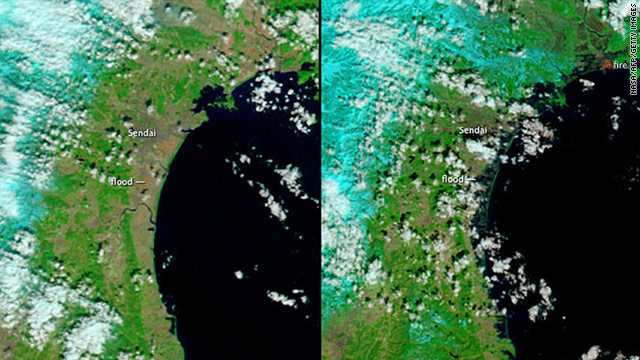
Police said between 200 and 300 bodies were found along the coast in Sendai, the biggest city in the area near the quake's epicentre. It has a population of one million and is relatively flat.
Kyodo, quoting the Fire and Disaster Management Agency and local police, said the coastal city of Rikuzentakata was "virtually destroyed" by a tsunami wave.
"Our initial assessment indicated that there has already been enormous damage," said chief cabinet secretary Yukio Edano.
Many buildings, including an oil refinery plant in Sendai, were still burning Sunday. An out-of-control blaze burned through the night in the city of Kesennuma. Japanese broadcaster NHK said local authorities had no way of tackling it.
In the city of Ichihara, flames shot 30 metres into the air from a fire at an oil refinery. TV video showed a large building on fire in the Odaiba district of Tokyo.
Early morning television scenes bordered on the apocalyptic. Jumbled piles of vehicles could be seen in farmland flooded with several metres of water. People are still stranded on rooftops. Many others were seen standing on cut-off rural roads, surrounded by huge seas of standing water.
Rescue helicopters hovered over inundated homes, lifting people to safety.
A ship with 81 people onboard was ripped from its moorings at a shipyard in Miyagi. It was later found at sea and those on board are being airlifted to safety, AFP reported, citing a report from the Jiji news agency.
Many aftershocks
There have been at least 150 powerful aftershocks since the quake struck. Among the strongest was a 6.6-magnitude tremor, which rattled Tokyo on Saturday. No tsunami warnings were issued and there were no reports of injuries.
In Hawaii, a two-metre-high wave hit parts of Maui and smaller waves hit Oahu and Kauai. In northern California, authorities were searching for a man believed swept out to sea. No significant wave action was felt in B.C.
Quake moved Honshu 2.5 metres
Japan is used to earthquakes and has instituted strict building codes and carries out frequent earthquake and tsunami drills. But the sheer intensity of Friday's disaster was such that even the best preparation could only mitigate the tragedy.
Officials said the initial quake was the most powerful one to hit the region in 1,200 years. The USGS says the force of the quake was so strong that Honshu — Japan's biggest island — was moved 2.5 metres to the east.
The quake was 8,000 times more powerful than the one that struck Christchurch, New Zealand, in February
Aid agencies
The Canadian Red Cross quickly launched a Japan Earthquake/Tsunami fund. In the first nine hours, officials told CBC News that Canadians had donated $176,000.
The International Committee of the Red Cross (ICRC) has also set up a Family Links website to help people trying to re-establish contact with missing family members and friends. The ICRC says the worst hit areas are in the prefectures of Miyagi, Fukushima, Tochigi and Ibaraki.
E2EK1EL
Check the video out ...
Some good news by CNN to keep the mind at ease and explains some questionable fears from yesterday's blast.
Originally posted by kotsy
not really... they have the freedom to say whatever they want, no matter how dumb.
nope
it's unethical comments towards other culture/nationality
I say suspend they accounts immediately.
FunkyCrew
also in regards to '86 events - people weren't told anything not to alarm the population
only the highest ranks of gov officials, as well as KGB were aware of the real dangers of what was going on - people who worked on the site were just wearing regular syrgical/raspitory masks
my family knew because of grandpa, and he just told us not to leave our house - that day we got a very long acid rain..
jester
---
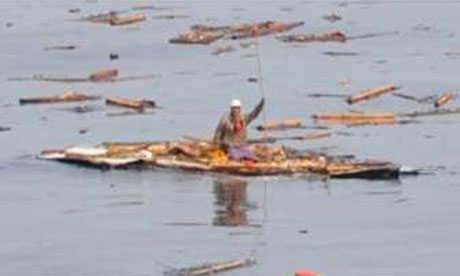
Japan tsunami survivor Hiromitsu Shinkawa found 10 miles out at sea
(Courtesy of the Guardian UK)
VDub
quote:
Originally posted by FunkyCrew
nope
it's unethical comments towards other culture/nationality
I say suspend they accounts immediately.
Freedom of speech is a cornerstone of our society...
I'd still love to knock some sense into these douchers though...
jester
It is just insane how some of the water was like 36ft high and went 3+ km in land :(