|
:::Your-:~Pic7arS~:-Thread::: (pg. 889)
|
View this Thread in Original format
| nefardec |
| quote: | Originally posted by Miss Pie
Aren't most Catholic churches also laid out in cross shaped floor plans? Kind of limits the design a little that way too. |
They went through many phases.
Originally churches were based on a basilican plan, after those spaces designed by the romans. Basically a big, long space with two side isles and columns on either side. The center was reserved for the clergy, and the people stood in the side isles.
Also inherited from the Romans was a round plan, where there was an inner circle and an outer ring. the clergy was only allowed in the inner circle, and it was again separated from the outer ring by columns.
Then it became standard for churches to be laid out in cross plan. The long part is known as the nave, and the crossing part is the transept. The nave is usually longer, though there are some good examples of square/radially symmetrical churches like Hagia Sophia - this became popular in the renaissance when people like davinci and other architects like bramante were studying geometric, humanist forms, instead of merely perpetuating the religious dogma. You generally enter from the west and walk to the east in a cruciform church. And in many cathedrals the side isles contain separate chapels to various saints.
The cruciform plan has many different variations, mainly variants on proportion and the amount of side isles and the kind of ambulatory behind the altar - St Peter's basilica is probably one of my favorite plans.
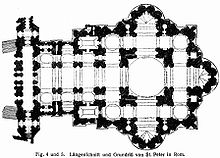
And there are other random variants - for instance Basilica San Nicola in Bari, Italy has a great split level thing, where right when you get to the altar, the middle stairs go up, and the side stairs go straight into the crypt.
The thing with church architecture at this time was that the plan wasn't seen as a measure of creativity - the plan was functional, in a spiritual sense. It was standard in the way that automobiles have four wheels, a hood, and a trunk (sorry brits). The aesthetic agenda of these churches was to actually physically transport a person from the secular world to the divine world, through a series of incremental portals and spaces. Not only physically, but visually, which is why you'll see a lot of forced perspective at the end of churches behind the altars. This was considered high-tech. Perspective was considered a technological way to reach spiritual realms, particularly in paintings and relief sculptures behind the altar.
Catholic churches now are pretty much anything goes, as long as there is an altar, a tabernacle, and the stations of the cross. Typically a baptimsal font is included too.
I really like historical mosque architecture, mostly because of the way they function as public spaces. The open plans are much more about community and less about dogma and ritual.
 |
|
|
| igottaknow |
| quote: | Originally posted by Lira
:stongue: |
is that really you? |
|
|
| Lira |
Nah, I haven't snogged a blonde for nearly a decade - and I'm always wearing a plaid shirt or a long-sleeved shirt :D
In all fairness, I don't even think that guy looks like me but, what the hell, everyone reckons he does so I don't mind :p |
|
|
| Sushipunk |
| quote: | Originally posted by Lira
So, wait, does that mean sashimihardcore wears a ring and you don't? And that's the norm there? Now I'm surprised :p |
Yeah, that's normal here, as far as I know. I don't wear a ring, but she does. Everyone else I know who's been engaged has been the same.
| quote: | Originally posted by Lira
ps.: Took this picture yesterday for you... no birds, just a sign of the Sushipunk Complot spreading its wings and banning everyone's ass all over the world:
 |
ASS-BAN :gsmile: |
|
|
| Silky Johnson |
| quote: | Originally posted by nefardec
They went through many phases.
Originally churches were based on a basilican plan, after those spaces designed by the romans. Basically a big, long space with two side isles and columns on either side. The center was reserved for the clergy, and the people stood in the side isles.
Also inherited from the Romans was a round plan, where there was an inner circle and an outer ring. the clergy was only allowed in the inner circle, and it was again separated from the outer ring by columns.
Then it became standard for churches to be laid out in cross plan. The long part is known as the nave, and the crossing part is the transept. The nave is usually longer, though there are some good examples of square/radially symmetrical churches like Hagia Sophia - this became popular in the renaissance when people like davinci and other architects like bramante were studying geometric, humanist forms, instead of merely perpetuating the religious dogma. You generally enter from the west and walk to the east in a cruciform church. And in many cathedrals the side isles contain separate chapels to various saints.
The cruciform plan has many different variations, mainly variants on proportion and the amount of side isles and the kind of ambulatory behind the altar - St Peter's basilica is probably one of my favorite plans.
And there are other random variants - for instance Basilica San Nicola in Bari, Italy has a great split level thing, where right when you get to the altar, the middle stairs go up, and the side stairs go straight into the crypt.
The thing with church architecture at this time was that the plan wasn't seen as a measure of creativity - the plan was functional, in a spiritual sense. It was standard in the way that automobiles have four wheels, a hood, and a trunk (sorry brits). The aesthetic agenda of these churches was to actually physically transport a person from the secular world to the divine world, through a series of incremental portals and spaces. Not only physically, but visually, which is why you'll see a lot of forced perspective at the end of churches behind the altars. This was considered high-tech. Perspective was considered a technological way to reach spiritual realms, particularly in paintings and relief sculptures behind the altar.
Catholic churches now are pretty much anything goes, as long as there is an altar, a tabernacle, and the stations of the cross. Typically a baptimsal font is included too.
I really like historical mosque architecture, mostly because of the way they function as public spaces. The open plans are much more about community and less about dogma and ritual.
|
Awesome, thanks for that. Your knowledge makes me sort of wish I stuck with art, heh. |
|
|
| Nrg2Nfinit |
| quote: | Originally posted by tubularbills
:stongue: :stongue: :stongue: :stongue: :stongue: :stongue: :stongue: :stongue: |
man.. no matter how many times i see this, the resemblance to ygrene is uncanny! |
|
|
| VAR |
 |
|
|
| nefardec |
| quote: | Originally posted by Miss Pie
Awesome, thanks for that. Your knowledge makes me sort of wish I stuck with art, heh. |
not sure if serious.... but in case you are, you're welcome. kind of sad that this is the only opportunity i have to share what i learned in 5 years of ivy league school though :haha: |
|
|
| Lira |
| quote: | Originally posted by nefardec
Catholic churches now are pretty much anything goes, as long as there is an altar, a tabernacle, and the stations of the cross. Typically a baptimsal font is included too. |
The Catedral de Brasilia wholeheartedly agrees:

 |
|
|
| nefardec |
yes, that's a great cathedral. my favorite part is the entrance and the way the crypt goes downstairs behind the altar.
i spent a week in your city studying architecture at universidade de brasilia :) (and eating delicious food by the pound!!)
i really liked this church too (these are some of my photos)


and this one (not my photo). you have some weird churches lol. damn niemeyer.

and some more of my photos since this is a photo thread!


have to love the façades on the superblocks!


brutal university building


brasilia has a pigeon hotel directly across from (and mocking) the secretariat building (government legislature), which looks similar :haha:

cp.

 |
|
|
| Lira |
I always forget you've already been here. When was it? Was the JK bridge already around? You're supposed to see it from the restaurants around the lake:

That's not Niemeyer's, by the way, and it looks exactly like a bridge for pedestrian's in Nagoya's port:
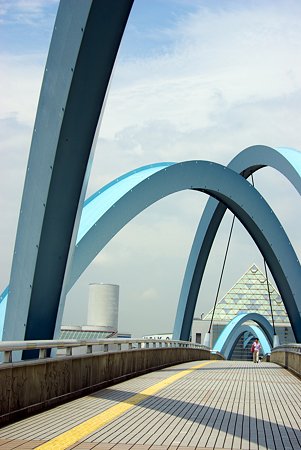
We do have our fair share of quirky buildings, though I wish we had more. Niemeyer is senile and unstoppable, and this is his latest project: A new TV tower...

to replace the old one.

I doubt the view from the new one will be better than this:

He also recently finished an igloo-shaped museum in the centre of Brasilia:

That blue church is called "Igreja Dom Bosco", which I affectionately call "Dom Boxxo" because it IS a box... and architects say it's supposed to be a great exemplar of contemporary engineering because it's a 40x40 metres wide box with no pillars/walls inside. Is it really supposed to be that awesome?

Also, did you see the Teatro Nacional? The walls are really fun to climb:
 |
|
|
|
|

