|
TranceAddict Investors Club @ Marketocracy (pg. 151)
|
View this Thread in Original format
| Capitalizt |
Wrong..The fed is God.
But I'm glad to see you have an open mind and are switching gears on some things krypt. |
|
|
| Capitalizt |
Leap in U.S. debt hits taxpayers with 12% more red ink
By Dennis Cauchon, USA TODAY
http://www.usatoday.com/news/washin...5-28-debt_N.htm
Taxpayers are on the hook for an extra $55,000 a household to cover rising federal commitments made just in the past year for retirement benefits, the national debt and other government promises, a USA TODAY analysis shows.
The 12% rise in red ink in 2008 stems from an explosion of federal borrowing during the recession, plus an aging population driving up the costs of Medicare and Social Security.
That's the biggest leap in the long-term burden on taxpayers since a Medicare prescription drug benefit was added in 2003.
The latest increase raises federal obligations to a record $546,668 per household in 2008, according to the USA TODAY analysis. That's quadruple what the average U.S. household owes for all mortgages, car loans, credit cards and other debt combined.
"We have a huge implicit mortgage on every household in America — except, unlike a real mortgage, it's not backed up by a house," says David Walker, former U.S. comptroller general, the government's top auditor.
USA TODAY used federal data to compute all government liabilities, from Treasury bonds to Medicare to military pensions.
Bottom line: The government took on $6.8 trillion in new obligations in 2008, pushing the total owed to a record $63.8 trillion.
The numbers measure what's needed today — set aside in a lump sum, earning interest — to pay benefits that won't be covered by future taxes.
Congress can reduce or increase the burden by changing laws that determine taxes and benefits for programs such as Medicare and Social Security.
Rep. Jim Cooper, D-Tenn., says exploding debt has focused attention on the government's financial challenges. "More and more, people are worried about our fiscal future," he says.
Key federal obligations:
• Social Security. It will grow by 1 million to 2 million beneficiaries a year from 2008 through 2032, up from 500,000 a year in the 1990s, its actuaries say. Average benefit: $12,089 in 2008.
• Medicare. More than 1 million a year will enroll starting in 2011 when the first Baby Boomer turns 65. Average 2008 benefit: $11,018.
•Retirement programs. Congress has not set aside money to pay military and civil servant pensions or health care for retirees. These unfunded obligations have increased an average of $300 billion a year since 2003 and now stand at $5.3 trillion. |
|
|
| Q5echo |
| quote: | Originally posted by Krypton
Remember the over $10 trillion in capital lost over the course of the recession? The Fed only put in $2 trillion. |
help me undrestand this. what is your correlation between the $10 trillion in lost capital and the Fed's $2 trillion? |
|
|
| Capitalizt |
| He means home values and other things that declined in value by that much. The fed printed a few trillion but not enough to compensate for all the wealth was destroyed in the real estate and market crash. Of course I don't think they should even attempt to compensate for it because most of that wealth was illusory to begin with. The fed is diluting the value of the dollar today to counteract a popped bubble that should never have existed in the first place. Declining values and the liquidation of bad investments is a good thing, but I think Krypt (and most keynesians) believe we need to keep profits, prices, and asset values on a constant upward path regardless of the cost. |
|
|
| Krypton |
| quote: | Originally posted by Capitalizt
Wrong..The fed is God.
But I'm glad to see you have an open mind and are switching gears on some things krypt. |
The Fed is god?:haha:
Gee, is this recession god's judgment on us? LOL. It's obvious the Fed is not all powerful. Otherwise inflation would be constant and stable, recessions would not happen, and we would be in perpetual growth mode. |
|
|
| Krypton |
| quote: | Originally posted by Q5echo
help me undrestand this. what is your correlation between the $10 trillion in lost capital and the Fed's $2 trillion? |
Cap likes to say the Fed is controlling the economy as if we live in the Soviet Union or something. I'm stating that that is far from the truth. The economy is taking its course regardless of what the Fed is doing. Millions are losing their jobs. Trillions in capital is still being lost. Stock market values are nothing like they were in 2007. Real estate values also plummeted. But Cap still wants to say the correction is not taking place because of Fed policies.
Think about it this way Q. You get into an accident and lose half of your blood. You'r about to bleed to death but in the emergency room, the doctors give you blood transfusions to replace your lost blood. Without it, you'd die. Your body is still ed up but now at least, the doctors have stabilized your vital functions. Well, this is what happened to the economy. The economy suffered a huge accident and lost a lot of bloody (lost capital). The Fed (doctor), therefore, needed to inject blood (new money) into the economy to replace the massive amount lost. This is not to keep asset prices high or artificially manipulate the economy as Cap always wants to make it out to be. The economy simply needed blood to just function. Not to prosper. Just to stay alive. The economy needed the Fed's liquidity just to stay alive. That's how bad it was. The doctor doesn't give blood transfusions so you can run marathons and win... No, the doctor does it just to save your life. The Fed infused liquidity just to keep the economy alive. This is something Cap refuses to accept for whatever reason. He advocates the doctor watching the patient die. Letting the economy crash and burn when something can be done to stop its death. He would have wanted it to die with some ideal of a libertarian utopia coming out of the other side. Thankfully, the government and Fed aren't stupid enough to let the entire economy collapse in on itself with bank runs, massive unemployment, deflationary spiral, even people losing all of their deposits because of insolvent banks.
So in mentioning $10 trillion of lost capital, and the $2 trillion the Fed has put in. It's obvious the influence of the Fed is marginal when compared to the gigantic waves in the economy. |
|
|
| Capitalizt |
| krypt refuses to admit that it was the doctor is who caused the accident in the first place by pumping the patient full of crack cocaine then putting him behind the wheel. He looks at nothing but the consequences..as if it were a phenomenon of nature..something that must be dealt with without understanding events that preceded it. He observes the immediate and the short term, without regard to the cause of the current crisis and the long term effects of his chosen "cure". The chosen "cure" today is endless debt and credit expansion..the exact same thing that caused the bubble in the first place. It is creating a problem infinitely worse than the current disease. |
|
|
| Krypton |
| quote: | Originally posted by Capitalizt
krypt refuses to admit that it was the doctor is who caused the accident in the first place by pumping the patient full of crack cocaine then putting him behind the wheel. He looks at consequences..the immediate..the short term, without regard to the cause of the current crisis and the long term effects of his chosen "cure". |
Yea, because the Fed FORCED the banks to securitize subprime mortgage securities, FORCED insurance companies to sell far too much in collateral debt obligations, and FORCED mortgage brokers to make fraudulent loans! Yes it's all the Fed's fault!:rolleyes: |
|
|
| Capitalizt |
When a kindergarten teacher brings a huge bag full of candy into the classroom and leaves for a few minutes, she doesn't FORCE the kids to eat it and go bat insane on a sugar high does she? The kids are the ones who tore everything up in a mindless euphoric celebration. The teacher didn't cause the mess herself..it's true. But to pretend she didn't enable it?
is exactly what you are doing.. Why can't you acknowledge it krypt? The people running the central bank are only human. We all make mistakes. They kept the cheap money spigot on far too long when the real estate market was already booming.. This led to insane levels of property speculation and all of the fancy leveraging and paper games played by the banks. It is what caused the bubble to inflate beyond a sustainable level. Everything flows from the price of money..and when the price is too cheap (like now), bad happens in the future. We've already seen it with the housing bubble..
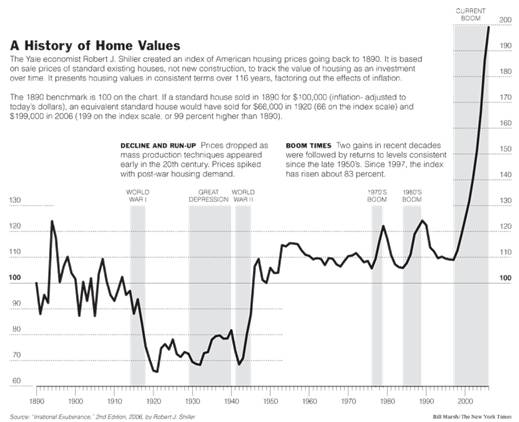
The amount of cheap money pumped in by the fed in the early 2000's is absolutely DWARFED by what we've seen in the past year..

I shudder to think of the bubble that is in the works now.. It's going to be the bubble to end all bubbles my man, and there are only two possible outcomes..a devastating depression or hyperinflation. There is no easy way out. Given that a depression is politically unfavorable and given that politicians can always blame inflation on those who are raising prices rather than their foolish policies, I'm betting on the latter. |
|
|
| Krypton |
| quote: | Originally posted by Capitalizt
When a kindergarten teacher brings a huge bag full of candy into the classroom and leaves for a few minutes, she doesn't FORCE the kids to eat it and go bat insane on a sugar high does she? The kids are the ones who tore everything up in a mindless euphoric celebration. The teacher didn't cause the mess herself..it's true. But to pretend she didn't enable it?
is exactly what you are doing.. |
The Fed's job isn't to stop asset bubbles. When one does occur, then it goes about trying to limit the collateral damage done by the collapse of the asset bubble. Low interest rates are one reason for the subprime mortgage crisis. But to say it's the CAUSE is giving far too much blame. |
|
|
| Krypton |
| Asset bubbles occur in any economy, regardless of what the central bank's policies are. |
|
|
| Capitalizt |
| quote: | Originally posted by Krypton
Low interest rates are one reason for the subprime mortgage crisis. But to say it's the CAUSE is giving far too much blame. |
It's not the ONLY cause krypt..but it's a biggie. |
|
|
|
|

