I believe we are likely to have major problems that endure down the road.
Don't worry!
Shakka
Here's today's Ned Davis piece (unfortunately I can't recreate the charts).
quote:
Client Question- What do you think the main themes for 2010 will be?
Answer - I enjoy speculating as much as the next guy, but I think forecasting is, at best, educated guesswork, and at worst, very dangerous as it can leave one hanging out on an unprofitable branch and miss the "big picture" tree.
However, I will give you my "two-cents worth." I think the biggest them for 2010 is likely to be "how do we finance these incredibly risky deficits?" As the NY Times put it, "Does Uncle Sam basically have a $12 trillion adjustable rate mortgage at teaser rates?" This deficit was easy to finance over the past year, because the government had the financing market almost to itself.
Consumers saved more and paid back consumer credit debt. Corporations did borrow int he bond market, but aggressively cut inventories and paid off bank loans. State and local governments tried to cut back sharply on spending. So not only was the federal government largely by itself in borrowing, they had banks flush with liquidity to buy their bonds. And the Federal Reserve was a huge buyer, but that buyer is now gone. A lot of dollars going overseas due to the trade deficits were recycled back into government bonds.
The deficit will remain huge. Corporations will likely need some bank loans to rebuild inventories. And foreigners, due to the debased U.S. dollar, are slowly but surely cutting back on their huge buying of government debt. We cannot finance the deficit without help from foreigners. China and OPEC are my biggest concerns.
If the economy continues to rebound, I just don't see how the deficits will be easily financed. Of course, the Fed could continue to print up dollars, and flush them into the banking system. However, with commodity prices already soaring, any further monetization could lead to inflation, pushing up bond yields and sending debt service much higher. The "wonderful" job the Fed and Obama did this year may not look so good next year when it comes time for someone to pay the "dollar bills" we borrowed to stimulate. Of course, some of these bills could be paid for by rich taxpayers, but what that will do to the incentive to hire new workers is another theme we will unfortunately need to visit next year."
occrider
quote:
Originally posted by Shakka
The EPA existed long before Farr's rant and he had no problem hiring Americans then. I don't think he ever advocated going back to a 19th century type work environment. Frankly, that is a ludicrous stance to take. You say you were being facetious but then you go and use the same tactics again. Perhaps it's not the goals that this new administration is pursuing--perhaps it's the mentality that those ends they hope to achieve will somehow justify the means being used to accomplish them that is such a game changer? It's pretty clear he's not advocating what you're insinuating, rather his comments are a direct response to the policies that have been being introduced just in the last year. Consolidation of government power, higher taxes on industry in order to push radical new policies and agendas, trying to legislate private business compensation policies, etc. He's merely saying how business-unfriendly new policies are and that in response he is likely to minimize his exposure to regions that are less friendly and increase exposure where it is more friendly. Does that mean he is going to only employ sweat shops in Singapore? I highly doubt it. Does that mean he will strip all employees of benefits? Seeing as how that was never the case before, I highly doubt that will be the case now, but we'll see what our government has to say about that. Being snarky and suggesting that there are only two roads to take here (Cap & Tax or kill the environment, radical healthcare reform or kill millions of people) is a silly counterpoint that reeks of laziness and a desire to trust that the fools in charge are coming up with the best ideas to solve our problems and that they should not be challenged, when surely you would even admit that only a few of them at best have the basic understanding of economics.
I will try to explain my position again … I deliberately adopted an obtuse and hyperbolic stance with respect to issues like the EPA, labor laws, etc., in order to highlight Farr’s one-sidedness on this issue. Farr focuses on impact of these legislative initiatives from a business standpoint ALONE (and a very narrow standpoint at that too, but I’ll address that later). Hence my “snarky” and admittedly “lazy” (the entire point of my snarky and facetious comments was to insinuate that Farr was being one-sided and ultimately lazy with his criticisms by way of imitation … I’m glad you recognize that) counterpoint that I can make this a completely one-sided, fear mongering issue as well: “omg universal healthcare will make us less competitive, jobs will leave the country! … omg not having universal healthcare is amoral and lots of people will die! … (and the favorite of the left) omg globalization gives unfair advantages to third world countires, jobs will leave the country!” See, it’s very easy to criticize policy when I focus solely on the cons.
quote:
No he's not. He's telling it like it is from his point of view. He's saying that current policies and proposals are not business friendly and are counter-productive. In response he will seek better ways to run his business. Just because he had the gall to say what many are afraid to say does not mean he's fear mongering. If he walks the walk in addition to talking the talk, I don't know how you will be able to say it's just fear mongering. Maybe you think he's overreacting, but that's a different argument altogether.
By your logic the entire anti-globalization argument that loony lefties cling to are legitimate as well. I mean they are right when you only consider their “point of view” … globalization WILL result in the loss of jobs from the US to India, China, and other third worlds. What those loonies neglect to realize is that it’s because we’re genuinely uncompetitive in those areas and the transfer of those jobs is a natural part of creative destruction that results in cheaper products for the American consumer and a retrained more skilled … well wtf you already know all this.
Fine this dude has the “gall” to say he’s going to be hurt by universal health care … that’s great, I’m going to be hurt too but I’m not whining about it because I’m thinking about more than what it’s going to cost me.
quote:
Yes, TARP is certainly part of it, but it's a much broader argument than just TARP. We have a government that seems to want (and think it is well within its rights) to micromanage every aspect of private enterprise. And current fiscal/monetary policy is an experiment--possibly the biggest one ever conducted. The scope and degree of the deficit spending, monetary base explosion, alphabet soup of unconventional credit programs are unheard of. There is no precedent for this kind of thing layered on top of an already unprecedented amount of total leverage (look at government, corporate and private debt levels relative to our GDP). As smart as you may or may not think Bernanke, Geithner, Bair, etc., may be, they do not know the ultimate results of what they are engaging in, let alone the collateral damage or potential rolling asset bubbles they may inflate with their quantitative easing, nor do they really know how and when any "exit strategy" may work. It is an experiment in unconventional policy plain and simple. We had the good fortune of speaking with Dino Kos the other day who confirmed as much (i.e. have you ever tried to thread a needle...in the dark?) Meanwhile the value of our currency is eroding right in front of us. I have no problem borrowing a couple of quotes from the venerable Ned Davis on this topic:
Additionally, from Bill Gross in the NY Times this AM. This was a good article, I'm sure you saw it: NY Times
Well first of all, with respect to Keynesian fiscal policy … there’s absolutely nothing new with that … one can simply study history …
The monetary policy of the fed is indeed VERY radical, however, in the fall/winter of 2007 did you disagree with TARP? Did you disagree with TALF? TSLF? PDCF? CPFF? MMIFF? Etc., etc., etc. .. . You of all people knew what was going on last fall and you knew why each of these programs were put into place so I’m extremely curious to hear why you disagree with any of these programs specifically (please no vague ideological statements about the monetary expansion of credit … I would like to know which program you’re against and why).
quote:
No, I am not advocating that.
Why not? It appears to be working.
quote:
Perhaps a major problem I have with you and those that are "ardent supporters" of this "Keynesian" policy is that the assumptions are so rosy and optimistic. If we just pursue more massive deficit spending and unconventional credit easing, everything will be fine and dandy on the upswing. We'll come out on the other side unscathed. There will certainly be no adverse collateral damage. I believe that this is not a situation where you have 2 possible outcomes--a good one and a bad one. I believe we are likely to have major problems that endure down the road. All we are currently doing is kicking the can down the road, postponing the day of reckoning in hopes that we can somehow come up with a better plan or some wait for some massive round of economic growth that propels us out of the problems we have created for ourselves. While I may concede that it was necessary to engage in a lot of the policy moves in order to not see complete economic failure, I do not believe that we are ensuring a positive outcome 5-10 years from now. There are and continue to be major structural flaws in our economy which unfortunately are not being addressed. The hard decisions are usually the right ones, and unfortunately they are not the decisions our elected and non-elected leaders are willing to make because it requires pain and sacrifice--two things that will not get you reelected or reappointed.
And again, back to the original discussion, as it pertains to Farr and Emerson...whether politically motivated or not based on his and his senior management's philosophy, I think they are reacting to the playing field that is being laid before them. You may think it is some jawboning based on some "false dichotomy" and that they are advocating going back to a pre-FDA world with no employment standards, but I think that's just being silly when you know that is not the case and he has never suggested as much.
Come now … you know that Keynesian policy isn’t just about deficit spending our way into victory. You’re missing the entire other half of the equation. Do you REALLY think this is the proper time and place for contractionary fiscal policy? I have to say … you’re a couple years past due. I’ve been ARGUING for contractionary fiscal policy since 5 years ago back when we were in the boom years:
Hmmmm I don’t remember too many republicans backing me up at that time … hence the reason why I left the republican party (haha you’re probably one of the few people that might remember me as a republican … you and opus because I used to argue with him to no end).
quote:
Edit: P.S. As you have said on more than one occasion that you don't plan on having any children, it's a bit disingenuous of you to talk about "our" children, no? Or have you decided to help join the fight against our demographic decline? ;)
Haha you got me there. Don’t have kids … don’t want kids. However for the global warming issue I’ve adopted a moral standpoint as opposed to a self-interest standpoint (which encompases the interests of one’s children I suppose). However, global warming is such a generational issue (although I have seen some changes in my lifetime via scuba diving) that I feel that I have to qualify my arguments in terms that others will more easily understand or accept. In other words, the argument … yea I’m not going to personally experience the ramifications of global warming, and neither are you, but your kids will so “haha sucks to be your kids” … is not as effective as saying, we should address global warming for the sake of “our” children.
Shakka
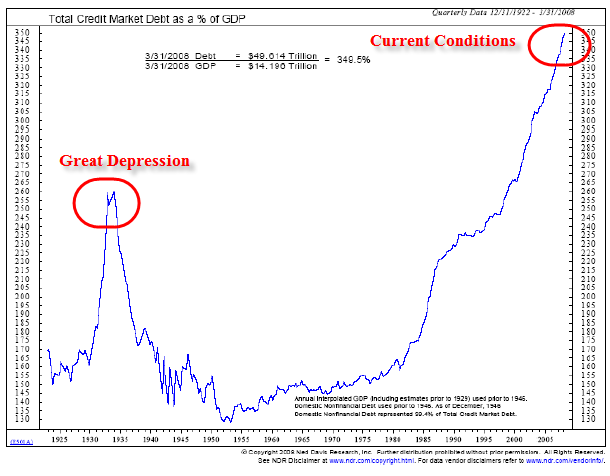
I did agree with TARP when it was initially announced. I do believe that in order to have a long-term, we must first be able to have a short-term and TARP and many other programs did give us some breathing room, so to speak. However, that does not mean that I don't think there should be limits and that our current track of deficit spending is completely out of control (let alone those who are already crying for a second stimulus package). This is, imho, the most scary and most telling chart I know of and is the one that keeps me up at night if nothing else does. There is such a thing as a Keynesian liquidity trap. In light of the events in Dubai this week I think it's worth taking at least a minute to ponder things over. Who will bail out the U.S. if we default on our debt?
Btw, this chart is only through March 2008 so it is actually understating how bad the total credit market debt vs. GDP is by a noteworthy margin.
Krypton
Though we don't want a liquidity trap, the benefits far outweighed the risks of the Fed's massive liquidity infusions. Even if there was a liquidity trap, that wouldn't exactly mean the Fed is powerless to stimulate the economy. It would just not happen by interest rates alone.
Shakka
quote:
Originally posted by Krypton
the benefits far outweighed the risks of the Fed's massive liquidity infusions.
I don't think we'll know the real answer to this for quite some time personally. We also may have simply created a bigger problem down the road. In any event it will take years, if not decades, to know for sure. The Fed minutes notably said:
quote:
"Members noted the possibility that some negative side effects might result from the maintenance of very low short-term interest rates for an extended period, including the possibility that such a policy stance could lead to excessive risk-taking in financial markets or an anchoring of inflation expectations."
quote:
Even if there was a liquidity trap, that wouldn't exactly mean the Fed is powerless to stimulate the economy. It would just not happen by interest rates alone.
Right--they'd likely begin to monetize debt (to a far greater extent than they have done so far) and truly trash the dollar to try to "dig" their way out of a massive hole that they helped create. The inflationary side-effects of such a policy could potentially be disastrous, not to mention the geo-political impact given how much of our debt is held by foreigners.
Edit: I just checked out the latest Ned Davis data on total credit market debt vs. GDP. The latest update they have is through 6/30/2009. Still a bit stale but the number is now at 373.3%.
Shakka
quote:
Originally posted by occrider
The monetary policy of the fed is indeed VERY radical, however, in the fall/winter of 2007 did you disagree with TARP? Did you disagree with TALF? TSLF? PDCF? CPFF? MMIFF? Etc., etc., etc. .. . You of all people knew what was going on last fall and you knew why each of these programs were put into place so I’m extremely curious to hear why you disagree with any of these programs specifically (please no vague ideological statements about the monetary expansion of credit … I would like to know which program you’re against and why).
Firstly, I have been pretty familiar with most of the alphabet soup credit programs the Fed introduced, but admittedly I am not familiar with MMIFF. Is that Money Market Insurance for Failed Financials or something? Anyway, I digress.
Do I have to be rabidly pro or anti anything in order to recognize that every action has consequences? And further, that while one action may put a band-aid on a gaping wound in the near-term, it may not do a damn thing down the road to head off the bleeding it was intended to staunch? Or that, heaven forbid, it might actually create other problems down the road in spite of what little good it might bring today?
Say a football player in a big game and sprains his ankle and is unable to play. His brilliant medics decide to load him up with painkillers so that he is able to continue to play in the big game (as opposed to treating the injury and allowing it to heal). The player goes out and because he is playing injured but can't feel the pain goes on to break his leg, tear his ACL/MCL, etc. and as a result suffers potentially career ending injuries. But maybe he was able to score one more touchdown before seeing his career (and future earnings) get destroyed by actions that now look irresponsible in hindsight. Were the coaches right to load him up with drugs given that the team has lost a key player, possibly for good?
Capitalizt
quote:
Originally posted by Shakka
Right--they'd likely begin to monetize debt (to a far greater extent than they have done so far) and truly trash the dollar to try to "dig" their way out of a massive hole that they helped create. The inflationary side-effects of such a policy could potentially be disastrous, not to mention the geo-political impact given how much of our debt is held by foreigners.
Inflation is going to be only one problem out of many. There is no way the economy can absorb this amount of new money without severe malinvestments and dislocation of the economic fundamentals. The fed has set the stage for a much more painful crisis in the future. Sure, an inflationary outcome is inevitable but there are also major distortions rippling through markets now as a result of incessant government intervention and negative real interest rates. It is impossible to tell just how many unsustainable projects and bad investments have been undertaken as a result of all this "stimulus", but these are future forms of wealth destruction and will be deflationary in nature. I believe the bubble currently being blown is the "everything" bubble..the mother of all bubbles with all assets (worldwide) rising in price on a tide of government debt, cheap credit, and Keynesian insanity. We can only defy reality for so long however. The sh!t will eventually hit the fan and I'm afraid we will be facing a stagflationary nightmare in the next ten years that will make the crash of 2007-2009 look like a picnic.
Krypton
Shakka, if you could get a meeting with the President and Federal Reserve Chairman, what would you propose they do today?
Shakka
quote:
Originally posted by Krypton
Shakka, if you could get a meeting with the President and Federal Reserve Chairman, what would you propose they do today?
Firstly, my job isn't to come up with policy, it is to react to what they do to try to make money for my clients. My criticisms are independent of how I try to survive. Secondly....firstly.
Krypton
quote:
Originally posted by Shakka
Firstly, my job isn't to come up with policy, it is to react to what they do to try to make money for my clients. My criticisms are independent of how I try to survive. Secondly....firstly.
It's a hypothetical. Just play along. You too capitalizt. I want to know what you would propose too.
Capitalizt
quote:
Originally posted by Krypton
It's a hypothetical. Just play along. You too capitalizt. I want to know what you would propose too.
The opposite of everything you favor..on pretty much everything. ;) Stop intervening..stop diverting resources, stop printing money, protect the purchasing power of the dollar, stop propping up failures, stop propping up housing prices, allow all malinvestment to be liquidated, abolish corporate and capital gains taxes, reduce government spending and personal income tax rates dramatically across the board, allow interest rates to rise to their natural level, encourage investment based on savings rather than endless debt and credit expansion, etc. In short, as shakka said with his football player analogy above..we first need to face the consequences of our actions and take the pain rather than hiding it again..THEN we need to make rational choices to restore the long term health of our economy. You may have shifted left over the past few months krypt, but I'm sure you realize that government does not create wealth. It only exists by feeding off the productive sector of the economy..and what producers need to plan and act effectively long range is a stable currency, low tax rates, and limited government. Sadly we are headed in the opposite direction on all three fronts.