|
TranceAddict Investors Club @ Marketocracy (pg. 18)
|
View this Thread in Original format
| Shakka |
| quote: | Originally posted by mndeg
Am I the only person who uses technical analysis? I'm from the stockfetcher camp.
lol |
No, just one of the few who publicly admits it!;) Technical analysis is voodoo for the lazy man! Just kidding, I actually use it quite extensively, but only as a backup to fundamental analysis to help me control risk and better time my trading.
| quote: | | btw if you are doing fundamental analysis I would highly advise against using options unless it's used as damage control. |
I would disagree. There are 3 primary reasons that I use options:
1) Insurance
2) To short a stock that is unborrowable for whatever reason (also because buying an option has limited loss risk exposure while shorting a stock has theoretically unlimited risk, so there is an element of attraction there with the offset being that the option has a limited window of time before expiration). This is actually a synthetic short position, but it works the same.
2) To leverage a position where I have a high degree of conviction based on the fundamentals in order to "squeeze more juice" out of the trade, if you will. You can turn a low beta stock into a high beta stock with options. It's quite marvelous when it works.
That said, options are risky if you don't know how to trade them as they are much less liquid than stocks, much more volatile than stocks, and you can lose just as much money in a faster amount of time!;) |
|
|
| Capitalizt |
I only use TA after I've decided to buy a stock based on fundamentals. Sometimes TA has pushed me over the edge when I was considering a stock...when something hits a double bottom (the second dip in a "W" for the newbies), I like to buy there because it "feels" like an indication of support..
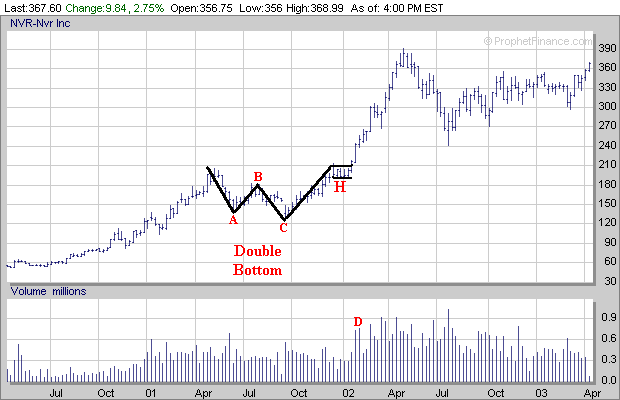
Other than that I think TA is pretty crazy...it seems to tell people to buy at highs ("Krispy Kreme is up up 300%...look at that strength! It's a BREAKOUT! BUY NOW!") TA usually says to buy after a stock has already soared, and to sell after is has already crashed to new lows. It completely ignores valuation which is what counts in the long run. |
|
|
| mndeg |
There's many ways to use TA. I don't think there is an indicator that makes you buy at highs. Unless you're using them backwards. lol or you think the saying buy strength sell weakness is TA.
And the thing with options, most options are way too illiquid either the spreads will get you or the timing will. |
|
|
| Krypton |
| quote: | Originally posted by mndeg
Am I the only person who uses technical analysis? I'm from the stockfetcher camp.
lol
www.stockfetcher.com
I'd like to infuse both TA and fundamental analysis for a more laid back strategy. There are services like vectorvest that screen for fundamental analysis but I've heard something as simple as msn moneycentral powersearches can do just about as well.
I can generally pinpoint the general trend in short term trades but as of right now I'd rather not devote the time to trading and worrying about trading.
btw if you are doing fundamental analysis I would highly advise against using options unless it's used as damage control. |
With my CVFF Fundamentals Fund, I rely on dollar cost averaging rather than technical analysis. If see a company's fundamentals are better than its industry and market, I buy a position immediatly. If the price drops more than 5%, at the beginning of each quarter, I will buy more shares of that stock to replace my 5% with new funds. That way, I offset losses, and are able to buy more shares at a cheaper price. This works very well if you have a passive trading strategy.
Otherwise, if I were picking very specific stocks, and not just adding any stock that had a good balance sheet, I would first look at the fundamentals, then estimate an intrinsic value, then would I use Technical Analysis to determine my enter point. And if I wanted to sell, I'de use Technical Analysis to determine an exit point. But I never justify any decision to add a position just based on what the stock price does. Because the stock price is not a reliable indicator of the inherent value of the company underlying the stock. The stock price is just what the market values the security at any one time. And if you trust what the market thinks, you'll lose every time, because the market is not rational. |
|
|
| mndeg |
The website is extremely slow, how are you posting?
Anyway how much TA do you know? I've entered trades perfectly using TA filters without knowing what the company does or even what the ticker stands for. I don't think you can actually buy high using TA. I'm really not sure what you are using when you talk about TA. I use a 2 period RSI bollinger bands linear regression channels and 2 EMA's.
I also have quite a bit of filters that will tell me which stocks apply to the conditions. I've also watched guys gain around 3% of their total position every day just by buying strength using high of day and getting out before it falls (daytrading). http://www.greenonthescreen.blogspot.com/
The same guy also simply filtered for strength and basically it just kept going and going and going, about 25% for one month as a portfolio.
and I never said the market was rational. I think that's kind of the point of TA, so you know when a stock is oversold or overbought (irrational)Anyone can look at the balance sheet and technically all of that is priced in, real growth vs expected growth is not though. |
|
|
| Krypton |
| quote: | Originally posted by mndeg
The website is extremely slow, how are you posting?
Anyway how much TA do you know? I've entered trades perfectly using TA filters without knowing what the company does or even what the ticker stands for. I don't think you can actually buy high using TA. I'm really not sure what you are using when you talk about TA. I use a 2 period RSI bollinger bands linear regression channels and 2 EMA's.
I also have quite a bit of filters that will tell me which stocks apply to the conditions. I've also watched guys gain around 3% of their total position every day just by buying strength using high of day and getting out before it falls (daytrading). http://www.greenonthescreen.blogspot.com/
The same guy also simply filtered for strength and basically it just kept going and going and going, about 25% for one month as a portfolio.
and I never said the market was rational. I think that's kind of the point of TA, so you know when a stock is oversold or overbought (irrational)Anyone can look at the balance sheet and technically all of that is priced in, real growth vs expected growth is not though. |
It really depends on what you believe about the market. I believe active trading is detrimental to the overall long-term returns. I also believe the market, and thus stock price movements are irrational and impossible to predict. With that said, it's impossible to time the market. These are my beliefs, so I subscribe to long-term, passive, mechanical investing rather than watching charts everyday trying to time when to get in and get out. That's just not for me. But it may be for you. You may be better at tracking short-term fluctuations; I'm just better at estimating and tracking long-term changes rather than charting.
But if and when I use Technical Analysis, I use the 50 and 200 day moving average to determine trend. But my most fundamental use of TA is the drawing of support and resistance lines. I only use TA if I want to time my entry or exit points. So that's basically it. I don't use any of the more complex indicators or base any of my trades on a chart. If I use TA, I have already made up my mind as to what I'm going to do with the stock. |
|
|
| mndeg |
| I once made a portfolio using fundamental analysis using cash flow to price, pe, and another factor. Short term it was terrible (~3months) but long term it faired much better. I'm going to combine TA and fundamentals including sector plays for a more laid back strategy. When Peter Lynch became a fund manager he couldn't stop buying stocks. He bought hundreds and hundreds because their fundamentals looked good. He is pretty much scared by TA, he says it's meaningless. He had draw downs that lasted years before he ever could become profitable. He also said you could not time the market but many people including the guys featured on the market wizards would say the opposite. |
|
|
| Krypton |
| quote: | Originally posted by mndeg
I once made a portfolio using fundamental analysis using cash flow to price, pe, and another factor. Short term it was terrible (~3months) but long term it faired much better. I'm going to combine TA and fundamentals including sector plays for a more laid back strategy. When Peter Lynch became a fund manager he couldn't stop buying stocks. He bought hundreds and hundreds because their fundamentals looked good. He is pretty much scared by TA, he says it's meaningless. He had draw downs that lasted years before he ever could become profitable. He also said you could not time the market but many people including the guys featured on the market wizards would say the opposite. |
Then I would say I am more of Peter Lynch, Warren Buffet, Benjamin Graham type of investor. I could care less what the short term movements are. Saves me the time of looking at charts all the time. |
|
|
| Krypton |
| quote: | Originally posted by atbell
What's "TA"? |
Technical Analysis. It's using the stock price charts to look for patterns that indicate different things like trends and levels, etc. In my strategy, I use only to indicate entry and exit point. That's it. Other people, the technical analysts use all these complex indicators that tells them a million different things. They trade based on that, but it is short-term trading. I don't like basing any of my investments on stock price alone which is what TA does, so I'm a fundamental analysts and long-term buy and hold. |
|
|
| Krypton |
I'm taking psychology, so I had to write this short little paper, and it asked us to describe a real life event that we frequently observe around us and how studying social psychology helps us understand what is happening. This it asks what's the best way to observe and and gather data, yada yada. Boring right? Not if you make into something you know by heart:D. STOCK MARKET AND PSYCHOLOGY! Easy. Let me know if its relevant.
---------------------------------------------
September 3, 2007
Psychology of the Stock Market
According to the Efficient Market Theory, all market prices for any named security reflect all information that is known, and thus represents the collective beliefs of all investors as to the market value of the security (Han, 2002). The market is directed by the transactions of investors who are human. Humans are not mathematical creatures but rather biological in nature, and so when observing the market behavior at any one time, there is always the presence of irrational speculation based in the instinctual psychology of humans.
The 1990’s brought the internet to the developed world bringing an entirely new economy of internet business to millions around the world. New online start-ups began opening up almost everyday. It seemed like nothing would stop this new economy from completely dominating any market that had come before it. This new economy seemed to be the place every savvy investor was supposed to be and billions of dollars were poured into these dot-com companies. As the 1990’s came to an end, cautious voices began sounding off to an inevitable bust much to the dismay of the millions of dot-com investors. There was seemingly no reason to believe these naysayer’s as anyone who had invested 5 years prior to 2000 in the technology sector would have seen astronomical returns. Many people became instant millions during these times, but the naysayer’s were right. On March 10, 2000, the exorbitant technology market prices plummeted (NASDAQ). The technology index represented by the NASDAQ lost more than 60% of its value in the following two years representing billions of dollars wiped clean off the table. Anyone left behind would have lost it all and many were scared right out of the market.
This situation highlights a scenario that is not at all uncommon in the stock market. It starts with a new trend in which investors believe will be the next object to appreciate. As investors pile on, the businesses themselves neglect to follow traditional business models, so the market prices are not a true reflection of the underlying business model. Despite this, investors continue pouring more money into these faulty companies which seemingly defies rationality. The scenario then progresses to the sell-off, triggered by large institutional liquidation, which in turn starts a market panic. Investors across the board scramble to recover what money they have left in these decrepit businesses they thought were invincible.
Social psychology helps one to understand that the dot-com bust is characterized by the speculative driving force of the human herd mentality. Everyone saw everyone else getting rich from these new dot-com companies and so started the mass buying of the entire technology sector. No one wanted to be left out. This instinctual desire to be in the group of winners blinded investors to the reality of what really drives the markets long-term. Profitable business models were scrapped for novelty stocks which had not even made a profit, but despite this, the herd mentality dominated.
Understanding this mass movement requires a study of group psychology using naturalistic observation. Participants in the market at the time of the dot-com boom would have found it difficult to take a step back and observe market psychology alone driving up stock prices in its natural setting, irrespective of the business model. Therefore to truly observe the scenario from an unbiased and objective view would have required a separation from participation in the market or more specifically the technology sector. Any naturalistic observer would have examined the underlying business models without any emotion towards the business and seen the exorbitant prices were not supported by business performances but only by the extremely high demand for stock by a stampede of speculating investors. The correct mode of interaction would have been not to participate in any of the rampant speculation, but to examine business fundamentals and base an investment decision on this analysis.
Wise investors always examine the market from an unbiased, objective, and individualistic view so as to separate one’s self from the stampede. Humans are group creatures and are always susceptible to the influence of others actions, especially when it seems like everyone is doing the same thing. Taking a step back to observe the psychological market forces can help a sophisticated investor avoid the cycles of the inevitable busts that always end the booms.
References
Han, A. (2002). Efficient Market Hypothesis. Retrieved September 10, 2007 from http://www.alvinhan.com/Efficient-Market-Hypothesis.htm
NASDAQ 40-year Price Chart. Retrieved September 10, 2007 from http://chart.finance.yahoo.com/c/my/_/_ixic |
|
|
| Krypton |
I wrote this for the Motley Fool forum for Capital Trust (CT).
Tip: If your not a speculator, stay away from this one. If you like shorting, this one might be worth shorting.
-----------------
Capital Trust is a finance and investment management company that specializes in credit-sensitive structured financial products. The current credit contraction has affected this $579 million dollar small cap company and its appears they've taken on extensive debt. They have in excess of $2 billion worth of debt with only $24 million cash on hand. The company has way more debt than it has in assets. Anyone owning these shares would own more debt than company in my opinion. Very risky. Current ratio which is assets/liabilities is 0.189 and should be above 1 if assets are greater than liabilities. The Debt/Equity ratio is 5.2 meaning there is 5 times more debt than assets.
I stress to every investor out there, debt is a killer, especially this much. I'de short this one. This is one company you want to stay away from.
Below are my valuations for CT. Three of them are excellent valuation being over 20% higher than the current price. But then I saw my PSR whose formula runs like this... Price = [(sales)(PS) - (long-term debt)] / shares outstanding...
Methods
PE: $53.32 / 53.83%
PS: $42.10 / 21.48%
PSR: $-$74.14 / -313.92%
PB: $57.83 / 66.84%
Yield: $34.67 / 0.03%
You'll notice my valuation for the PSR method is negative. How could this be. Well, its because they have a lot of debt, more debt than sales. I love PSR for indicating that fact in this otherwise attractive small cap.
My average estimation is that CT stock is really worth $22-23. If I had a margin account, I'de short.
Despite my gloomy prospects for this company, it is better than average when compared against its industry peers. I mean, that's really not saying much though when the industry was credit sensitive financial products. It also does not perform better than the S&P. |
|
|
|
|

