|
TranceAddict Investors Club @ Marketocracy (pg. 166)
|
View this Thread in Original format
| pkcRAISTLIN |
| quote: | Originally posted by Capitalizt
The opposite of everything you favor..on pretty much everything. ;) Stop intervening..stop diverting resources, stop printing money, protect the purchasing power of the dollar, stop propping up failures, stop propping up housing prices, allow all malinvestment to be liquidated, abolish corporate and capital gains taxes, reduce government spending and personal income tax rates dramatically across the board, allow interest rates to rise to their natural level, encourage investment based on savings rather than endless debt and credit expansion, etc. In short, as shakka said with his football player analogy above..we first need to face the consequences of our actions and take the pain rather than hiding it again..THEN we need to make rational choices to restore the long term health of our economy. You may have shifted left over the past few months krypt, but I'm sure you realize that government does not create wealth. It only exists by feeding off the productive sector of the economy..and what producers need to plan and act effectively long range is a stable currency, low tax rates, and limited government. Sadly we are headed in the opposite direction on all three fronts. |
yeah, that's the way. complain ad nauseum about deficits but then cut all the tax rates so you can never afford to pay it back. you and bush jr would get on famously re shortsighted economic "plans". |
|
|
| Capitalizt |
| quote: | Originally posted by pkcRAISTLIN
yeah, that's the way. complain ad nauseum about deficits but then cut all the tax rates so you can never afford to pay it back. you and bush jr would get on famously re shortsighted economic "plans". |
Dubya was a big government pro-war . I consider myself the opposite. :) Cutting taxes is perfectly fine as long as you cut out the cancer growing in D.C. at the same time. |
|
|
| occrider |
| quote: | Originally posted by Shakka
I did agree with TARP when it was initially announced. I do believe that in order to have a long-term, we must first be able to have a short-term and TARP and many other programs did give us some breathing room, so to speak. However, that does not mean that I don't think there should be limits and that our current track of deficit spending is completely out of control (let alone those who are already crying for a second stimulus package). This is, imho, the most scary and most telling chart I know of and is the one that keeps me up at night if nothing else does. There is such a thing as a Keynesian liquidity trap. In light of the events in Dubai this week I think it's worth taking at least a minute to ponder things over. Who will bail out the U.S. if we default on our debt?
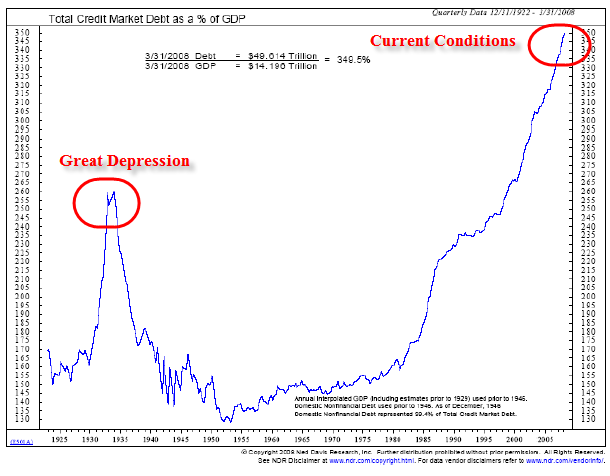
Btw, this chart is only through March 2008 so it is actually understating how bad the total credit market debt vs. GDP is by a noteworthy margin. |
Dubai? You're comparing the US to Dubai? Britain might be a closer comparison ... Japan perhaps, but there's no reason to make a dubai/US comparison. However, what exactly is that chart explaining? I'm unsure as to the specifics of the y variable.
| quote: |
Firstly, I have been pretty familiar with most of the alphabet soup credit programs the Fed introduced, but admittedly I am not familiar with MMIFF. Is that Money Market Insurance for Failed Financials or something? Anyway, I digress.
|
MMIFF is the Money Market Investor Funding Facility. It's one of the initiatives the fed adopted when the shadow banking industry collapsed, particularly the money markets, which prevented solid AAA companies from conducting short term debt financing which prevented the financing of payrolls and the such. Amex was particularly hard hit despite the fact that they've always been profitable. Cash holdings went from 2 weeks pre-crisis to one year post-crisis. Same happened with GE, P&G, Boeing, and most other companies in the DOW.
| quote: |
Do I have to be rabidly pro or anti anything in order to recognize that every action has consequences? And further, that while one action may put a band-aid on a gaping wound in the near-term, it may not do a damn thing down the road to head off the bleeding it was intended to staunch? Or that, heaven forbid, it might actually create other problems down the road in spite of what little good it might bring today?
Say a football player in a big game and sprains his ankle and is unable to play. His brilliant medics decide to load him up with painkillers so that he is able to continue to play in the big game (as opposed to treating the injury and allowing it to heal). The player goes out and because he is playing injured but can't feel the pain goes on to break his leg, tear his ACL/MCL, etc. and as a result suffers potentially career ending injuries. But maybe he was able to score one more touchdown before seeing his career (and future earnings) get destroyed by actions that now look irresponsible in hindsight. Were the coaches right to load him up with drugs given that the team has lost a key player, possibly for good?
|
Dude ... seriously, how am I supposed to respond to this? I never said you had to be rabidly pro/anti anything. I asked you to specifically oppose or support any of the federal reserve's emergency facilities since you seemed to be opposed to something ... and you respond with an ideological, sports analogy? Look no offense but I'm only interested in an analytical discussion of Fed policy. If you're trying to dumb down for me I assure you, analogies such as this are completely unnecessary. What facilities of the fed did you agree with? What did you disagree with? Were you against ALL their programs? Please tell me you're not taking the easy out of being against the fed whilst being unable to intelligentely articulate why you're against them. |
|
|
| Shakka |
| quote: | Originally posted by occrider
Dubai? You're comparing the US to Dubai? Britain might be a closer comparison ... Japan perhaps, but there's no reason to make a dubai/US comparison. However, what exactly is that chart explaining? I'm unsure as to the specifics of the y variable. |
Given the extremely high leverage that both countries have been operating on, it is not a silly comparison. Yes, Dubai is relatively small by comparison, but then again it doesn't take a huge domino falling to cause a contagion. You, if anybody, should know that. I remember how subprime was ring-fenced...actually it was just a canary in a coal mine.
| quote: | | Dude ... seriously, how am I supposed to respond to this? I never said you had to be rabidly pro/anti anything. I asked you to specifically oppose or support any of the federal reserve's emergency facilities since you seemed to be opposed to something ... and you respond with an ideological, sports analogy? Look no offense but I'm only interested in an analytical discussion of Fed policy. If you're trying to dumb down for me I assure you, analogies such as this are completely unnecessary. What facilities of the fed did you agree with? What did you disagree with? Were you against ALL their programs? Please tell me you're not taking the easy out of being against the fed whilst being unable to intelligentely articulate why you're against them. |
You're only interested in discussing monetary policy? I have more problem with current fiscal policy than I do with much of the monetary policy (with some caveats). The major one being the Fed's ability to 1) get all of the money lent out reigned back in without harming the system. Fiscal policy is reckless--our politicians continue to simply write massive blank checks that we have no way of paying for and are dependent on the willingness of foreigners to finance most of that debt (and the Fed itself to take down something like 30% of every treasury auction) so that this massive deficit spending can be pulled off. With respect to specific programs:
TARP - I have acknowledged that something needed to be done though the haste with which such a massive spending authorization was pushed through does not sit well with me. Particularly in light of the fact that most of the spending has not been on real stimulus, but on expanding entitlement programs that are just wealth transfer programs.
CPFF - This was a good program that helped small businesses finance day to day operations when the commercial paper market dried up. I believe it helped loosen credit up much more than it otherwise would have. However, now we have a situation where many, many billions of dollars of short-term paper has been issued and will be coming due in the next couple of years when this program expires. When that paper needs to be rolled (assuming it will get rolled), it will likely be at MUCH less favorable rates. So what have we really accomplished other than to kick the can down the road?
TALF - This program would probably be OK if it were really only available to high-quality borrowers, but that is not the case. When companies like Harley-Davidson who have financial services arms made up of 25%+ in subprime borrowers are allowed access to these facilities under the guise of being high-quality, something is wrong. Not to mention the program offers such terms that give investors leveraged returns on the taxpayer's dime (I guess that's what it takes to get people interested). I don't think this is healthy.
On the fiscal side, as I mentioned, our elected leaders continue to push agendas that we have no way of affording, thinking they know more than we do and are in a better position to micro-manage the citizenry's lives. Cash-for-Clunkers was a dumb program that added more debt to the system, borrowed future sales in an effort to dress up numbers in the near-term to make things appear better, and was hugely wasteful given the number of perfectly good cars and trucks that ended up getting destroyed...all funded by taxpayers. Now we have a Cash-for-Caulking proposal which aims to do the same thing. Not to mention C4C probably stole sales from other sectors of the economy. It is resulting in massive miss-allocations of capital and I have a problem with that.
Aside from that, propping up failed institutions, forcing healthy institutions to accept money and then telling them how to run their operations, etc., is not healthy, imho. I would like to see more letting weaker institutions be swallowed up by stronger hands (which fortunately we are seeing the FDIC starting to play a part in with a lot of recent deals. That is a good thing).
AIG is a black hole that we've thrown hundreds of billions of dollars into that will ultimately never be recovered. Fannie and Freddie need to be gotten rid of, not propped up and kept on life support. If the counter-argument is that without institutions being propped up we'd be much better off, I'd argue that we should not be in this position in the first place and are fighting to sustain something that is unsustainable and will end up paying for with interest down the road.
Now, I've got to get to work so I can actually make money, but hopefully that's enough to chew on for now. I'm not against the Fed (like Ron Paul), I am against the Fed destroying the value of our currency and the implications that go along with it.;) |
|
|
| atbell |
| quote: | Originally posted by occrider
Dubai? You're comparing the US to Dubai? Britain might be a closer comparison ... Japan perhaps, but there's no reason to make a dubai/US comparison. However, what exactly is that chart explaining? I'm unsure as to the specifics of the y variable.
|
The chart seems to be a track of the total debt to GDP ratio as aposed to the often cited government debt to GDP ratio of the US. The first number is, as the chart seems to show, about 350% but the second number is more like 70-80%. This is probably the biggest mistake that macro analysts make. I tend to call it debt de-centralization which has made it near imposible to gauge exactly how much money the US as a country owes.
A part of the problem is trying to figure out exactly how much of the outstanding debt of corporate, private, and municipal america the Feds are going to support. Based on the actions of the past two years I'd say they are on the hook for about 50% of the debt that defaults.
The next problem is figuring out how much of the debt outstanding is going to default, 1/3 ? 2/3?
After making those estimates for yourself then they can be applied to the Z1 reports that the Federal Reserve releases twice a year. That will give you a notion of how much debt the US actually has which can then be compared to the GDP.
A sad note about Dubi v. US is that the Dubai government has proven to be more capitalist than the US, saying that they will not stand behind the company and that corporate risk has nothing to do with the federal government. I agree with this stand point more than bailouts. Things need to fail for returns on risk to even exist. Without the risk it is hard to argue that there is any reason for returns.
| quote: |
MMIFF is the Money Market Investor Funding Facility. It's one of the initiatives the fed adopted when the shadow banking industry collapsed, particularly the money markets, which prevented solid AAA companies from conducting short term debt financing which prevented the financing of payrolls and the such.
|
Then maybe these companies shouldn't be rated AAA if they need the money market to survive. The ratings companies seem to have come under a lot of fire, justly, for so many of the problems that have surfaced. It kind of shows how an individual should still be responsible for doing thier own due dillegence when choosing investments.
| quote: |
Dude ... seriously, how am I supposed to respond to this? I never said you had to be rabidly pro/anti anything. I asked you to specifically oppose or support any of the federal reserve's emergency facilities since you seemed to be opposed to something ... and you respond with an ideological, sports analogy? Look no offense but I'm only interested in an analytical discussion of Fed policy. If you're trying to dumb down for me I assure you, analogies such as this are completely unnecessary. What facilities of the fed did you agree with? What did you disagree with? Were you against ALL their programs? Please tell me you're not taking the easy out of being against the fed whilst being unable to intelligentely articulate why you're against them. |
Excelent!
The fed is a relatively open institution. For instance, compare the fed web site to Disney corporate. The fed has all kinds of papers, research, speaches, and data which is used in the other components whereas Disney has almost nothing. If people are unwilling to read what is presented and to comment on the pros/cons then there really isn't much point in debate... |
|
|
| Shakka |
| quote: | Originally posted by atbell
The chart seems to be a track of the total debt to GDP ratio as aposed to the often cited government debt to GDP ratio of the US. The first number is, as the chart seems to show, about 350% but the second number is more like 70-80%. This is probably the biggest mistake that macro analysts make. I tend to call it debt de-centralization which has made it near imposible to gauge exactly how much money the US as a country owes.
A part of the problem is trying to figure out exactly how much of the outstanding debt of corporate, private, and municipal america the Feds are going to support. Based on the actions of the past two years I'd say they are on the hook for about 50% of the debt that defaults.
The next problem is figuring out how much of the debt outstanding is going to default, 1/3 ? 2/3?
After making those estimates for yourself then they can be applied to the Z1 reports that the Federal Reserve releases twice a year. That will give you a notion of how much debt the US actually has which can then be compared to the GDP. |
You are waaaaaay overcomplicating this. First, I'm not sure what the 2nd number is that you are referring to (70-80%?). Am I overlooking something? The chart is a simple illustration of just how much leverage is embedded in our economy as a whole. Given the lessons of the Great Depression in the U.S., as well as lessons learned from other countries that have choked on debt, this chart should scare everyone, particularly in light of the copious debt we are now being asked to swallow in the name of saving the system. I don't know what debt-decentralization means. Further I don't think it's even relevant to the big picture topic I'm trying to get at. Who cares who owes who what? The point is that this debt is out there and the amount of debt is not debatable. We have been burying ourselves under a pile of debt for the last 30 years and it has finally begun to come full circle. It doesn't have to do with how much debt the Feds are going to "support". Again, the point is quite simple--there is an unprecedented amount of leverage embedded in our system and while it magnified returns on the upside, it also cuts both ways which is why we are seeing so many institutions fall apart at the drop of a hat because their foundations are built upon so much debt and it takes a very small adverse event to wipe out what small slivers of equity they have while the debt is left in tact. People tend to focus primarily on income statements to gauge the financial health of an institution without much of a passing glance at the health of the balance sheet.
Btw, Ned Davis Research also breaks these charts out for private, corporate, etc. debt vs. GDP. They are also not the only economic research firm that does this, however, their reputation is that of one of the best firms out there for what they do, imho. |
|
|
| atbell |
| quote: | Originally posted by Shakka
You're only interested in discussing monetary policy? I have more problem with current fiscal policy than I do with much of the monetary policy (with some caveats). The major one being the Fed's ability to 1) get all of the money lent out reigned back in without harming the system.
|
I've wondered about this too. I think one easy fix would be to increase tier one capital ratio requirements at banks. This is an easy way to reduce money supply (aka fight inflation) while building up the strength of financial institutions.
| quote: |
Fiscal policy is reckless--our politicians continue to simply write massive blank checks that we have no way of paying for and are dependent on the willingness of foreigners to finance most of that debt (and the Fed itself to take down something like 30% of every treasury auction) so that this massive deficit spending can be pulled off.
|
The fed takes much less than 30% of each T bill auction, if I remember correctly (I'm pretty good with number memory) it was closer to 3% of every auction over the two years before spring 2009 (I began a study of treasury auctions but have yet to finish it)
As for the politicians, well they aren't part of the fed at all. Ben Bernanke does a really good job of making it clear that the deficit is not something that the Fed has any control over and that they simply respond to what the government has done. This is definately problematic because politicians always have a mid-term mandate for economic prosperity yet the Fed is longer term (in theory).
I think that the days of blank cheque writting are over regarless. The politicians are starting to realize that there isn't much more breathing room in terms of using Federal cash to get the economy going. They are probably just going to try and switch the focus to something else that has a more positive spin, like maybe a new litter of puppies.
| quote: |
With respect to specific programs:
TARP - I have acknowledged that something needed to be done though the haste with which such a massive spending authorization was pushed through does not sit well with me. Particularly in light of the fact that most of the spending has not been on real stimulus, but on expanding entitlement programs that are just wealth transfer programs.
|
Much like the early reconstruction money paid out in Iraq the TARP seems to have just plain gone away. Where did the money go? Why? It is mandated in the pages of TARP that there be regular updates but I haven't had the time to follow them, has anyone?
| quote: |
CPFF - This was a good program that helped small businesses finance day to day operations when the commercial paper market dried up. I believe it helped loosen credit up much more than it otherwise would have. However, now we have a situation where many, many billions of dollars of short-term paper has been issued and will be coming due in the next couple of years when this program expires. When that paper needs to be rolled (assuming it will get rolled), it will likely be at MUCH less favorable rates. So what have we really accomplished other than to kick the can down the road?
|
But kicking the can down the road has been the US system for decades, that's what any loan is at the end of the day, delay of the inevitable.
| quote: |
TALF - This program would probably be OK if it were really only available to high-quality borrowers, but that is not the case. When companies like Harley-Davidson who have financial services arms made up of 25%+ in subprime borrowers are allowed access to these facilities under the guise of being high-quality, something is wrong. Not to mention the program offers such terms that give investors leveraged returns on the taxpayer's dime (I guess that's what it takes to get people interested). I don't think this is healthy.
|
I haven't read this one, it's far to long. I've looked at some of the buy American insentives and I didn't like them. Protectionisim is a great way to start disputes, disputes are great ways to start conflicts, and conflicts start wars.
| quote: |
On the fiscal side, as I mentioned, our elected leaders continue to push agendas that we have no way of affording, thinking they know more than we do and are in a better position to micro-manage the citizenry's lives. Cash-for-Clunkers was a dumb program that added more debt to the system, borrowed future sales in an effort to dress up numbers in the near-term to make things appear better, and was hugely wasteful given the number of perfectly good cars and trucks that ended up getting destroyed...all funded by taxpayers. Now we have a Cash-for-Caulking proposal which aims to do the same thing. Not to mention C4C probably stole sales from other sectors of the economy. It is resulting in massive miss-allocations of capital and I have a problem with that.
|
Pushing programs that the US can't afford is another hall mark of the country but it is not the politicians who are the force behind this, it's the population. US, UK, and Canadian attitudes about public costs are archaic to say the least. The public sphere is a complicated, dry, beaurocratic, and expensive thing to maintain. Roads, water, and power alone take thousands and thousands of people to coordinate and billions of dollars to run. The problem is that people have become so entitled that they just expect the things that generations before struggled to build to carry on free of charge. This is the reason that the infrastructure in the US is crubling while debts mount and the economy falters. Realisim is in short supply and few want to hear things like trillions are required just to make up for road maintenance that has been put off for years.
| quote: |
Now, I've got to get to work so I can actually make money, but hopefully that's enough to chew on for now. I'm not against the Fed (like Ron Paul), I am against the Fed destroying the value of our currency and the implications that go along with it.;) |
It's not the Fed that has destroyed the value of the US dollar it is the people of the United States who have destoryed the value. This has happened through irresponsible living habits and ignorance of the rest of the world. If the broad set of the population had been more focused on just living a relaxed life in comfortable surroundings instead of optimizing every process, every negotiation, and every cent of spending there would have been a much different response from the Fed. If the people had stood up to Regan, to Bush I & II, had taken an interest in the comportment of thier society and it's leadership, then things would have been a lot different.
The fact that the majority of people in the US (or a majority) supported the invation of Iraq despite the on going conflict in Afganistan and the already obsene level of debt makes it difficult to lay blame on any small group.
Now what I'm waiting for is groups of people such as yourself who come to the conclusion that they did not support the actions that drove the US dollar to the edge so they feel no reason to sit and suffer the consequences. This should cause a migration out of the US as finances crumble along with the bridges and roads that were once the badge of US freedome. I'm actually quite surprised that capital flight hasn't begun already, in other currency crisis it was quick to take hold.
I guess denial is a powerful thing. |
|
|
| Shakka |
| quote: | Originally posted by atbell
I've wondered about this too. I think one easy fix would be to increase tier one capital ratio requirements at banks. This is an easy way to reduce money supply (aka fight inflation) while building up the strength of financial institutions. |
Agree, though clearly tangible capital requirements need to be more stringent as well.
| quote: | | The fed takes much less than 30% of each T bill auction, if I remember correctly (I'm pretty good with number memory) it was closer to 3% of every auction over the two years before spring 2009 (I began a study of treasury auctions but have yet to finish it) |
The 30% number is what the Fed is currently taking down (i.e. monetizing debt/quantitative easing/whatever you want to call it). And should China or another large treasury buyer start to pull back, the Fed will likely have to step in that much more to support the debt auctions.
| quote: | | Where did the money go? Why? It is mandated in the pages of TARP that there be regular updates but I haven't had the time to follow them, has anyone? |
Amazing, isn't it?! No accountability.
| quote: | | But kicking the can down the road has been the US system for decades, that's what any loan is at the end of the day, delay of the inevitable. |
Kicking the can down the road is one thing if you can afford to service your debt burden. However it's entirely a different issue if you're not addressing the problem but are just playing smoke and mirrors so you don't have to deal with it until later, while compounding the potential problems today.
| quote: | | Pushing programs that the US can't afford is another hall mark of the country but it is not the politicians who are the force behind this, it's the population. |
I'd say all parties are responsible. Congressional members routinely go on outlandish spending boondoggles that have absolutely no merit (i.e. Pelosi demanding a personal 757, Bridges to nowhere, Iraq, etc). Our entire culture has been on a debt binge for decades, as I stated earlier.
| quote: | | The problem is that people have become so entitled that they just expect the things that generations before struggled to build to carry on free of charge. |
I agree. And here we are (we being our leaders) pushing more and more expansion of entitlement programs
| quote: | | It's not the Fed that has destroyed the value of the US dollar it is the people of the United States who have destoryed the value. |
I believe the Fed has played a role, whether by hook or crook. They control the dollar printing press.
| quote: | | Now what I'm waiting for is groups of people such as yourself who come to the conclusion that they did not support the actions that drove the US dollar to the edge so they feel no reason to sit and suffer the consequences. |
We are all feeling the consequences. Perhaps a reason that I am frustrated with it or, as you say, feel I feel no reason to sit and suffer the consequences are 1) I am responsible with my personal finances so it is frustrating to have a government that is undermining my own thrift, forcing me to subsidize those who were irresponsible and reckless with their own finances, and 2) as a free person, I have the right and autonomy to defend the fruits of my labor, government be damned. |
|
|
| occrider |
| quote: | Originally posted by Shakka
|
Sorry if my post seemed slightly antagonistic as I'm looking back in hindsight. Not my intention at all ... I had quite a bit to drink that night. Anyway, thanks for your response as to the fed's monetary policies ... I've actually read quite a bit about the Fed's actions during that time period and I've become somewhat of an avid supporter considering contextual facts. I'll be replying in my usual late ass fashion :). |
|
|
| Shakka |
| quote: | Originally posted by occrider
Sorry if my post seemed slightly antagonistic as I'm looking back in hindsight. Not my intention at all ... I had quite a bit to drink that night. Anyway, thanks for your response as to the fed's monetary policies ... I've actually read quite a bit about the Fed's actions during that time period and I've become somewhat of an avid supporter considering contextual facts. I'll be replying in my usual late ass fashion :). |
That's cool. And with hindsight I think I should clarify that I am more fed up with fiscal actions than a lot of monetary policy (not surprising given congressional motivations are always suspect, imho). However, I do still maintain that there are several flaws with many of the Fed's programs (mainly eligibility issues as well as some of the carrots they waved to get investors on board at taxpayer expense). I understand that the Fed had to act quickly and decisively so there were likely to be imperfect implementations, but I still think some parts could have been done better than they were and that they could've taken a harder stance on some of the programs where they seemed to cave in to some demands in order to get something done.
But I do still maintain significant currency concerns and what that probably means for all of us down the road. |
|
|
| Krypton |
I need some input on my first macro economic analysis. I know it's much harder to gauge than just analyzing a company.
-----------------------------------------------------
http://www.finance.com/yahoo_site_a...S.336152354.pdf
The Dow Jones Industrial Average (Dow) has seen an unprecedented 62% gain from its 12 year low in March. This uptrend has reflected the restoration of confidence in the financial system. The Federal Reserve initiated emergency actions to prop up failing banks and flood liquidity into the economy. The market’s uptrend can be explained by the resumption of capital in-flows into stocks. This analyst’s aggregate rating of the Dow is a HOLD. The aggregate fundamentals grade is a C indicating the economy is fundamentally average. The Dow is worth $9,909.19 or a 5.37% discount according to Betapeg’s aggregate valuation indicating the market is currently fairly valued. Investors should proceed with caution. The Volatility Index (VIX) is extremely close to its 52 week low indicating widespread market optimism which is inherent in an overly bought market. The Dow is simultaneously close to its 52 week high which is another indicator of a highly bought out market. Risk is elevated when the VIX is low and the Dow is high. This analyst recommends a portfolio allocation of 50% stocks and 50% bonds/cash to mitigate the elevated risk of a market correction. |
|
|
| Capitalizt |
| sounds good to me krypt, but given you think we are due for a correction, why not 35-40% stocks? If you stay at 50% I think you should distinguish between industries too. Some industries are overbought while I personally believe energy companies still have a ways to go. All the liquidity flooding the world will inevitably lead to higher oil & natural gas demand (and hence rallying prices).. The sheer amount of fiscal and monetary stimulus being pushed makes a massive boom inevitable (even if it's artificial);) ..so I think companies with abundant natural resources at their disposal are still way undervalued despite the recent rally. |
|
|
|
|

